
Pegasus
Pegasus · Winged Horse — A Legendary Creature from Greek Mythology
Names in Other Languages
 페가수스한국어
Pegasus · 천마 — 그리스 신화의 날개 달린 말
 ペガサス日本語
Pegasus(ペガサス)· 天馬 — ギリシャ神話の翼ある馬
 天馬(佩加索斯)繁體中文
Pegasus · 天馬 — 希臘神話中的有翼駿馬
 PegasosDeutsch
Pegasus · Geflügeltes Pferd — Legendäres Wesen der griechischen Mythologie
 PégaseFrançais
Pegasus · Cheval ailé — Créature légendaire de la mythologie grecque
 PegasoEspañol
Pegasus · Caballo Alado — Criatura legendaria de la mitología griega
 PégasoPortuguês
Pegasus · Cavalo Alado — Criatura lendária da mitologia grega
 PegazPolski
Pegasus · Skrzydlaty Koń — Legendarna istota z mitologii greckiej
 ПегасРусский
Pegasus · Крылатый конь — Легендарное существо древнегреческой мифологии
Pegasus (Greek Pegasos) is the winged horse of Greek myth, born from the blood of Medusa when Perseus severed her head and the blood mingled with the foam of the sea. His brother, born in the same moment, is the golden-sworded giant Chrysaor. Hesiod's Theogony 280-286 derives the name from Greek pege ('spring' or 'fountain'), where the foam from which Pegasus rose was conceived as a marine spring. The hero Bellerophon, given a golden bridle by Athena, tamed Pegasus at the spring of Peirene in Corinth and together they slew the Chimera, his most celebrated exploit. The spring of Hippocrene ('horse-spring') on Mount Helicon, sacred to the Muses, is said to have sprung where Pegasus struck the ground with his hoof, making him also the emblem of poetic inspiration. When Bellerophon, grown proud, tried to ride Pegasus up to Olympus, Zeus sent a gadfly that stung the horse and threw the hero, but Pegasus reached Olympus safely and became the bearer of Zeus's thunderbolts. He is fixed in the heavens as the constellation Pegasus.
Origin
The earliest literary reference is Hesiod's Theogony 280-286 (eighth century BCE), where Pegasus and his brother Chrysaor leap from the severed neck of Medusa as Perseus strikes. Hesiod gives the name's etymology as pege ('spring'), since the blood-and-foam from which Pegasus was born was a marine spring. The Iliad VI.181ff., in the tale of Glaucus, first mentions the slaying of the Chimera. Pindar's Olympian 13 and Isthmian 7 develop the partnership of Bellerophon and Pegasus. The canonical narrative is fixed in pseudo-Apollodorus' Bibliotheca II.3.2 (first to second century CE), which describes Athena giving Bellerophon a golden bridle and the taming of Pegasus at the Corinthian spring of Peirene. Ovid's Metamorphoses IV and V complete the Latin reception, and the constellation Pegasus enters Ptolemy's Almagest among the 48 classical constellations in the second century, retained in the modern IAU list of 88.
Features
- Snow-white winged horse
- Born from Medusa's severed neck alongside his brother Chrysaor
- Name derives from Greek pege ('spring' or 'fountain')
- Strikes Mount Helicon with his hoof to open the spring of Hippocrene
- Companion to Bellerophon in the slaying of the Chimera
- Bearer of Zeus's thunderbolts on Olympus
Stories
Pegasus is among the most frequent figures of Greek art: emblem of Corinth on its silver staters from the sixth century BCE, painted on black-figure and red-figure vases alongside Bellerophon, set in Pompeian wall paintings, Roman mosaics, and Byzantine silks. In astronomy the constellation Pegasus, listed in Ptolemy's Almagest, persists in the modern IAU 88; its Great Square of Pegasus is a canonical autumn landmark of the northern sky. The Renaissance produced Andrea Mantegna's and Sandro Botticelli's paintings of Pegasus, and the Baroque ceiling of Pietro da Cortona established the figure as emblem of the Muses. In modern times the TriStar Pictures logo (1984), the British Airways logo of 1984, the Pegasus statue in Minneapolis, and the countless astronomy tools named for the constellation keep the iconography alive.
Weakness
Pegasus rarely has stated personal weaknesses; the constitutive limit is the question of who may ride him. Pseudo-Apollodorus' Bibliotheca makes clear that Pegasus cannot be mounted by just anyone: only the bearer of Athena's golden bridle can tame him. Bellerophon himself could not catch Pegasus at the Corinthian spring of Peirene without Athena's dream-vision and her gift of the bridle. When Bellerophon, grown proud, tried to ride Pegasus up to Olympus, Zeus sent a gadfly that stung the horse and threw the hero, fixing the symbolic limit that Pegasus's back is not safe for mortals lacking divine warrant. After his catasterism into the constellation Pegasus, the horse is no longer available to human heroes at all, a final mythic closure.
Cultural Significance
Pegasus is not merely a mythic animal but the allegory of poetic inspiration. The Muses' spring of Hippocrene on Mount Helicon, opened by Pegasus's hoof, is identified with Hesiod's own poetic invocation at the start of the Theogony, and this tradition produced the Renaissance figure of the poet's Pegasus, the embodiment of poetic afflatus. Dante invokes Pegasus canonically in Paradiso XVIII, and from the seventeenth century onward Pegasus became the standard frontispiece motif of European poetry volumes. In astronomy, the constellation Pegasus and its Great Square remain the canonical marker of the autumn northern sky; in heraldry, the Pegasus of the Inner Temple in London, the British Airways logo of 1984, and the TriStar Pictures logo of 1984 fixed the modern reception. The figure continues to be renewed in J. K. Rowling's Harry Potter, Disney's Hercules (1997), and the Dungeons and Dragons monster manuals.
In Popular Culture
- Hesiod, Theogony 280-286 (8th c. BCE) — Pegasus and Chrysaor born from Medusa's blood
- Homer, Iliad VI.181 ff. — Pegasus and the slaying of the Chimera in the tale of Glaucus
- Pindar, Olympian 13 and Isthmian 7 — partnership of Bellerophon and Pegasus
- Pseudo-Apollodorus, Bibliotheca II.3.2 (1st-2nd c. CE) — canonical Bellerophon narrative
- Ovid, Metamorphoses IV and V — Latin reception
- Ptolemy, Almagest (2nd c.) — Pegasus among the 48 classical constellations
- Dante, Paradiso XVIII — canonical re-reading of Pegasus
Trivia
Hesiod derives the name Pegasos from Greek pege ('spring'), but modern linguists have proposed a Hittite root, pihassassa ('lightning'), which matches the function of Pegasus as bearer of Zeus's thunderbolts. The spring of Hippocrene, sacred to the Muses, is an actual ancient sanctuary on the slopes of Mount Helicon in Boeotia; Pausanias' Description of Greece IX.31.3 (second century CE) reports its identification by hoof-shape and lasting cult. Corinth adopted Pegasus as the civic emblem of the polis and stamped him on silver staters from the sixth century BCE onward, citing Bellerophon's capture of Pegasus at the Corinthian spring of Peirene. The American film company TriStar Pictures adopted Pegasus as its logo in 1984; the opening-sequence flight of the winged horse became one of the most recognisable cinema logos of the late twentieth century.
Related

Nemean Lion
Nemean Lion · Invulnerable Beast — Immortal creature of Greek myth

Hydra
Hydra · Lernaean serpent — Multi-headed mythical beast
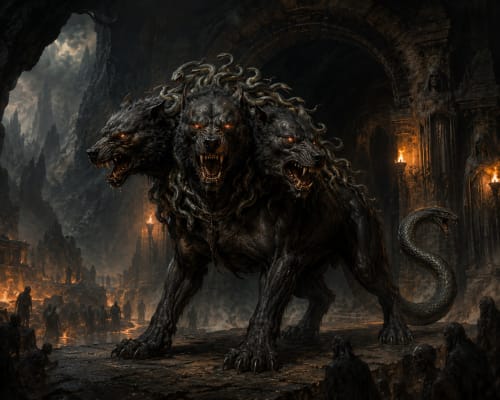
Cerberus
Cerberus · Infernal Gatekeeper — Legendary triple-headed hound
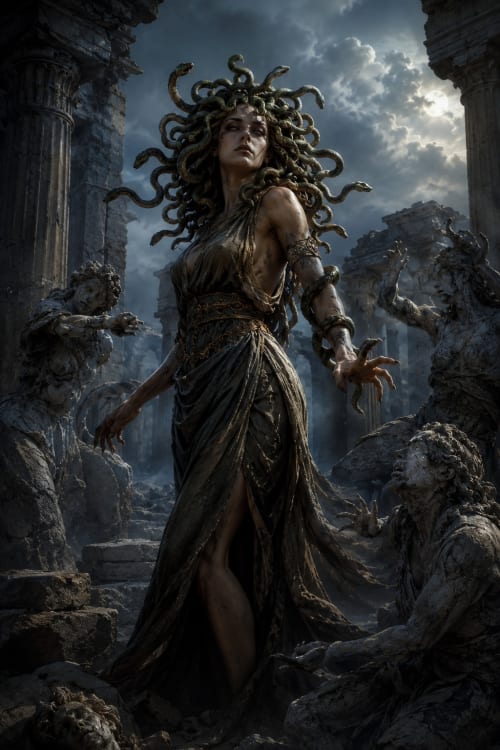
Medusa
Medusa · Monster — Ancient creature with snakes for hair

Centaur
Centaur · Half-human, half-horse — Legendary creature of Greek myth

Charybdis
Charybdis · Oceanic Monster — The Devouring Whirlpool

Phoenix
Phoenix · Firebird — Legendary bird reborn from flames

Lamia
Serpent-bodied Enchantress · Seductress and Devourer in Greek Mythology

Chimera
Chimera · Monstrous hybrid — Mythical creature with combined animal traits
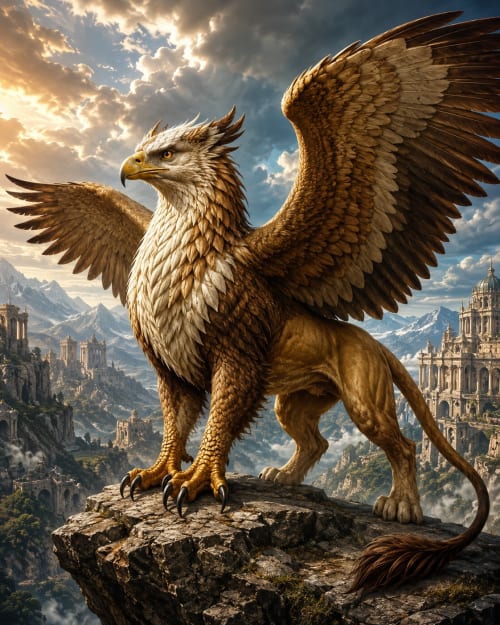
Griffin
Griffin · Legendary Lion-Eagle — Mythical creature with eagle foreparts and lion hindquarters

Naga
Naga · Serpent People — Mythical half-human, half-serpent beings

Peryton
Borges's Imaginary Stag-Bird Hybrid