
Chimera
Chimera · Monstrous hybrid — Mythical creature with combined animal traits
Names in Other Languages
 키메라한국어
Chimera · 괴수 — 다양한 동물의 특징이 결합된 괴생명체
 キメラ日本語
キメラ · 合成獣 — 複数の動物が組み合わさった神話上の怪物
 奇美拉繁體中文
Chimera · 合成怪獸 — 結合多種動物特徵的神話生物
 ChimäreDeutsch
Chimäre · Mischwesen — Mythische Kreatur aus Tierteilen
 ChimèreFrançais
Chimère · Créature hybride — Monstre mythique composé de plusieurs animaux
 QuimeraEspañol
Quimera · Criatura híbrida — Monstruo mítico de partes animales combinadas
 QuimeraPortuguês
Quimera · Criatura híbrida — Monstro mítico de partes de diversos animais
 ChimeraPolski
Chimera · Stworzenie hybrydowe — Mitologiczna bestia o cechach wielu zwierząt
 ХимераРусский
Химера · Мифическое существо — Существо с чертами разных животных
A composite monster of Greek myth — head of a lion, body of a goat (with a goat-head springing from the back), tail ending in a snake-head, and mouth spewing perpetual flame. First named in Homer's Iliad 6.179-183 (c. eighth century BCE) and given her parentage in Hesiod's Theogony 319-325 (c. 700 BCE) as the daughter of Typhon and Echidna, sibling of Cerberus and the Hydra. She laid waste to Lycia until the hero Bellerophon, riding the winged horse Pegasus, plunged a lead-tipped spear into her gullet; her own fire melted the lead, which seared her vitals (Apollodorus, Library 2.3.1). 'Chimera' has since become the common English noun for any composite or fantastic hybrid, and in biology the term chimerism (Hans Spemann, 1920s) denotes an organism with two distinct genotypes.
Origin
The earliest direct attestation is Iliad 6.179-183 (c. 8th c. BCE oral tradition), where the Trojan ambassador Glaucus recounts the slaying of the Chimera by his ancestor Bellerophon: 'in front a lion, behind a serpent, in the middle a goat, breathing forth the terrible might of blazing fire'. Hesiod's Theogony 319-325 (c. 700 BCE) fixes the genealogy: Chimera is the offspring of Typhon and Echidna (or of Echidna's daughter the Hydra), sibling of Cerberus, the Hydra, Orthos, and the Sphinx. The hero-narrative is canonised in Apollodorus's Library 2.3.1 (1st to 2nd c. CE) and Hyginus's Fabulae 57 (c. 2nd c. CE): King Proitos of Corinth, wishing Bellerophon dead, sent him to the Lycian king Iobates, who set the task of killing the Chimera. Bellerophon bridled Pegasus with the golden bridle given by Athena, attacked from above, and drove into the Chimera's gullet a spear-shaft tipped with lead; when the monster breathed fire the lead melted and killed her from within. The geographic prototype is Mount Chimera in Lycia (modern Yanartaş in Antalya Province, Turkey), where natural methane vents have produced perpetual flames for at least five millennia; Strabo, Geography 14.3.5 (1st c. CE), already identifies this as the basis of the myth. The most famous visual prototype is the Etruscan bronze Chimera of Arezzo (c. 400 BCE), unearthed in November 1553 at Arezzo and now in the Museo Archeologico Nazionale in Florence (inventory number 1).
Features
- Lion at the front, goat (a goat-head rises from the back), serpent at the rear; three heads on one body
- Continuous fire-breath — Homer calls it 'the terrible might of blazing fire of divine descent'
- Daughter of Typhon and Echidna; sibling of Cerberus, the Hydra, Orthos, and the Sphinx (Hesiod, Theogony 319-325)
- Roamed the mountains of Lycia and laid them waste, slaying both livestock and people
- The Etruscan bronze Chimera of Arezzo (c. 400 BCE) is the earliest fixed visual canon, with lion body, goat-head from the spine, and serpent tail
Stories
In myth the Chimera is the trial of Bellerophon and the archetype of every composite monster. Homer presents her as an irrational terror that no hero can defeat without divine aid — the winged Pegasus, the golden bridle from Athena, the lead-tipped spear. From the Renaissance onward 'chimera' enters European languages (English chimerical, French chimere, German Hirngespinst) as a common noun for any fantastic or illusory thing. In biology, Hans Spemann (Embryonic Development and Induction, Yale University Press, 1938) coined the technical sense of chimera for an organism with cells of two different genotypes, after his 1924 salamander dorsal-lip transplant experiments. Dungeons & Dragons (AD&D Monster Manual, TSR, 1977) standardised the lion-goat-dragon three-headed variant as a Challenge Rating 6 monster, and the Chimera has since been a fixture of Magic: The Gathering, Final Fantasy, and recent video-game horror such as Sekiro (FromSoftware, 2019).
Weakness
Mythologically, the Chimera's decisive weakness is her own fire. Bellerophon did not meet her in direct combat: he tipped his spear-shaft with lead and drove it into her gullet, and when she breathed flame the lead melted and burned her internal organs (Apollodorus 2.3.1; Hyginus, Fabulae 57). The attack from above on Pegasus — she had no answer to a flying opponent — was equally decisive. In fifth-edition D&D the Chimera is Challenge Rating 6, vulnerable to flying spellcasters, cold attacks, and ranged tactics that exploit the absence of any breath weapon at distance.
Cultural Significance
The myth's geographic source is the Yanartaş methane vents in modern Antalya Province, Turkey, where natural gas escapes from the rock and burns continuously; a 2007 report from the Antalya University Geology Department judged that the same vents have burned for some five thousand years. The Etruscan Chimera of Arezzo, dug up in November 1553 from a well shaft in Arezzo, was kept by Cosimo I de' Medici and praised by Giorgio Vasari in the 1568 second edition of his Lives of the Artists as 'the summit of Etruscan bronze'; today it is the first piece, inventory number 1, in the collection of the Museo Archeologico Nazionale in Florence (length 78.5 cm, weight about 18 kg). In biology, 'chimera' moved from myth to laboratory through Hans Spemann's 1924 salamander experiments (Nobel Prize 1935) and has been a central term in immunology and genetic engineering since the 1950s. In modern popular culture Vincenzo Natali's film Splice (2009) and FromSoftware's Sekiro: Shadows Die Twice (2019) are typical contemporary reworkings.
In Popular Culture
- Homer, Iliad 6.179-183 (c. 8th c. BCE) — lion-goat-serpent triple form and fire-breath
- Hesiod, Theogony 319-325 (c. 700 BCE) — parentage from Typhon and Echidna, siblings
- Apollodorus, Library 2.3.1 (1st-2nd c. CE) — Bellerophon, Pegasus, lead-tipped spear
- Strabo, Geography 14.3.5 (1st c. CE) — identifies Mount Chimera in Lycia as the source
- Etruscan bronze Chimera of Arezzo (c. 400 BCE; Museo Archeologico Nazionale, Florence, inv. 1) — visual canon
- Dante Alighieri, Purgatorio 6.92 (c. 1308-1320) — used as a figure of vain phantasm
- Hans Spemann, Embryonic Development and Induction (Yale University Press, 1938) — biological term
- Gary Gygax, Advanced Dungeons & Dragons Monster Manual (TSR, 1977) — game canon
- Wizards of the Coast, Magic: The Gathering Theros set (2014) — chimeric cards
- FromSoftware, Sekiro: Shadows Die Twice (2019) — modern game variation
Trivia
- The eternal flames of Yanartaş are fuelled by methane and hydrogen and have, according to a 2007 Antalya University geology study, burned in the same spots for at least five thousand years; Homer's 'fire of divine descent' is now generally read as a mythic reading of this natural gas phenomenon.
- The Chimera of Arezzo was unearthed on 15 November 1553 during well-digging; Cosimo I de' Medici ordered its conservation, and the piece carries inventory number 1 at the Museo Archeologico Nazionale in Florence — the first object catalogued when the museum opened.
- The extension of 'chimera' to mean 'illusion, fantastic notion' predates Dante: Cicero, De natura deorum 1.108, already uses chimaera figuratively for an impossible hypothesis, a usage that medieval Latin carried forward.
- Hans Spemann's salamander dorsal-lip transplant experiments of 1924 gave rise to the embryological 'organiser' concept (Nobel Prize for Physiology or Medicine, 1935) and supplied biology with the term chimera for an organism of two genotypes.
Related

Centaur
Centaur · Half-human, half-horse — Legendary creature of Greek myth

Lamia
Serpent-bodied Enchantress · Seductress and Devourer in Greek Mythology

Strix
Strix · Night Bird — Vampiric Bird of Ancient European Myth

Sphinx
Sphinx · Guardian of Riddles — Hybrid of Human and Lion

Nemean Lion
Nemean Lion · Invulnerable Beast — Immortal creature of Greek myth

Hydra
Hydra · Lernaean serpent — Multi-headed mythical beast
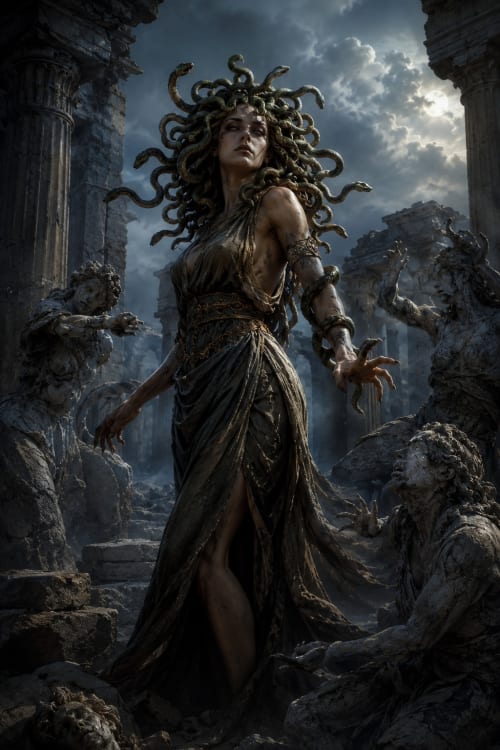
Medusa
Medusa · Monster — Ancient creature with snakes for hair

Cretan Bull
Seventh Labor of Heracles in Greek Myth

Phoenix
Phoenix · Firebird — Legendary bird reborn from flames
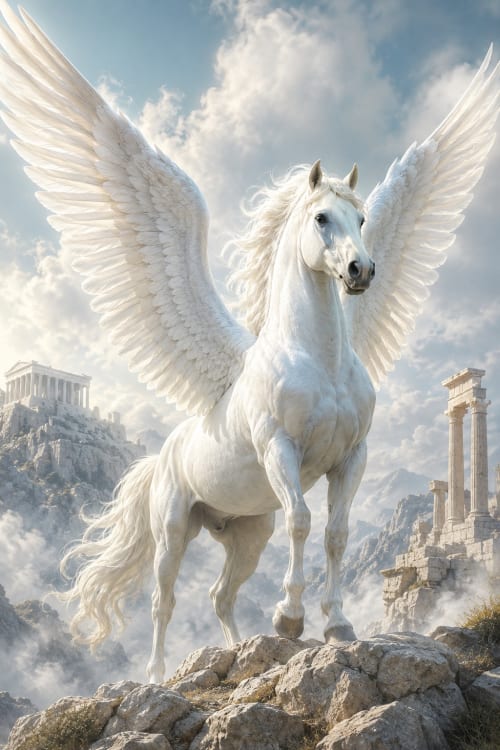
Pegasus
Pegasus · Winged Horse — A Legendary Creature from Greek Mythology
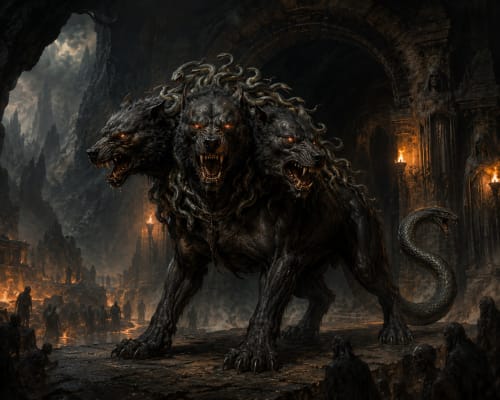
Cerberus
Cerberus · Infernal Gatekeeper — Legendary triple-headed hound

Amphisbaena
Two-Headed Serpent of Greek Myth