Hermes
Hermes · God of Travel, Trade, Thieves, and Messengers
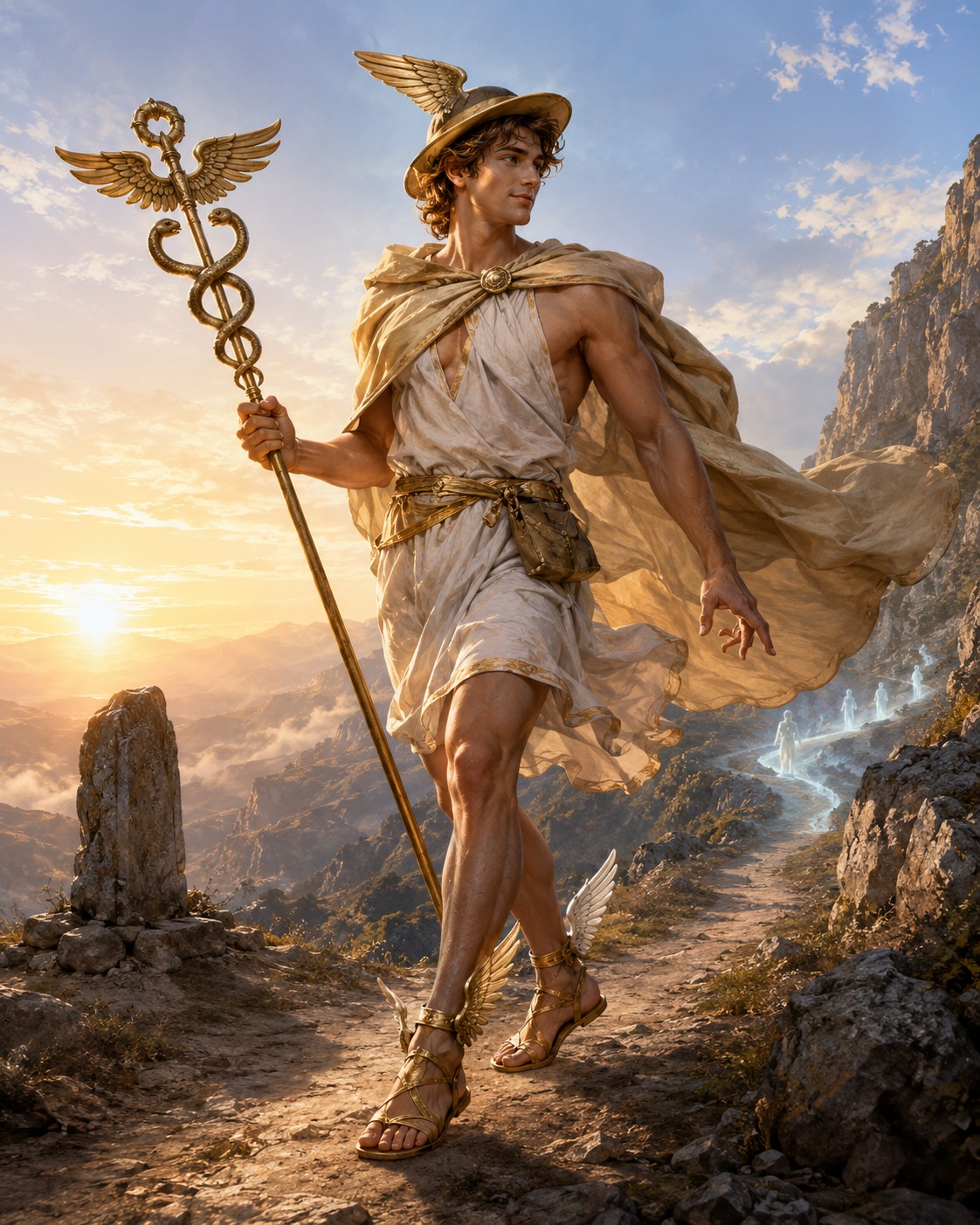
Hermes (Ancient Greek Hermes, Latin Mercurius) is the decisive canonical god of messengers, travel, commerce, thieves, gambling, oratory, and borders among the 12 Olympian gods of Greek mythology, and the decisive canonical iconographic figure who, as the son of Zeus (Zeus) and Maia (Maia, eldest of the Pleiades), was born in a cave on Mount Cyllene (Kyllene) — on the day of his birth — invented the lyre (lyra) from a tortoise shell — and stole the sacred 50 cattle of Apollo (Apollo). The etymology Greek Hermes is derived from herma (herma, 'pile of stones, boundary stone') — the decisive canonical vocabulary, and the aliases Argeiphontes (Argeiphontes, 'slayer of Argos'), Diaktoros (Diaktoros, 'guide'), Psychopompos (Psychopompos, 'soul guide'), and Soter (Soter, 'saviour') are the decisive canonical vocabulary. The decisive textual canon is the Homeric Hymns (Homeric Hymns) No. 4 — Hymn to Hermes — 580 lines of c. 7th-6th century BCE — the decisive canon of Hermes's birth, lyre invention, and Apollo's cattle theft — and Theogony (Theogony) lines 938-939 of Hesiod of c. 8th-7th century BCE — the decisive canon of Hermes's birth as the son of Zeus and Maia.