
Centaur
Centaur · Half-human, half-horse — Legendary creature of Greek myth
Names in Other Languages
 켄타우로스한국어
Centaur · 반인반수 — 그리스 신화의 전설적 생명체
 ケンタウロス日本語
ケンタウロス · 半人半馬 — ギリシャ神話の伝説的存在
 半人馬繁體中文
Centaur · 半人半馬 — 希臘神話的傳說生物
 ZentaurDeutsch
Zentaur · Halb Mensch, halb Pferd — Legendäres Wesen der griechischen Mythologie
 CentaureFrançais
Centaure · Mi-homme, mi-cheval — Créature légendaire de la mythologie grecque
 CentauroEspañol
Centauro · Mitad humano, mitad caballo — Criatura legendaria de la mitología griega
 CentauroPortuguês
Centauro · Meio homem, meio cavalo — Criatura lendária da mitologia grega
 CentaurPolski
Centaur · Półczłowiek, półkoń — Legendarna istota z mitologii greckiej
 КентаврРусский
Кентавр · Полу-человек, полу-лошадь — Легендарное существо греческой мифологии
A Greek mythological race with the upper body of a human joined to the lower body of a horse, dwelling chiefly on Mount Pelion in Thessaly. Most centaurs are depicted as savage and lecherous — the famous Centauromachy began when the centaurs, drunk at the wedding of Peirithoos, attacked the bride Hippodameia and the Lapith women (Parthenon south metopes, 447-432 BCE). The decisive exception is Chiron, son of Cronus and the nymph Philyra, master of medicine, music, philosophy, and astronomy, and the teacher of Heracles, Achilles, Jason, and Asclepius. Struck by accident with Heracles's hydra-poisoned arrow, Chiron gave up his immortality to Prometheus to end his pain, and Zeus set him in the heavens as the constellation Centaurus.
Origin
The earliest direct attestation of the centaurs is Homer's Iliad 1.262-263 and Odyssey 21.295-304 (oral tradition, c. 8th c. BCE), where Peirithoos recalls his war with 'the beast-folk of the mountains'. Homer uses only the name Kentauroi and does not describe the half-horse form; Hesiod's Shield of Heracles 178-190 (c. 7th c. BCE) gives the canonical iconography. Pindar's Pythian 2.40-48 (early 5th c. BCE) fixes the origin myth — Ixion, having tried to violate Hera, was given a cloud-image Nephele in her form; the centaurs are his offspring by Nephele. Chiron and Pholus stand apart, born of Cronus and the nymph Philyra (Apollodorus, Library 1.2.4). The Centauromachy with the Lapiths is the subject of the thirty-two south metopes of the Parthenon (workshop of Pheidias, 447-432 BCE; the surviving slabs include the Elgin Marbles in the British Museum) and becomes the canonical visual emblem of Greek civilisation against savagery. Ovid's Metamorphoses 12.210-535 (8 CE) carries the war into Latin literature. The Chiron tradition is consolidated in Apollodorus's Library 2.5.4 (1st to 2nd c. CE): the teacher of heroes is wounded by Heracles's hydra-poisoned arrow by accident and, in unending agony, surrenders his immortality to Prometheus.
Features
- Human upper body (head, arms, chest) joined at the waist to a horse's lower body (four legs and tail); about six feet at the human shoulder and around eight feet long
- Powerful build allowing simultaneous use of bow, spear, or club with the gallop of a horse; faster than a mounted human in a direct charge
- Two poles in the race: the savage centaurs of Pelion, given to lust, drunkenness, and impulsive violence, and Chiron, a master of medicine, music, astronomy, and prophecy
- Native to Mount Pelion in Thessaly; smaller groups on Mount Pholoe in Elis and at Cape Malea
- Two parallel genealogies: most centaurs are sons of Ixion and the cloud-Nephele, while Chiron and Pholus are sons of Cronus and the nymph Philyra
Stories
In myth the centaurs occupy both poles at once. The savage centaurs embody the wild — eros, drunkenness, impulsive violence — set against the Greek logos, and the Centauromachy reads as Hellenic self-definition (John Boardman, The Parthenon and its Sculptures, University of Texas Press, 1985). Chiron, by contrast, is the canonical teacher-figure of Greek heroic myth — Heracles (Apollodorus 2.4.9), Achilles (Iliad 11.831), Jason (Apollonius Argonautica 1.554), Asclepius (Pindar Pythian 3.5-7), and Aktaion (Apollodorus 3.4.4) were all his pupils. The constellation Centaurus is identified with Chiron from Eratosthenes's Catasterismi 38 (3rd c. BCE) and remains in the modern IAU eighty-eight-constellation system. Modern fantasy carries both poles: C. S. Lewis's Chronicles of Narnia (Geoffrey Bles, 1950-56) gives the noble centaur Glenstorm; J. K. Rowling's Harry Potter (Bloomsbury, 1997-2007) places Firenze and Bane in the Forbidden Forest at Hogwarts; the AD&D Monster Manual (TSR, 1977) standardised the savage centaur for tabletop, and Blizzard's Warcraft III (2002) made the centaurs of Kalimdor a hostile tribe.
Weakness
Mythologically the centaurs' decisive weakness is wine and self-control. The Centauromachy at Peirithoos's wedding was triggered by wine: Ovid (Metamorphoses 12.219-220) names the wine and the rape attempt in the same line. When Heracles visited Pholus, the breaking of the sacred wine jar drew every centaur of the mountain into a frenzy and they were slaughtered (Apollodorus 2.5.4). Even Chiron fell to a human hero's weapon: Heracles's stray hydra-poisoned arrow gave him an immortal wound. Tactically, the four-legged body is poor in narrow passages, indoor spaces, stairs, and marshland; in fifth-edition D&D the centaur is Challenge Rating 2, vulnerable to ranged tactics and confined terrain.
Cultural Significance
Centaurs are the most powerful Greek figure for the boundary between self and barbarian, and the thirty-two south metopes of the Parthenon (Pheidias's workshop, 447-432 BCE) are their visual summit. Removed by Thomas Bruce, Lord Elgin between 1801 and 1812, the surviving Elgin Marbles are held by the British Museum and remain at the centre of the long-standing Greek government request for return. The Chiron tradition supplied Western medicine its founder-figure: William Harvey's 1628 dedication of De motu cordis to King Charles I names Chiron as 'the first father of medicine'. The astronomer Charles Kowal discovered the small Saturn-Uranus-orbit body 2060 Chiron in 1977, and the International Astronomical Union now uses centaur names (Pholus, Nessus, Chariklo, and so on) for the whole population of centaur-class minor planets after a 1985 naming convention. C. S. Lewis, J. K. Rowling, and Rick Riordan in the Percy Jackson novels (Disney-Hyperion, 2005-2009) have all redeployed Chiron as the teacher-of-heroes archetype for contemporary readers.
In Popular Culture
- Homer, Iliad 1.262-263 and Odyssey 21.295-304 (c. 8th c. BCE) — beast-folk of Pelion
- Hesiod, Shield of Heracles 178-190 (c. 7th c. BCE) — canonical iconography
- Pindar, Pythian Ode 2.40-48 (early 5th c. BCE) — origin from Ixion and the cloud Nephele
- Parthenon south metopes (workshop of Pheidias, 447-432 BCE; Elgin Marbles, British Museum) — Centauromachy in stone
- Apollodorus, Library 2.5.4 (1st-2nd c. CE) — Heracles, Pholus and the death of Chiron
- Ovid, Metamorphoses 12.210-535 (8 CE) — Centauromachy in Latin
- Eratosthenes, Catasterismi 38 (3rd c. BCE) — constellation Centaurus as Chiron
- C. S. Lewis, The Chronicles of Narnia (Geoffrey Bles, 1950-56) — Glenstorm and the noble centaur
- J. K. Rowling, Harry Potter series (Bloomsbury, 1997-2007) — Firenze, Bane, the Forbidden Forest
- Rick Riordan, Percy Jackson and the Olympians (Disney-Hyperion, 2005-2009) — Chiron as Mr Brunner
Trivia
- The etymology of Kentauros is still unsettled: Wilhelm Schulze in Quaestiones Epicae (1892) proposed an Indo-European root meaning 'ox-prodder', while a Greek folk etymology read it as 'wind-hunter' (anemos with thauros); neither has been generally accepted.
- After the 1977 discovery of 2060 Chiron between Saturn and Uranus by Charles Kowal, the International Astronomical Union ruled in 1985 that all members of this Centaur class of minor planets should be given the names of mythological centaurs — Pholus, Nessus, Chariklo, Hylonome.
- Of the thirty-two south metopes of the Parthenon, only twelve survive in good condition. The rest were defaced by Byzantine Christian crosses in the sixth century or shattered in the Venetian bombardment of 1687 (New Acropolis Museum, Athens, conservation report 1996).
- Rick Riordan introduced Chiron in Percy Jackson as a wheelchair-using Latin teacher named Mr Brunner who rises out of the wheelchair as a centaur. At an American Library Association talk in 2010 Riordan said this image was his tribute 'to the teachers who quietly raise the heroes of our myths'.
Related

Chimera
Chimera · Monstrous hybrid — Mythical creature with combined animal traits

Lamia
Serpent-bodied Enchantress · Seductress and Devourer in Greek Mythology

Nemean Lion
Nemean Lion · Invulnerable Beast — Immortal creature of Greek myth

Hydra
Hydra · Lernaean serpent — Multi-headed mythical beast

Cretan Bull
Seventh Labor of Heracles in Greek Myth
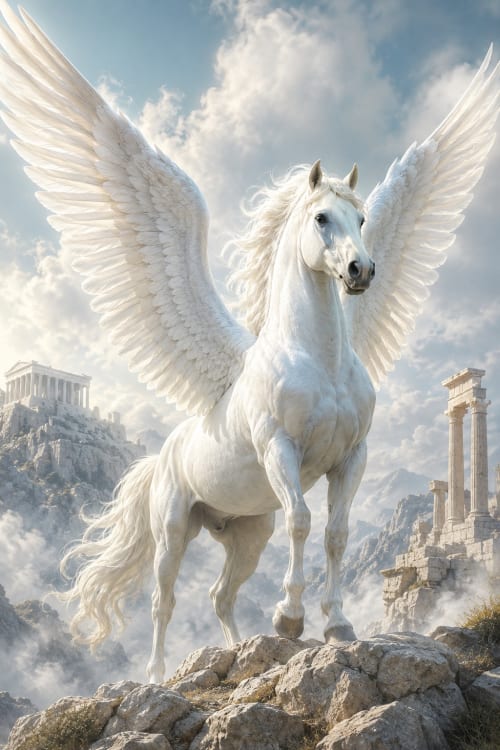
Pegasus
Pegasus · Winged Horse — A Legendary Creature from Greek Mythology
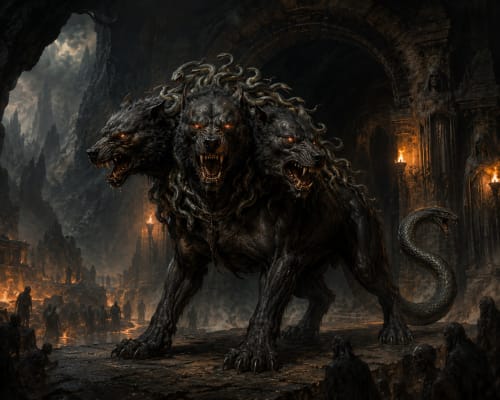
Cerberus
Cerberus · Infernal Gatekeeper — Legendary triple-headed hound

Sphinx
Sphinx · Guardian of Riddles — Hybrid of Human and Lion
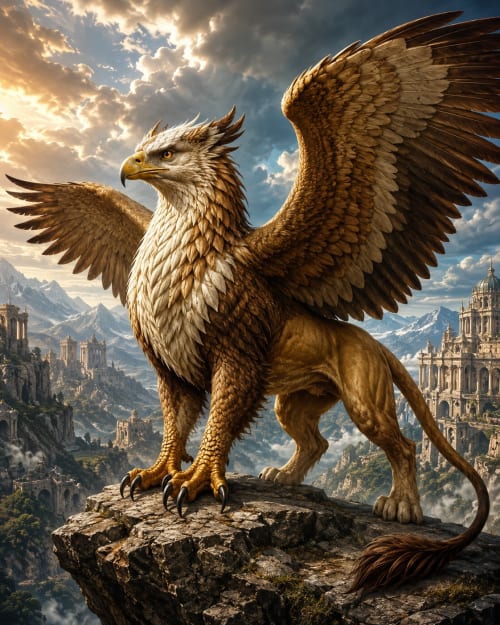
Griffin
Griffin · Legendary Lion-Eagle — Mythical creature with eagle foreparts and lion hindquarters

Strix
Strix · Night Bird — Vampiric Bird of Ancient European Myth
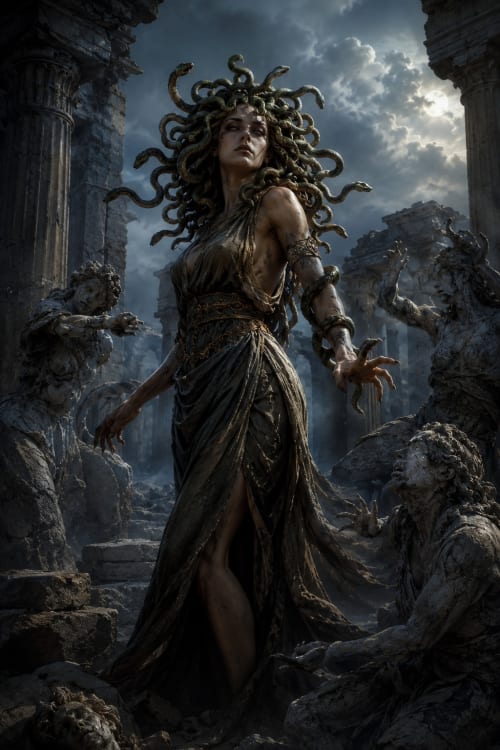
Medusa
Medusa · Monster — Ancient creature with snakes for hair

Amphisbaena
Two-Headed Serpent of Greek Myth