
Phoenix
Phoenix · Firebird — Legendary bird reborn from flames
Names in Other Languages
 피닉스한국어
Phoenix · 불사조 — 불에서 다시 태어나는 전설의 새
 フェニックス日本語
Phoenix・不死鳥 — 炎から蘇る伝説の鳥
 鳳凰繁體中文
Phoenix · 不死鳥 — 從烈火重生的傳說之鳥
 PhönixDeutsch
Phoenix · Feuervogel — Legendärer Vogel, der aus der Asche aufersteht
 PhénixFrançais
Phoenix · Oiseau de feu — Légendaire oiseau renaissant des flammes
 FénixEspañol
Phoenix · Ave fénix — Legendaria ave que renace del fuego
 FênixPortuguês
Phoenix · Ave de Fogo — Pássaro lendário que renasce das chamas
 FeniksPolski
Phoenix · Ognisty ptak — Legendarny ptak odradzający się z popiołów
 ФениксРусский
Phoenix · Огненная птица — Легендарная птица, возрождающаяся из пепла
The Phoenix (Greek Phoinix, Latin Phoenix) is the immortal bird of ancient Egyptian and Greco-Roman myth. At the end of a 500-year life (or, in alternative reckonings, the 1461-year Egyptian Great Year), it builds a nest of frankincense, cinnamon, and myrrh, sets itself alight upon it, and is reborn from its own ashes as a new young phoenix. The earliest Greek literary reference is in Herodotus, Histories II.73 (fifth century BCE), where the bird is associated with Heliopolis in Egypt; the bird's true root is the Egyptian Bennu, sacred to the sun god Ra at Heliopolis, a grey heron figured as the soul of Ra and the embodiment of the first light of creation. From Greco-Roman tradition the figure was taken up in 1 Clement 25, c. 96 CE, where the early Christian author cites the phoenix as a natural proof of the resurrection of Christ, and from there it became a standard image of Christian iconography. The Chinese fenghuang, Slavic Zhar-Ptitsa, and Persian Simurgh are distinct in origin but were later compared and conflated with the phoenix in nineteenth-century comparative mythology.
Origin
The earliest Greek reference is Herodotus' Histories II.73 (fifth century BCE), where the phoenix appears at Heliopolis every five hundred years to bury its father in a myrrh-egg at the temple of the Sun. Herodotus explicitly says he has not seen the bird himself but reports the tale from the priests of Heliopolis. The true iconographic root is the Egyptian Bennu, the sacred grey heron of Heliopolis, conceived as the soul of Ra, the first light of creation, and the symbol of resurrection. Around 96 CE, 1 Clement 25 takes up the phoenix as a natural proof of Christ's resurrection, and the Physiologus (second to fourth centuries) consummates the allegorisation. Ovid Metamorphoses XV.392-407 (early first century CE), Pliny Natural History X.2, Tacitus Annals VI.28 (recording a phoenix appearance at Heliopolis in 34 CE), and Lactantius' Latin poem De Ave Phoenice (third to fourth century) fix the canonical description.
Features
- Great bird with brilliant purple, crimson, and gold plumage
- Lifespan of five hundred years (or the Egyptian Great Year of 1461)
- Builds a nest of frankincense, cinnamon, and myrrh at the end of its life
- Burns itself to death on the nest; is reborn from the ashes
- In Herodotus, the offspring carries the father's body in a myrrh-egg to Heliopolis
- The Egyptian Bennu, a grey heron of Heliopolis, is the ultimate iconographic root
Stories
In Christian iconography the phoenix became the standard sign of Christ's resurrection from the late first century. It appears on the apse mosaics of Santa Pudenziana in Rome, in the Galla Placidia mausoleum at Ravenna, and throughout medieval bestiaries (Aberdeen Bestiary, MS Bodley 764). Dante invokes it in Inferno XXIV among the metamorphoses of the thieves. Elizabeth I of England adopted the phoenix as her personal device, most famously in Nicholas Hilliard's Phoenix Portrait of c. 1574, in which the bird stands for the sovereign's singular, undying nature. Shakespeare's The Phoenix and the Turtle (1601), Stravinsky's Firebird ballet (1910), J. K. Rowling's Fawkes in Harry Potter and the Chamber of Secrets (1998), and the Marvel Comics Dark Phoenix saga keep the figure central to modern popular culture.
Weakness
The phoenix has no traditional predator, since the absence of mortality is its defining property. Its constitutive limit lies in the conditions of resurrection: in Herodotus and Ovid, the bird must build its pyre from frankincense, cinnamon, and myrrh, and the rebirth occurs at or near the temple of the sun at Heliopolis. The cycle, whether five hundred or one thousand four hundred sixty-one years, is absolute. Christian allegory tightens these conditions so that the phoenix's death and rebirth align with Christ's. Later fantasy (notably Dungeons and Dragons) adds the gaming convention that the phoenix is temporarily vulnerable at the moment of rebirth, but this is a modern accretion absent from the classical sources.
Cultural Significance
The phoenix is the four-thousand-year culmination of an iconographic chain: Egyptian Bennu, Greco-Roman phoinix, Christian resurrection sign, Renaissance emblem of eternity, modern pop-culture character. 1 Clement's first-century adoption of the phoenix as proof of Christ's resurrection set the figure at the heart of medieval Christian art, and Elizabeth I's adoption of the phoenix as her personal device made it the Renaissance emblem of singular sovereignty. The East-Asian fenghuang (Chinese), ho-o (Japanese), and bonghwang (Korean), although iconographically distinct, were equated with the phoenix in nineteenth-century English-language translation, leading to the modern convention of rendering all three by the single word phoenix. The Slavic Zhar-Ptitsa (immortalised in Stravinsky's 1910 ballet) and Persian Simurgh entered the same comparative-mythology family. In modern culture J. K. Rowling's Fawkes, Marvel's Dark Phoenix saga, and the Dungeons and Dragons monster keep the figure renewed.
In Popular Culture
- Herodotus, Histories II.73 (5th c. BCE) — earliest Greek reference to the phoenix at Heliopolis
- Ovid, Metamorphoses XV.392-407 (c. 8 CE) — Latin canon of the cinnamon-and-myrrh pyre
- Pliny, Natural History X.2 and Tacitus, Annals VI.28 — phoenix appearance at Heliopolis in 34 CE
- 1 Clement 25 (c. 96 CE) — earliest Christian adoption as a sign of Christ's resurrection
- Lactantius, De Ave Phoenice (3rd-4th c.) — Latin poetic canon
- Physiologus (2nd-4th c.) — completion of the Christian allegory
- J. K. Rowling, Harry Potter and the Chamber of Secrets (1998) — Dumbledore's phoenix Fawkes
Trivia
The iconographic root of the phoenix is the Egyptian Bennu, the sacred heron of Heliopolis; Greek phoinix likely meant 'purple bird' or 'bird of Phoenicia', combining colour and geography of an eastern import. The 1461-year lifespan probably derives from the Egyptian Sothic Cycle, the 4 by 365.25-year period after which the heliacal rising of Sirius and the Nile flood realign. 1 Clement's late-first-century citation of the phoenix as proof of Christ's resurrection is among the earliest cases of a pagan icon assimilated into Christian allegory, a milestone in comparative-religious history. Elizabeth I adopted the phoenix as her personal device to signify the sovereign's singular, undying nature; Nicholas Hilliard's Phoenix Portrait of c. 1574 is the iconic image.
Related

Naga
Naga · Serpent People — Mythical half-human, half-serpent beings

Peryton
Borges's Imaginary Stag-Bird Hybrid

Manticore
Persian Legendary Lion-Man-Scorpion Hybrid
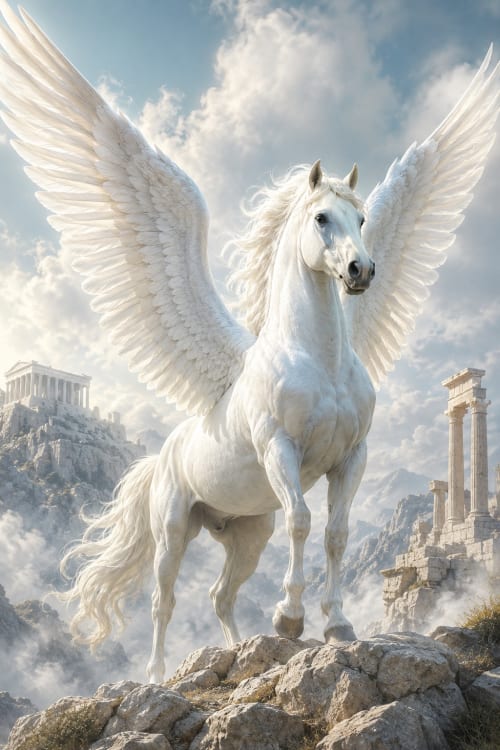
Pegasus
Pegasus · Winged Horse — A Legendary Creature from Greek Mythology

Unicorn
Unicorn · Monoceros — Legendary Horse with a Sacred Horn

Monoceros
Monoceros · Unicorn — Legendary one-horned creature

Strix
Strix · Night Bird — Vampiric Bird of Ancient European Myth

Nemean Lion
Nemean Lion · Invulnerable Beast — Immortal creature of Greek myth
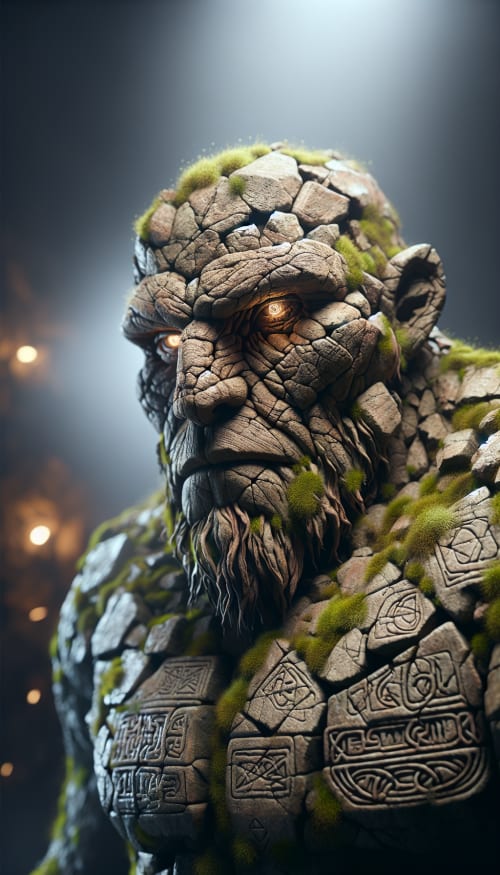
Golem
Golem · Artificial Creature — A being made from inanimate materials

Hydra
Hydra · Lernaean serpent — Multi-headed mythical beast
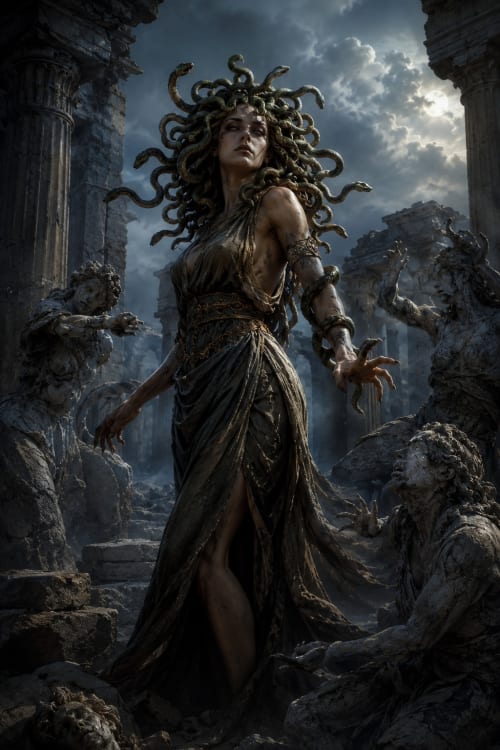
Medusa
Medusa · Monster — Ancient creature with snakes for hair

Cretan Bull
Seventh Labor of Heracles in Greek Myth