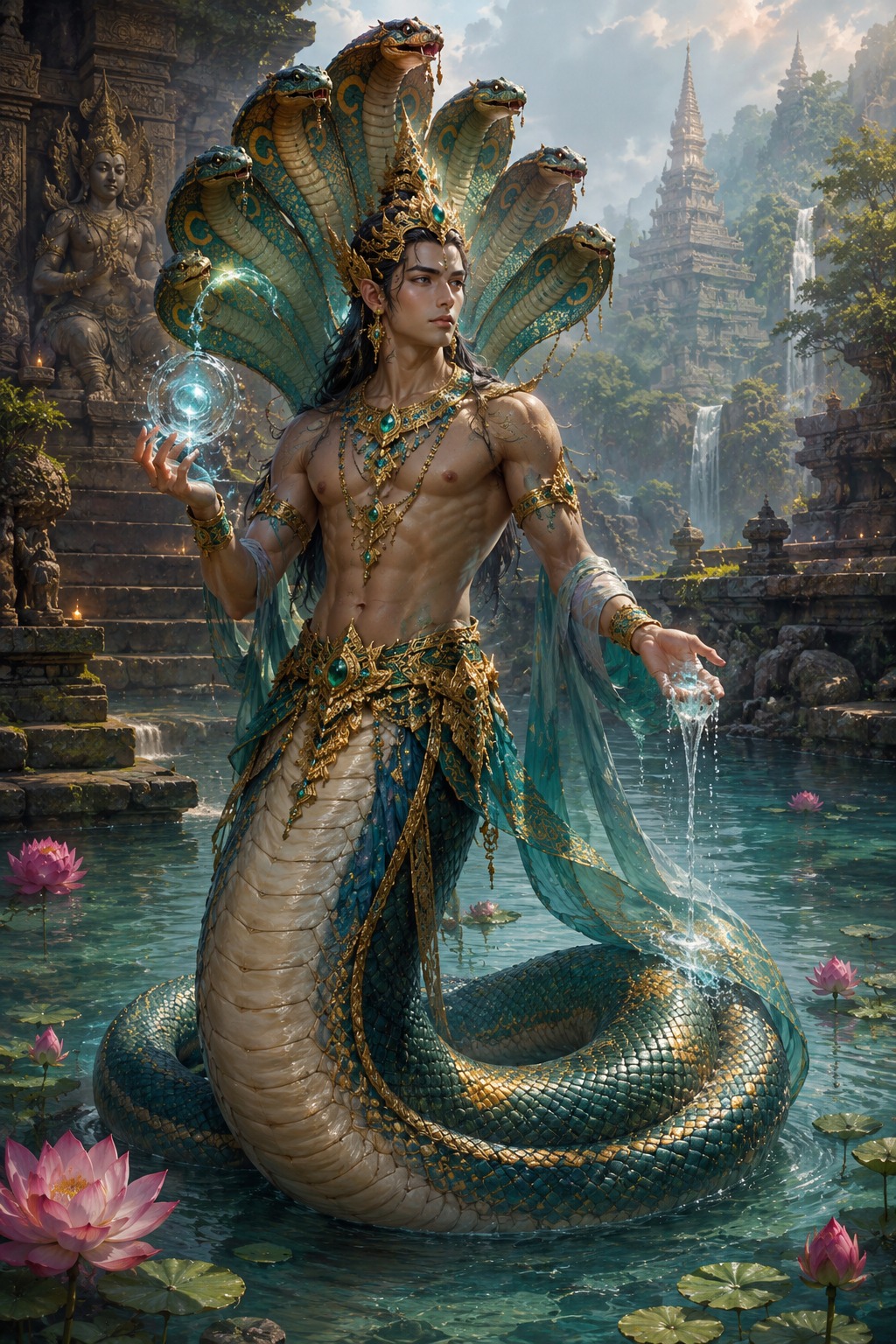
Naga
Naga · Serpent People — Mythical half-human, half-serpent beings
Names in Other Languages
 나가한국어
나가한국어Naga · 뱀 인간 — 신화 속 반인반수 존재
 ナーガ日本語
ナーガ · 蛇人間 — 神話上の半人半蛇の存在
 那伽繁體中文
那伽 · 蛇人 — 神話中的半人半蛇生物
 NagaDeutsch
Naga · Schlangenmenschen — Mythische Halbmenschen, Halbschlangen
 NagaFrançais
Naga · Peuple-serpent — Créatures mythiques mi-humaines, mi-serpents
 NagaEspañol
Naga · Gente serpiente — Mitad humano, mitad serpiente en la mitología
 NagaPortuguês
Naga · Povo-Serpente — Seres míticos meio-humanos, meio-serpentes
 NagaPolski
Naga · Ludzie-węże — Mityczne półludzkie, półwężowe istoty
 НагаРусский
Нага · Змеиный народ — Мифические полулюди-полузмеи
The Naga (Sanskrit nāga, 'serpent') is a semi-divine serpent-being of Indian and Southeast Asian mythology, depicted as a human-cobra hybrid: human torso above, vast coiled serpent body below, often crowned with multiple hoods. Nagas guard rivers, lakes, wells, and the subterranean realm of Patala, summon monsoon rains, and hoard treasure in jewel-encrusted underground palaces. In Hinduism, Vishnu sleeps on the cosmic serpent Shesha amid the milk-ocean; Shiva wears Vasuki coiled around his neck. In Buddhism, the naga-king Mucalinda sheltered the freshly enlightened Buddha for seven days beneath his seven hoods. In Jainism, the twenty-third Tirthankara Parshvanatha is always depicted with a seven-headed naga halo. Across Cambodia, Thailand, and Laos, multi-headed naga balustrades flank every temple stairway, and Angkor Wat's seven- and nine-headed naga causeways link the human and divine realms.
Origin
The earliest naga references appear in the Rigveda and Atharvaveda (c. 1500-1000 BCE) as serpent hymns. The full mythology crystallises in the Mahabharata's Adi Parva, especially the tale of Astika and King Janamejaya's serpent sacrifice (Sarpa Satra). According to the epic, the nagas descend from the sage Kashyapa and his wife Kadru; their capital is the subterranean Bhogavati, ruled by the eight naga-kings (Ashta-nagaraja) led by Shesha, Vasuki, and Takshaka. The Bhagavata and Vishnu Puranas relate the Samudra Manthan, the churning of the milk-ocean, in which Vasuki served as the churning rope. In Buddhism, the Pali Vinaya Pitaka's Mahavagga records the Mucalinda episode, and the fifth-century Sri Lankan chronicle Mahavamsa describes the Buddha mediating a naga dispute. The Cambodian foundation myth tells how the Brahmin Kaundinya married the naga-princess Soma, founding the Funan dynasty; Khmer kings still claim naga descent.
Features
- Upper body human, lower body a giant serpent, typically a cobra
- Multiple hoods or heads, often seven, sometimes a thousand
- Guardian of waters and the subterranean realm Patala
- Venomous yet rain-bringing, simultaneously deadly and life-giving
- Shape-shifters who assume human form and marry mortals
- Owners of jewel-laden underground palaces
Stories
Nagas appear chiefly as guardian icons on temples and palaces. The seven-headed naga balustrades of Angkor Wat symbolise the rainbow bridge between human and divine worlds. Wat temples across Thailand and the royal sanctuaries of Luang Prabang in Laos place naga sculptures at every staircase. Each October at the end of the Buddhist Lent, glowing 'Naga fireballs' rise from the Mekong River in a phenomenon officially celebrated by Thai and Lao governments. In India, the festival Naga Panchami, on the fifth day of Shravana, honours serpents with offerings of milk and flowers. The Kashmiri city Anantnag, literally 'city of infinite nagas', preserves dozens of sacred naga springs.
Weakness
The naga's eternal enemy is the divine bird Garuda. In the Mahabharata, Garuda steals the amrita (nectar of immortality) from heaven to free his enslaved mother Vinata from the nagas, becoming their hereditary predator. King Janamejaya's Sarpa Satra used Vedic mantras to draw serpents into sacrificial fire, and folk tradition holds nagas vulnerable to iron, mantras, and peacock feathers (a Garuda relative). In Buddhist tales, nagas submit to the Buddha's compassion and authority. Mongoose, sacred ash, and Garuda amulets remain traditional protective charms across South Asia.
Cultural Significance
Nagas are not mere monsters but the deified expression of indigenous serpent cults fused with Vedic religion. Their reach spans the Indian subcontinent, Southeast Asia, Tibet, and southern China. Vishnu's Shesha, Shiva's Vasuki, and the Buddha's Mucalinda place nagas alongside the highest divinities. Regional variants include Manasa, the Bengali snake goddess; Pakhangba of Manipur; the seven-hooded halo of Parshvanatha in Jainism; and the southern Indian naga-stone (nagakal) cult. When Buddhism reached East Asia, Chinese translators rendered naga as 'long' (dragon), seeding the dragon iconography of China, Korea, and Japan. The naga remains a living national emblem in Cambodia's royal regalia, Lao tourism imagery, and Indian constitutional ceremony.
In Popular Culture
- Mahabharata Adi Parva — Astika and the Sarpa Satra serpent sacrifice
- Bhagavata Purana and Vishnu Purana — Shesha, Vasuki, and the churning of the milk-ocean
- Pali Vinaya Mahavagga — Mucalinda shelters the newly enlightened Buddha
- Mahavamsa (5th-century Sri Lankan chronicle) — Buddha mediates among nagas
- Cambodian Funan foundation myth — Kaundinya and the naga-princess Soma
- Rudyard Kipling, The Jungle Book (1894) — Kaa the python channels naga motifs
- Dungeons & Dragons Monster Manual (1977 onward) — guardian, spirit, water, dark, bone nagas
Trivia
Sanskrit nāga means both 'serpent' and 'elephant', linking the cobra's spread hood with the elephant's flared ears. The 'Naga fireballs' of the Mekong River, observed every October at the end of Vassa, are red glowing orbs rising from the riverbed; Thailand and Laos officially recognise them as cultural heritage. The Indian states of Nagaland and parts of Assam derive their names from the Naga peoples, though whether this ethnonym is etymologically tied to the mythic naga remains an anthropological debate. Kashmir's Anantnag, 'the place of countless nagas', still preserves dozens of sacred springs identified with individual naga-kings.
Related

Phoenix
Phoenix · Firebird — Legendary bird reborn from flames

Peryton
Borges's Imaginary Stag-Bird Hybrid

Charybdis
Charybdis · Oceanic Monster — The Devouring Whirlpool

Nemean Lion
Nemean Lion · Invulnerable Beast — Immortal creature of Greek myth

Hydra
Hydra · Lernaean serpent — Multi-headed mythical beast
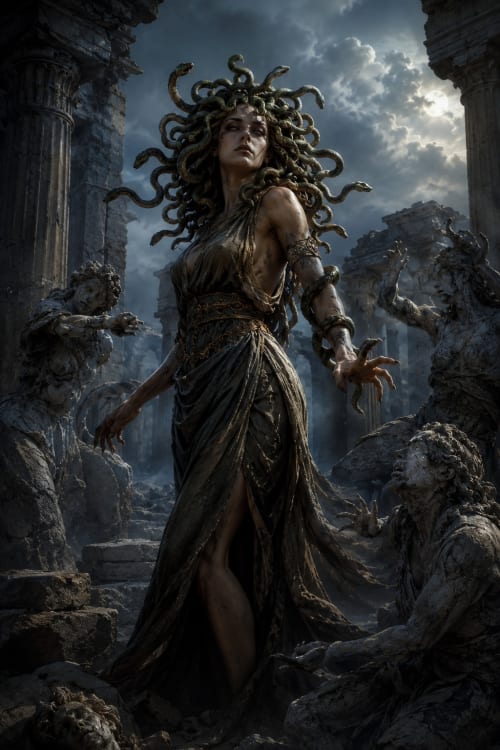
Medusa
Medusa · Monster — Ancient creature with snakes for hair
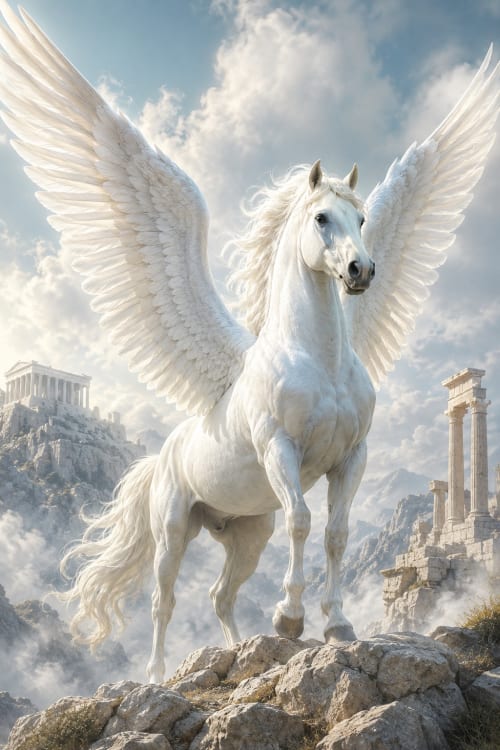
Pegasus
Pegasus · Winged Horse — A Legendary Creature from Greek Mythology
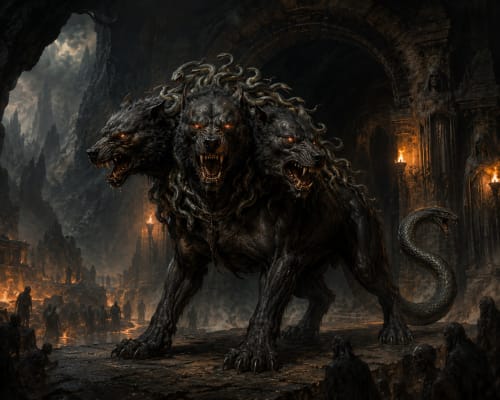
Cerberus
Cerberus · Infernal Gatekeeper — Legendary triple-headed hound
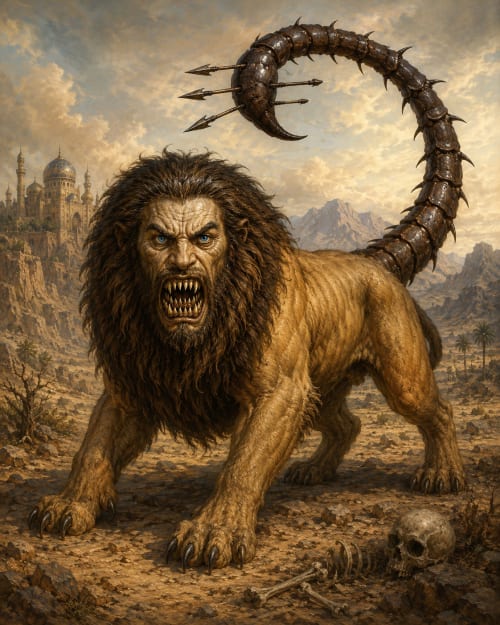
Manticore
Persian Legendary Lion-Man-Scorpion Hybrid

Sphinx
Sphinx · Guardian of Riddles — Hybrid of Human and Lion

Chimera
Chimera · Monstrous hybrid — Mythical creature with combined animal traits
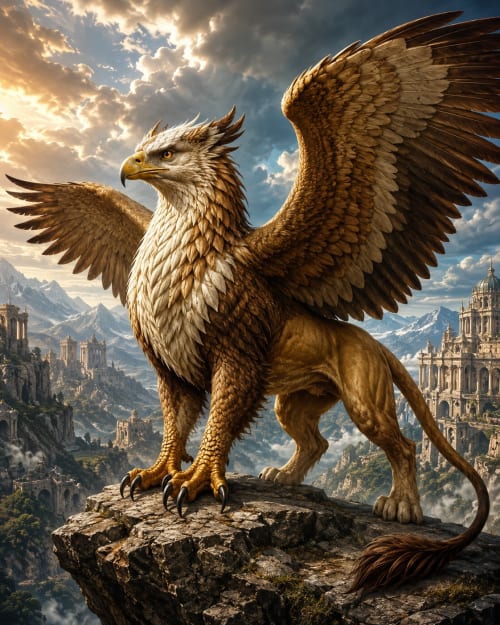
Griffin
Griffin · Legendary Lion-Eagle — Mythical creature with eagle foreparts and lion hindquarters