
Charybdis
Charybdis · Oceanic Monster — The Devouring Whirlpool
Names in Other Languages
 카리브디스한국어
Charybdis · 해양 괴수 — 삼키는 소용돌이의 괴물
 カリュブディス日本語
カリュブディス · 海の怪物 — 飲み込む渦巻き
 卡律布狄斯繁體中文
Charybdis · 海洋怪物 — 吞噬一切的漩渦
 CharybdisDeutsch
Charybdis · Seeungeheuer — Verschlingender Strudel
 CharybdeFrançais
Charybde · Monstre marin — Le tourbillon dévoreur
 CaribdisEspañol
Caribdis · Monstruo marino — El remolino devorador
 CaríbdisPortuguês
Caríbdis · Monstro marinho — O redemoinho devorador
 CharybdaPolski
Charybda · Morski potwór — Pożerający wir
 ХарибдаРусский
Харибда · Морское чудовище — Поглощающий водоворот
A monstrous sea-creature of Greek myth who lives at the foot of a narrow cliff in the Strait of Messina between Sicily and the Italian mainland. Daughter of Poseidon and Gaia in the later tradition, she was changed into a creature by the wrath of Zeus; three times a day she draws the dark sea down into a vast whirlpool and again belches it back, swallowing every ship and creature that comes too near. In Homer's Odyssey book 12 (c. eighth century BCE) Odysseus must pass between Charybdis and the six-headed Skylla on the opposite cliff, and from that ordeal comes the English idiom 'between Scylla and Charybdis' for an unwinnable choice.
Origin
The earliest direct attestation is Homer's Odyssey, book 12, lines 73-126, 234-260, and 426-446 (the oral tradition is dated to the eighth century BCE; the oldest surviving manuscript is Marcianus Graecus 454, A, of the tenth century, in the Biblioteca Marciana in Venice). Homer describes Charybdis as a vast whirling mouth beneath a fig-tree on a narrow strait, who 'three times a day swallows down the dark water and three times spews it back forth in dreadful fashion'. Her genealogy — daughter of Poseidon and Gaia, transformed by Zeus's thunderbolt — is consolidated in the Byzantine commentary of Eustathios of Thessalonica's Commentarii ad Homeri Odysseam (twelfth century). Virgil's Aeneid, book 3, lines 420-432 (19 BCE) carries her into Latin canon, and Ovid's Metamorphoses, book 13, lines 730-734 (8 CE) compresses her into 'a being with a mouth that drinks and vomits the sea'. Apollodorus's Epitome 7.20-23 (first to second century CE) gives the prose mythological summary, and Eustathios fixes the Olympian genealogy in the twelfth century. Dante uses her as the figure of the Fourth Circle of Hell, where the avaricious and prodigal clash, at Inferno 7.22-24 (c. 1308-1320). Desiderius Erasmus crystallised the proverb in his Adages 1.5.4 (1500-1508) as 'inter Scyllam et Charybdim', and from there it spread across early-modern Europe.
Features
- Fixed at the foot of the narrow left cliff in the Strait of Messina; unable to move from her place
- Three times a day she draws down a great whirlpool and three times spews it back (Odyssey 12.105-106)
- Pulls every ship and creature near her into the suck and answers with foam and a great roar on the surge back up
- Homer never describes her body directly; only the whirl and roar evoke her, and later iconography developed the toothed-mouth variant
- Paired with six-headed Skylla on the opposite cliff, so that the strait forces the traveller into a one-or-the-other choice
Stories
In myth Charybdis stands for the absolute danger that must be passed around. In Odyssey book 12, Odysseus, on Circe's advice, hugs Skylla's side and loses six men to her but escapes the total wreck Charybdis would bring; on his second passage (12.426-446) he loses every companion and clings alone to the fig-tree until Charybdis vomits up his shattered raft. The phrase 'between Scylla and Charybdis' has been the proverb of the lose-lose dilemma since Erasmus's Adages, and is a fixture of political and ethical rhetoric from Edmund Burke's Reflections on the Revolution in France (1790) onward. Wizards of the Coast's Stormwrack: Mastering the Perils of Wind and Wave (Dungeons & Dragons, 2005) introduces Charybdis as a Challenge Rating 11 oceanic hazard-monster, and Magic: The Gathering's Legends set (1994) included a blue creature card simply named Charybdis.
Weakness
Charybdis's decisive weakness is that she is fixed in one place and can therefore be avoided; in the Odyssey itself Circe expressly advises Odysseus 'hug Skylla's side rather than risk Charybdis' (book 12, lines 108-110). Her three-a-day cycle makes the moment of vomiting a window for passage, as Odysseus exploits on his second crossing. Direct attack or weaponry barely touches her — she is a force of nature — and the post-classical commentaries (Eustathios on Odyssey, twelfth century) treat her as fully destroyable only by another divine bolt or by Poseidon's wrath.
Cultural Significance
The geographic model for Charybdis is the Strait of Messina between Sicily and the Italian mainland, where tidal turning creates a real rotational eddy (Italian garofalo). The eddy was weakened by the seafloor disturbances of the 1908 Messina earthquake and tsunami but is still observable today (Italian National Institute of Oceanography ISMAR, report of 2015). The Charybdis-and-Skylla either-or motif has become the canonical analogue of a dilemma across political theory, ethics, and game theory; Michael Goldman's The Charybdis-Scylla Constraint (MIT Press, 1984) made it canonical for bargaining theory. The Police song Wrapped Around Your Finger from Synchronicity (A&M Records, 1983) carried the phrase into pop culture with the line 'You consider me the young apprentice, caught between the Scylla and Charybdis', and the great whirlpool of the Kraken in Gore Verbinski's Pirates of the Caribbean: Dead Man's Chest (Disney, 2006) is a direct visual descendant.
In Popular Culture
- Homer, Odyssey book 12 (c. 8th c. BCE; manuscript Marcianus Graecus 454 A, 10th c., Biblioteca Marciana, Venice) — the passage of Charybdis and Skylla
- Virgil, Aeneid book 3, lines 420-432 (19 BCE) — canonisation in Latin
- Ovid, Metamorphoses book 13, lines 730-734 (8 CE) — the mouth that drinks and vomits the sea
- Apollodorus, Epitome 7.20-23 (1st to 2nd c. CE) — prose mythological summary
- Eustathios of Thessalonica, Commentarii ad Homeri Odysseam (12th c. Byzantine) — Olympian genealogy
- Dante Alighieri, Inferno 7.22-24 (c. 1308-1320) — Fourth Circle of Hell analogue
- Erasmus, Adages 1.5.4 (1500-1508) — 'inter Scyllam et Charybdim' as a canonical proverb
- The Police, Wrapped Around Your Finger, on Synchronicity (A&M Records, 1983) — pop-music allusion
- Wizards of the Coast, Stormwrack: Mastering the Perils of Wind and Wave (D&D, 2005) — game-mechanical Charybdis
- Gore Verbinski (dir.), Pirates of the Caribbean: Dead Man's Chest (Disney, 2006) — visual descendant of the whirlpool
Trivia
- The actual rotational eddy in the Strait of Messina is called garofalo in Italian; ISMAR (the Italian National Research Council Institute of Marine Sciences) confirmed in a 2010 seafloor survey that the eddy was much more violent in the Homeric period before the 1908 Messina earthquake disturbed the strait floor.
- Charybdis's three-a-day cycle does not match the real twelve-and-a-half-hour tidal cycle of the strait; Kenneth Mathews, in The Geography of the Iliad and the Odyssey (Routledge, 2008), suggests that the Homeric observer remembered only sunrise, noon, and sunset turbulences as 'three times'.
- Erasmus's 1500 Adages was composed of 818 short Latin proverbs, and his autograph note at Leiden University Library records that 'inter Scyllam et Charybdim' (1.5.4) was lifted directly from Ovid.
- Sting (Gordon Sumner), the lyricist of The Police, told BBC Radio 4 in a 2003 interview that the line 'caught between the Scylla and Charybdis' in Wrapped Around Your Finger was drawn directly from his reading of Homer as an English literature student at Newcastle University.
Related
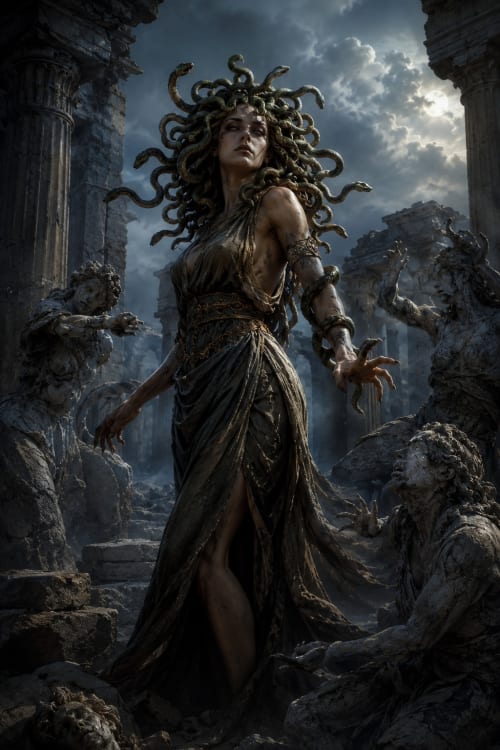
Medusa
Medusa · Monster — Ancient creature with snakes for hair

Nemean Lion
Nemean Lion · Invulnerable Beast — Immortal creature of Greek myth

Hydra
Hydra · Lernaean serpent — Multi-headed mythical beast

Naga
Naga · Serpent People — Mythical half-human, half-serpent beings
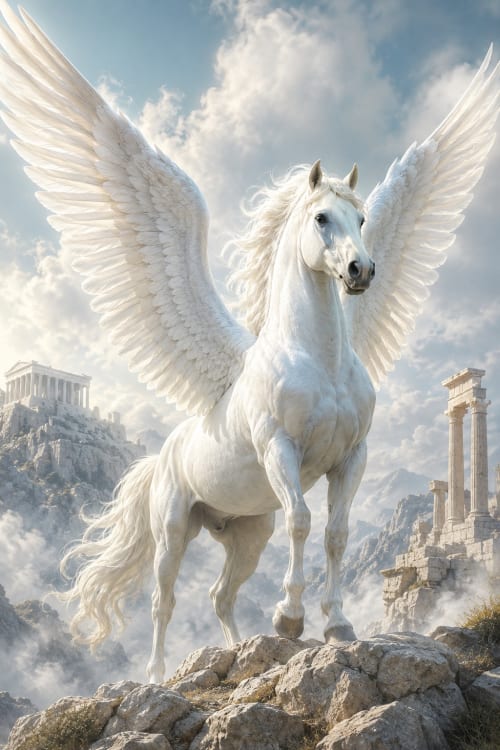
Pegasus
Pegasus · Winged Horse — A Legendary Creature from Greek Mythology
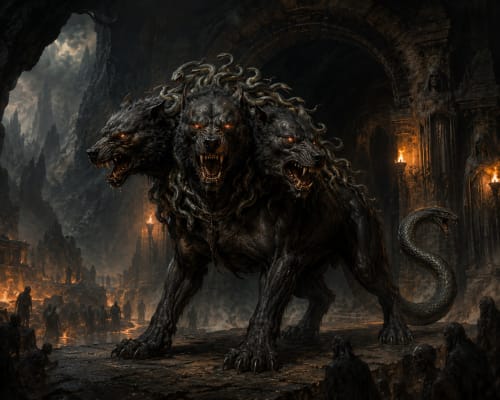
Cerberus
Cerberus · Infernal Gatekeeper — Legendary triple-headed hound

Lamia
Serpent-bodied Enchantress · Seductress and Devourer in Greek Mythology

Chimera
Chimera · Monstrous hybrid — Mythical creature with combined animal traits

Phoenix
Phoenix · Firebird — Legendary bird reborn from flames

Centaur
Centaur · Half-human, half-horse — Legendary creature of Greek myth

Peryton
Borges's Imaginary Stag-Bird Hybrid
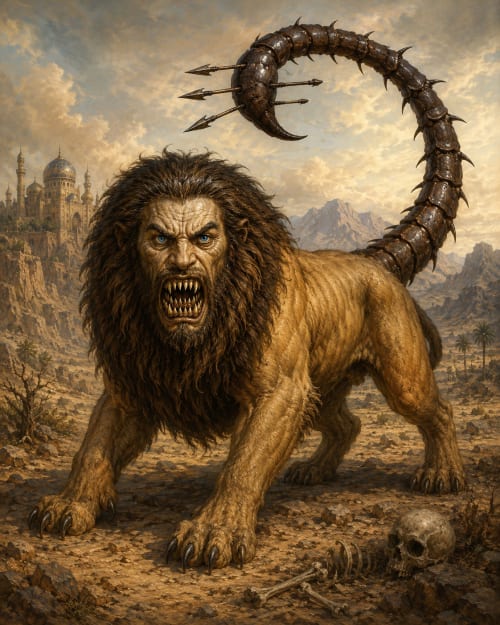
Manticore
Persian Legendary Lion-Man-Scorpion Hybrid