
Medusa
Medusa · Monster — Ancient creature with snakes for hair
Names in Other Languages
 메두사한국어
Medusa · 괴물 — 머리카락이 뱀으로 된 고대의 괴물
 メドゥーサ日本語
メドゥーサ · モンスター — 蛇の髪を持つギリシャ神話の怪物
 梅杜莎繁體中文
梅杜莎 · 怪物 — 擁有蛇髮的古希臘傳說生物
 MedusaDeutsch
Medusa · Monster — Antikes Wesen mit Schlangenhaaren
 MéduseFrançais
Méduse · Monstre — Créature antique à la chevelure de serpents
 MedusaEspañol
Medusa · Monstruo — Criatura antigua con cabellos de serpientes
 MedusaPortuguês
Medusa · Monstro — Criatura antiga com serpentes no lugar do cabelo
 MeduzaPolski
Meduza · Potwór — Starożytna istota z wężami zamiast włosów
 МедузаРусский
Медуза · Монстр — Древнее существо со змеями вместо волос
Medusa (Greek Medousa) is the youngest of the three Gorgon sisters of Greek myth, Stheno, Euryale, and Medusa, and the only one of the three who is mortal. According to Hesiod's Theogony she is the daughter of the sea deities Phorcys and Ceto, with serpents for hair and a gaze that turns any who behold her to stone. The first-century Roman poet Ovid, in Metamorphoses IV, supplied the most influential variant: Medusa had once been the beautiful priestess of Athena's temple, was raped within the sanctuary by Poseidon, and was transformed into a monster by Athena, who punished the desecration of her shrine. The hero Perseus slew her, aided by Hermes' winged sandals, Hades' helm of invisibility, and Athena's polished bronze shield, by looking only at her reflection. From her severed neck sprang the winged horse Pegasus and the giant Chrysaor; her head, the Gorgoneion, became a powerful apotropaic device fixed at the centre of Athena's aegis.
Origin
The earliest literary reference is Hesiod's Theogony 270-283 (eighth century BCE), where the three Gorgons appear as daughters of the sea deities Phorcys and Ceto. Stheno and Euryale are immortal; only Medusa is mortal. This essential asymmetry, fixed at the very root, makes Medusa alone vulnerable to the hero. Homer's Iliad 5.741 and 11.36 already feature the Gorgon's head, the Gorgoneion, fixed on Athena's aegis as a terrifying apotropaic device; the Odyssey 11.634 places the Gorgon in the realm of Hades. The canonical Perseus narrative is preserved in pseudo-Apollodorus' Bibliotheca II.4.2 (first to second century CE), with Pindar's Pythian 12 and Ovid's Metamorphoses IV.769-803 expanding the legend. The Ovidian motif of Medusa as a punished priestess, raped by Poseidon and punished by Athena, is a Latin innovation; in the Greek tradition she was always a monstrous Gorgon by birth.
Features
- Hair of living serpents
- A petrifying gaze that turns onlookers to stone
- Youngest of the three Gorgon sisters and the only one mortal
- Variants in Apollodorus give her golden wings and bronze claws
- Pegasus and Chrysaor spring from her severed neck
- The severed head becomes an apotropaic device, the Gorgoneion
Stories
The severed head of Medusa is the most powerful apotropaic image of Greek and Roman art: the Gorgoneion, fixed on Athena's aegis, painted on Greek black-figure vases from the sixth century BCE onward, set on Corinthian mosaics, struck on Sicilian coins. Renaissance and Baroque art canonised the figure: Benvenuto Cellini's bronze Perseus with the Head of Medusa (1554, Loggia dei Lanzi, Florence); Caravaggio's Head of Medusa (1597-1598, Uffizi); Peter Paul Rubens's Head of Medusa (1617-1618, Kunsthistorisches Museum, Vienna). Dante invokes Medusa as a threat at the gates of Dis in Inferno IX.52-63. In modern culture the Versace fashion logo (adopted 1978), the films Clash of the Titans (1981 and 2010), and the Dungeons and Dragons Monster Manual keep the figure central. The twentieth-century feminist re-reading by Helene Cixous, The Laugh of the Medusa (1975), reframed Medusa as an emblem of feminine power.
Weakness
Medusa's decisive weakness is that her own gaze is effective against her. According to pseudo-Apollodorus, Perseus bore Athena's polished bronze shield and used it as a mirror, looking only at Medusa's reflection while severing her head. The mirror-shield is one of the most refined hero-test patterns in Greek myth, displacing the danger of the gaze by reflection. Variants make her most vulnerable while asleep; in Pindar's Pythian 12 and pseudo-Apollodorus, Perseus obtains information from the Graiai sisters and uses Hermes' winged sandals and Hades' helm of invisibility to behead her in sleep. The deepest structural weakness, however, is built in from the start: of the three Gorgons, only Medusa is mortal, so she is the only one who can be slain.
Cultural Significance
Medusa is not merely a monster but the most complex figure of Greek myth. The severed head, the Gorgoneion, is the apex of apotropaic iconography from the sixth century BCE onward, and the mirror-shield structure of Perseus's slaying is the mythic archetype of philosophical treatments of gaze, reflection, and knowing. Caravaggio's 1597-1598 Head of Medusa, Cellini's 1554 Perseus, and Rubens's 1617-1618 painting are central works of Renaissance and Baroque art. In 1975 the French feminist Helene Cixous published Le Rire de la Meduse, recasting Medusa from victim of patriarchal myth to emblem of feminine creative power; this became a foundational text of feminist criticism. Versace's adoption of the Gorgoneion as fashion logo in 1978, the canonisation of the Medusa as a Dungeons and Dragons monster, and her recurring role in modern fantasy preserve her as the most frequently re-interpreted figure in classical mythology.
In Popular Culture
- Hesiod, Theogony 270-283 (8th c. BCE) — earliest literary reference to the three Gorgons
- Homer, Iliad 5.741 and 11.36 — the Gorgoneion fixed on Athena's aegis
- Pindar, Pythian 12 — Perseus's exploit against Medusa
- Pseudo-Apollodorus, Bibliotheca II.4.2 (1st-2nd c. CE) — canonical Perseus narrative
- Ovid, Metamorphoses IV.769-803 — innovation of the punished-priestess motif
- Dante, Inferno IX.52-63 — Medusa as a threat at the gates of Dis
- Helene Cixous, Le Rire de la Meduse (1975) — feminist re-reading
Trivia
The Greek name Medousa is the feminine participle of the verb medo, 'to rule' or 'to be queen', so the name itself means 'queen' or 'ruler'. This etymology became the starting point of twentieth-century feminist re-readings, including Helene Cixous's, that recast Medusa as a sovereign figure rather than a monster. From the severed neck of Medusa flowed two streams of blood: that of the left vein was a deadly poison, that of the right vein could raise the dead, an antithesis recorded by pseudo-Apollodorus and Euripides' Ion. The Ovidian motif of Athena's punishment, absent from the Greek tradition, became dominant in Renaissance painting and shaped the modern perception of Medusa as wrongly transformed victim rather than primordial monster. Gianni Versace adopted the Gorgoneion as the fashion house logo in 1978, citing in interviews 'the power to fascinate that Medusa exerts'.
Related

Nemean Lion
Nemean Lion · Invulnerable Beast — Immortal creature of Greek myth

Charybdis
Charybdis · Oceanic Monster — The Devouring Whirlpool

Hydra
Hydra · Lernaean serpent — Multi-headed mythical beast
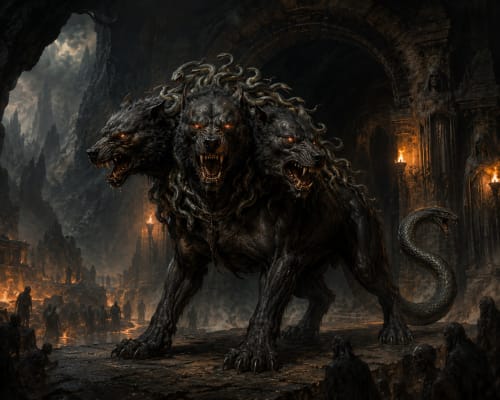
Cerberus
Cerberus · Infernal Gatekeeper — Legendary triple-headed hound

Sphinx
Sphinx · Guardian of Riddles — Hybrid of Human and Lion
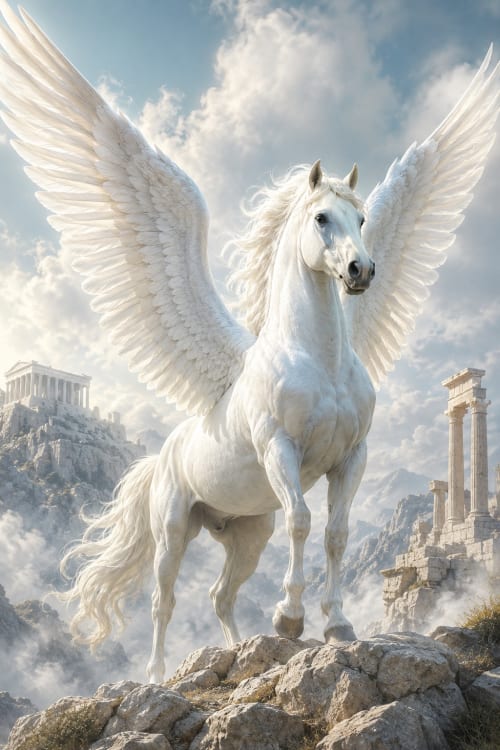
Pegasus
Pegasus · Winged Horse — A Legendary Creature from Greek Mythology

Lamia
Serpent-bodied Enchantress · Seductress and Devourer in Greek Mythology

Amphisbaena
Two-Headed Serpent of Greek Myth
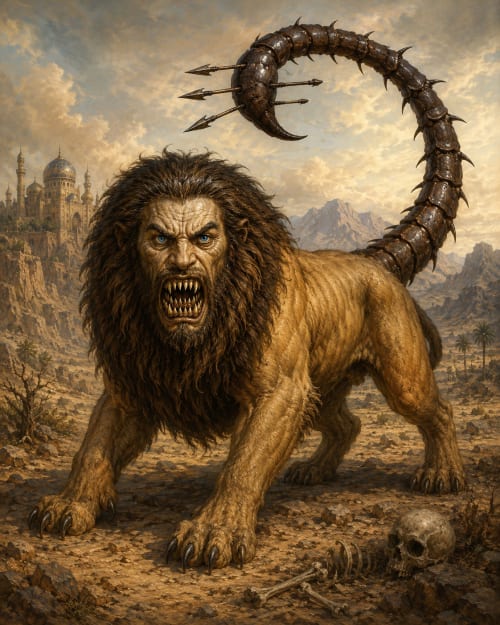
Manticore
Persian Legendary Lion-Man-Scorpion Hybrid
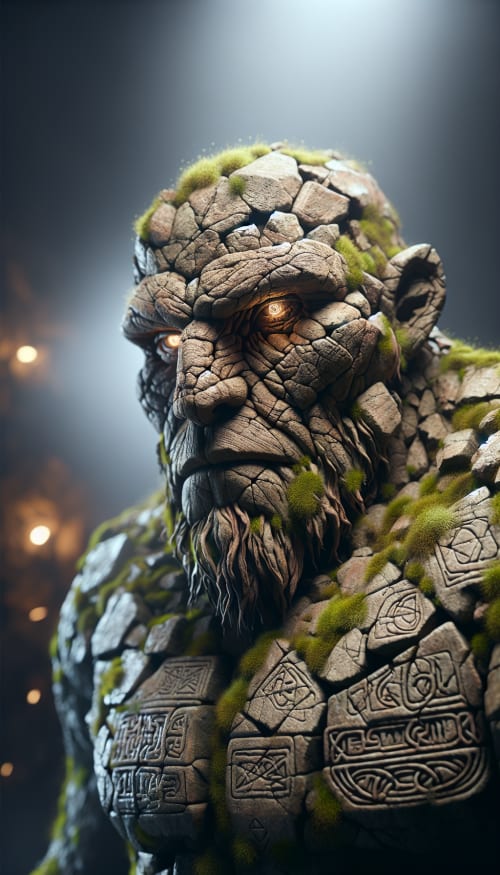
Golem
Golem · Artificial Creature — A being made from inanimate materials

Chimera
Chimera · Monstrous hybrid — Mythical creature with combined animal traits

Phoenix
Phoenix · Firebird — Legendary bird reborn from flames