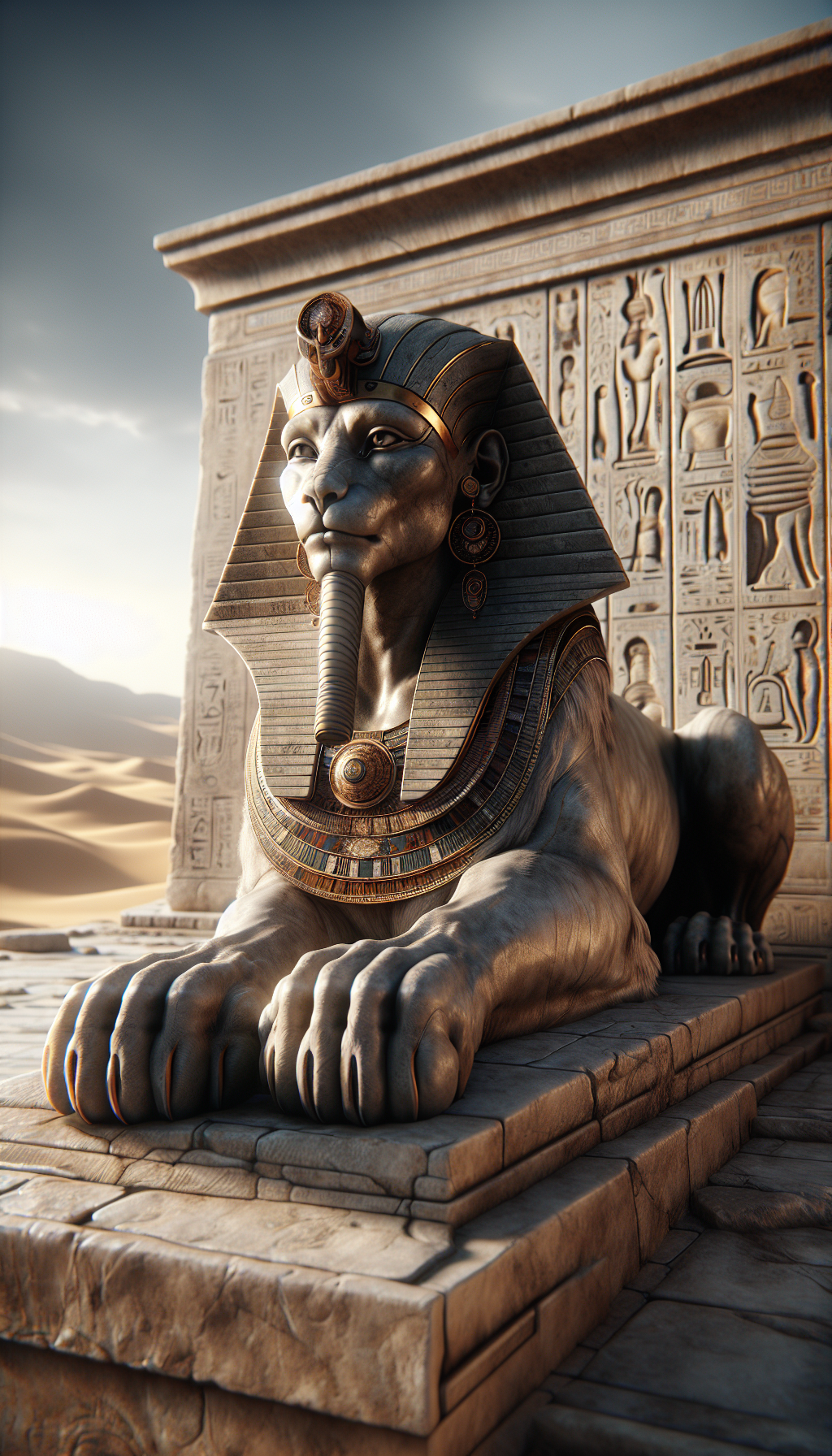
Sphinx
Sphinx · Guardian of Riddles — Hybrid of Human and Lion
Names in Other Languages
 스핑크스한국어
Sphinx · 수수께끼의 수호자 — 인간과 사자의 혼합 생명체
 スフィンクス日本語
スフィンクス · 謎の守護者 — 人間とライオンの混合生物
 斯芬克斯繁體中文
斯芬克斯 · 謎語守護者 — 人獸混合生物
 SphinxDeutsch
Sphinx · Rätselwächter — Mensch-Löwen-Hybride
 SphinxFrançais
Sphinx · Gardien des énigmes — Hybride humain-lion
 EsfingeEspañol
Esfinge · Guardiana de acertijos — Híbrido de humano y león
 EsfingePortuguês
Esfinge · Guardiã dos enigmas — Híbrido de humano e leão
 SfinksPolski
Sfinks · Strażnik zagadek — Hybryda człowieka i lwa
 СфинксРусский
Сфинкс · Страж загадок — Гибрид человека и льва
The Sphinx (Greek Sphinx, Egyptian shesep-ankh) is a mythic composite of human head and lion body, developed in two parallel traditions. The Egyptian Sphinx, usually a wingless male with the head of a pharaoh, served as guardian of temples and tombs, exemplified by the Great Sphinx of Giza (73 m long, 20 m high), carved from a single limestone outcrop in the reign of Khafre around 2530 BCE. The Greek Sphinx, by contrast, is a winged female with a savage temper who took her station outside Thebes in Boeotia and devoured travellers who could not answer her riddle. When Oedipus solved her riddle, 'What walks on four legs at dawn, two at noon, and three at evening?', answering 'Man', the Sphinx hurled herself from her cliff. From this Egyptian-Greek synthesis the Sphinx became the archetype of the guardian-tester: wisdom and threat, protection and danger, fused in a single hybrid body.
Origin
The earliest Egyptian Sphinx is the Great Sphinx of Giza, attributed to Khafre of the Fourth Dynasty around 2530 BCE. By the New Kingdom the form had branched into the androsphinx (human head), criosphinx (ram-headed, sacred to Amun), and hierakosphinx (falcon-headed, sacred to Horus). At Karnak and Luxor the avenue of sphinxes, roughly three kilometres long, was lined with hundreds of leonine guardians. In Greece, the Sphinx first appears in Hesiod's Theogony lines 326-329, as the offspring of Orthrus and Chimera (or Echidna). The canonical Oedipus narrative is fixed in pseudo-Apollodorus' Bibliotheca III.5.8, while the earliest explicit text of the riddle appears in Euripides' Phoenissae, lines 1024-1054. Diodorus Siculus IV.64, Pausanias IX.26.3, and Hyginus' Fabulae 67 elaborate the legend. Greek sphinx derives from sphingein, 'to strangle' or 'to bind', as the Etymologicum Magnum records.
Features
- Human head (often a pharaoh or a woman) on a lion body
- Egyptian form wingless and male; Greek form winged and female
- Guardian of temples, tombs, and royal precincts
- Tester of mortals through riddles and judgment
- Janus-faced: simultaneously protector and threat
- Stationed at thresholds, gates, roads, and frontiers
Stories
In Egypt the Sphinx was royal iconography, ranged before temple pylons, pyramid precincts, and the processional ways of Luxor and Karnak. Hatshepsut commissioned her female-pharaoh sphinxes; Thutmose IV's Dream Stele records the Great Sphinx promising him kingship in exchange for clearing its sands; Amenhotep III's Memphite sphinxes survive in fragmentary form. In Greece the iconography is fixed on the Oedipus myth and survives on Attic vases and Boeotian reliefs. Neoclassical revival produced Ingres' Oedipus and the Sphinx (1808) and the Symbolist masterpiece by Gustave Moreau (1864). Oscar Wilde published his long poem The Sphinx in 1894. The modern Sphinx canonical role in popular culture runs from Edgar Allan Poe (The Sphinx, 1846) to J. K. Rowling's Harry Potter and the Goblet of Fire (2000) and the Dungeons and Dragons monster classification.
Weakness
The Greek Sphinx's decisive vulnerability is the solving of her own riddle. Pseudo-Apollodorus reports that when Oedipus answered 'Man', the Sphinx threw herself from her seat to her death. A variant tradition gives a second riddle, 'Two sisters born of one mother, each giving birth to the other' (answer: Day and Night); when both are solved the Sphinx perishes. The Egyptian Sphinx's vulnerabilities are physical rather than mythic: the Great Sphinx of Giza lost its nose to the fourteenth-century Sufi zealot Sa'im al-Dahr, who according to the fifteenth-century historian al-Maqrizi destroyed it as an idol. The popular myth that Napoleon's troops shot off the nose is refuted by Frederic Louis Norden's 1737 drawings showing the nose already missing.
Cultural Significance
The Egyptian Sphinx, fused with the solar god Re-Harmakhis ('Horus of the Horizon'), embodied divine kingship and protection; the Greek Sphinx became the emblem of trial and fate, the riddle to be solved. The two traditions met in European art from the Renaissance onward, producing the winged female sphinxes of Versailles, the Ramses II sphinxes brought to St Petersburg's Neva embankment in 1832, and the Freemasonic iconography of the eighteenth century. In psychoanalysis Freud made the Sphinx's riddle the primal scene of ego-formation in his Oedipus complex. Hegel's Aesthetics reads the Sphinx as the symbol of humanity's transition from East to West, from nature to self-knowledge. In contemporary culture the Sphinx survives in Harry Potter's Triwizard maze, Edgar Allan Poe's tale, Ralph Waldo Emerson's poem of 1841, and the iconic Egyptian tourism imagery of the Giza plateau.
In Popular Culture
- Great Sphinx of Giza — Khafre of the Fourth Dynasty, c. 2530 BCE
- Hesiod, Theogony 326-329 — offspring of Orthrus and Chimera (or Echidna)
- Pseudo-Apollodorus, Bibliotheca III.5.8 — canonical Oedipus and Sphinx narrative
- Euripides, Phoenissae 1024-1054 — earliest explicit text of the riddle
- Hyginus, Fabulae 67 and Pausanias, Description of Greece IX.26.3
- Ingres, Oedipus and the Sphinx (1808) and Gustave Moreau, Oedipus and the Sphinx (1864)
- J. K. Rowling, Harry Potter and the Goblet of Fire (2000) — the Sphinx of the Triwizard maze
Trivia
Greek sphinx derives from sphingein, 'to strangle' or 'to bind', the act by which she dispatched those who failed her riddle, as recorded by the Etymologicum Magnum. A competing hypothesis traces the Greek name to Egyptian shesep-ankh ('living image'), though no scholarly consensus exists. The Great Sphinx of Giza lost its nose to the fourteenth-century Sufi zealot Sa'im al-Dahr, according to the fifteenth-century chronicler al-Maqrizi; Frederic Louis Norden's 1737 drawings already show it noseless, refuting the Napoleon-shot legend. The Avenue of Sphinxes connecting Karnak and Luxor, lined with around 1300 sphinx statues over roughly three kilometres, was reopened by the Egyptian government with a ceremonial procession on 25 November 2021.
Related

Lamia
Serpent-bodied Enchantress · Seductress and Devourer in Greek Mythology

Nemean Lion
Nemean Lion · Invulnerable Beast — Immortal creature of Greek myth
Medusa
Medusa · Monster — Ancient creature with snakes for hair

Amphisbaena
Two-Headed Serpent of Greek Myth

Chimera
Chimera · Monstrous hybrid — Mythical creature with combined animal traits

Centaur
Centaur · Half-human, half-horse — Legendary creature of Greek myth

Strix
Strix · Night Bird — Vampiric Bird of Ancient European Myth

Hydra
Hydra · Lernaean serpent — Multi-headed mythical beast

Cretan Bull
Seventh Labor of Heracles in Greek Myth
Cerberus
Cerberus · Infernal Gatekeeper — Legendary triple-headed hound
Golem
Golem · Artificial Creature — A being made from inanimate materials

Phoenix
Phoenix · Firebird — Legendary bird reborn from flames