
Bola
A throwing weapon that entangles legs with weighted cords
Names in Other Languages
 볼라한국어
볼라한국어Bola · 끈에 달린 돌 투척 무기
 ボーラ日本語
紐付き石の投擲武器
 流星錘繁體中文
繩索連接石球的投擲武器
 BolaDeutsch
Die Wurfwaffe mit verbundenen Gewichten
 BolasFrançais
L'arme de jet aux poids reliés
 BoleadorasEspañol
El arma arrojadiza con pesos conectados
 BoleadeirasPortuguês
A arma de arremesso com pesos conectados
 BolaPolski
Broń miotana z połączonymi ciężarkami
 БолаРусский
Метательное оружие со связанными грузами
The bola is a throwing weapon of two or three heavy stone or metal weights joined by cords, which on being thrown spins through the air and wraps around the legs of its target to bind its movement. Its chief trait is that it is a capturing weapon, made to seize rather than to kill. It is a hunting weapon developed by the indigenous peoples of South American Patagonia, used mainly to hunt fast grassland animals such as the rhea, the South American ostrich, and the guanaco, a wild relative of the llama. It later grew more famous as the gauchos, the South American cowboys, used it to drive cattle. Each weight is about 200 to 500 g and the cords about 60 to 100 cm, and it was used as a weapon of war too, fielded by the army of the Inca Empire.
Origin
The bola is a hunting weapon used for thousands of years by the indigenous peoples of South American Patagonia, the Tehuelche and the Mapuche. On the open grassland, the pampas, where it was hard to shoot a bow, this weapon that wrapped the legs of an animal fleeing at full speed and brought it down was a chief means of the hunt. It later became a symbol of South American cowboy culture as the gauchos of Argentina, Uruguay, and southern Brazil adopted it for herding, especially for catching cattle. The bola was also used in war: the army of the Inca Empire fielded it, and it is recorded that the Mapuche used it to wrap and bring down the legs of Spanish cavalry horses.
Features
- A structure of two or three stone or metal weights joined by cords
- A capturing weapon that spins in flight and wraps around the legs
- Weights of about 200 to 500 g each, cords about 60 to 100 cm
- A traditional hunting weapon of the indigenous people of South American Patagonia
- An emblematic tool of gaucho herding culture
- Also used as a weapon of war by the army of the Inca Empire
Stories
The bola is whirled overhead to gather centrifugal force in the weights, then thrown at the legs of a fleeing animal or enemy. Thrown, the bola spins through the air, and the weights, spread apart, wrap around the legs and by their momentum bind them fast to bring the target down. Its purpose is to bind the movement and take captive rather than to kill, so it suited taking a fast rhea or guanaco alive or stopping cattle. On the battlefield it was used to wrap the legs of a mounted enemy's horse and unhorse him. Its effective range is roughly 15 to 30 m, a weapon that aimed at a target's legs from a distance.
Weakness
The bola is essentially a single-use throwing weapon, so once thrown it must be recovered or given up for another weapon. Its effective range of 15 to 30 m is short, and it cannot be used in close combat once an enemy has pressed in. The motion of whirling it overhead and throwing also needs some space, and considerable skill is required to aim true at the legs and make it wrap. Above all, being specialized for capture and restraint rather than direct killing, its limit is clear as a decisive blow that fells an opponent at a stroke.
Cultural Significance
The bola is a symbol of the South American gaucho and the culture of the pampas grassland. What was originally the hunting weapon of the Patagonian indigenous peoples carried on as the herding tool of the gaucho and is deeply engraved in the folklore and identity of Argentina and Uruguay. The episode in which the Mapuche, facing the cavalry of the Spanish conquerors, wrapped and brought down the legs of their horses is told as a case of a simple hunting tool becoming a weapon against invasion. Far to the north, the Inuit of the Arctic too caught flying birds with a bola of several weights, an intriguing case of two unrelated cultures independently making a weapon of the same idea.
In Popular Culture
The bola often appears in works set in South America or the frontier West, or in media dealing with the primitive and the hunt. In games it is drawn as a binding or capturing weapon that ties up a foe's feet, appearing as the tool of a gaucho or indigenous hunter character. Its true nature as a weapon that binds movement rather than kills directly is rarely reflected accurately, however, and it is often simplified into merely a thrown blunt weapon. In real gaucho culture the bola, the boleadoras, can still be seen today in folk performances and demonstrations.
Trivia
- The naturalist Charles Darwin, during the voyage of the Beagle, tried using the bola, the boleadoras, while riding in the pampas, and accidentally wrapped the legs of his own horse and brought it down, an episode he recorded with self-deprecating humor in The Voyage of the Beagle.
- The bola is not a killing weapon but a capturing one: whirled overhead and thrown, the spread weights wrapped by their momentum around the legs of a fleeing rhea or guanaco or of a war-horse, and the Mapuche used it to bind the legs of Spanish cavalry horses.
- The three-weight bola, the boleadoras, carried on from the hunting weapon of the Patagonian indigenous peoples into the herding tool of the gauchos of Argentina, Uruguay, and southern Brazil and became their symbol, and far to the north the Inuit of the Arctic too brought down flying birds with a bola of several weights.
Related

Sling
An ancient projectile weapon hurling stones by centrifugal force

Javelin
A light spear designed for throwing

Spear
Humanity's oldest weapon

Gladius
The standard short sword of the Roman legionnaire

Halberd
The versatile polearm combining axe, spear, and hook

Longsword
The quintessential two-handed sword of medieval Europe
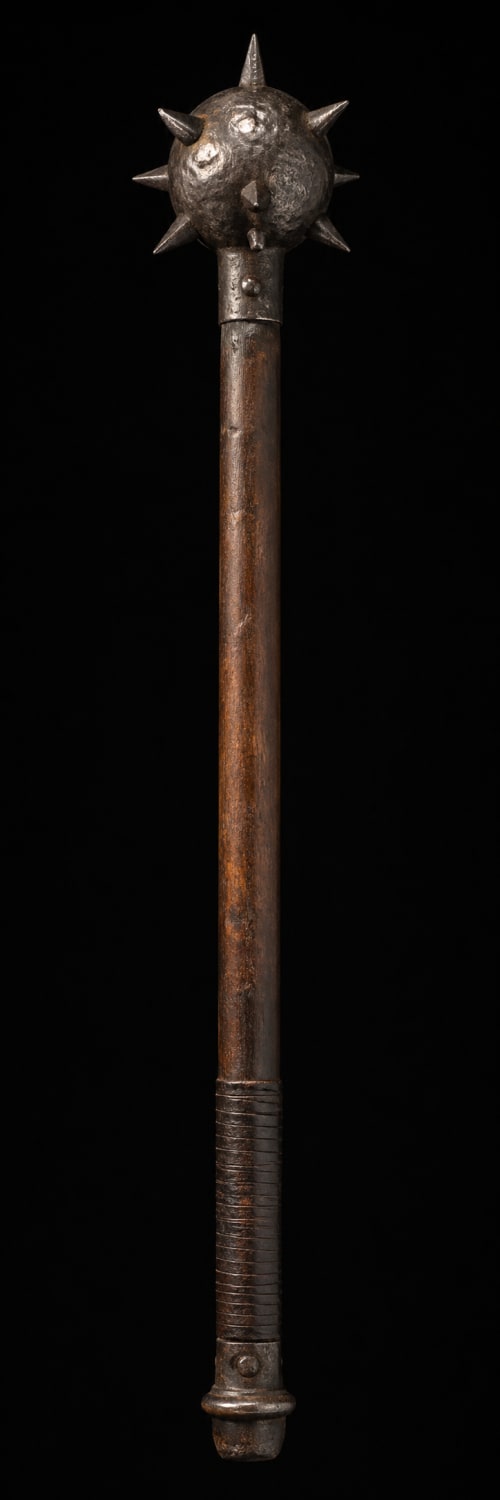
Morning Star
The spiked ball weapon of medieval warfare
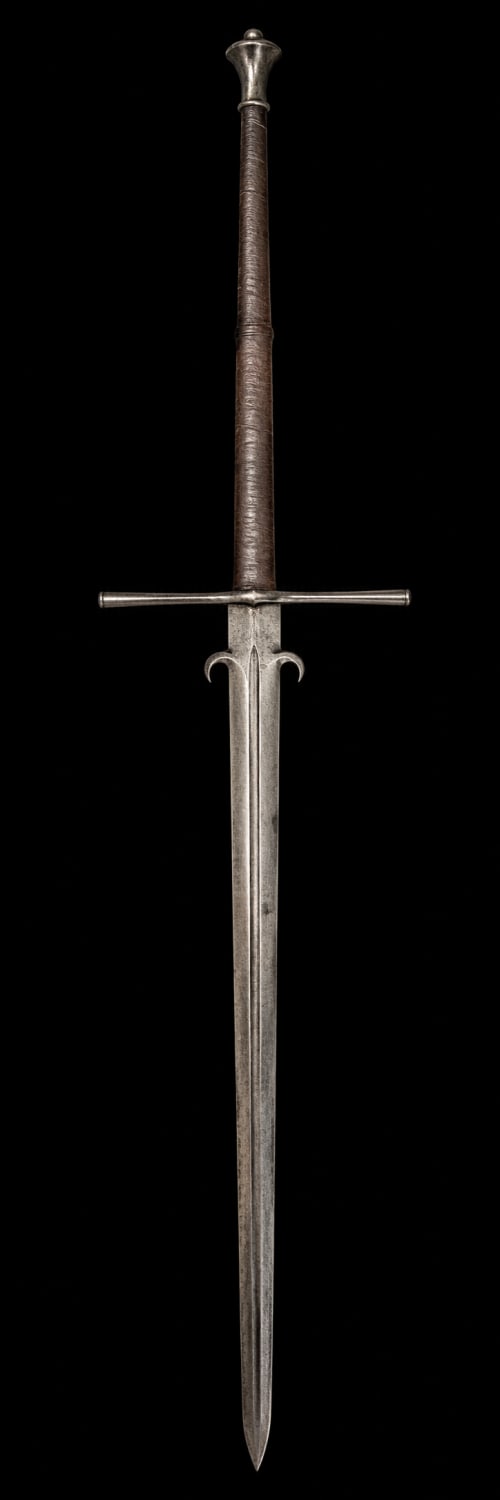
Zweihänder
The massive two-handed sword of German Landsknechts

Crossbow
The mechanized ranged weapon of the medieval era

Battle Axe
An axe designed specifically for combat

Sabre
The curved cavalry sword for slashing

Lance
The cavalry charge weapon of the mounted knight