
Battle Axe
An axe designed specifically for combat
Names in Other Languages
 전투 도끼한국어
Battle Axe · 전투에 특화된 도끼
 戦斧日本語
戦斧日本語戦闘専用の斧
 戰斧繁體中文
專為戰鬥設計的斧頭
 StreitaxtDeutsch
Die kampfoptimierte Axt
 Hache de guerreFrançais
La hache optimisée pour le combat
 Hacha de guerraEspañol
El hacha optimizada para combate
 Machado de guerraPortuguês
O machado otimizado para combate
 Topór bojowyPolski
Topór zoptymalizowany do walki
 Боевой топорРусский
Топор, оптимизированный для боя
The battle axe is an axe designed specifically for war. Unlike the everyday axe for splitting wood or felling trees, its head is light and its edge broad and thin, so that it bites deep even as it is swung fast. With a blade of about 15 to 30 cm and a total length of about 60 to 120 cm, it is handled in one hand or two. Each age and region had its own form: the long two-handed Dane axe of the Vikings, the throwing francisca of the Franks, and the mounted sagaris of the Scythians are the chief examples. The hooking technique, in which the lower horn of the blade, the beard, catches the top of an enemy's shield and pulls it down to nullify his defense, is characteristic, and being simpler and cheaper to make than a sword, it was widely issued.
Origin
The axe is one of the oldest tools and weapon types humankind used, from the Stone Age, and through the Bronze and Iron Ages it developed into forms specialized for war. The battle axe, branched off from the everyday axe, gave rise to forms unique to each civilization: the Dane axe of the Vikings and Anglo-Saxons, the throwing francisca of the Franks, and the sagaris of the Scythian and Persian world. Because the head could be made with little metal and simple forging and fitted to a wooden haft, it was cheap and quick to make compared with the costly sword, so it was widely used as the weapon of the common warrior, especially in the Norse and Germanic societies where the sword was scarce.
Features
- A light, broad war-specific axe head
- Many variants such as the Dane axe, the francisca, and the sagaris
- A blade of about 15 to 30 cm, a total length of about 60 to 120 cm
- Hooking, catching a shield with the beard, the lower horn, to nullify it
- Simpler and cheaper to make than a sword
- Used in one hand or two
Stories
The power of the battle axe lay in a cut that gathered force onto a narrow edge. Brought down hard, with that force concentrated on a single point of the blade, it split shields, cleaved helmets, and dealt deep wounds. The hooking that was the axe's own specialty caught the top rim of an enemy's shield with the lower horn of the blade, the beard, pulled it down to break his defense, and then struck the opening laid bare. The Franks used the francisca, thrown in a volley just before the charge, to scatter the enemy's shields and formation, and the elite household guards of the Vikings and Anglo-Saxons, the huscarls, cut down both horse and man with the two-handed Dane axe.
Weakness
The weakness of the battle axe arises from its structure, leaning toward the cut. It is hard to parry with precision as one does with a sword, and it does not lend itself well to the straight thrust. The wooden haft risks being cut by an enemy's blade or breaking in a violent clash. Above all, the great axe used in two hands leaves no hand for a shield, so the body is exposed and defenseless while swinging. The head is heavy, so on a miss it takes time to move into the next motion, easily allowing a counter.
Cultural Significance
The battle axe is deeply imprinted on the public mind as the symbol of the Viking warrior. The spear was in truth more common, but the axe was held a prized and emblematic weapon in Norse warrior culture and so was strongly bound to it: the axe of Saint Olaf is borne on the coat of arms of Norway to this day. Going further back, the double-bitted ceremonial axe of the Minoan civilization, the labrys, was a sacred symbol beyond a weapon. The axe was also, in societies where the sword was a symbol of wealth and rank, a practical and universal weapon that the common warrior could take in hand.
In Popular Culture
The battle axe is a weapon never missing from works dealing with Vikings and the Middle Ages and from fantasy. It commonly appears as the emblematic weapon of the warrior and the berserker in films and dramas such as Vikings and in countless games, and as the representative weapon of the dwarf races. A huge great axe swung in two hands, or a figure with an axe in each hand, is often drawn. In fiction, though, the axe is often exaggerated as unrealistically heavy and huge, or the image of Viking equals axe is hardened further while the fact that the spear was actually more common is hidden.
Trivia
- The francisca, the Frankish throwing axe, was hurled in a volley just before the charge to break the enemy's shields and scatter his formation, and bounced irregularly on the ground so it was hard to dodge; some hold that the Franks took their name from this axe, though the etymology is debated.
- The two-handed Dane axe was the emblematic weapon of the elite household guards of the Anglo-Saxons and the Norse, the huscarls, and appears on the Bayeux Tapestry depicting the Battle of Hastings in 1066, where King Harold's huscarls wielded it against the Norman cavalry.
- The hooking that opened a gap by catching the rim of an enemy's shield with the lower horn of the blade, the beard, and pulling it down was the axe's own specialty, and the axe, cheaper and easier to make than a sword, was the weapon of the common warrior in the Norse and Germanic societies where the sword was a symbol of rank; the axe of Saint Olaf remains on the coat of arms of Norway today.
Related

Halberd
The versatile polearm combining axe, spear, and hook

Longsword
The quintessential two-handed sword of medieval Europe
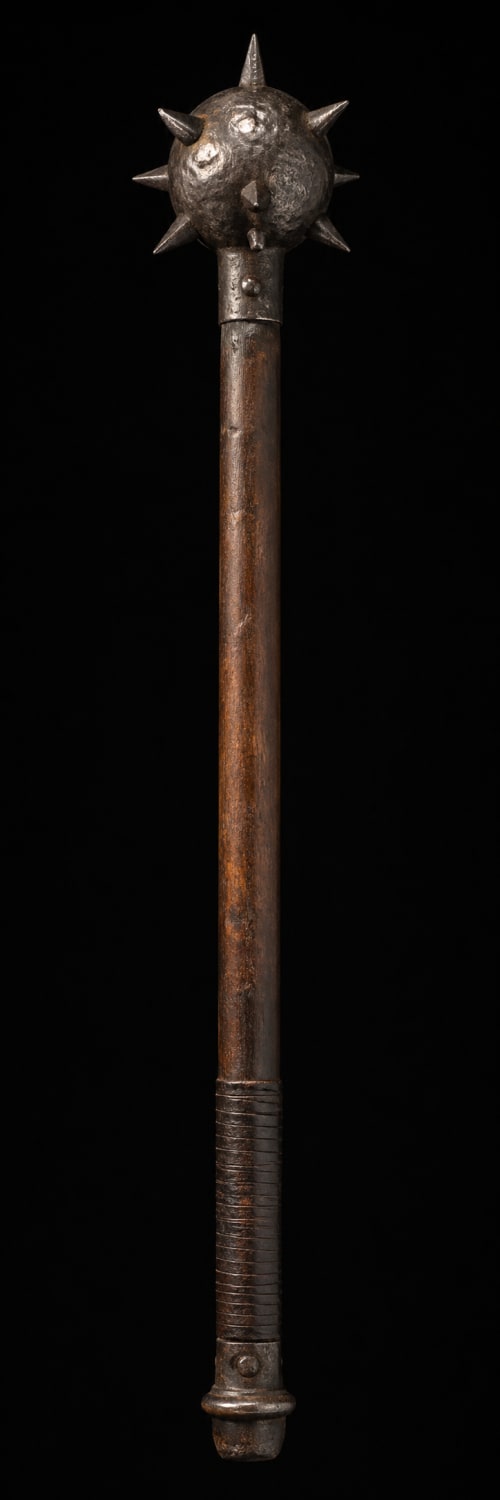
Morning Star
The spiked ball weapon of medieval warfare
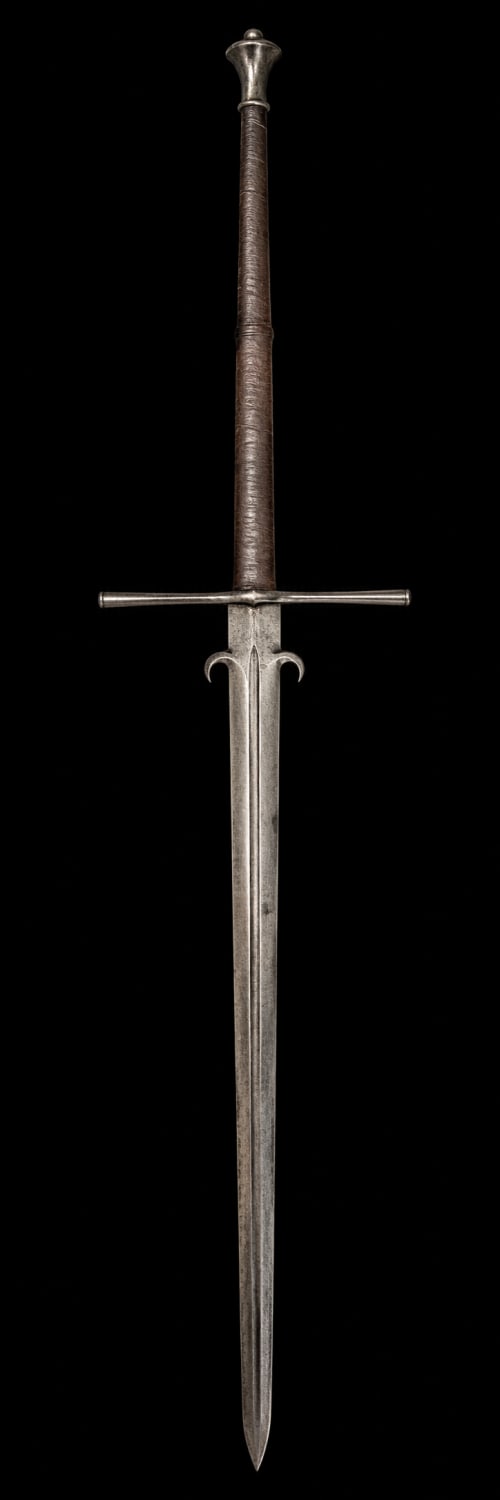
Zweihänder
The massive two-handed sword of German Landsknechts

Glaive
A polearm with a curved single-edged blade

Falchion
A single-edged medieval European chopping sword
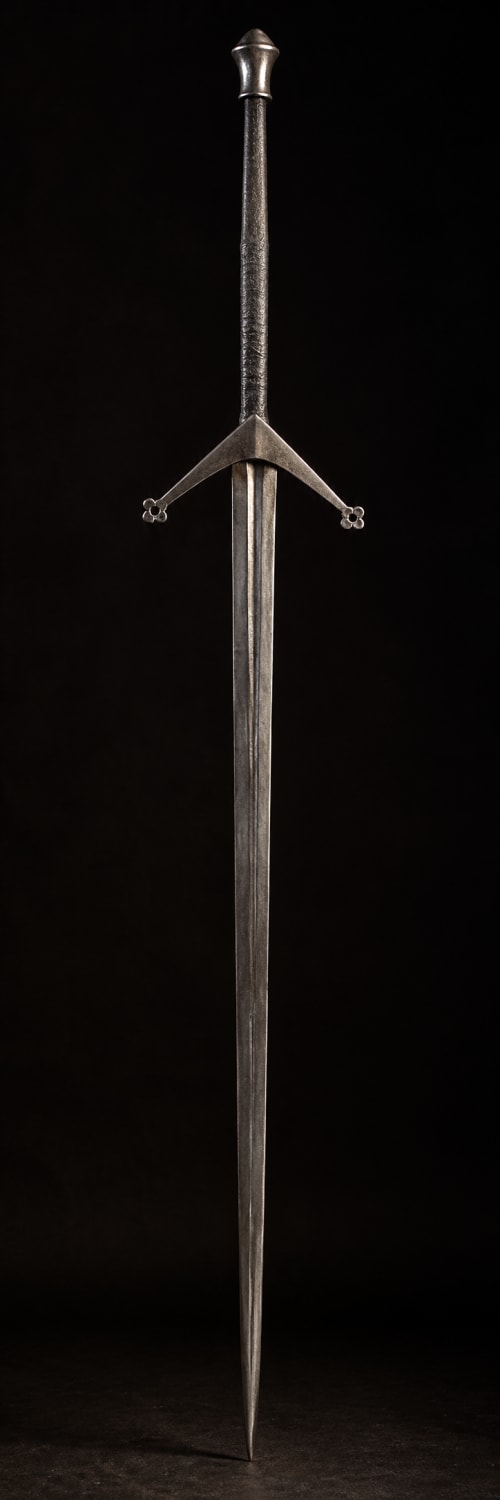
Claymore
The great two-handed sword of the Scottish Highlands

Pike
An extremely long spear for massed infantry formations

Flail
A chain-linked striking weapon that bypasses shields

Dane Axe
The Viking two-handed battle axe

Spear
Humanity's oldest weapon

Crossbow
The mechanized ranged weapon of the medieval era