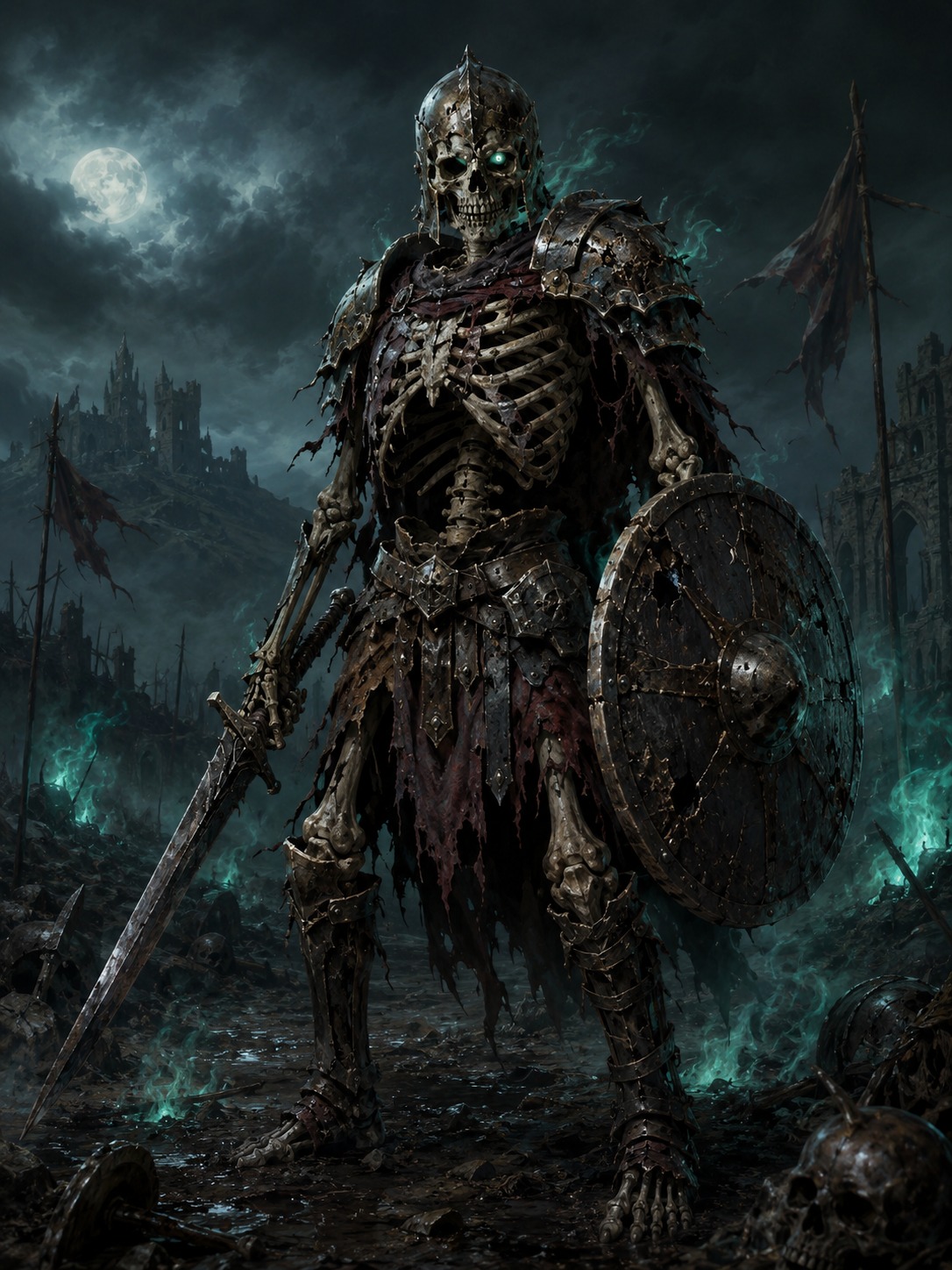
Skeleton Warrior
Skeleton Warrior · Undead Soldier — A warrior risen from death and granted unlife
Names in Other Languages
 스켈레톤 전사한국어
Skeleton Warrior · 해골 병사 — 죽음에서 다시 일어난 불사의 전사
 スケルトン戦士日本語
Skeleton Warrior · 骸骨兵士 — 死より蘇った不死の戦士
 骷髏戰士繁體中文
Skeleton Warrior · 骸骨士兵 — 從死亡中復甦的不死戰士
 SkelettkriegerDeutsch
Skeleton Warrior · Untoter Soldat — Ein aus dem Tod erhobener, untoter Krieger
 Guerrier SqueletteFrançais
Skeleton Warrior · Soldat Mort-vivant — Un guerrier relevé de la mort
 Guerrero EsqueletoEspañol
Skeleton Warrior · Soldado No-muerto — Guerrero resucitado de la muerte
 Guerreiro EsqueletoPortuguês
Skeleton Warrior · Soldado Morto-vivo — Guerreiro ressuscitado pela necromancia
 Szkieletowy WojownikPolski
Skeleton Warrior · Nieumarły Żołnierz — Wojownik powstały z martwych
 Скелет-воинРусский
Skeleton Warrior · Воин-нежить — Воин, воскресший из мёртвых
The Skeleton Warrior (English Skeleton Warrior, Latin Sceletus Bellator) is the warrior-type undead composed of the bones of the dead, summoned or resurrected by magic, curse, or black sorcery, who fights with sword, spear, shield, and armour, possessed of pure skeletal frame without flesh or soul — the decisive canonical iconographic undead figure of modern Western fantasy. The English skeleton derives from the Greek skeleton ('dried corpse'), through the Latin sceleton, settling in English in the sixteenth century, and is depicted as an instrumental being without original personality or will, faithfully obeying only the commands of the Necromancer. The mythical archetype is the Spartoi (Sparta, 'the Sown Ones') of Cadmus in ancient Greek mythology — armed warriors who grew from the ground when Cadmus, by the instruction of the goddess Athena, sowed the teeth of a dragon he had killed. The decisive modern canon is the famous scene in the 19 July 1963 British release of the film Jason and the Argonauts directed by Don Chaffey (1917-1990) — the four-and-a-half-minute scene of seven skeleton warriors in stop-motion animation by the British cinema special-effects master Ray Harryhausen (1920-2013) duelling with the Greek hero Jason — the decisive canon of modern skeleton-warrior iconography. The Skeleton monster of the 1974 tabletop RPG Dungeons & Dragons (D&D) by Gary Gygax (1938-2008), in the 1977 Monster Manual, established the canon of the modern fantasy RPG.
Origin
The iconographic origin is the Spartoi tradition of Cadmus in ancient Greek mythology. The decisive canon is in the Catalogue of Women by the eighth-century BCE Greek poet Hesiod and Book 3 of the Argonautica by the third-century BCE Alexandrian Apollonius Rhodius (Apollonios Rhodios, 295-215 BCE): the Phoenician prince Cadmus, arriving in Boeotia, by the instruction of the goddess Athena killed a dragon and sowed its teeth, from which armed warriors grew from the ground; when Cadmus threw a stone among them, they killed each other in battle, with only five surviving, who became the founders of the noble houses of Thebes. The episode in Apollonius Rhodius's Argonautica in which the Greek hero Jason (Iason), to obtain the Golden Fleece from King Aietes of Colchis, summons the Spartoi by sowing the same dragon's teeth, and with the help of Medea makes them fight each other, is the decisive canon. The Danse Macabre (Dance of Death) iconography of twelfth- to fourteenth-century Christian Europe — the mural of the Dance of Death at the Cemetery of the Holy Innocents (Cimetiere des Saints-Innocents) in Paris around 1424 — canonised the skeleton as the symbol of human fate in European painting after the fourteenth-century Black Death. The four-and-a-half-minute scene of seven skeleton warriors in stop-motion animation by Ray Harryhausen in Don Chaffey's 19 July 1963 film Jason and the Argonauts — four and a half months of work at 24 frames per second of stop-motion — is the decisive canon of modern skeleton-warrior iconography.
Features
- Body composed only of bones and empty eye sockets
- No soul, or a weak soul
- Use of swords, spears, shields, and armour
- Control by the Necromancer's magic
- No original personality or will
- Regeneration: rising again after being shattered
Stories
The Spartoi of Cadmus and the Spartoi of Jason at Colchis in ancient Greek mythology are the mythical archetype, and the third-century BCE Apollonius Rhodius's Argonautica is the decisive literary canon. The decisive modern cinematic canon is the four-and-a-half-minute scene of seven skeleton warriors in stop-motion animation by Ray Harryhausen in Don Chaffey's 19 July 1963 film Jason and the Argonauts — four and a half months of work on the four-and-a-half-minute scene — the decisive cinematic canon of modern skeleton-warrior iconography. The Skeleton monster of the 1974 tabletop RPG Dungeons & Dragons (D&D) by Gary Gygax and Dave Arneson (1947-2009), in the 1977 first edition of the Monster Manual, established the canon of the modern fantasy RPG. The Tomb Kings Skeleton Warrior of the British Games Workshop's miniatures game Warhammer Fantasy Battle (1985-1990) is the miniatures-game skeleton canon, and the skeleton enemy in the 1986 Japanese Konami video game Castlevania is the origin of the video-game skeleton. The Skeleton Warrior enemy of the PC game Diablo, released by Blizzard Entertainment in the United States on 31 December 1996 — and canonised in Diablo II of 7 November 1997 as the summoned monster of the Necromancer class — settled the twenty-first-century global video-game skeleton canon. The skeleton enemies of the Catacombs region in the PC and console game Dark Souls by the Japanese FromSoftware, released on 22 September 2011, are the decisive twenty-first-century dark-fantasy canon.
Weakness
The Skeleton Warrior's weaknesses are: (1) physical impact — the decisive weakness that the body, composed only of bones without flesh or muscle, is vulnerable to blunt weapons (mace, hammer) and strong impact and shatters; the decisive cinematic scene in the 1963 Jason and the Argonauts canon in which Jason and the heroes shatter the skeleton warriors with sword and shield; (2) divine power and the holy grace (Turn Undead) — the canonical weakness of the Cleric class's 'Turn Undead' rule, in which divine power repels the undead, in the 1974 D&D system canon (1977 D&D Player's Handbook); (3) fire — the decisive weakness that dry bones burn well in fire, the canonical fire-weapon canon of the 1996 Diablo and the 2011 Dark Souls; (4) killing the Necromancer — the D&D and Diablo canon that when the Necromancer who summoned and controlled the Skeleton Warriors is killed, the magic is undone and the warriors fall simultaneously; (5) sacred weapons — the canon that holy water, the Blessed Sword, and silver weapons deal decisive damage to the Skeleton Warrior; (6) sealing the impure skeleton — the canonical weakness in the 1996 Diablo of twice annihilating the Skeleton Warrior, first by stripping the flesh and second by shattering the skeleton; (7) blunt weapons and hammers — the D&D canonical damage-type weakness that bones are hard against swords but shatter against blunt weapons; (8) the self-destruction of the Spartoi — the mythical decisive weakness in the 1963 Jason and the Argonauts and the mythical canon, in which the hero throws a stone to make the Skeleton Warriors fight each other.
Cultural Significance
The Skeleton Warrior is not merely a horror icon but the canonical iconographic figure of the Western fantasy canon, traversing ancient Greek mythology, the medieval Macabre iconography, the 1963 Ray Harryhausen stop-motion film, the 1974 Gygax D&D, the 1996 Blizzard Diablo, and the 2011 FromSoftware Dark Souls. The four-and-a-half-minute scene of seven skeleton warriors in Don Chaffey's 1963 film Jason and the Argonauts — Ray Harryhausen worked from September 1962 to January 1963 for four and a half months — is the decisive canon of film special-effects history, and the inheritance of the Harryhausen stop-motion canon by American film directors George Lucas (b. 1944) and Steven Spielberg (b. 1946) in 1977 (motion-control filming in Star Wars) is the decisive event. Gary Gygax and Dave Arneson's Dungeons & Dragons (D&D), released in January 1974 by TSR in Lake Geneva, Wisconsin, USA, is the decisive origin of the modern fantasy RPG, and the Skeleton monster of the 1977 Monster Manual — consistent through to 5e (5th Edition) of 2014, for 40 years — is the fantasy RPG skeleton canon. The Skeleton Warrior of Blizzard's Diablo of 31 December 1996 (25 million units sold worldwide) and the Diablo II of 2000 (40 million units sold worldwide) and the Dark Souls series of FromSoftware of 2011 (50 million units sold worldwide) — the video-game Skeleton Warriors — became the decisive canon of the twenty-first-century global video-game market. The villain Skeletor of the 1985 American Mattel action figures Masters of the Universe — a skull head within a helmet — is the canon of 1980s American children's popular-culture skeleton.
In Popular Culture
- Hesiod, Catalogue of Women (eighth century BCE) — origin of the Cadmus Spartoi myth
- Apollonius Rhodius, Argonautica (third century BCE) — decisive canon of the Colchis Spartoi
- Medieval European Macabre iconography (fourteenth century) — Dance of Death skeleton iconography
- Don Chaffey and Ray Harryhausen, Jason and the Argonauts (1963) — decisive cinematic skeleton-warrior canon
- Gygax, D&D Monster Manual, Skeleton (1977) — fantasy RPG skeleton canon
- Mattel, Masters of the Universe, Skeletor (1985) — 1980s children's popular-culture canon
- Konami, Castlevania, Skeleton (1986) — origin of the video-game skeleton
- Blizzard, Diablo, Skeleton Warrior (1996) — decisive twenty-first-century video-game canon
- FromSoftware, Dark Souls, Catacombs skeleton (2011) — decisive twenty-first-century dark-fantasy canon
- Games Workshop, Warhammer Fantasy Battle, Tomb Kings (1985-1990) — miniatures-game skeleton canon
Trivia
The Greek etymology of skeleton, skeleton, means 'dried corpse' or 'dried thing', the participial form of the verb skello (to dry up), and entered English in 1578 as canonical vocabulary, in the anatomical work of the English physician Thomas Vicary (1490-1561). The Colchis Spartoi episode of lines 1,278-1,407 of Book 3 of the third-century BCE Apollonius Rhodius's Argonautica — the decisive literary canon of Skeleton Warrior iconography in Greek mythology — is the earliest Skeleton-Warrior iconography of Greek myth. Don Chaffey's 19 July 1963 film Jason and the Argonauts (distributed by Columbia Pictures of the USA) — though earning only about 3.5 million dollars at the American box office — was selected as the 41st of the BFI (British Film Institute) 100 Great British Films in 2003 and the canon of the 100 Great Films of the American Director's Guild of America (DGA) in 1997, the decisive cinematic canon. Ray Harryhausen — through The 7th Voyage of Sinbad (1957), Jason and the Argonauts (1963), Clash of the Titans (1981), and a fifty-year career — was the decisive master of stop-motion animation, who died at the age of 92 on 7 May 2013. The Skeleton monster of the January 1974 first-edition D&D box set — by TSR of Lake Geneva, Wisconsin, USA — has been the consistent canon of fantasy RPG skeleton from the 1977 first edition of the Monster Manual through to 5e (2014), forty years. Blizzard's Diablo of 31 December 1996 (25 million units sold worldwide) and the 2000 Diablo II (40 million units sold worldwide) — the Necromancer-class summoning skeleton mechanism — settled the decisive canon of the twenty-first-century video-game skeleton.
Related
Vampire
Vampire · The Bloodsucker — Night's Aristocrat Living Immortal on the Blood of the Living
Revenant
Revenant · The Vengeful Returned — A Corpse Risen From the Grave for One Purpose
Banshee
Banshee · The Wailing Death-Herald — Lament of Celtic Lore
Dullahan
Dullahan · The Headless Horseman — Ireland's Death-Bringing Envoy
Mummy
Mummy · The Bandaged Dead — A Cursed Corpse Guarding the Tomb
Ghoul
Ghoul · The Corpse-Eater — A Desert Monster That Digs Up and Devours the Dead
Wraith
Wraith · The Vengeful Specter — A Dark Spirit That Lost Its Form, Leaving Only Hatred
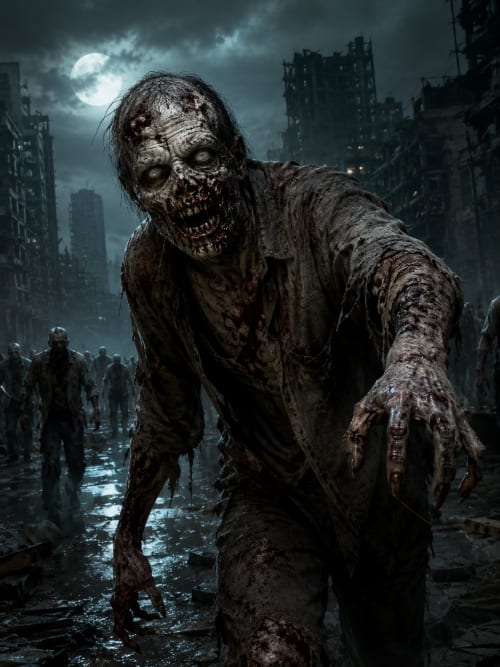
Zombie
Zombie · The Reanimated Corpse — Mindless Man-Eating Hordes of the Dead
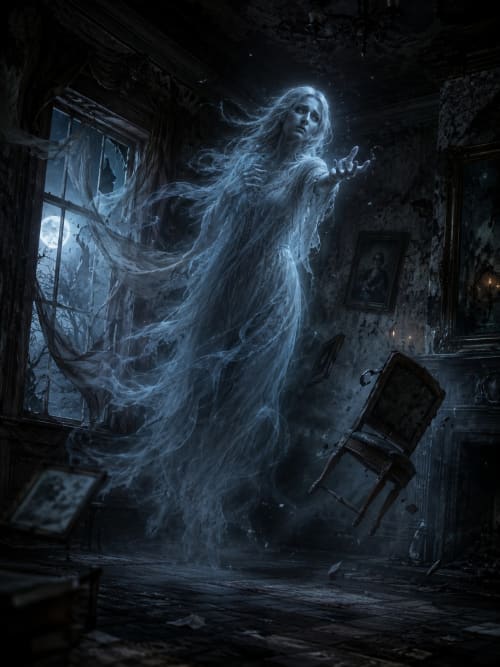
Ghost
Ghost · The Wandering Spirit — A Soul Bound to the World by Attachment and Unfinished Story
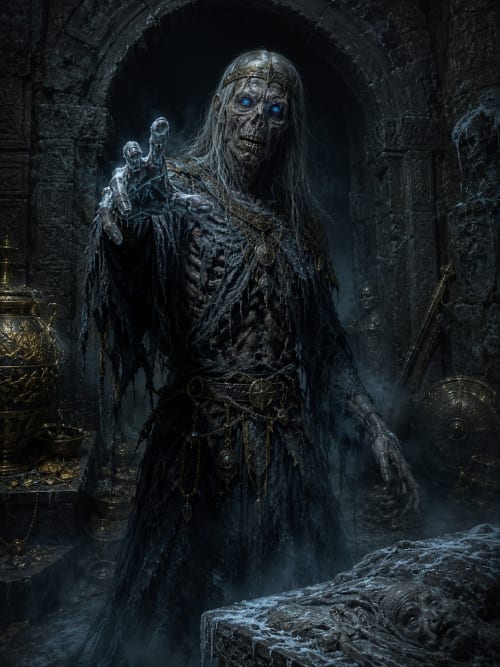
Wight
Wight · The Barrow Dead — A Cursed Corpse Guarding the Tomb's Treasure
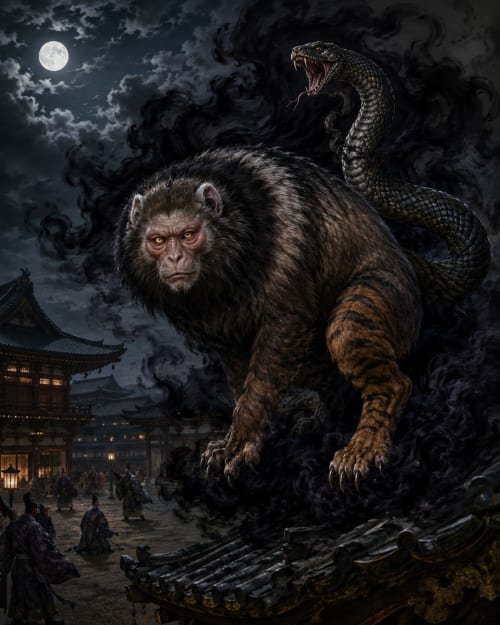
Nue
Nue · Chimera — Legendary Japanese Monster
Gremlin
Gremlin · The Machine-Breaking Yokai — A Prankster of the Modern Technological Age