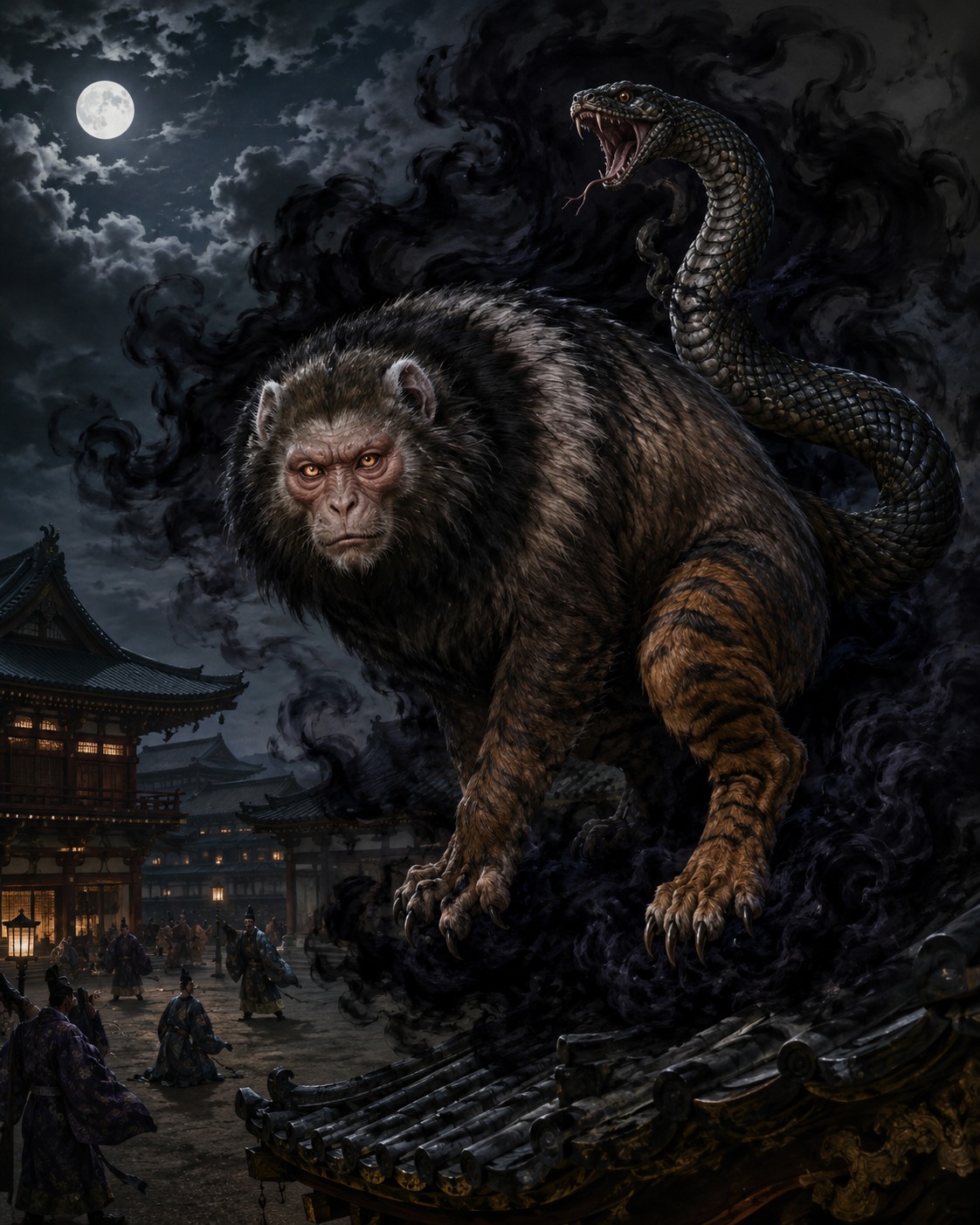
Nue
Nue · Chimera — Legendary Japanese Monster
Names in Other Languages
 누에한국어
누에한국어Nue · 괴수 — 일본 전설의 괴조
 鵺(ぬえ)日本語
ぬえ · キメラ — 日本の伝説的怪物
 鵺(ぬえ)繁體中文
鵺 · 奇美拉 — 日本傳說怪獸
 NueDeutsch
Nue · Chimäre — Legendäres japanisches Ungeheuer
 NueFrançais
Nue · Chimère — Monstre légendaire japonais
 NueEspañol
Nue · Quimera — Monstruo legendario japonés
 NuePortuguês
Nue · Quimera — Monstro lendário japonês
 NuePolski
Nue · Chimera — Legendarny potwór japoński
 НуэРусский
Нуэ · Химера — Легендарное японское чудовище
The Nue (Japanese Nue) is the canonical iconographic figure of the Heian-period Japanese chimeric yokai, possessed of the face of a monkey, the body of a raccoon dog (tanuki) or wildcat, the legs of a tiger, and the tail of a snake — one of the most mysterious composite yokai of Japanese legend. The name derives from the archaic Japanese name of the indigenous bird White's thrush (Zoothera dauma, in Japanese tora-tsugumi), whose sad and uncanny cry, when heard, is said in the canon to portend disaster — the canonical bird of the Onmyodo (Yin-Yang Way) belief of the Heian Imperial court. The iconographic origin is the Onmyodo belief of the Heian period (794-1185) and the canonised gunki-mono (military-tale) tradition of the late twelfth century. The decisive textual source is the chapter Nue in Book 4 of the early thirteenth-century Heike Monogatari (Tale of the Heike), the decisive canon of Japanese gunki-mono: in the spring of 1153 a black cloud appeared every dawn over the Heian-kyo Imperial Court from the eastern mountains and disturbed the sleep of Emperor Konoe (reigned 1139-1155), causing his illness; Minamoto no Yorimasa (1104-1180), the greatest archer of the Heian period, shot the nue down from within the black cloud — the decisive textual canon of the Nue legend. The 1779 yokai catalogue Konjaku Gazu Zoku Hyakki by Toriyama Sekien (1712-1788) established the visual canon of the Nue.
Origin
The iconographic origin is the Onmyodo (Yin-Yang Way) belief of the Heian period (794-1185) and the gunki-mono (military-tale) tradition. The etymology of nue is the archaic Japanese name of the indigenous bird White's thrush (Zoothera dauma, in Japanese tora-tsugumi), whose sad and uncanny cry, heard in autumn and spring, was the canonical bird portending disaster in the Heian-period Onmyodo belief. The decisive textual source is the early-thirteenth-century (c. 1218) canon of Japanese gunki-mono, the Heike Monogatari, Book 4, Chapter Nue. The plot is: in the spring of 1153 (Ninpyo 3) a black cloud appeared every dawn over the Heian-kyo Imperial Court from the eastern mountains and disturbed the sleep of Emperor Konoe (reigned 1139-1155), causing his illness; the Minister of the Left Fujiwara no Yorinaga ordered Minamoto no Yorimasa (1104-1180), the greatest archer of the Heian period, to subdue it, and Yorimasa, with his attendant Ino Hayata, shot the nue down from within the black cloud — the decisive canon. The corpse of the Nue — the composite yokai with a monkey's face, tanuki's body, tiger's legs, and snake's tail — was placed in a hollow log and floated down the Kamogawa river, and at the places where it washed ashore — Miyakojima in Osaka and Ashiya in Hyogo — Nue-zuka (Nue mounds) and the cult of Nue settled. The early-fourteenth-century Genpei Seisuiki extended the Heike Monogatari Nue canon, and Toriyama Sekien's 1779 yokai catalogue Konjaku Gazu Zoku Hyakki established the visual canon of the Nue.
Features
- Face of a monkey
- Body of a raccoon dog (tanuki) or wildcat
- Legs of a tiger
- Tail of a snake
- Sad cry like the White's thrush (tora-tsugumi)
- Appearance at night accompanied by black cloud
Stories
The chapter Nue in Book 4 of the early-thirteenth-century Heike Monogatari is the decisive textual source of the Nue canon, the early-fourteenth-century Genpei Seisuiki extended the canon, and Toriyama Sekien's 1779 yokai catalogue Konjaku Gazu Zoku Hyakki established the visual canon of the Nue. The decisive Noh play Nue by the Muromachi-period (1336-1573) Konparu Zenchiku (1405-1471) — in which the wraith of the Nue drifts along the river — is the canon of the tragic Noh Nue, and the Kabuki play Tokaido Yotsuya Kaidan of 1825 by Tsuruya Nanboku and the contemporary Kabuki play Nue Heike Monogatari established the Edo Kabuki Nue canon. The short story Nue (1921) by the Japanese writer Ryunosuke Akutagawa (1892-1927) — a modern adaptation of the Heike Monogatari Nue canon — is the canon of Taisho-period Japanese literature on the Nue. The novel Shin Heike Monogatari (1968) by the Japanese writer Eiji Yoshikawa (1892-1962) is the decisive modern Japanese novelistic adaptation of the Nue canon, and the Nue character of Hiroyuki Takei's (b. 1972) 1998 manga Shaman King is the twenty-first-century Japanese-manga Nue canon. The Houju Nue character of the 2010 Japanese doujin game Touhou Seirensen (Undefined Fantastic Object) is the twenty-first-century Japanese-game Nue canon, and the Nue character in the 2013 Japanese animation Yo-kai Watch is the twenty-first-century Japanese children's animation canon.
Weakness
The Nue's weaknesses are: (1) arrows — the decisive weakness in the thirteenth-century Heike Monogatari canon, in which the greatest archer of the Heian period Minamoto no Yorimasa (1104-1180) shoots down the Nue from within the black cloud, the decisive canon of Japanese warrior-hero narrative; (2) the tiger-tracks and pursuit — the canon in the Heike Monogatari that Yorimasa's attendant Ino Hayata finishes the fallen Nue with a sword; (3) the sacred bow and arrow — the bow Yorimasa used in the Heike Monogatari is said to be Raikomaru, the heirloom bow of the Minamoto clan, the canonical weapon of the warrior; (4) the warrior's courage and decisiveness — the canon in the Heike Monogatari that, when the Nue was hidden in the black cloud, Yorimasa drew his bowstring only once, the canon of one-shot-one-kill (ippatsu-hicchu); (5) Shinto purification rite — the canon that the Nue's corpse was purified by being floated down the Kamogawa river; (6) Onmyodo rite — the canon that the Heian-period Onmyoji Abe no Seimei (921-1005) and the Onmyodo rite seal composite yokai like the Nue; (7) dawn cry of the White's thrush (tora-tsugumi) — the Japanese folk canon that when the dawn cry of the White's thrush, the etymological source of the Nue, is heard, the Nue vanishes; (8) the Emperor's legitimacy — in the Heike Monogatari canon, the appearance of the Nue is the canonical portent of the decline of the late-Heian Imperial house and the arrival of the warrior age, and the restoration of the Emperor's legitimacy is the weakness of Nue pacification.
Cultural Significance
The Nue is not merely a horror yokai but the canonical iconographic figure of the Heian Onmyodo belief, the late-Heian Imperial decline, and the late-twelfth-century arrival of the Genpei (Minamoto-Taira) Civil War — the decisive iconographic figure. The Nue canon of the early-thirteenth-century Heike Monogatari is analysed as the canonical interpretation of the socio-historical event of Emperor Konoe's illness in 1153 and his death in 1155 (at age 17), the late-Heian Imperial decline, and Minamoto no Yorimasa (1104-1180) — who committed suicide at the Battle of Uji River in 1180, the decisive origin of the Minamoto clan uprising — is the warrior-hero whose Nue subjugation became the decisive scene of his heroic narrative. The Nue-zuka (Nue Mound) of Miyakojima ward, Osaka, and the Nue-zuka shrine of Ashiya, Hyogo Prefecture — preserving the tradition that the Nue's corpse was floated down the Kamogawa and washed ashore — are the decisive sacred sites of the Japanese folkloristic Nue cult, where the Nue placation rite is performed every May. The Nue iconography in Toriyama Sekien's 1779 Konjaku Gazu Zoku Hyakki — the canon of the Edo yokai catalogue — was modernised in the 1968 Nue character of Shigeru Mizuki's (1922-2015) manga GeGeGe no Kitaro, and the Houju Nue of the 2010 doujin game Touhou Seirensen settled the twenty-first-century global Nue canon. Eiji Yoshikawa's 1968 Shin Heike Monogatari is the Japanese national-novel adaptation of the Nue canon, and Ryunosuke Akutagawa's 1921 short story Nue is the decisive work of Taisho-period Japanese literature on the Nue.
In Popular Culture
- Heike Monogatari, Book 4, Nue (early thirteenth century) — decisive textual source of the Nue canon
- Genpei Seisuiki (early fourteenth century) — extension of the Nue canon
- Konparu Zenchiku, Noh play Nue (fifteenth century) — Muromachi Noh Nue canon
- Toriyama Sekien, Konjaku Gazu Zoku Hyakki (1779) — Edo visual canon of the Nue
- Ryunosuke Akutagawa, short story Nue (1921) — Taisho Japanese literary Nue canon
- Eiji Yoshikawa, Shin Heike Monogatari (1968) — modern Japanese novel Nue canon
- Shigeru Mizuki, GeGeGe no Kitaro, Nue (1968) — Japanese manga Nue canon
- Hiroyuki Takei, Shaman King, Nue (1998) — twenty-first-century Japanese manga Nue canon
- Doujin game Touhou Seirensen, Houju Nue (2010) — twenty-first-century Japanese game Nue canon
- Osaka Nue-zuka, Hyogo Nue-zuka shrine — decisive sacred sites of the Japanese folkloristic Nue cult
Trivia
The Sino-Japanese character for Nue combines bird and night, meaning 'bird of the night', the canonical Japanese spelling, and the etymology is the archaic Japanese name of the indigenous bird White's thrush (Zoothera dauma, in Japanese tora-tsugumi). The sad and uncanny cry of the White's thrush — according to a 2018 analysis by Japanese acousticians, a high-frequency call of about 800-1,200 Hertz — was canonised in the Heian Imperial Court as a portent of disaster. The chapter Nue in Book 4 of the early-thirteenth-century Heike Monogatari is the decisive episode: in April of 1153 (Heian-period Ninpyo 3) at the Heian-kyo Imperial Court, Minamoto no Yorimasa shot down the Nue from within the black cloud at 4 a.m. (the hour of the Tiger). Minamoto no Yorimasa was the seventy-six-year-old warrior who committed suicide at the Battle of Uji River on 26 May 1180, resisting the Taira no Kiyomori family's army, and his Nue subjugation episode became the decisive visual canon through the ukiyo-e print Yorimasa Nue Taiji-zu (Yorimasa Subduing the Nue) by Utagawa Kuniyoshi (1798-1861) of c. 1830 in the Edo period. The Nue-zuka of Miyakojima ward, Osaka, was designated as Japanese intangible cultural heritage in 1989, preserving the canonical tradition that the Nue's corpse drifted ashore in a hollow log, and the Nue-zuka shrine of Ashiya in Hyogo Prefecture, where the annual Nue placation rite is performed every May, is the decisive sacred site of the Nue cult. Hiroyuki Takei's 1998 manga Shaman King (cumulative print run of 38 million copies) and the Houju Nue of the 2010 doujin game Touhou Seirensen — top of the Japanese doujin market share — settled the twenty-first-century global Nue canon.
Related
Banshee
Banshee · The Wailing Death-Herald — Lament of Celtic Lore
Oni
Oni · The Japanese Demon — A Horned, Hulking Man-Eating Ogre
Onryo
Onryo · The Japanese Vengeful Ghost — A Cursing Specter Returned in Grudge
Vampire
Vampire · The Bloodsucker — Night's Aristocrat Living Immortal on the Blood of the Living
Dullahan
Dullahan · The Headless Horseman — Ireland's Death-Bringing Envoy

Skeleton Warrior
Skeleton Warrior · Undead Soldier — A warrior risen from death and granted unlife
Tsukumogami
Tsukumogami · The Tool Yokai — A Spirit Dwelling in a Hundred-Year-Old Object
Revenant
Revenant · The Vengeful Returned — A Corpse Risen From the Grave for One Purpose
Jiangshi
Jiangshi · The Chinese Hopping Corpse — A Stiff, Leaping Corpse-Spirit
Kappa
Kappa · The Japanese Water Yokai — A River Prankster With Power in a Head-Dish
Gumiho
Gumiho · Nine-Tailed Fox — The Bewitching Fox-Spirit of East Asia
Mummy
Mummy · The Bandaged Dead — A Cursed Corpse Guarding the Tomb