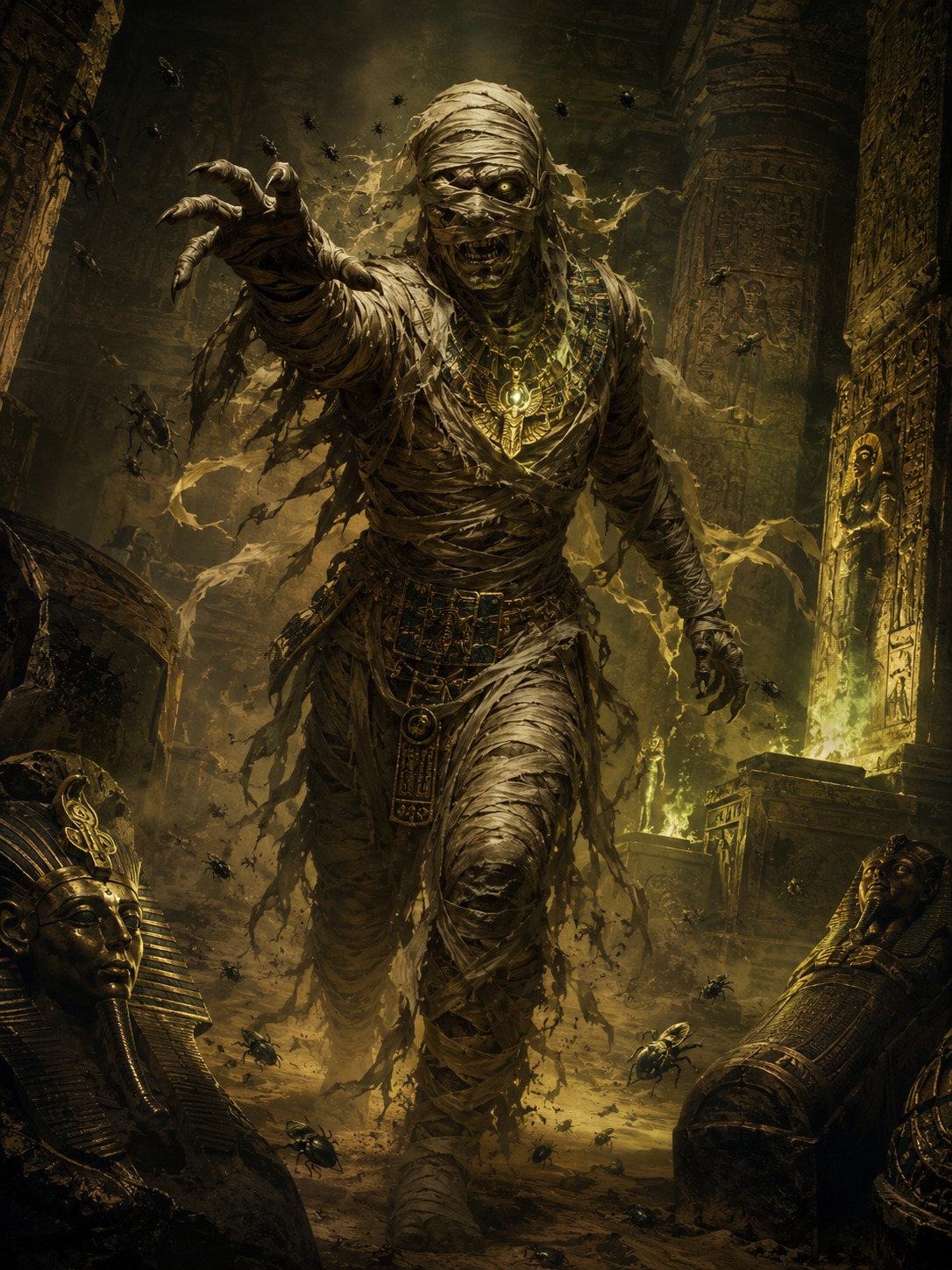
Mummy
Mummy · The Bandaged Dead — A Cursed Corpse Guarding the Tomb
Names in Other Languages
 미라한국어
미라한국어Mummy · 붕대 감긴 망자 — 무덤을 지키는 저주받은 시체
 マミー日本語
Mummy · 包帯の死者 — 墓を守る呪われた死体
 木乃伊繁體中文
Mummy · 纏布的亡者 — 守墓的受詛咒屍體
 MumieDeutsch
Mummy · Der bandagierte Tote — Ein verfluchter Leichnam, der das Grab bewacht
 MomieFrançais
Mummy · Le mort bandé — Un cadavre maudit gardant le tombeau
 MomiaEspañol
Mummy · El muerto vendado — Un cadáver maldito que guarda la tumba
 MúmiaPortuguês
Mummy · O morto enfaixado — Um cadáver amaldiçoado que guarda o túmulo
 MumiaPolski
Mummy · Zabandażowany zmarły — przeklęty trup strzegący grobowca
 МумияРусский
Mummy · Забинтованный мертвец — проклятый труп, стерегущий гробницу
The Mummy (English mummy, from Persian mumiya 'bitumen') is the undead embalmed corpse, wrapped in linen bandages, that rises from the tomb to take vengeance and curse the living. Its iconographic prototype is the ancient Egyptian mummification practice and afterlife belief: the seventy-day funerary rite — extraction of the brain through the nostril, separation of the viscera into four canopic jars dedicated to the sons of Horus (Imsety, Hapy, Duamutef, Qebehsenuef), natron desiccation, linen wrapping with embedded Book of the Dead amulets — was canonised from the Old Kingdom (c. 3000 BC) and refined through the New Kingdom (1550-1295 BC). Herodotus described the procedure in detail in Histories Book II (c. 440 BC). The 1922 November discovery of the tomb of Tutankhamun (c. 1341-1323 BC) in the Valley of the Kings by the British archaeologist Howard Carter, and the April 1923 death of his patron Lord Carnarvon, globalised the 'Curse of the Pharaohs' legend. Karl Freund's Universal horror film The Mummy (1932), with Boris Karloff as Imhotep, fixed the cinematic canon of the vengeful resurrected mummy.
Origin
The iconographic origin is the ancient Egyptian mummification practice and afterlife belief. The seventy-day funerary rite, canonised from the Old Kingdom (c. 3000 BC) and refined through the Eighteenth-Dynasty New Kingdom (1550-1295 BC), consisted of: (1) extraction of the brain with a hooked instrument through the nostril; (2) lateral incision and removal of the viscera into the four canopic jars of the sons of Horus (Imsety for the liver, Hapy for the lungs, Duamutef for the stomach, Qebehsenuef for the intestines); (3) desiccation in natron (natural sodium bicarbonate) for forty days; (4) anointing with resins and oils; (5) wrapping in dozens of layers of linen bandages with embedded Book of the Dead amulets; (6) the Opening of the Mouth ritual performed by a priest wearing the mask of the jackal-headed god Anubis. Herodotus recorded three price tiers of mummification in Histories Book II (c. 440 BC), and the Book of the Dead chapter 125 weighing-of-the-heart scene is the canonical image of post-mortem judgement. Howard Carter's 1922 discovery of Tutankhamun's tomb and the 1923 death of Lord Carnarvon globalised the modern Curse of the Pharaohs legend.
Features
- Natron-desiccated corpse wrapped in dozens of layers of linen bandages
- Curse upon tomb intruders (no documented Egyptological case; a product of films and novels)
- Slow but unstoppable pursuit — the decisive iconography of Karl Freund's 1932 film
- Command of sand, scarab beetles, and plague — the decisive iconography of Stephen Sommers's 1999 film
- Viscera preserved in canopic jars after extraction of the heart
- When revived, tragically driven to seek the reincarnation of a lost beloved
Stories
The classic literary canon of mummy horror begins with Bram Stoker's 1903 novel The Jewel of Seven Stars — the mummy of an Egyptian queen, Tera, is transported to England and attempts reincarnation. Universal Pictures' The Mummy (Karl Freund, 22 December 1932, with Boris Karloff as Imhotep) fixed the cinematic canon: the priest Imhotep, buried alive four thousand years earlier, awakens to seek his reincarnated beloved Anck-es-en-Amon, the template for all subsequent mummy films. Hammer Film Productions' The Mummy (Terence Fisher, 1959, with Christopher Lee) led the British horror revival. Stephen Sommers's The Mummy (May 1999, with Arnold Vosloo as Imhotep and Brendan Fraser as Rick O'Connell) redefined the mummy as a vast threat commanding sandstorms and scarab swarms, earning 415 million US dollars worldwide; The Mummy Returns (2001) and The Mummy: Tomb of the Dragon Emperor (2008) followed. Alex Kurtzman's Dark Universe reboot The Mummy (2017, with Sofia Boutella as Ahmanet and Tom Cruise) attempted a female mummy lead.
Weakness
The mummy's weaknesses are: (1) extreme flammability — the desiccated linen wrappings and resin-impregnated corpse ignite immediately, resulting in complete annihilation; (2) destruction of the source of the curse — destroying protective amulets (the scarab, the ankh, the Eye of Horus) or canopic jars containing the viscera deprives the mummy of resurrection; (3) reverse incantation of Book of the Dead spells — reading the awakening spell in reverse returns the mummy to sleep; (4) sealing by sacred texts such as the Book of Amun-Ra, the canonical resolution of Stephen Sommers's 1999 film. In Karl Freund's 1932 film, Imhotep crumbles into four thousand years of weathering the moment he loses the amulet of Isis, and in Sommers's 1999 film, Imhotep is dragged back to the realm of death by the closing incantation of the Book of Amun-Ra. If the Egyptian Opening of the Mouth ritual is the rite that awakens the mummy, its inverse rite is the weakness.
Cultural Significance
The mummy is not merely a horror icon but a product of nineteenth- and twentieth-century Egyptology, colonialism, and Orientalism. Napoleon's 1798 Egyptian expedition and Jean-Francois Champollion's 1822 decipherment of the Rosetta Stone established Egyptology as a discipline, triggering British, French, and German tomb-excavation rivalry. Howard Carter's 4 November 1922 discovery of Tutankhamun's tomb and Lord Carnarvon's death from a mosquito-bite septicaemia in April 1923 were sensationally reported by the Daily Mail and the New York Times as the 'Curse of the Pharaohs', laying the popular foundation of mummy horror; the causal link between Carnarvon's death and the excavation is academically unproven, but newspaper reportage congealed it into iconography. Mummy films became one wing of the Universal Pictures Golden Age of Horror (Dracula, Frankenstein, the Wolf Man, the Mummy) from 1932. Edward Said's 1978 Orientalism reads Egyptian mummy iconography as a paradigm case of Western Eastern-othering. Debates over the ethics of displaying mummies at the British Museum and the Egyptian Museum in Cairo continue into the twenty-first century.
In Popular Culture
- Herodotus, Histories Book II (c. 440 BC) — earliest detailed record of mummification
- 4 November 1922, Howard Carter's discovery of Tutankhamun's tomb — origin of the modern Curse of the Pharaohs legend
- 5 April 1923, death of Lord Carnarvon — explosion of 'Curse of the Pharaohs' newspaper coverage
- Theophile Gautier, The Mummy's Foot (1840), The Romance of a Mummy (1857) — Romantic literary origin
- Arthur Conan Doyle, Lot No. 249 (1892) — canonical mummy horror short story
- Bram Stoker, The Jewel of Seven Stars (1903) — Victorian British mummy novel canon
- Karl Freund, The Mummy (1932) — cinematic canon of the Imhotep mummy
- Terence Fisher, The Mummy (1959) — British mummy film of Hammer Horror
- Stephen Sommers, The Mummy (1999) — globalisation of sandstorm and scarab iconography
Trivia
The English word mummy derives from Persian mumiya ('bitumen, black resin'). Medieval Arab physicians mistook the blackened resin treatment of Egyptian mummies for natural bitumen, calling them mumiya, and Renaissance European apothecaries sold powdered mummy as a panacea — a grotesque chapter in pharmaceutical history that lasted from the sixteenth to seventeenth centuries. Howard Carter's discovery of Tutankhamun's tomb (KV62) on 4 November 1922 was the only essentially intact pharaonic tomb ever found in the Valley of the Kings, yielding the golden mask, the gold coffins, and 5,398 grave goods, now divided between the Egyptian Museum in Cairo and the Grand Egyptian Museum. The Curse of the Pharaohs legend began with the Daily Mail's sensational coverage of Lord Carnarvon's death on 5 April 1923, but of the twenty-six members of Carter's excavation team, only six died within the following decade — statistically unremarkable. Karl Freund's 1932 The Mummy (Boris Karloff as Imhotep) was produced to coincide with the tenth anniversary of the Tutankhamun discovery. Stephen Sommers's 1999 The Mummy earned 415 million US dollars worldwide on an 80 million budget, while the 2017 Tom Cruise reboot's failure was the decisive event that collapsed Universal's Dark Universe franchise plan.
Related
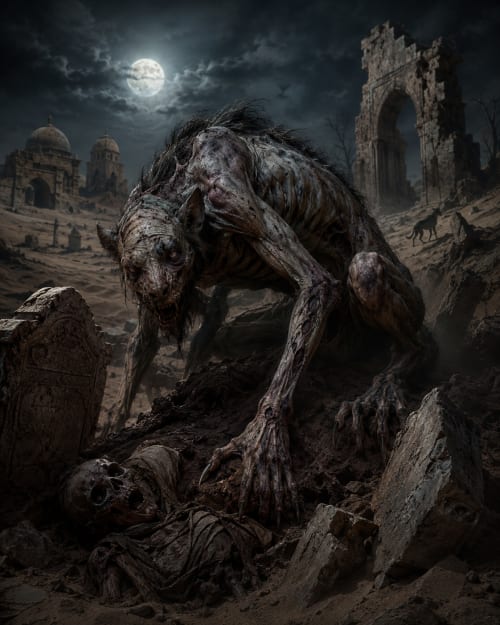
Ghoul
Ghoul · The Corpse-Eater — A Desert Monster That Digs Up and Devours the Dead
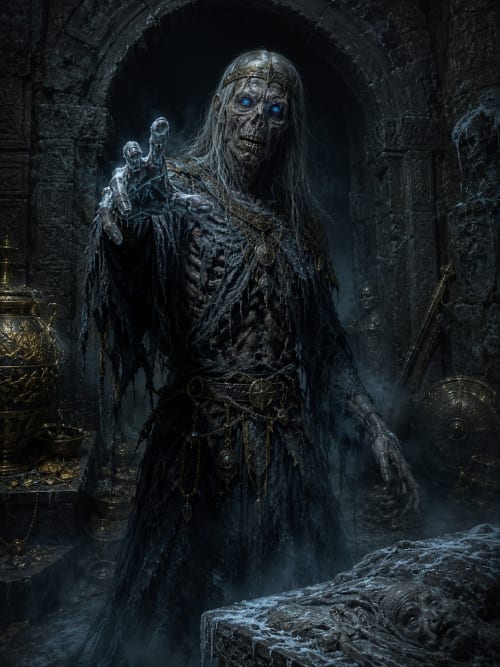
Wight
Wight · The Barrow Dead — A Cursed Corpse Guarding the Tomb's Treasure
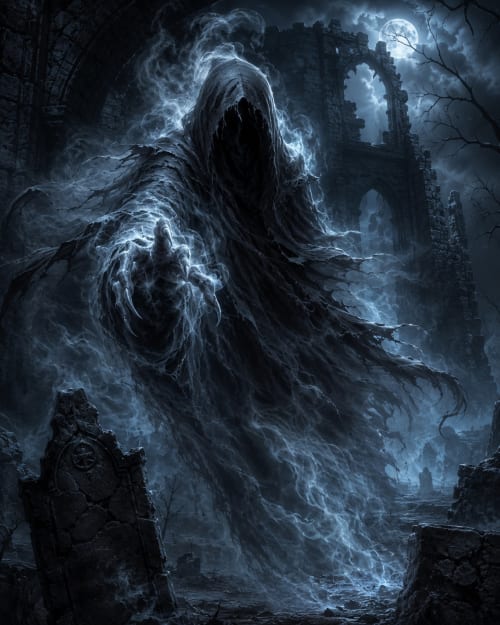
Wraith
Wraith · The Vengeful Specter — A Dark Spirit That Lost Its Form, Leaving Only Hatred
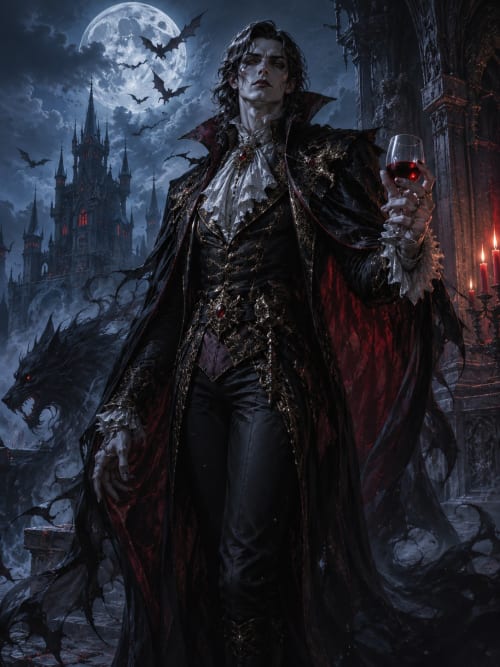
Vampire
Vampire · The Bloodsucker — Night's Aristocrat Living Immortal on the Blood of the Living
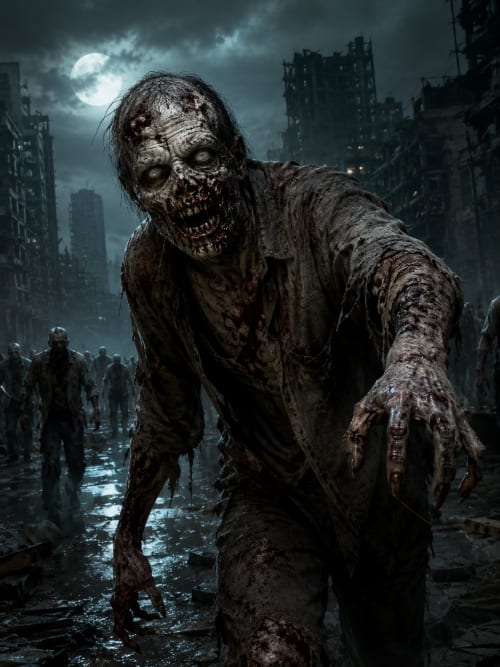
Zombie
Zombie · The Reanimated Corpse — Mindless Man-Eating Hordes of the Dead

Skeleton Warrior
Skeleton Warrior · Undead Soldier — A warrior risen from death and granted unlife
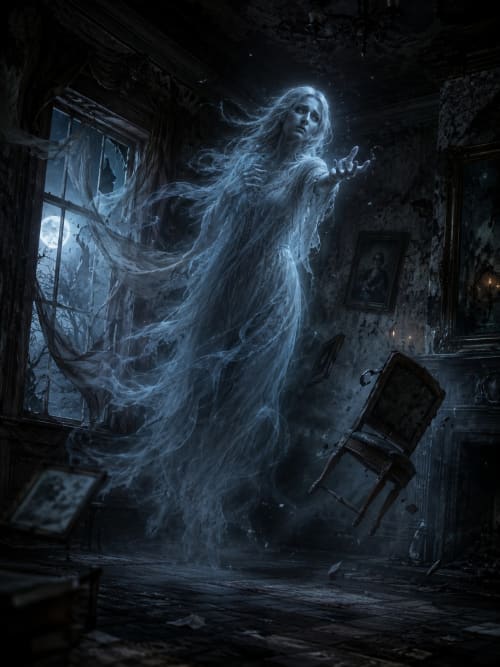
Ghost
Ghost · The Wandering Spirit — A Soul Bound to the World by Attachment and Unfinished Story
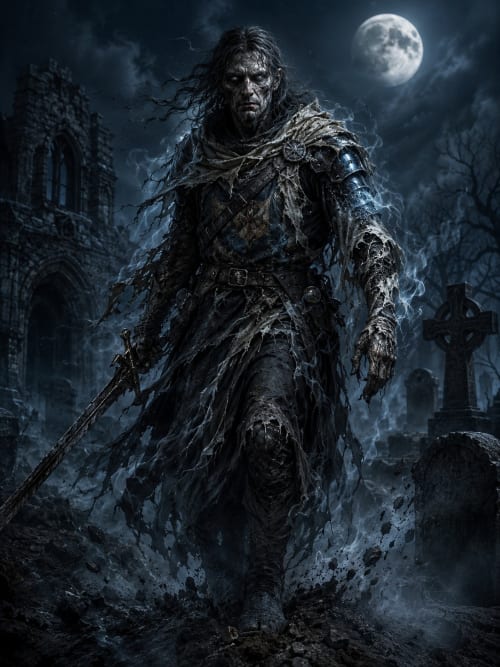
Revenant
Revenant · The Vengeful Returned — A Corpse Risen From the Grave for One Purpose
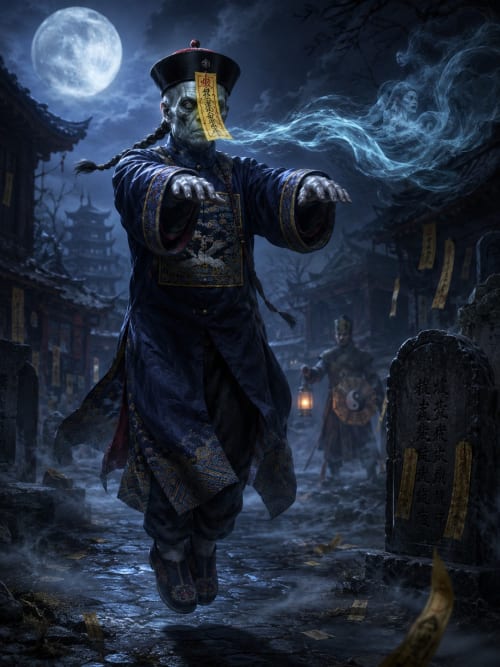
Jiangshi
Jiangshi · The Chinese Hopping Corpse — A Stiff, Leaping Corpse-Spirit

Banshee
Banshee · The Wailing Death-Herald — Lament of Celtic Lore
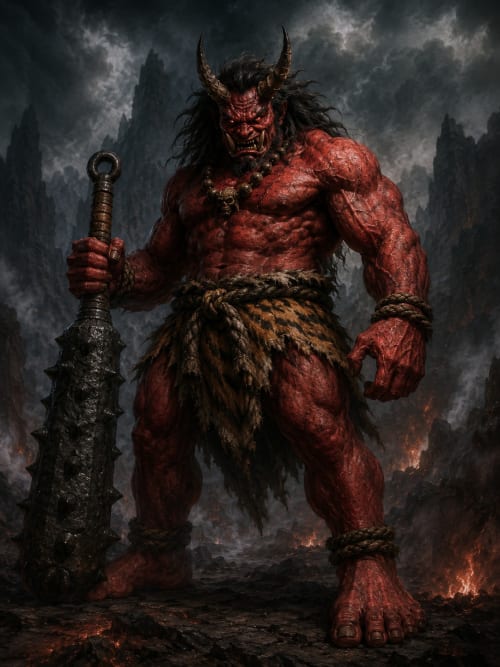
Oni
Oni · The Japanese Demon — A Horned, Hulking Man-Eating Ogre
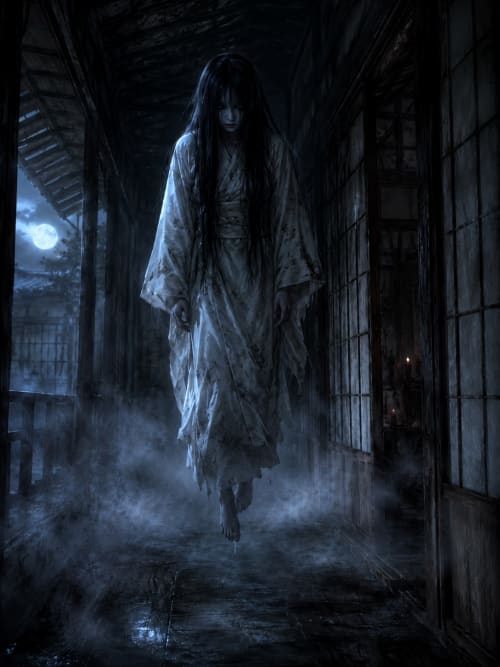
Onryo
Onryo · The Japanese Vengeful Ghost — A Cursing Specter Returned in Grudge