Halfling
Halfling · The Little Folk — Peaceful Farming Folk
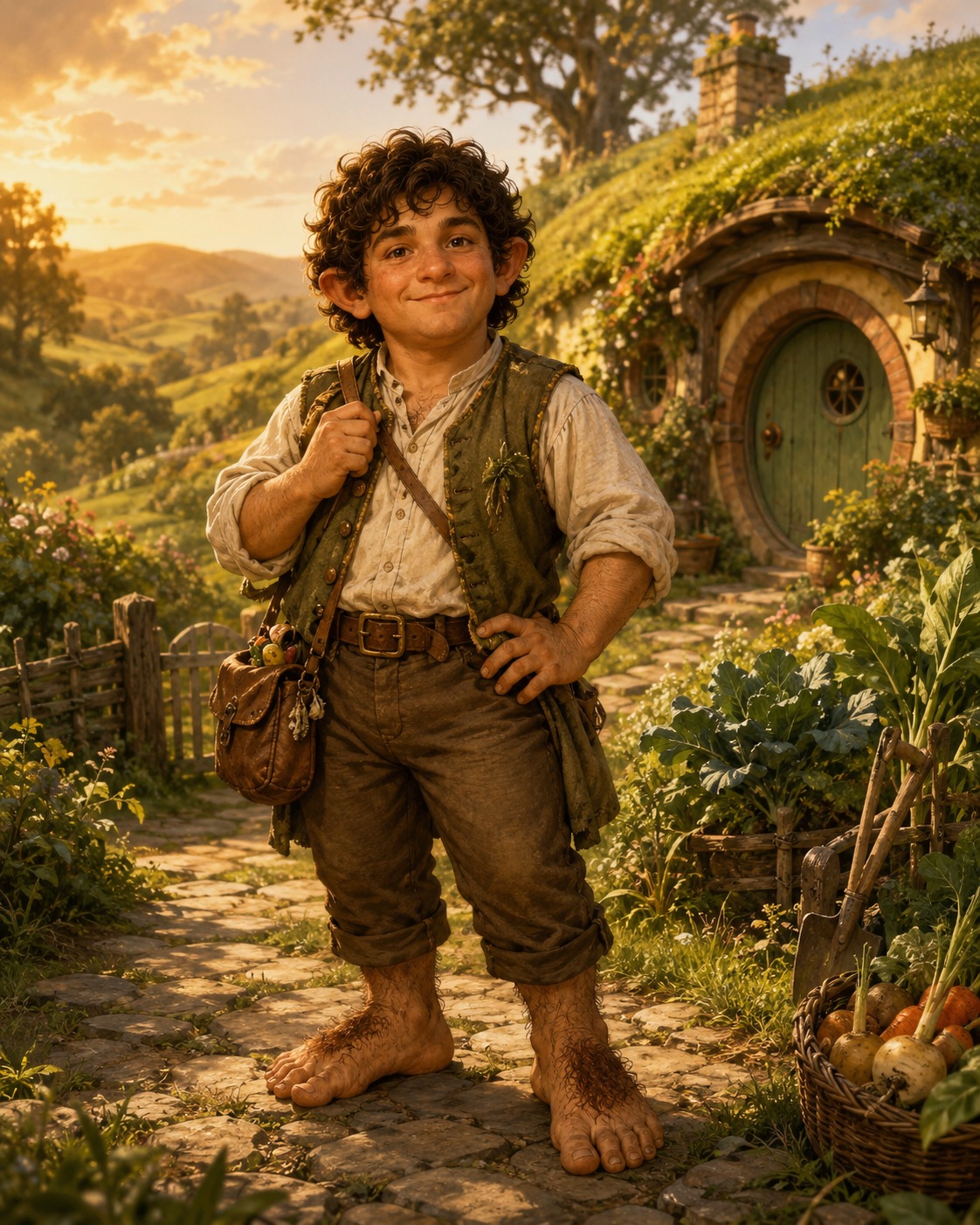
The halfling is the generic D&D name for J.R.R. Tolkien's hobbit, the small humanoid race introduced in 'The Hobbit, or There and Back Again' (George Allen & Unwin, London, 21 September 1937) and 'The Lord of the Rings' (1954-55). The word 'Halfling' itself is Tolkien's own term — in Appendix F of 'The Lord of the Rings', he gives it as the common designation by which Men of Middle-earth called the hobbits, derived from Old English 'half + -ling' ('one half-grown'). After Saul Zaentz's Tolkien Enterprises filed a trademark claim against TSR in July 1977 over the use of 'Hobbit', 'Ent', 'Balrog', 'Mithril' and 'Nazgûl', the AD&D Player's Handbook (1977) renamed Gygax's 1974 'Hobbit' race 'Halfling', and the name has been canonical since. In the fifth-edition Player's Handbook (2014), halflings stand ninety to one hundred and five centimetres tall, weigh eighteen to twenty-two kilograms, and bear curly brown or fair foot-hair on large bare feet with thick leather soles, round faces, curly brown, fair or red hair and an average lifespan of one hundred and fifty years. Their society is built on peaceful farming and herding communities, Shire-style chimney-houses and a famously elaborate seven-meal day (first breakfast, second breakfast, elevenses, luncheon, afternoon tea, dinner, supper). Fifth-edition racial traits are +2 Dexterity, Lucky (reroll natural 1s), Brave (advantage on fear saves) and Halfling Nimbleness (move through larger creatures' spaces), with the two canonical subraces Lightfoot (+1 Charisma, stealth advantage) and Stout (+1 Constitution, poison resistance). The same iconography is visible in the Halfling counties of Warhammer Fantasy (Games Workshop, from 1986) and is locked into modern popular imagination by Peter Jackson's 'Lord of the Rings' trilogy (2001-2003) and 'Hobbit' trilogy (2012-2014).