
Xiphos
The double-edged short sword of ancient Greek hoplites
Names in Other Languages
 크시포스한국어
Xiphos · 고대 그리스 보병의 보조검
 クシポス日本語
古代ギリシャ重装歩兵の補助剣
 克西福斯繁體中文
古希臘重步兵的輔助劍
 XiphosDeutsch
Das Kurzschwert des griechischen Hopliten
 XiphosFrançais
L'épée courte de l'hoplite grec
 XifosEspañol
La espada corta del hoplita griego
 XifosPortuguês
A espada curta do hoplita grego
 KsyfosPolski
Krótki miecz greckiego hoplity
 КсифосРусский
Короткий меч греческого гоплита
The xiphos is the short double-edged sword that the ancient Greek hoplite wore at his hip, with a blade only about 45 to 60 cm long. Its defining feature is the leaf-shaped blade: it widens gradually from the hilt, reaches its broadest point about two-thirds of the way along, then tapers sharply to the tip. This shape sets the center of mass toward the point to strengthen the cut, while the sharp tip also allows a thrust. First made in bronze and later in iron, it is light, around 500 to 700 g. The hoplite hung it on his left hip from a baldric and drew it with the right hand only when his main weapon, the long spear called the dory, broke or the enemy pressed in too close behind the shields.
Origin
The xiphos appeared around the 8th century BC at the end of the Greek Dark Age and was used across the Greek world for some 500 years into the Hellenistic period. The leaf-shaped double-edged blade is itself an old design found throughout Bronze Age Europe, and the xiphos is that form refined into a sidearm to suit the tactics of the Greek heavy infantry. It served as the hoplite's companion weapon in the Persian Wars and the Peloponnesian War, forged first in bronze and then, as ironworking spread, in iron. The word xiphos is a very old Greek term for sword, already named as the blade carried by the heroes of Homer's epics.
Features
- A leaf-shaped double-edged blade (about 45 to 60 cm)
- Broadest about two-thirds of the way along the blade
- Center of mass set forward to strengthen the cut
- A sharp point that serves for both cut and thrust
- Bronze in early examples, iron in later ones
- Light at about 500 to 700 g and easy to carry
Stories
The xiphos was always a secondary weapon. The stars of hoplite combat were the long dory spear and the great round shield, the hoplon, and the xiphos came into play only when those two could no longer do their work. When phalanxes locked together and spears snapped, or when the enemy pushed inside the shield wall so close that the spear was useless, the soldier drew the xiphos from his left hip and fought in the press, stabbing and cutting at close quarters. Short and light, it suited the body-to-body melee between packed ranks, and the leaf-shaped blade served equally for a single thrust into a gap and for quick cuts.
Weakness
The short blade gives it very limited reach, leaving it badly outmatched against an enemy with a spear or a longer sword who keeps his distance. Being a sidearm rather than the main weapon, it could never dominate a battlefield on its own, and away from the collective tactics of the phalanx and the protection of the shield its power fell off sharply. Its short length also made it markedly poor at parrying or pushing aside an opponent's longer weapon.
Cultural Significance
The xiphos is one of the emblems of the ancient Greek citizen-soldier, the hoplite. In a military culture where the free citizens of the city-state armed themselves and stood in the line of battle, the xiphos worn at the hip alongside spear and shield was part of the basic kit of a single warrior. Vase paintings, both red- and black-figure, and reliefs often show a soldier with the xiphos drawn. Greek infantry might instead choose the kopis, the curved single-edged chopping sword also called the makhaira; the two were used side by side as the hoplite's companion blade.
In Popular Culture
The xiphos appears as the hoplite's sidearm in works dealing with ancient Greece. It is a familiar short blade in films about Greece and the Trojan War such as 300 and Troy, and in games set in ancient Greece like Assassin's Creed Odyssey. In fiction, though, the sword often gets more emphasis than the fact that the hoplite's main weapon was the spear, so it tends to be shown with its true role as a sidearm blurred. The distinctive leaf-shaped double edge is reproduced accurately only fairly rarely.
Trivia
- According to an anecdote recorded by Plutarch, when someone mocked the Spartans for their very short swords, a Spartan replied to the effect that they reached the enemy well enough once you took a step closer, a story told to show the spirit of the Spartan warrior who fought with the short xiphos.
- Xiphos is a very old Greek word for sword, appearing already as the name of the blade carried by the heroes in Homer's Iliad and Odyssey.
- The leaf-shaped blade of the xiphos bulges wide in the middle to throw the mass toward the point, so that even a short sword could put solid weight behind a single cut, an old idea shared with many Bronze Age European swords.
Related

Gladius
The standard short sword of the Roman legionnaire

Spear
Humanity's oldest weapon

Javelin
A light spear designed for throwing

Falchion
A single-edged medieval European chopping sword

Dao
The iconic single-edged Chinese saber

Halberd
The versatile polearm combining axe, spear, and hook

Longsword
The quintessential two-handed sword of medieval Europe
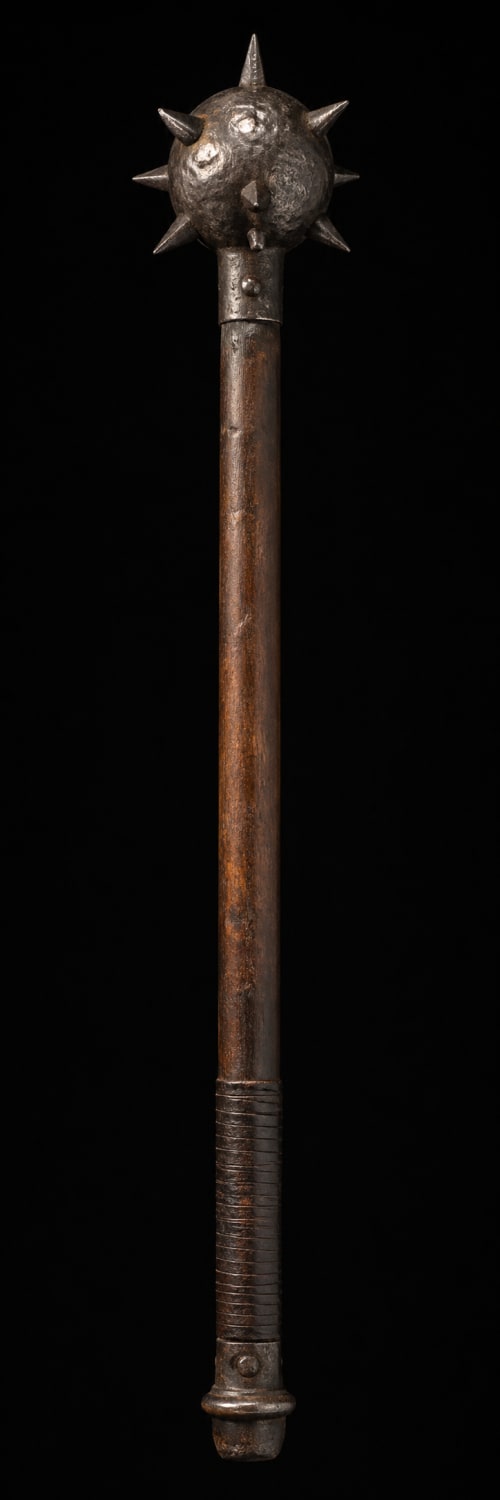
Morning Star
The spiked ball weapon of medieval warfare
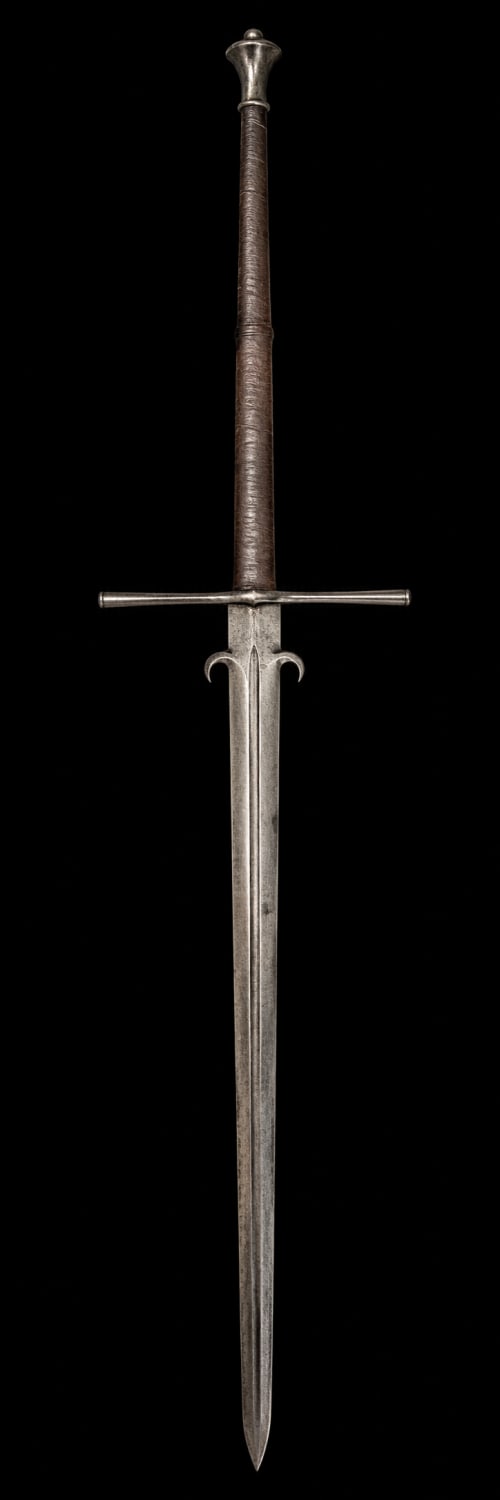
Zweihänder
The massive two-handed sword of German Landsknechts

Battle Axe
An axe designed specifically for combat

Musket
The muzzle-loading firearm of the early modern era

Glaive
A polearm with a curved single-edged blade