
Katar
India's push dagger with a transverse grip
Names in Other Languages
 카타르한국어
Katar · 인도의 주먹 관통 단검
 カタール日本語
インドの拳突短剣
 拳刃繁體中文
印度的推刺匕首
 KatarDeutsch
Der indische Fauststoßdolch
 KatarFrançais
Le poignard-poing indien
 KatarEspañol
El puñal de puño indio
 KatarPortuguês
O punhal de punho indiano
 KatarPolski
Indyjski sztylet pięściowy
 КатарРусский
Индийский кинжал-кастет
The katar is a push-dagger peculiar to India: an H-shaped horizontal grip set at right angles to the blade, held in the fist so that the blade juts forward over the knuckles, straight in line with the forearm. Because of this, one does not swing it but stabs as if throwing a punch, driving the force of the arm and the body weight into a single point at the tip. Its blade ranges from about 30 to 90 cm, and many were made with a thickened, reinforced point to punch through mail. It appeared in 14th-century South India and reached its height under the Mughal Empire, and among the finer pieces there is a split, or scissor, variant whose blade opens to either side into three prongs when the grip is squeezed. Its indigenous Indian name is the jamdhar.
Origin
The katar is thought to have first appeared in 14th-century South India, especially around Tamil Nadu and Vijayanagara. It then spread across North India and reached its height under the Mughal Empire (1526 to 1857), and was especially prized in the warrior cultures of the Rajputs, the Marathas, and the Sikhs. On the Indian battlefield, where mail was common, this dagger that gathered the strength of the arm into a single point to pierce armor became a decisive weapon of close combat. In India it was originally called the jamdhar, a name commonly explained as the tooth of Yama, the god of death.
Features
- An H-shaped horizontal grip, the blade jutting forward from the fist
- A powerful straight thrust driven by the arm and body weight like a punch
- A blade ranging from about 30 to 90 cm
- A thickened, reinforced point made to punch through mail
- A split, or scissor, variant that opens into three prongs when the grip is squeezed
- A symbol of the Rajput and Sikh warrior and a weapon of Indian martial arts (gatka)
Stories
The power of the katar came from the thrust delivered as if throwing a punch. Because the blade lay in a straight line with the forearm, there was no need to bend the wrist: extending the arm straight drove the force of the shoulder and the body weight into the tip, piercing deep into the gaps of mail or into the torso. Against an unarmored foe a single thrust could deal a mortal wound. The two side bars wrapped the fist and wrist and gave a measure of protection, and some forms added a guard covering the back of the hand. In the Indian martial art of gatka it is handled as the central weapon of close techniques that rush in and thrust in quick succession.
Weakness
Specialized as it is for the thrust, the katar is very limited in defense. It is poor at cutting or parrying, and its short blade leaves it utterly outmatched against an enemy with a polearm or long sword who keeps his distance. Because the grip is held firmly in the fist, it is awkward to drop the weapon quickly or switch to another in an emergency. In the end it is a purely offensive dagger that shows its worth only in the close quarters after one has pressed inside the enemy's reach, and is weak in a fight of distance.
Cultural Significance
The katar was a symbol of rank and valor in India, especially in Rajput warrior culture. A katar richly adorned with gold and gems was a thing of prestige worn at court and an heirloom, and among the Rajput nobility hunting a tiger or lion with nothing but a single katar was regarded as a proof of courage. It also holds an important place in Sikh warrior culture and the martial traditions of North India. As the indigenous name jamdhar, the tooth of Yama the god of death, shows, the katar was a weapon that called to the Indian imagination both death and valor together.
In Popular Culture
The katar often appears as an exotic punch-dagger in games and works set in India or the East or featuring assassin-type characters. In RPGs that place the katar in a class of its own, such as Diablo and Ragnarok Online, it is frequently drawn as a close weapon capable of rapid repeated strikes. The scissor variant, whose blade opens when the grip is squeezed, is especially favored in fiction for its distinctive gimmick. Often, though, it is shown gripped as a matched pair in both hands, so the impression of a fast, exotic dagger is emphasized over its true, weighty purpose of piercing armor.
Trivia
- The katar is built so that the blade lies in a straight line with the forearm and is thrust as if throwing a punch, and many were made with a thickened, reinforced point to drive the arm and body weight into a single spot and pierce mail.
- Among the finer katars there was a split, or scissor, variant whose blade opened to either side into two or three prongs when the grip was squeezed hard, a feature more a display of the smith's craft than a matter of battlefield efficiency.
- The indigenous Indian name of the katar is jamdhar, commonly explained as the tooth of Yama the god of death, and the Rajput nobility would prove their valor by hunting a tiger with a single katar.
Related
Hand Cannon
The earliest portable gunpowder weapon

Halberd
The versatile polearm combining axe, spear, and hook

Longsword
The quintessential two-handed sword of medieval Europe
Morning Star
The spiked ball weapon of medieval warfare
Zweihänder
The massive two-handed sword of German Landsknechts

Battle Axe
An axe designed specifically for combat

Mongol Bow
The composite bow of mounted archers

Glaive
A polearm with a curved single-edged blade

Dane Axe
The Viking two-handed battle axe

Falchion
A single-edged medieval European chopping sword
Claymore
The great two-handed sword of the Scottish Highlands
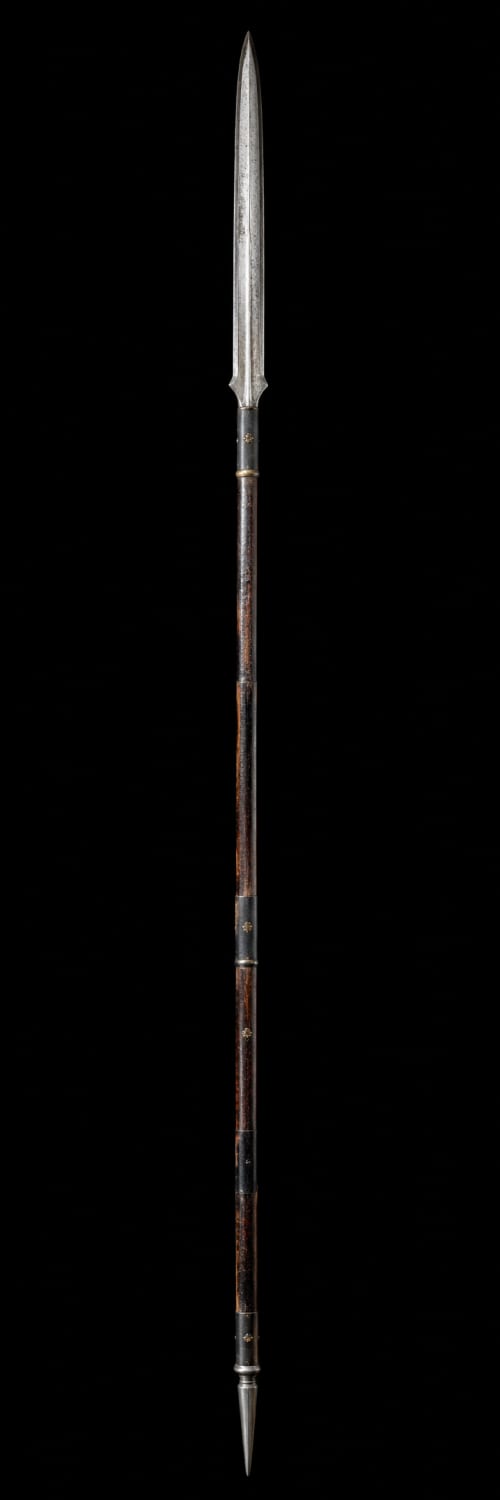
Yari
The straight-bladed Japanese spear