
Claymore
The great two-handed sword of the Scottish Highlands
Names in Other Languages
 클레이모어한국어
Claymore · 스코틀랜드의 양손 대검
 クレイモア日本語
スコットランドの両手大剣
 闊劍繁體中文
蘇格蘭高地雙手大劍
 ClaymoreDeutsch
Das schottische Großschwert der Highlander
 ClaymoreFrançais
La grande épée écossaise des Highlanders
 ClaymoreEspañol
La gran espada escocesa de los Highlanders
 ClaymorePortuguês
A grande espada escocesa dos Highlanders
 ClaymorePolski
Wielki miecz szkockich górali
 КлейморРусский
Большой шотландский меч хайлендеров
The claymore is the great two-handed sword of the Scottish Highland warrior, its name coming from the Gaelic claidheamh-mor, the great sword. About 130 to 150 cm in total length and 2.2 to 2.8 kg in weight, its most striking visual traits are the V-shaped cross-guard sloping forward and the quatrefoil, four-leaf, terminals at the ends of the quillons. Its weight distribution suits wide, arcing cuts, so it is strong at sweeping cuts swung broadly in both hands. It was used by the warriors of the Scottish clans from the 15th to the 17th century and is widely known as a weapon symbolic of the Scottish martial tradition.
Origin
The claymore is a great two-handed sword that appeared in the Scottish Highlands in the 15th century and was used into the 17th. It is often cited as a symbol of Scottish independence, but this great two-handed form took hold after the time of William Wallace and Robert the Bruce, so what was used at Stirling Bridge in 1297 or Bannockburn in 1314 were swords and spears of an earlier form: the link between the claymore and the wars of independence is largely a later symbol. The name claymore was also later used for the basket-hilted broadsword of the 17th and 18th centuries, so it came to name two different swords.
Features
- A total length of about 130 to 150 cm, a weight of about 2.2 to 2.8 kg
- A V-shaped cross-guard sloping forward, a distinctive design
- Quatrefoil, four-leaf, terminals at the ends of the guard
- A weapon symbolic of the Scottish clan warrior
- A name from the Gaelic for great sword
- A weight distribution suited to wide, arcing cuts
Stories
The claymore was a weapon swung broadly in both hands to sweep and cut down a foe. Thanks to its long, heavy blade and a weight distribution made for wide arcs, a single swing could threaten several men at once or break up an enemy's formation. In the warfare between clans it was used as a shock weapon, the warrior at the fore swinging the great sword as he charged in to break the enemy line. The famous later Highland Charge tactic and the Jacobite risings such as Culloden, however, were fought by Highlanders not with this two-handed claymore but with the basket-hilted broadsword used together with a small round shield, the targe.
Weakness
The weakness of the claymore arises from its size and weight. Large and heavy, it must be held in both hands, so it leaves no hand for a shield, and in a confined space or a dense formation there is no room to swing it broadly, so it cannot show its full power. After a single swing it takes time to move into the next motion, so it is outpaced by an enemy with a fast, nimble weapon such as the rapier. By nature it is a weapon that shines only when swung broadly in open space.
Cultural Significance
The claymore is a national weapon symbolic of the Scottish Highlands and clan culture. Bound to the spirit of independence against England, it became fixed as a symbol of the Scottish martial tradition: the image of William Wallace swinging a great sword in the film Braveheart spread that impression widely, though as a depiction it is out of its time. At the National Wallace Monument in Stirling a huge sword said to be Wallace's is kept, but its authenticity and dating are debated among scholars. The modern M18 Claymore mine, meanwhile, was named after this Scottish sword in the sense that it sweeps away the enemy like a great sword.
In Popular Culture
The claymore is one of the most famous great two-handed swords in fantasy and games. In games such as Dark Souls and Final Fantasy it is commonly used as the representative name of a class of heavy, strong greatsword, and in films and dramas set in Scotland, such as Braveheart and Outlander, it appears as the emblematic weapon of the Highland warrior. In fiction, though, great sword is often lumped together as claymore regardless of period, and the two-handed claymore and the basket-hilted broadsword are often not distinguished.
Trivia
- The name claymore comes from the Gaelic claidheamh-mor, the great sword, and names two things, often causing confusion: the great two-handed sword of the 15th and 16th centuries with its sloping guard and quatrefoil terminals, and the later basket-hilted broadsword of the 17th and 18th centuries carried by the Jacobites.
- The modern M18 Claymore directional anti-personnel mine was named after this Scottish sword by its designer, from the idea that it sweeps away the enemy at one stroke like a great sword.
- The two-handed claymore became a national symbol of the Scottish Highlands and the clan warrior, but the famous Highland Charge and the Jacobite risings (Culloden in 1746) were fought mainly not with the two-handed sword but with the basket-hilted broadsword and the round shield, the targe, and the authenticity of the Wallace Sword kept at the National Wallace Monument is debated.
Related

Longsword
The quintessential two-handed sword of medieval Europe
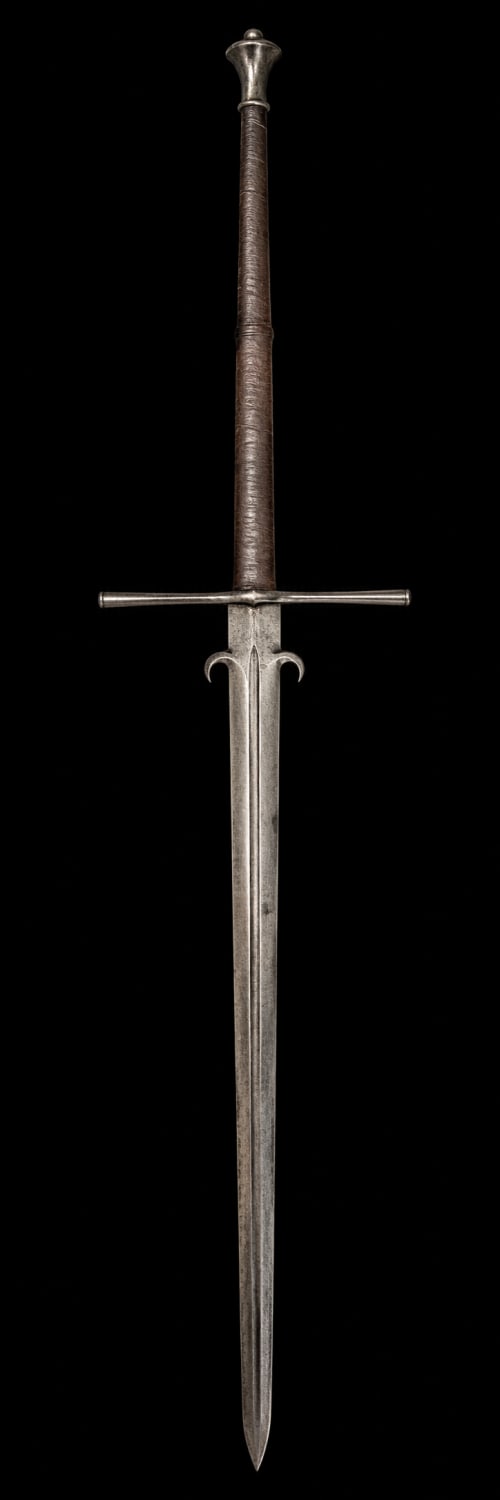
Zweihänder
The massive two-handed sword of German Landsknechts

Halberd
The versatile polearm combining axe, spear, and hook
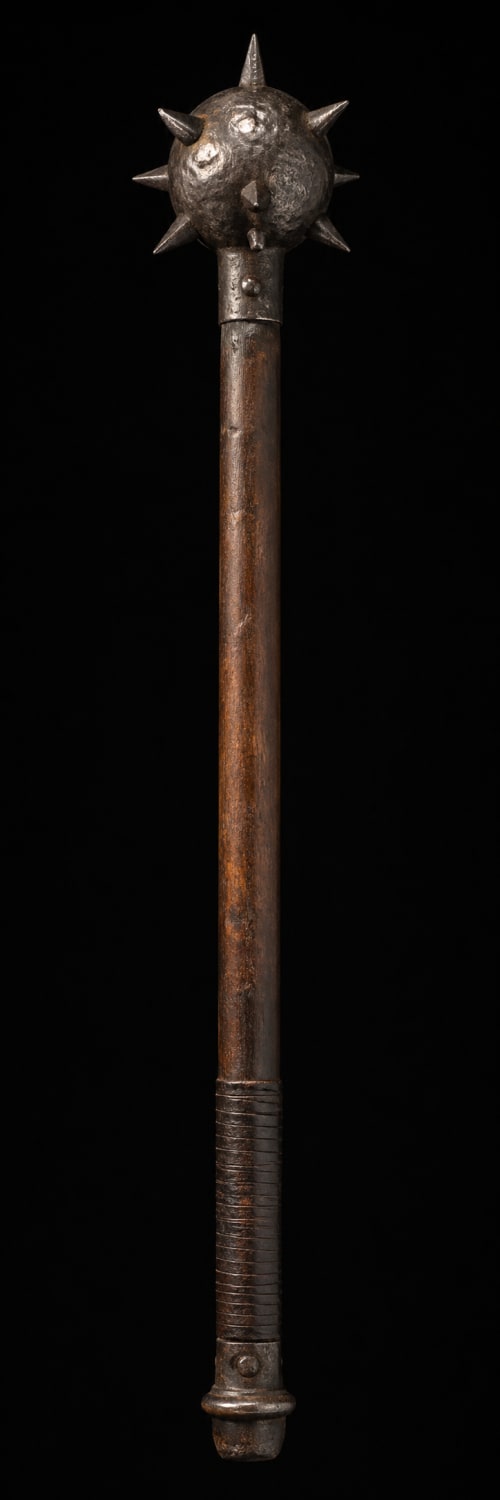
Morning Star
The spiked ball weapon of medieval warfare

Battle Axe
An axe designed specifically for combat

Glaive
A polearm with a curved single-edged blade

Falchion
A single-edged medieval European chopping sword

Pike
An extremely long spear for massed infantry formations

Flail
A chain-linked striking weapon that bypasses shields

Spear
Humanity's oldest weapon

Crossbow
The mechanized ranged weapon of the medieval era

Lance
The cavalry charge weapon of the mounted knight