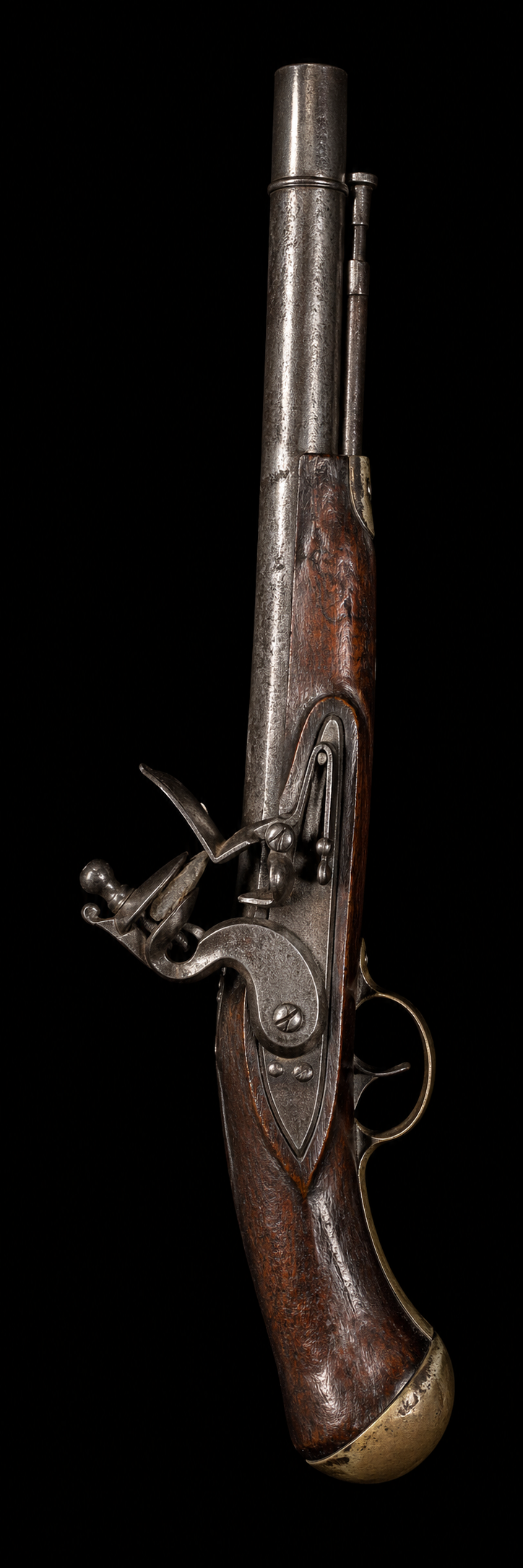
Flintlock Pistol
A single-shot pistol ignited by striking flint
Names in Other Languages
 플린트락 권총한국어
Flintlock Pistol · 부싯돌 점화 단발 권총
 フリントロック式拳銃日本語
火打石式単発拳銃
 燧發手槍繁體中文
燧石點火式單發手槍
 SteinschlosspistoleDeutsch
Die Feuersteinpistole der frühen Neuzeit
 Pistolet à silexFrançais
Le pistolet à pierre à feu de l'époque moderne
 Pistola de chispaEspañol
La pistola de pedernal de la Edad Moderna
 Pistola de pederneiraPortuguês
A pistola de pederneira da Era Moderna
 Pistolet skałkowyPolski
Pistolet krzemieniowy wczesnej nowożytności
 Кремнёвый пистолетРусский
Кремнёвый пистолет Нового времени
The flintlock pistol is a single-shot pistol fired when flint strikes a steel frizzen, the sparks ignite priming powder in the pan, and that flash passes through the touchhole to set off the main charge. Born when the flintlock mechanism perfected in early-17th-century France was applied to the pistol, it replaced the earlier matchlock and wheellock and spread widely for military and civilian use from the 17th to the 19th century. Its effective range was a mere 15 m or so and its accuracy poor, and after one shot reloading took a long time — so once fired, the pistol was often reversed and used as a club, striking with the heavy butt. It was the emblem of pirates and cavalry, and the standard weapon of the honor duel.
Origin
The flintlock pistol descends from the flintlock mechanism perfected in early-17th-century France (around the 1610s) by Marin le Bourgeoys, who combined several ignition systems. Striking sparks by flint against steel, this mechanism replaced the matchlock — which required carrying a lit cord — and the costly wheellock, becoming the standard through its simplicity, reliability, and low cost. From the mid-17th to the early 19th century it was the issue pistol of armies and a civilian arm for self-defense and dueling across Europe and the colonies, until the percussion cap, breech-loading, and metallic cartridge of the mid-19th century retired it.
Features
- A single-shot flintlock pistol ignited by sparks from flint
- Needs reloading after one shot (slow to load)
- Effective range about 15 m, poor accuracy from a smoothbore barrel
- Could be reversed and used as a club after firing
- The emblematic weapon of pirates and cavalry
- The standard weapon of the duel
Stories
Cavalry fired one shot at close range just before the charge and switched at once to the sword or saber, while pirates, to make up for the single shot, slung several loaded pistols across the body on cords and fired them one after another before closing for the boarding fight. With its short range it told only within a few dozen paces, and rather than expecting a hit it counted on a single close blow and the effect of noise and smoke. In the honor duel it was the ceremonial arm: the two paced off the agreed distance, turned, and fired a single shot each. Once the one shot was spent, the pistol was flipped over to become a makeshift bludgeon, struck down with its heavy butt.
Weakness
Its gravest weakness was being single-shot — after one shot the powder, ball, and priming had to be reloaded and the flint checked, so reloading was slow. Its effective range of about 15 m was very short, and the smoothbore barrel made it inaccurate. The priming powder lay exposed, so rain or damp brought frequent misfires (the priming flashing but the gun not firing), and a worn flint or a 'flash in the pan' was common. Strong wind could even blow the priming away. These limits were resolved with the percussion cap and metallic cartridge of the 19th century.
Cultural Significance
The flintlock pistol is a symbol of the Age of Sail and its pirates, and of the culture of the honor duel. In the 18th and 19th centuries gentlemen answered insults with a duel, and a matched pair of fine dueling pistols was an emblem of that culture of honor — the 1804 duel of Alexander Hamilton and Aaron Burr being the famous case. The flintlock also left a deep mark on the English language: from the priming flashing without firing came 'flash in the pan'; from the gun's three parts (lock, stock, and barrel) came 'lock, stock, and barrel' (the whole thing); and from the safety position came to 'go off half-cocked' (to act rashly).
In Popular Culture
The flintlock pistol is a stock weapon of works set among pirates and the Age of Sail. In the film Pirates of the Caribbean, the single-shot flintlock that Jack Sparrow saves a lone shot in for years is a series icon, and it features as a core firearm in pirate games such as Assassin's Creed IV: Black Flag and Sea of Thieves. The musical Hamilton dramatizes the Hamilton–Burr duel as 'ten paces.' It is usually portrayed as 'powerful in one shot but slow to reload,' used to wring tension from the question of when to spend that single shot.
Trivia
- The flintlock left several English idioms. From the priming powder in the pan flashing while the gun fails to fire came 'flash in the pan' (something that flares briefly and amounts to nothing); from the gun's three parts — lock, stock, and barrel — came 'lock, stock, and barrel' (the whole thing, all of it).
- The pair of Wogdon dueling pistols used in the 1804 Hamilton–Burr duel survive to this day, and the fact that they concealed a hair-trigger device has been debated ever since.
- The pirate Blackbeard (Edward Teach) was famous for slinging several loaded pistols across his chest on cords — because each fired only once, he could fire one and switch to the next in a boarding fight.
Related

Musket
The muzzle-loading firearm of the early modern era

Sabre
The curved cavalry sword for slashing

Rapier
A thrust-oriented slender sword of Renaissance Europe

Halberd
The versatile polearm combining axe, spear, and hook

Longsword
The quintessential two-handed sword of medieval Europe

Spear
Humanity's oldest weapon
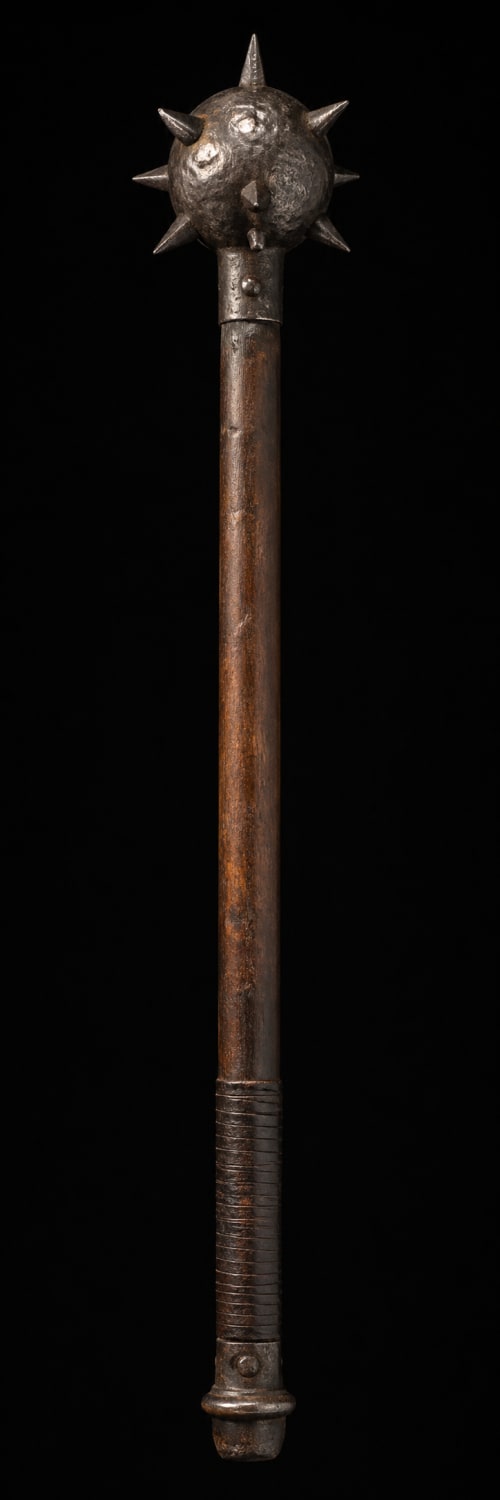
Morning Star
The spiked ball weapon of medieval warfare
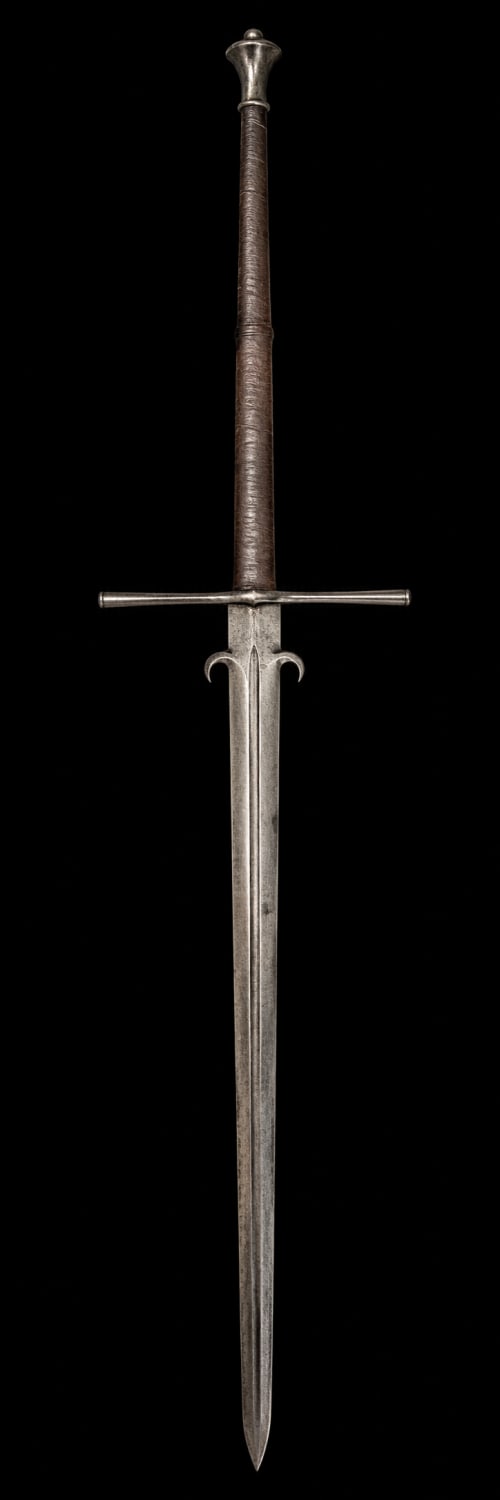
Zweihänder
The massive two-handed sword of German Landsknechts

Crossbow
The mechanized ranged weapon of the medieval era

Battle Axe
An axe designed specifically for combat

Lance
The cavalry charge weapon of the mounted knight
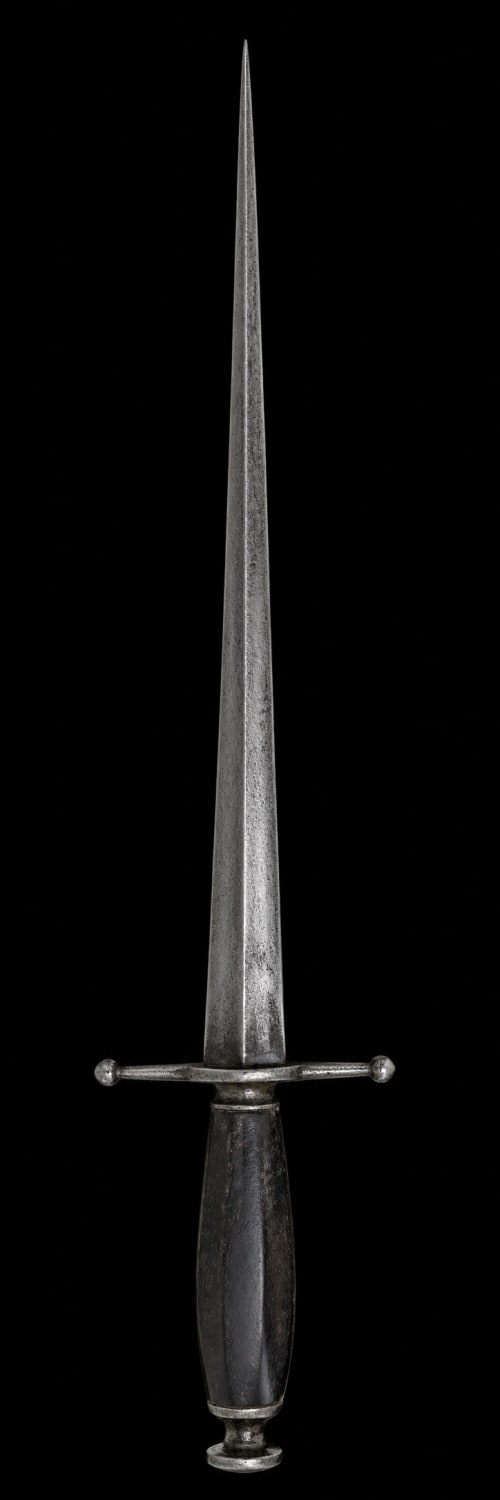
Stiletto
The Italian thrusting-only dagger