
Basilisk
King of Serpents in Medieval European Legend
Names in Other Languages
 바실리스크한국어
Basilisk · 중세 유럽 전설의 뱀의 왕
 消えたバジリスク日本語
バジリスク · 伝説の怪物 — 視線で命を奪う神話的生物
 消失的巴西利斯克繁體中文
巴西利斯克 · 傳說怪獸 — 擁有致命凝視的神話生物
 Verschwundener BasiliskDeutsch
Basilisk · Legendäres Ungeheuer — Mythisches Wesen mit tödlichem Blick
 Basilic disparuFrançais
Basilic · Monstre légendaire — Créature mythique au regard mortel
 Basilisco desaparecidoEspañol
Basilisco · Bestia legendaria — Criatura mítica de mirada letal
 Basilisco DesaparecidoPortuguês
Basilisco · Monstro Lendário — Criatura mítica com olhar mortal
 Zaginiony BazyliszekPolski
Bazyliszek · Legendarna bestia — Mityczne stworzenie o zabójczym spojrzeniu
 Исчезнувший василискРусский
Василиск · Легендарный зверь — Мифическое существо со смертельным взглядом
The Basilisk (Greek basiliskos 'little king', Latin basiliscus) is the legendary serpent-king of Greco-Roman natural history and medieval European bestiaries. The first detailed description is in Pliny the Elder's Natural History VIII.33 (c. 77-79 CE), where the basilisk is a small serpent twelve fingers long (about 23 cm) inhabiting the deserts of Cyrene in North Africa, with a crown-shaped white mark on its head, whose hiss alone scatters all other snakes; whose gaze kills any creature that meets it; whose breath withers grass and shatters stone; and whose corpse is still venomous — Pliny relates an anecdote of a horseman who pierced one with a spear, only for the venom to travel up the shaft and kill rider and horse alike. From the twelfth century onward, English bestiaries such as the Aberdeen Bestiary and MS Bodley 764 reshaped the figure into a hybrid with the head, wings, and feet of a rooster and the tail of a snake, identifying it with the cockatrice. J. K. Rowling's Harry Potter and the Chamber of Secrets (1998) made the basilisk a canonical figure of modern fantasy.
Origin
The etymology of basilisk is Greek basiliskos, the diminutive of basilios ('king'), 'little king', borrowed into Latin as basiliscus. The earliest detailed literary source is Pliny the Elder's Natural History VIII.33 (77-79 CE), which describes the basilisk as a small serpent of the Cyrenaean desert with a crown-shaped mark, killing by gaze and breath. The Septuagint translation of Psalm 91.13 rendered the Hebrew pethen ('cobra') as basiliskos, and the Latin Vulgate of the late fourth century carried this over as basiliscus, embedding the basilisk in Christian iconography as the beast that Christ tramples underfoot together with the lion. Solinus' Collectanea (third century), Aelian's De natura animalium books II-III, and Isidore of Seville's Etymologies XII.4.6-9 (seventh century) reinforced the figure. In the twelfth and thirteenth centuries, the English Aberdeen Bestiary, MS Bodley 764, and similar bestiaries standardised the cockerel-headed hybrid, identifying the basilisk with the cockatrice.
Features
- Original form: a small serpent with a crown-shaped mark on its head (Pliny)
- Medieval form: rooster's head, wings, and feet with a serpent's tail (cockatrice)
- A deadly gaze that kills anything that meets its eyes
- Breath that withers grass and shatters stone
- A hiss that scatters all other serpents — the king of snakes
- Even its corpse, blood, and fangs are intensely venomous
Stories
In Christian iconography the basilisk became an allegory of pride (superbia), one of the seven deadly sins, and of the devil itself: building on Psalm 91.13, Christ is depicted trampling the basilisk together with the lion underfoot. The eleventh-century reliefs of Burgos Cathedral and the twelfth-century Christ-and-basilisk image of Amiens are canonical examples. In heraldry the basilisk appears in the arms of William of Wykeham (fourteenth century), and in Renaissance natural history Ulisse Aldrovandi's Serpentum et Draconum Historia (1640) became the standard reference. Shakespeare's Richard III, Act I scene 2, has Anne wish her eyes were 'basilisks, to strike thee dead', citing the deadly gaze, and Dante invokes the basilisk in Inferno XXIV among the metamorphic serpents of the thieves. In modern culture J. K. Rowling's Harry Potter and the Chamber of Secrets (1998), the Dungeons and Dragons monster manuals, Assassin's Creed Odyssey, and the Witcher games preserve the basilisk as a canonical figure.
Weakness
Three traditional weaknesses are canonical. First, the weasel (or mongoose) is immune to the basilisk's venom and can kill it, a tradition Pliny first records, derived from the Greek generalisation of the Indian cobra-mongoose relationship. Second, the basilisk dies of its own gaze reflected in a mirror, a variant attested in Clement of Alexandria (second to third century) and modelled on the Perseus-Medusa mirror-shield motif. Third, the crow of a rooster kills the basilisk on the spot, a medieval bestiary motif that is theologically paradoxical given the late-medieval tradition that the basilisk hatches from an egg laid by a cock. The 1998 climax of Harry Potter and the Chamber of Secrets, in which Fawkes the phoenix blinds the basilisk and Harry then pierces its mouth with the Sword of Gryffindor, is a modern reworking of this three-fold weakness pattern.
Cultural Significance
The basilisk stands in the iconographic relay from Greek natural history through medieval Christian allegory, Renaissance natural science, and into modern fantasy. The Septuagint and Vulgate renderings of Psalm 91.13 made the basilisk a central figure of Christian art: the trampled beast under Christ's feet at Burgos in the eleventh century and at Amiens in the twelfth is the iconic image. From the twelfth and thirteenth centuries, the cockerel-headed hybrid of the English bestiaries identified the basilisk with the cockatrice, and Aldrovandi's Serpentum et Draconum Historia of 1640 became the Renaissance natural-history standard. Shakespeare's Richard III canonised the 'basilisk's gaze' as the English-language idiom for a deadly look, and J. K. Rowling's Chamber of Secrets (1998) made the basilisk a fixture of modern fantasy. The figure survives in Assassin's Creed Odyssey, the Witcher games, Dungeons and Dragons, and Marvel Comics.
In Popular Culture
- Pliny the Elder, Natural History VIII.33 (c. 77-79 CE) — earliest detailed description
- Septuagint, Psalm 91.13 — Hebrew pethen rendered as basiliskos
- Latin Vulgate, Psalm 91.13 (late 4th c.) — Christian iconographic integration
- Solinus, Collectanea (3rd c.) — natural-history reinforcement
- Isidore of Seville, Etymologies XII.4.6-9 (7th c.) — medieval iconographic codification
- Aberdeen Bestiary and MS Bodley 764 (12th-13th c.) — cockerel-headed hybrid standardised
- J. K. Rowling, Harry Potter and the Chamber of Secrets (1998) — modern fantasy canon
Trivia
The name basilisk derives from Greek basiliskos, the diminutive of basilios ('king'): 'little king', so called from the crown-shaped mark on its head. In Pliny the basilisk was a small serpent about twenty-three centimetres long, but through the medieval bestiaries the cockerel-headed hybrid grew in size, and in Harry Potter and the Chamber of Secrets (1998) the basilisk reached about fifty feet (fifteen metres). The mirror weakness is iconographically continuous with the Perseus-Medusa mirror-shield motif, an inheritance from the most refined hero-test pattern in Greek myth. Cockatrice was originally a distinct creature, but by the thirteenth century English bestiaries identified it with the basilisk, and in modern English the two terms are largely interchangeable; in American fantasy gaming (notably Dungeons and Dragons) the convention is to keep cockatrice for the cockerel-headed variant and basilisk for the lizard-like form. Slytherin's basilisk in Harry Potter and the Chamber of Secrets, sealed in the Chamber by Salazar Slytherin himself, is finally despatched by Harry with the Sword of Gryffindor.
Related

Strix
Strix · Night Bird — Vampiric Bird of Ancient European Myth
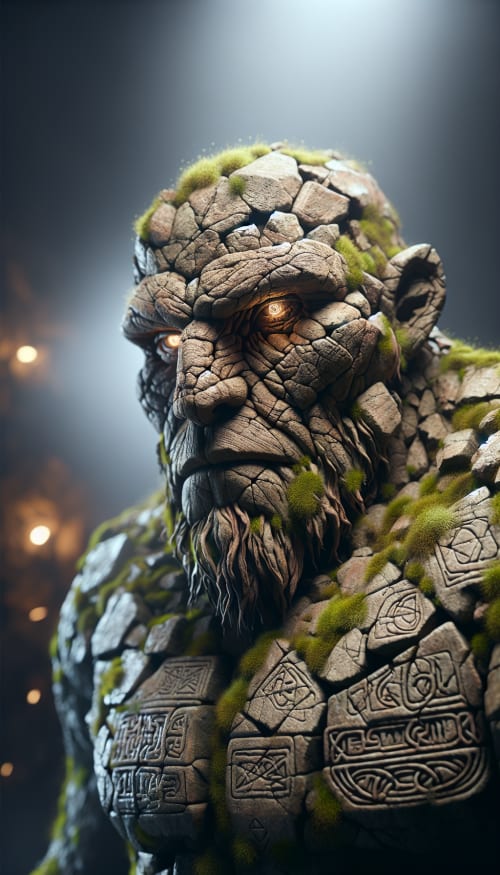
Golem
Golem · Artificial Creature — A being made from inanimate materials
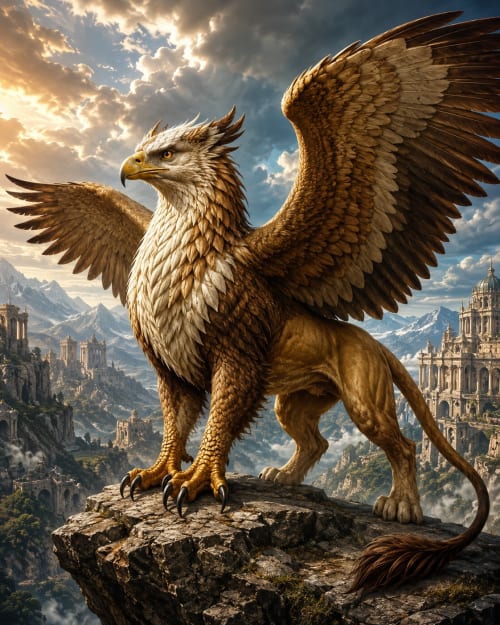
Griffin
Griffin · Legendary Lion-Eagle — Mythical creature with eagle foreparts and lion hindquarters

Unicorn
Unicorn · Monoceros — Legendary Horse with a Sacred Horn

Gargoyle
Gargoyle · Stone Monster — Legendary Protectors of Medieval Architecture

Lamia
Serpent-bodied Enchantress · Seductress and Devourer in Greek Mythology

Hydra
Hydra · Lernaean serpent — Multi-headed mythical beast

Cretan Bull
Seventh Labor of Heracles in Greek Myth
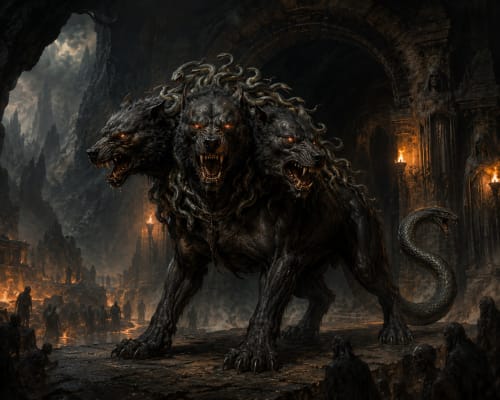
Cerberus
Cerberus · Infernal Gatekeeper — Legendary triple-headed hound

Amphisbaena
Two-Headed Serpent of Greek Myth
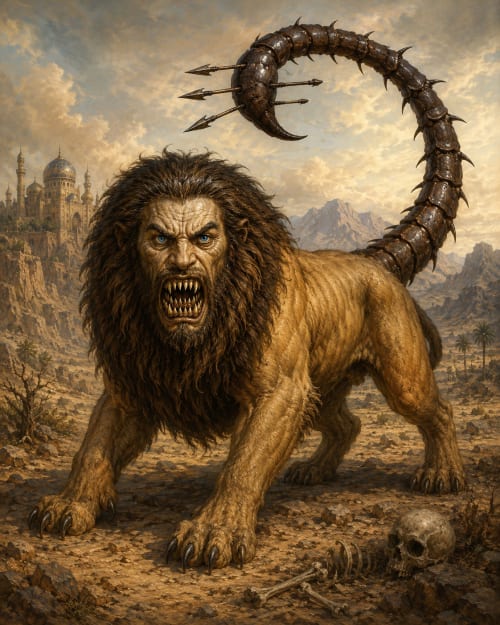
Manticore
Persian Legendary Lion-Man-Scorpion Hybrid

Phoenix
Phoenix · Firebird — Legendary bird reborn from flames