Lernaean Hydra
Nine-Headed Marsh Monster
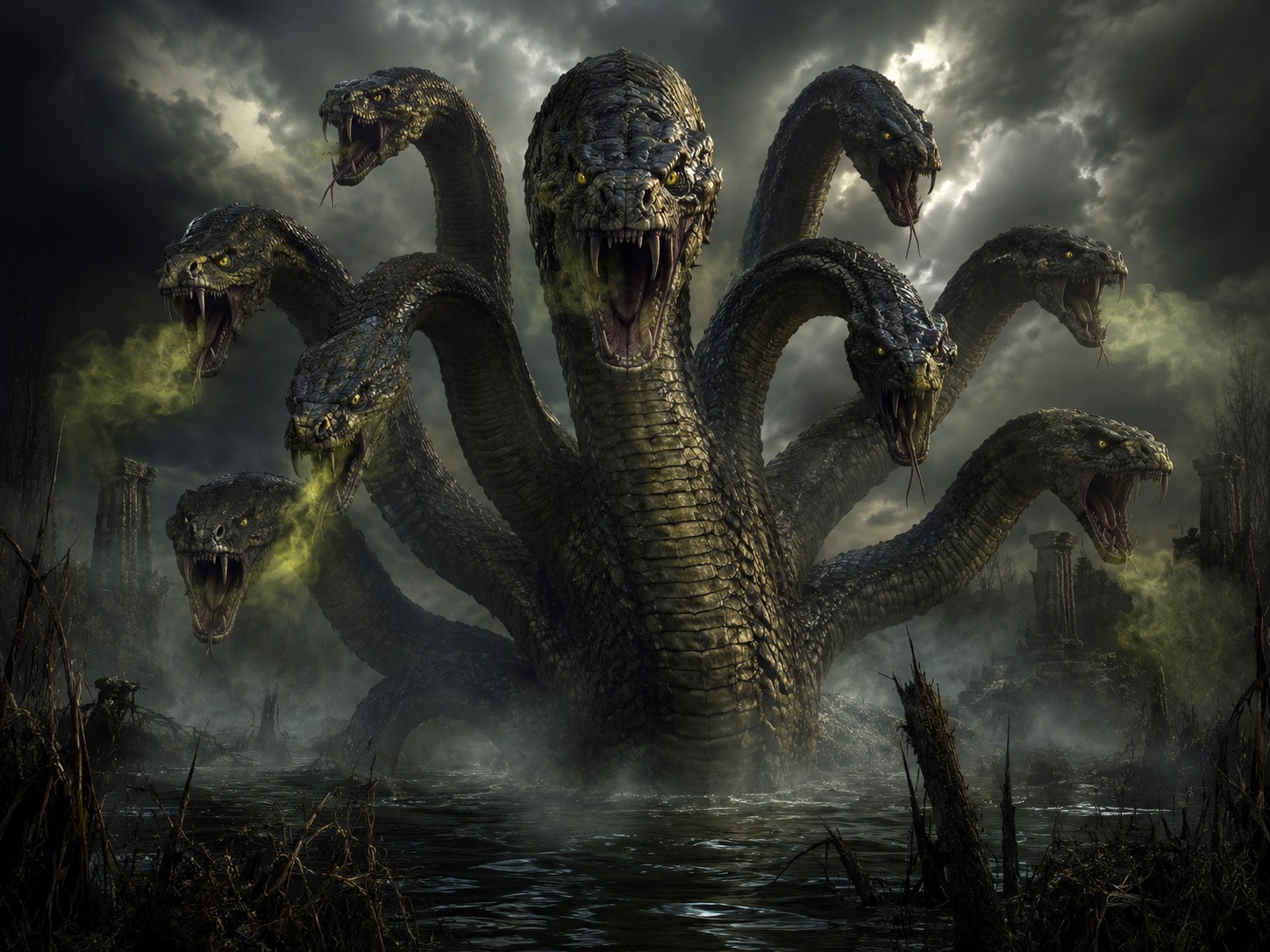
The Lernaean Hydra (ancient Greek 'Lernaia Hydra', Latin 'Hydra Lernaea') is the most iconic many-headed monster of Greek mythology, the second of Heracles's twelve labours imposed by King Eurystheus of Mycenae. Her birth is fixed by Hesiod (late eighth century BCE) in the 'Theogony' (c. 730 BCE), lines 313-318, as the daughter of the serpent Echidna and the storm-giant Typhon, sister of Cerberus, the Chimaera and the Nemean lion, and was reared by Hera to test Heracles. She is canonically nine-headed, the central head immortal (Pseudo-Apollodorus, 'Bibliotheke' II.5.2, second century BCE), and her decisive power is regenerative: every severed head sprouts two new ones. Heracles defeats her only with the help of his nephew and charioteer Iolaus, who cauterises each cut stump with a flaming torch; the final immortal head Heracles severs and buries beneath a great rock. The Hydra's venomous blood is then collected on Heracles's arrows and goes on to kill the centaur Nessus, the giant Antaeus and, finally, Heracles himself. Her lair is the Lerna marsh of Argolis on the eastern Peloponnese, identified with the archaeological site near modern Myloi village, ten kilometres south of Argos, where the University of Cincinnati expedition (1950-58, John L. Caskey) excavated a Neolithic settlement of the third millennium BCE.