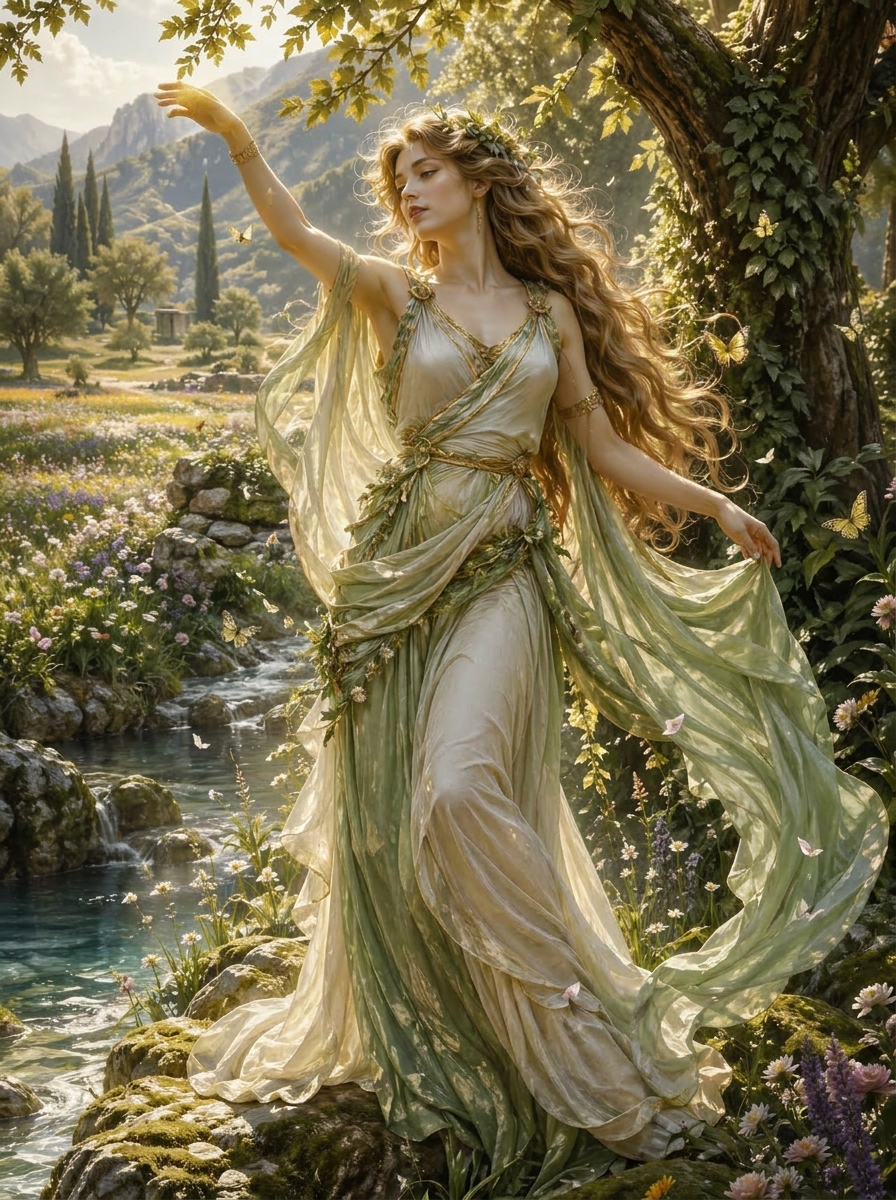
Nymph
General Term for Greek Nature Spirits
Names in Other Languages
 님프한국어
님프한국어Nymph · 그리스 신화의 자연 정령 통칭
 ニンフ日本語
Nymph — 森の下位精霊
 寧芙繁體中文
Nymph — 森林下位精靈
 NympheDeutsch
Nymph — Niedere Waldgeistin
 NympheFrançais
Nymph — Esprit Forestier Mineur
 NinfaEspañol
Nymph — Espíritu Forestal Menor
 NinfaPortuguês
Nymph — Espírito Florestal Menor
 NimfaPolski
Nymph — Niższy Duch Lasu
 НимфаРусский
Nymph — Низший Лесной Дух
The Nymph (Greek Nymphē, English Nymph) is the decisive canonical collective term for female spirits dwelling in various aspects of nature in ancient Greek mythology. The etymology is the Greek nymphē ('young woman, bride'), and they are classified according to their dwelling environment — Dryad (tree), Hamadryad (specific tree), Naiad (fresh water), Nereid (sea), Oread (mountain), Limniad (lake), Auloniad (valley) — the decisive canonical iconography. The decisive textual canon is line 420 of Book 6 of the Iliad and lines 105-109 of Book 6 of the Odyssey of the c. 8th-century-BCE Homer (Hesiodos) — nymphs accompanying Artemis — and the list of fifty Nereids in lines 240-264 and the list of three thousand Oceanids in lines 346-370 of the Theogony of c. 700-BCE Hesiod (Hesiodos) is the decisive Greek-mythological canon. The decisive Latin-literary canon is the Metamorphoses of c. 8 CE Ovid (Publius Ovidius Naso, 43 BCE - 17 CE), and the decisive Victorian visual canon is the 1896 painting Hylas and the Nymphs (Hylas and the Nymphs) of the British painter John William Waterhouse (1849-1917) — in the collection of the Manchester Art Gallery.
Origin
The iconographic origin is the Greek nature-spirit belief of the 8th-7th centuries BCE, and the earliest textual canon is the Iliad and the Odyssey of Homer of the c. 8th century BCE. The Greek etymology Nymphē originally means 'young woman, bride' — the decisive canonical vocabulary. The Theogony (Theogonia) of Hesiod (Hesiodos) of c. 700 BCE — the list of fifty Nereids (descendants of Pontus and Gaia) in lines 240-264 — is the decisive canon of Greek-mythological nymph systematisation, and the list of three thousand Oceanids (descendants of Oceanus and Tethys) in lines 346-370 is the decisive cosmological canon. The Homeric Hymns (Homeric Hymns) Book 3 Hymn to Demeter and Book 5 Hymn to Aphrodite are the decisive religious canon, and lines 1207-1272 of Book 1 of the Argonautica of the 4th-3rd-century-BCE Alexandrian poet Apollonius Rhodius (Apollonios Rhodios, 295-215 BCE) — in which Heracles's squire Hylas (Hylas) is drawn away by the Naiads of the Pegai (Pegai) spring — is the decisive Greek-literary nymph canon. The decisive Latin-literary canon is the metamorphosis canon of Echo (Echo, Book 3 lines 339-510), Arethusa (Arethusa, Book 5 lines 572-641), Daphne (Daphne, Book 1 lines 452-567), and Salmacis (Salmacis, Book 4 lines 285-388) of Ovid's Metamorphoses of c. 8 CE.
Features
- Near-immortal long lifespan
- Unparalleled beauty and grace
- Skilled in music, song, and dance
- Bound to dwelling environment (tree, spring, etc.)
- Mother or lover of gods and heroes
- Vanishes when environment is destroyed
Stories
The Iliad and the Odyssey of Homer of the c. 8th century BCE and the list of fifty Nereids in lines 240-264 and the list of three thousand Oceanids in lines 346-370 of Hesiod's Theogony of c. 700 BCE are the decisive canon of Greek-mythological nymph systematisation. Lines 1207-1272 of Book 1 of the Argonautica of the 3rd-century-BCE Apollonius Rhodius — in which Heracles's squire Hylas is drawn away by the Naiads of the Pegai spring — and the decisive metamorphosis canons of Echo, Arethusa, Daphne, and Salmacis of Ovid's Metamorphoses of c. 8 CE are the decisive Latin-literary canon. Renaissance Italy — the 1499 Hypnerotomachia Poliphili of Polifilo and the c. 1485 Birth of Venus (Nascita di Venere) and 1482 Primavera (Primavera) of Botticelli (Sandro Botticelli, 1445-1510) — established the Renaissance nymph visual-adaptation canon. The decisive Victorian visual canon is the 1896 painting Hylas and the Nymphs (Hylas and the Nymphs) of the British painter John William Waterhouse (John William Waterhouse, 1849-1917) — Manchester Art Gallery collection, 132.1 by 197.5 centimetres — and the 1893 Lamia, 1903 Echo and Narcissus, and 1909 The Naiad of Waterhouse are decisive Victorian painting canons. The Nymph of the 1977 D&D Monster Manual by Gary Gygax of TSR in the USA — consistent through to 5e (5th Edition) of 2014 — is the decisive canon of the modern fantasy RPG.
Weakness
The Nymph's weaknesses are: (1) environmental binding — bound to her dwelling nature (tree, spring, etc.), vanishing when it is destroyed — the most decisive canonical weakness; (2) not truly immortal — near-immortal lifespan, but not truly immortal like the gods, the decisive canon; (3) wrath of the gods — the decisive canon in lines 452-567 of Book 1 of Ovid's Metamorphoses of c. 8 CE in which Daphne (Daphne), pursued by Apollo, is transformed into a laurel tree; (4) tragedy of unrequited love — the decisive canon in lines 339-510 of Book 3 of Ovid's Metamorphoses in which Echo (Echo) loves Narcissus (Narcissus) one-sidedly and vanishes leaving only her voice; (5) revelation of sacred matters — the canon in Greek mythology that if a nymph reveals a god's secret, she is punished; (6) the departure of a hero — the decisive canon in lines 1207-1272 of Book 1 of the Argonautica of the 3rd-century-BCE Apollonius Rhodius — Hylas (Hylas) is drawn away by the Naiads of the Pegai (Pegai) spring, and Heracles is left behind from the Argo seeking him; (7) sacred sealing rite — the canon in Greek-mythological nature-spirit canon that the wrath of the goddess Artemis transforms a nymph; (8) forced union — the decisive canon in lines 285-388 of Book 4 of Ovid's Metamorphoses in which Salmacis (Salmacis) forcibly unites with Hermaphroditus, becoming a hermaphrodite. The decisive tragic finales are the metamorphosis canons of Daphne, Echo, Arethusa, and Salmacis of Ovid's Metamorphoses of c. 8 CE.
Cultural Significance
The Nymph is not merely a nature-spirit icon but the canonical iconographic figure of the Western decisive nature-spirit canon, traversing Homer's Iliad and Odyssey of the c. 8th century BCE, Hesiod's Theogony of c. 700 BCE, the Homeric Hymns, the 3rd-century-BCE Apollonius Rhodius's Argonautica, Ovid's Metamorphoses of c. 8 CE, the 1499 Hypnerotomachia Poliphili of Polifilo, the c. 1485 Birth of Venus of Botticelli, the 1873 Play of the Sirens of Boecklin, the 1896 Hylas and the Nymphs of Waterhouse, and the 1977 D&D Monster Manual. In the Greek-mythological nature-spirit belief of the Mycenaean civilization of the Greek Bronze Age (3000-1200 BCE), the decisive environmental canon of the spirits of sacred trees, springs, mountains, and seas became the decisive canon of Greek Bronze Age nature-spirit belief. The decisive Latin-literary canon is the Metamorphoses (Metamorphoses) of c. 8 CE Ovid (43 BCE - 17 CE) — Daphne in Book 1 lines 452-567, Echo in Book 3 lines 339-510, Salmacis in Book 4 lines 285-388, Arethusa in Book 5 lines 572-641, and the Hamadryad in Book 8 lines 738-878 — which settled as the decisive Greco-Roman metamorphosis canon. The decisive Victorian visual canon is the 1896 painting Hylas and the Nymphs (Hylas and the Nymphs) of the British painter John William Waterhouse (born 6 April 1849 in Rome, Italy, died 10 February 1917 in London, England) — 132.1 by 197.5 centimetres in the collection of the Manchester Art Gallery — and the 1893 Lamia, 1903 Echo and Narcissus, and 1909 The Naiad are the decisive Victorian Pre-Raphaelite canons.
In Popular Culture
- Homer, Iliad and Odyssey (c. 8th century BCE) — decisive origin canon
- Hesiod, Theogony lines 240-264 and 346-370 (c. 700 BCE) — decisive Greek-mythological canon
- Homeric Hymns (c. 7th century BCE) — decisive religious canon
- Apollonius Rhodius, Argonautica Book 1 lines 1207-1272 (3rd century BCE) — decisive Hylas and Naiads canon
- Ovid, Metamorphoses (c. 8 CE) — Latin decisive metamorphosis canon
- Polifilo, Hypnerotomachia Poliphili (1499) — Renaissance visual canon
- Botticelli, Birth of Venus, Primavera (c. 1485) — decisive Renaissance painting canon
- Boecklin, Play of the Sirens (1873) — decisive Symbolist canon
- Waterhouse, Hylas and the Nymphs (1896) — decisive Victorian visual canon
- Gygax, D&D Monster Manual, Nymph (1977) — decisive fantasy RPG canon
Trivia
The Greek etymology Nymphē of Nymph originally means 'young woman, bride' — the decisive canonical vocabulary — and the Latin Nympha, the English Nymph (first attested in 1380), the French Nymphe, and the German Nymphe are canonical vocabulary. The decisive classification of Greek-mythological nymphs according to dwelling environment is — Dryad (Dryas, tree), Hamadryad (Hamadryas, specific tree), Naiad (Naias, fresh water), Nereid (Nereis, sea), Oread (Oreias, mountain), Limniad (Limnias, lake), Auloniad (Aulonias, valley), Alseid (Alseis, forest), Epimelides (Epimelides, livestock), and Leimoniad (Leimonias, meadow) — and the list of fifty Nereids (descendants of Pontus and Gaia) in lines 240-264 and the list of three thousand Oceanids (descendants of Oceanus and Tethys) in lines 346-370 of Hesiod's Theogony are the decisive canon. The decisive metamorphosis canon of Ovid's Metamorphoses of c. 8 CE — Daphne (Book 1 lines 452-567 laurel transformation), Echo (Book 3 lines 339-510 voice-only transformation), Arethusa (Book 5 lines 572-641 spring transformation), and Salmacis (Book 4 lines 285-388 hermaphrodite union) — is the decisive Latin-literary canon. The 1896 painting Hylas and the Nymphs (132.1 by 197.5 centimetres) of the British painter John William Waterhouse (born 6 April 1849 in Rome, Italy, died 10 February 1917 in London) — after exhibition at the Royal Academy in 1896, in the collection of the Manchester Art Gallery — is the decisive Victorian Pre-Raphaelite canon, and was temporarily removed from the gallery in January 2018 and restored a month later, becoming a topic of discussion. The Nymph of the 1977 D&D Monster Manual by Gary Gygax of TSR in the USA — consistent through to 5e (5th Edition) of 2014 — is the decisive canon of the modern fantasy RPG nature spirit.
Related
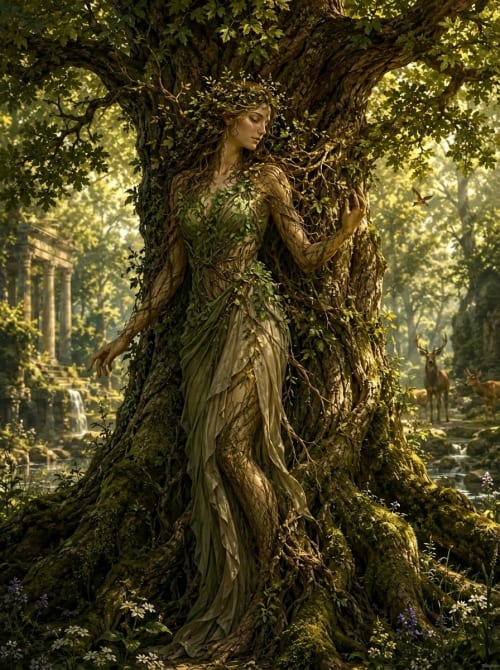
Dryad
Tree Nymph of Greek Mythology

Hamadryad
Greek Tree Spirit Bound to a Single Tree

Gnome
Earth Spirit of Paracelsus
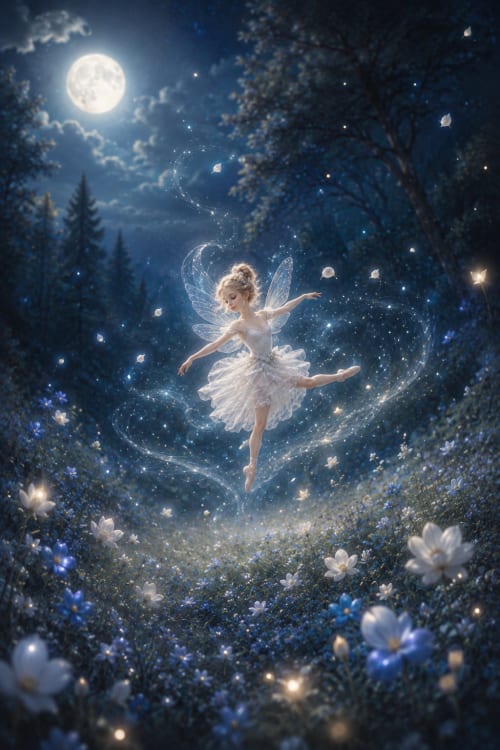
Sylphide
Small Sylph from Pope's The Rape of the Lock

Oread
Mountain Nymph of Greek Mythology

Will-o'-the-Wisp
English Folk Marsh Spirit
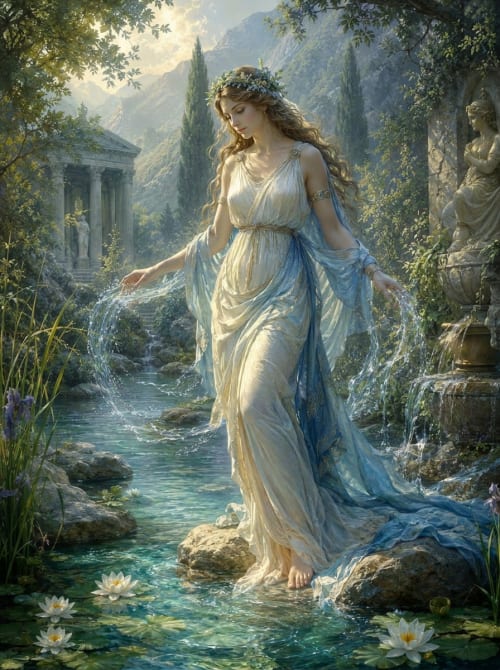
Naiad
Freshwater Nymph of Greek Mythology

Ignis Fatuus
Latin 'Foolish Fire,' Scientific Name for Will-o'-the-Wisp

Salamander
Fire Spirit of Paracelsus

Ariel
Air Spirit from Shakespeare's The Tempest

Jack Frost
Personification of Frost in English/Norse Folklore

Fire-drake
Fire Dragon of Beowulf and Norse Myth