Naiad
Freshwater Nymph of Greek Mythology
Names in Other Languages
 나이아드한국어
Naiad · 그리스 신화의 담수 님프
 ナイアド日本語
Naiad · エライム · エルクイネス — 水の精霊王
 奈阿德繁體中文
Naiad · 艾萊姆 · 艾爾奎內斯 — 水之精靈王
 NaiadDeutsch
Naiad · Ellaim · Elquiness — Wassergeist-König
 NaïadeFrançais
Naïade · Ellaim · Elquiness — Roi des Esprits de l'Eau
 NáyadeEspañol
Náyade · Ellaim · Elquiness — Rey de los Espíritus del Agua
 NáiadePortuguês
Náiade · Ellaim · Elquiness — Rei dos Espíritos da Água
 NajadaPolski
Najada · Ellaim · Elquiness — Król Duchów Wody
 НаядаРусский
Наяда · Эллайм · Элкинесс — Царь Духов Воды
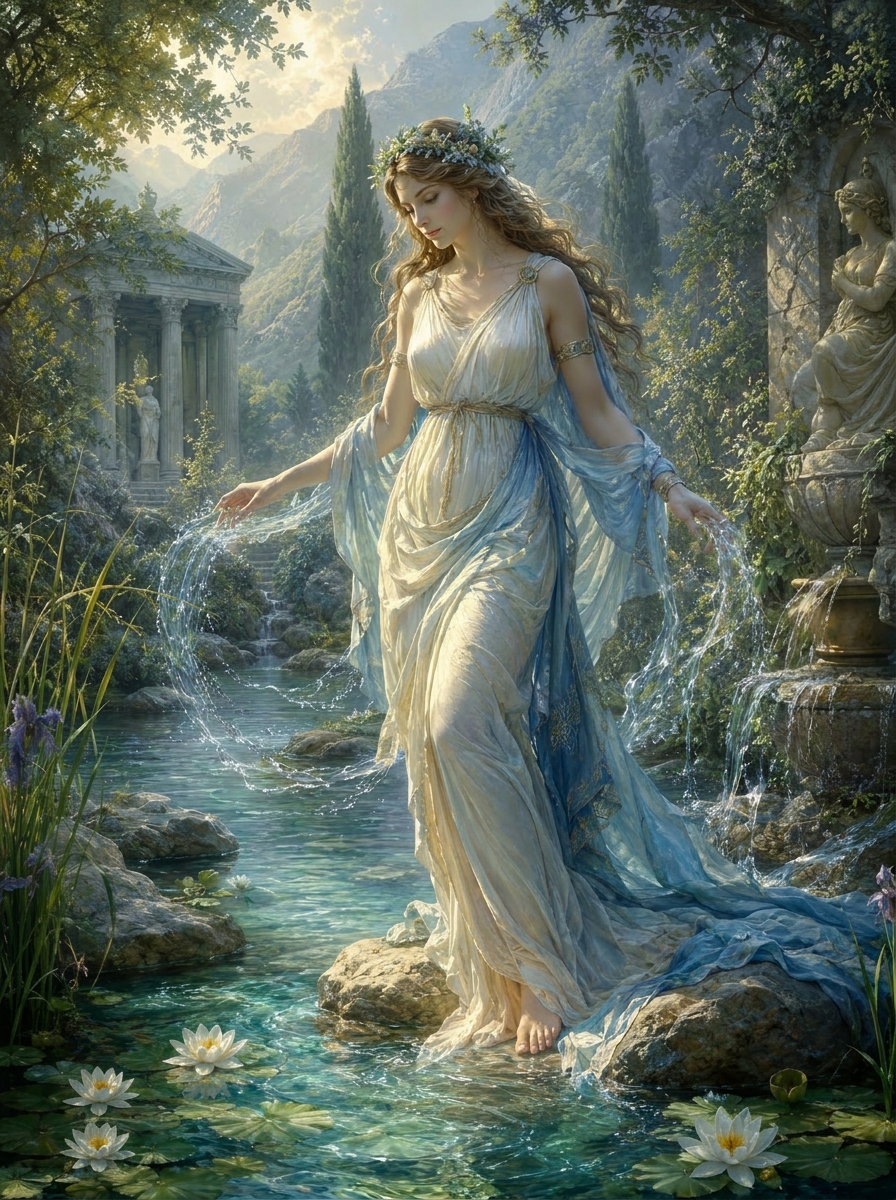
The Naiad (Greek Naias, plural Naiades, English Naiad) is the freshwater nymph (Greek nymphe) who dwells in the freshwater (springs, rivers, lakes, wells) of Greek mythology, in the form of a beautiful human female, embodying the divinity of the freshwater source — the decisive canonical iconographic figure of Greek-mythological nature spirits. The etymology derives from the Greek verb naein ('to flow'), and within the four-fold classification of nymphs — Naiad (freshwater), Oceanid (Oceanids, ocean), Nereid (Nereids, salt sea), and Dryad (Dryads, tree) — the Naiad is the decisive canon of freshwater. The decisive textual canon is in the Theogony (Theogonia) of the Greek poet Hesiod (Hesiodos), c. 700 BCE — lines 364-370, the canon of the 3,000 sisters Oceanids and 3,000 brothers River-gods (Potamoi) born to the river-god Oceanus (Okeanos) and his sister Tethys — is the decisive textual canon of the Naiad, and the river nymphs appear decisively in Books 14 and 20 of the Iliad and Books 13 and 17 of the Odyssey by Homer (Homeros) of the eighth century BCE. The Naiad Castalia of the Castalian Spring (Kastalia) by the Temple of Apollo at Delphi in Greece — the canonical inspiration of poetic prophecy — is the most decisive individual Naiad, and the 1896 painting Hylas and the Nymphs by the British Pre-Raphaelite painter John William Waterhouse (1849-1917) established the visual canon of the Naiad in the nineteenth-century Victorian era.
Origin
The iconographic origin is the Greek nature-spirit (numen) belief of the eighth and seventh centuries BCE, and the decisive textual canon begins in lines 364-370 of the Theogony (Theogonia, about 1,022 lines) of Hesiod (Hesiodos, the Boeotian peasant poet) of c. 700 BCE. The plot is: the river-god Oceanus (Okeanos, son of Gaia) at the origin of the cosmos married his sister Tethys (Tethys, mother of all the waters of the cosmos) and bore 3,000 daughters the Oceanids and 3,000 sons the River-gods (Potamoi), and these river-gods placed their decisive descendants the Naiads in their rivers and springs — the decisive canon. The river nymphs appear decisively in Books 14 and 20 of the Iliad and Books 13 and 17 of the Odyssey by Homer in the eighth century BCE, and the canon of Hera in Book 14 promising Pasithea (one of the Graces, Charites) to the god of sleep Hypnos appears. In lines 1,222-1,272 of Book 1 of the Argonautica by the Alexandrian poet Apollonius Rhodius (Apollonios Rhodios, 295-215 BCE) of the fourth and third centuries BCE — Hylas (Hylas), the squire of Heracles (Heracles), was enchanted by the Naiads at the spring of Pegai in Mysia (Asia Minor) and dragged into the water — the decisive episode, the tragic decisive event of the Naiad canon. The Idyll 13 of the third-century BCE Greek poet Theocritus (Theokritos, 300-260 BCE) poetically canonised the Hylas canon, and the Description of Greece by the second-century Greek geographer Pausanias (Pausanias) systematised the sacred sites of Naiad belief across Greece.
Features
- Form of a beautiful human female
- Dwelling in freshwater sources: springs, rivers, lakes, wells
- Presiding over the divinity, abundance, and life of the water source
- Permanent being bound to her own water source
- Sometimes becoming the lover of gods and heroes
- Inspiration of song, music, dance, and poetic prophecy
Stories
Hesiod's Theogony of c. 700 BCE — the canon of the 3,000 sisters Oceanids of Oceanus and Tethys — and the river-nymph canon of Homer's Iliad and Odyssey of the eighth century BCE are the origins of the Naiad canon, and the Hylas episode of Apollonius Rhodius's Argonautica of the fourth and third centuries BCE is the decisive canon. The third-century BCE Theocritus's Idyll 13 and the second-century Pausanias's Description of Greece extended the canon, and the Metamorphoses of the Roman poet Ovid (Publius Ovidius Naso, 43 BCE - 17 CE) of c. 8 BCE — Books 4, 5, 8, and 14 — established the Latin-literary Naiad canon. Renaissance Italy — Polifilo's Hypnerotomachia Poliphili of 1499 and the paintings of Caravaggio (1571-1610) of c. 1593 — settled the Renaissance visual canon of Naiad iconography. The 1893 painting Ulysses and the Sirens by the British Pre-Raphaelite Herbert James Draper (1863-1920) and the 1896 painting Hylas and the Nymphs by John William Waterhouse (1849-1917) — held by the Manchester Art Gallery in Britain — decisively established the visual canon of the Naiad in the nineteenth-century Victorian Pre-Raphaelite era. Paracelsus's 1566 A Book of Nymphs, Sylphs, Pygmies, and Salamanders and its Undine — the spirit of Water among the four element spirits — reinterpreted the Naiad in Renaissance European elementalism, and the Naiad monster of the 1977 D&D Monster Manual by Gary Gygax of TSR in the USA — consistent through to 5e (5th Edition) of 2014 — is the modern fantasy RPG Naiad canon. The 1989 Disney animation The Little Mermaid's Ariel and the 2003 Pixar Finding Nemo extended the twenty-first-century global freshwater and saltwater spirit iconography.
Weakness
The Naiad's weaknesses are: (1) drying up of the water source — since Hesiod's Theogony, the decisive weakness that the Naiad, bound to her own water source, vanishes immediately when the water source dries up, the core canon of Greek nature-spirit belief; (2) pollution of the water source — the canonical weakness in Greek mythology that the Naiad is weakened or transformed when the water source is polluted by sewage, corpses, or sacrilege, the canon of Naiad belief across Greece in Pausanias's Description of Greece; (3) Hesiodic binding — the decisive canon of environmental binding in Hesiod's Theogony, that the Naiad cannot leave her own water source; (4) hero's sword and sacred weapon — the heroic-mythological canon since the Hylas canon of Apollonius Rhodius's Argonautica of the fourth and third centuries BCE; (5) wrath of the gods — the canon of transformation tales, that in Book 8 of Ovid's Metamorphoses, Erysichthon (Erysichthon) cut down a tree of Demeter's sacred grove, and the Naiad was transformed by the wrath of Demeter; (6) flow of time — the canon in Greek mythology that the Naiad lives longer than humans, but ultimately disappears with her own water source; (7) hero's rejection — an adaptation of the Hylas canon, in which the Naiad vanishes in sorrow if the hero rejects her seduction; (8) intervention of other gods — the Greek-mythological canon that the Olympian gods Hera, Artemis, and Apollo transform or pacify the Naiad. In the finale of the Hylas canon of Apollonius Rhodius's Argonautica of the fourth and third centuries BCE, Heracles is left in lamentation searching for Hylas — the decisive tragedy of heroic myth — the decisive event of the Naiad canon.
Cultural Significance
The Naiad is not merely a nature-spirit icon but the canonical iconographic figure of the Greek-Western nature-spirit canon, traversing eighth-century BCE Homeric epic, seventh-century BCE Hesiodic Theogony, fourth- and third-century BCE Apollonius Rhodius Alexandrian-school epic, first-century BCE Ovidian Latin poetry, 1566 Paracelsus's elementalism, nineteenth-century British Pre-Raphaelite painting, and twentieth-century D&D fantasy RPG. The Naiad Castalia of the Castalian Spring (Kastalia) by the Temple of Apollo at Delphi (Delphi) — at the foot of Mount Parnassus (Parnassos) in central mainland Greece — is the decisive canon of poetic prophetic inspiration, the canonical inspiration of ancient Greek poets and of the 1819 Endymion of the British poet John Keats (1795-1821) and the nineteenth-century Romantic poetry. The tragic Hylas canon of Book 1 of the Argonautica of Apollonius Rhodius of the fourth and third centuries BCE — as the most tragic event of Heracles's heroic myth — was established as the visual canon of the nineteenth-century Victorian Pre-Raphaelite era by Waterhouse's 1893 painting Hylas and the Nymphs (held by the Manchester Art Gallery in Britain), and on 31 January 2018, the Manchester Art Gallery's temporary removal of the work became the decisive event of the twenty-first-century feminist controversy (the work was re-exhibited on 3 February the same year). The Greek-mythological ballet of the American Kennedy Center Concert Hall premiere of 21 May 1989 — under the influence of the American composer Claude Debussy's 1894 Prelude to the Afternoon of a Faun (Prelude a l apres-midi d un faune) — is the twentieth-century musical Naiad canon. The Naiad monster of the 1977 D&D Monster Manual — consistent through to 5e (5th Edition) of 2014 — is the decisive canon of the modern fantasy RPG nature spirit, and the 2010 Warner Brothers film Percy Jackson and the Olympians: The Lightning Thief (based on Rick Riordan's original) series settled the twenty-first-century global Greek-mythological young-adult cinematic canon.
In Popular Culture
- Homer, Iliad and Odyssey (eighth century BCE) — origin of the river-nymph canon
- Hesiod, Theogony, lines 364-370 (c. 700 BCE) — decisive canon of the 3,000 sisters of Oceanus and Tethys
- Apollonius Rhodius, Argonautica, Book 1, Hylas (fourth-third century BCE) — decisive heroic-mythological canon
- Theocritus, Idyll 13 (third century BCE) — poetic extension of the Hylas canon
- Ovid, Metamorphoses (c. 8 BCE) — Latin-literary Naiad canon
- Pausanias, Description of Greece (second century CE) — sacred sites of Naiad belief across Greece
- Paracelsus, A Book of Nymphs, Sylphs, Pygmies, and Salamanders, Undine (1566) — Renaissance elemental Undine canon
- Waterhouse, Hylas and the Nymphs (1896) — decisive Victorian Pre-Raphaelite visual canon
- Gygax, D&D Monster Manual, Naiad (1977) — fantasy RPG canon
- Castalian Spring at Delphi, Greece — decisive sacred site of poetic prophetic inspiration
Trivia
The Greek etymology Naias of Naiad — the substantival form of the verb naein ('to flow') — means 'one that flows', and the plural Naiades and English Naiad (first attested c. 1610) settled as canonical vocabulary. The 3,000 sisters born to Oceanus and Tethys in lines 364-370 of Hesiod's Theogony — the same canon appearing in line 7 of Book 20 of Homer's Iliad — are the decisive canon of Greek mythology, and Hesiod recorded that 'I cannot speak all their names, but the poets know them'. The Naiad Castalia of the Castalian Spring (Kastalia) at Delphi in Greece — the decisive inspiration of poetic prophecy — is the canonical inspiration of nineteenth-century Romantic poetry, including the 1819 Endymion of the British poet John Keats (1795-1821) and the 1850 poem Empedocles on Etna of the British poet Matthew Arnold (1822-1888). The Hylas canon of lines 1,222-1,272 of Book 1 of the Argonautica of Apollonius Rhodius of the fourth and third centuries BCE — as one of the most tragic heroic events of Greek mythology — was established as the decisive visual canon of the Victorian Pre-Raphaelite era by the 1860 painting of the British painter Henrietta Rae and Waterhouse's decisive 1893 painting Hylas and the Nymphs (held by the Manchester Art Gallery in Britain, 132 by 196 cm). On 31 January 2018, the Manchester Art Gallery's temporary removal of Waterhouse's Hylas and the Nymphs became the decisive event of the twenty-first-century feminist controversy, and on 3 February the same year the work was re-exhibited — by the announcement of the British Culture Minister Matt Hancock. The Naiad monster of the 1977 D&D Monster Manual by Gygax of TSR in the USA — consistent through to 5e (5th Edition) of 2014 — is the decisive canon of the modern fantasy RPG nature spirit.
Related

Nereid
Fifty Sea Nymph Sisters of Greek Mythology

Nix
Water Spirit of Germanic/Slavic Folklore
Undine
Water Spirit of Paracelsus

Oread
Mountain Nymph of Greek Mythology

Ignis Fatuus
Latin 'Foolish Fire,' Scientific Name for Will-o'-the-Wisp

Ariel
Air Spirit from Shakespeare's The Tempest
Dryad
Tree Nymph of Greek Mythology

Phoenix Spirit
Spirit Form of the Immortal Phoenix

Nymph
General Term for Greek Nature Spirits
Sylphide
Small Sylph from Pope's The Rape of the Lock

Will-o'-the-Wisp
English Folk Marsh Spirit

Salamander
Fire Spirit of Paracelsus