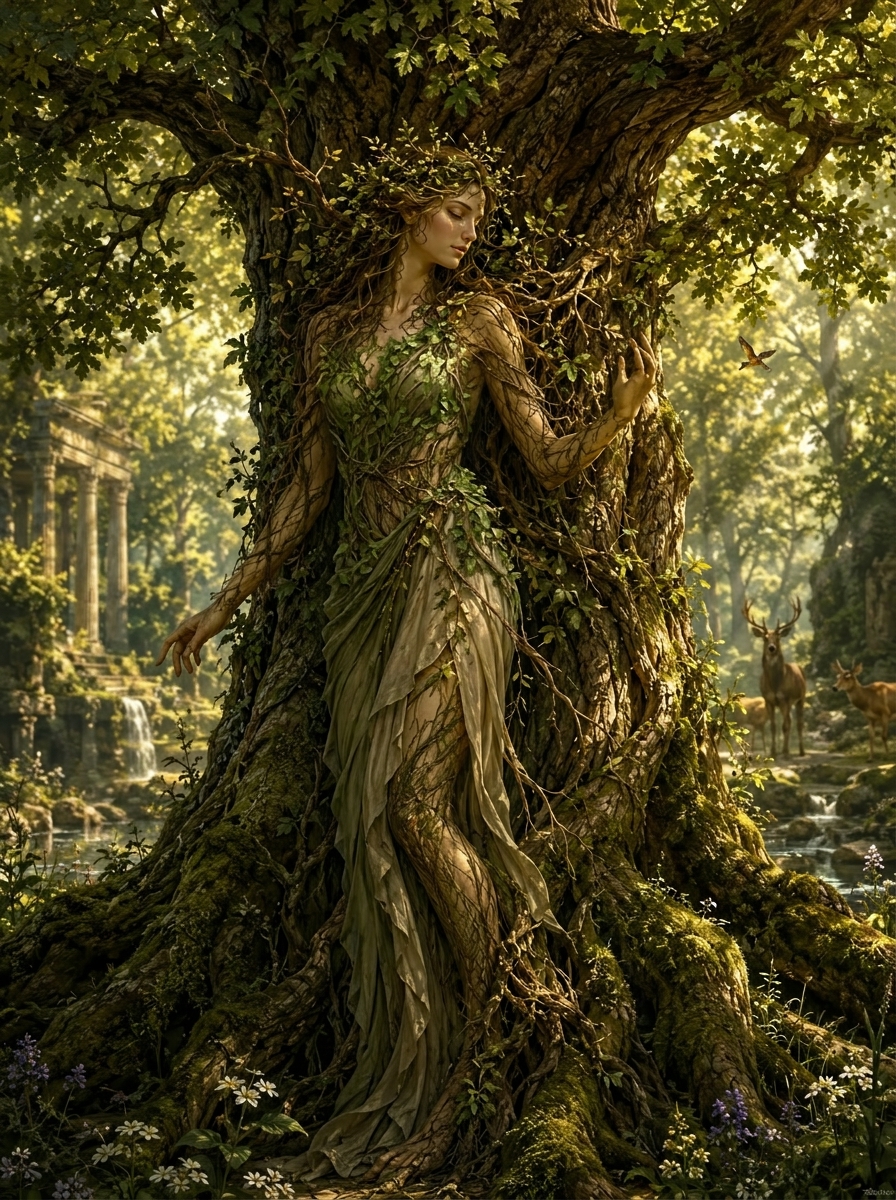
Dryad
Tree Nymph of Greek Mythology
Names in Other Languages
 드리아드한국어
Dryad · 그리스 신화의 나무 정령
 ドリュアド日本語
Dryad — 森の精霊王
 德律阿得斯繁體中文
Dryad — 森林精靈王
 DryadeDeutsch
Dryad — Waldgeister-König
 DryadeFrançais
Dryad — Roi des Esprits Forestiers
 DríadeEspañol
Dryad — Rey de los Espíritus Forestales
 DríadePortuguês
Dryad — Rei dos Espíritos da Floresta
 DriadaPolski
Dryad — Król Duchów Leśnych
 ДриадаРусский
Dryad — Король Лесных Духов
The Dryad (Greek Dryas, plural Dryades, English Dryad) is the tree nymph (Greek nymphe) of Greek mythology who dwells in forests and trees, originally meaning the spirit dwelling in the oak (drys, drys) but later extended as the general name of the spirit dwelling in all trees — the decisive canonical iconographic figure of the Greek-mythological nature spirit. The etymology derives from the Greek drys (drys, 'oak'), and within the classification of nymphs — Naiad (freshwater), Oceanid (ocean), Nereid (salt sea), Dryad (tree), Oread (mountain) — the Dryad is the decisive canon of the tree. The special canonical figure Hamadryad (Hamadryas, 'with the tree') is the decisive adaptation of the Dryad, permanently bound to a single tree and sharing its life and fate. The decisive literary canon is the Erysichthon canon in lines 738-878 of Book 8 of the Metamorphoses (Metamorphoses) of the Roman poet Ovid (Publius Ovidius Naso, 43 BCE - 17 CE) of c. 8 CE — in which the Thessalian king Erysichthon cuts down the oak of Demeter's sacred grove, killing the Hamadryad, and Demeter sends the spirit of hunger Limos (Limos) to punish him with eternal hunger so that he ultimately eats himself — and the Dryad monster of the 1977 D&D Monster Manual by Gary Gygax (1938-2008) of TSR in the USA, consistent through to 5e (5th Edition) of 2014, is the decisive canon of the modern fantasy RPG tree spirit.
Origin
The iconographic origin is the Greek nature-spirit (numen) belief of the eighth and seventh centuries BCE, and the earliest textual canon is the canon in lines 419-420 of Book 6 of the Iliad of the eighth-century BCE Homer (Homeros) — that the mountain nymphs planted elm trees by the grave of Eetion, father of Andromache — and the canon in the fragments of the Works and Days (Erga kai Hemerai) and the Catalogue of Women of Hesiod (Hesiodos) of c. 700 BCE — that the Hamadryad's lifespan equals nine generations of crows. The etymology of the substantival form Dryas of the Greek drys ('oak') originally meant only the spirit dwelling in the oak, but was later extended as the general name of the spirit dwelling in all trees in the Hymn to Delos of the third-century BCE Alexandrian poet Callimachus (Kallimachos, 310-240 BCE) and the Argonautica of Apollonius Rhodius (Apollonios Rhodios, 295-215 BCE). The decisive textual canon is the Erysichthon canon in lines 738-878 of Book 8 of Ovid's Metamorphoses of c. 8 CE: when the Thessalian king Erysichthon cuts down a great oak of Demeter's sacred grove, the Hamadryad dwelling within it dies and appeals to Demeter; Demeter sends the spirit of hunger Limos to Erysichthon, who suffers eternal hunger, sells all his property and finally his daughter Mestra into slavery, and at last gnaws his own flesh — the decisive canon. The Pomona-Vertumnus canon in lines 622-771 of Book 14 of the same Ovid's Metamorphoses — the love canon of the Latin fruit-tree nymph Pomona and the god of seasons Vertumnus — is the decisive extension canon of the Latin-literary tree spirit, and the Description of Greece of the second-century Greek geographer Pausanias (Pausanias) systematised the Dryad sacred sites across Greece.
Features
- Form of a beautiful woman
- Dwelling in a tree, ageing with the tree
- Skilled in music, dance, and song
- Absolutely protective of her own tree
- May become the lover of gods and heroes
- Hamadryad is permanently bound to a single tree
Stories
Line 419-420 of Book 6 of the Iliad of the eighth-century BCE Homer and the Works and Days of Hesiod of c. 700 BCE are the origins of the Dryad canon, and the third-century BCE Callimachus's Hymn to Delos and the Argonautica of Apollonius Rhodius extended the Alexandrian-school canon. The decisive literary canon is the Erysichthon-Hamadryad canon in lines 738-878 of Book 8 of Ovid's Metamorphoses of c. 8 CE and the Pomona-Vertumnus canon in lines 622-771 of Book 14, and the Description of Greece of the second-century Pausanias systematised the Dryad sacred sites across Greece. Renaissance Italy — Polifilo's Hypnerotomachia Poliphili of 1499 and the paintings of Caravaggio of c. 1593 — settled the Renaissance visual canon of Dryad iconography, and the first line 'light-winged Dryad of the trees' of the 1820 Ode to a Nightingale of the British poet John Keats (1795-1821) decisively settled the English-literary Dryad canon. The 1903 painting Hyacinthus of the British Pre-Raphaelite painter John William Waterhouse (1849-1917) and his 1908 Penelope and the Suitors and other Victorian paintings established the nineteenth-century Dryad visual canon, and the Dryads in the Pastoral Symphony sequence of Beethoven's in the Disney animation Fantasia, released on 13 November 1940 in the USA, and the Dryads in The Lion, the Witch and the Wardrobe of the British author C. S. Lewis (1898-1963) of 1950 settled the global children's-literary Dryad canon of the twentieth century. The Dryad monster of the 1977 D&D Monster Manual by Gygax of TSR in the USA — consistent through to 5e (5th Edition) of 2014 — is the decisive canon of the modern fantasy RPG tree spirit, and the Night Elf Dryad of Blizzard's Diablo of 31 December 1996, Warcraft III of 2002 — an adaptation with deer legs — and the Deku Tree of the 1986 Japanese Nintendo The Legend of Zelda series and others are the twenty-first-century global video-game Dryad canon.
Weakness
The Dryad's weaknesses are: (1) cutting down or death of her tree — the decisive weakness in the Greek-mythological nature-spirit canon that the Dryad vanishes immediately when the tree in which she dwells is cut down or dies, especially the Hamadryad permanently bound to a single tree — the decisive canon in the Erysichthon canon in lines 738-878 of Book 8 of Ovid's Metamorphoses of c. 8 CE; (2) the wrath of Demeter — the decisive retribution canon of the Greek-mythological nature spirit in the canon of Book 8 of Ovid's Metamorphoses, in which Demeter sends the spirit of hunger Limos (Limos) to the killer of the Dryad and punishes him with eternal hunger; (3) environmental binding — the environmental-binding canon of the Greek-mythological nature spirit, that the Dryad cannot leave her own tree or forest; (4) extinction of the species — when all trees of the species become extinct, the entire Dryad of that species weakens and vanishes; (5) human reckless logging — the decisive weakness most vulnerable to human logging and forest destruction; (6) flow of time — the canonical lifespan weakness in the fragment canon of Hesiod's Works and Days that the Hamadryad's lifespan equals nine generations of crows — one generation of crows being 9 years times 9 equals 81 years; (7) wrath of the gods — the canon that the Olympian gods transform the Dryad in the transformation tales, the Pomona canon of Book 14; (8) violation of nature — the canon that humans who profane the Dryad are punished. The decisive canonical finale of the Latin-literary tree-spirit tragedy in lines 771-775 of Book 8 of Ovid's Metamorphoses of c. 8 CE, in which the Hamadryad dies appealing to Demeter, and the first line 'light-winged Dryad of the trees' of the 1820 Ode to a Nightingale of the British poet John Keats is the decisive poetic canon of the English-literary Dryad iconography.
Cultural Significance
The Dryad is not merely a nature-spirit icon but the canonical iconographic figure of the Greek-Western nature-spirit canon, traversing eighth-century BCE Homeric epic, seventh-century BCE Hesiodic Works and Days, third-century BCE Alexandrian-school Callimachus and Apollonius Rhodius, first-century BCE Ovidian Latin poetry, nineteenth-century British Romantic poetry, twentieth-century Disney and C. S. Lewis, and twentieth-century D&D fantasy RPG. The Dryad belief of the sacred grove (temenos) of Greek mythology — the oak grove of Zeus's oracle at Dodona and the oak grove of Apollo at Delphi — is the decisive canon of the nature-spirit belief of the Mycenaean civilization of the Greek Bronze Age (3000-1200 BCE), and the Zeus oracle of Dodona is the decisive canon of Greek oracle belief from the eighth century BCE. The Erysichthon canon in lines 738-878 of Book 8 of Ovid's Metamorphoses of c. 8 CE is, as the decisive canon of Greco-Roman Environmental Justice and nature protection, frequently cited as a canonical text of Ecocriticism in the late twentieth century. The first line 'light-winged Dryad of the trees' of the May 1820 Ode to a Nightingale of the British poet John Keats (1795-1821) is the decisive poetic canon of the English-literary Dryad iconography, and the Dryads in the Pastoral Symphony sequence of Beethoven's Symphony No. 6 in the Disney animation Fantasia, released on 13 November 1940 in the USA — directed by David Hand — are the twentieth-century Disney Dryad visual canon. The Dryads in The Lion, the Witch and the Wardrobe of the British author C. S. Lewis of 1950 and the Ents of The Lord of the Rings (1954-1955) of J. R. R. Tolkien (1892-1973) — though Tolkien himself acknowledged the influence of British Celtic folklore, the Ents are evaluated as an adaptation of the Greek Dryad canon — became the decisive canon of twentieth-century English-literary fantasy, and the Dryad monster of the 1977 Gygax D&D Monster Manual — consistent through to 5e (5th Edition) of 2014 — is the decisive canon of the modern fantasy RPG tree spirit. The Night Elf Dryad — an adaptation with deer legs — of Blizzard Entertainment's PC game Warcraft III: Reign of Chaos, released on 5 November 2002, settled the twenty-first-century global video-game Dryad canon.
In Popular Culture
- Homer, Iliad, Book 6, lines 419-420 (eighth century BCE) — origin of the tree-nymph canon
- Hesiod, Works and Days fragment (c. 700 BCE) — Hamadryad lifespan canon
- Callimachus, Hymn to Delos (third century BCE) — Alexandrian Dryad canon
- Ovid, Metamorphoses, Book 8, lines 738-878 (c. 8 CE) — decisive Erysichthon-Hamadryad canon
- Ovid, Metamorphoses, Book 14, lines 622-771 — Pomona-Vertumnus Latin fruit-tree canon
- Pausanias, Description of Greece (second century CE) — Dryad sacred sites across Greece
- Keats, Ode to a Nightingale (1820) — decisive English-literary Dryad poetic canon
- Disney Fantasia, Beethoven Pastoral Symphony (1940) — Disney Dryad visual canon
- C. S. Lewis, The Lion, the Witch and the Wardrobe (1950) — children's-literary Dryad canon
- Gygax, D&D Monster Manual, Dryad (1977) — decisive fantasy RPG canon
Trivia
The Greek etymology Dryas of Dryad — the substantival form of drys ('oak') — means 'one who dwells in the oak', and the plural Dryades and English Dryad (first attested in 1555) settled as canonical vocabulary. The Hamadryas (Hamadryad) — a compound of hama ('with') and drys ('oak'), meaning 'with the tree' — is the canonical adaptation permanently bound to a single tree. The fragment canon of Hesiod's Works and Days (cited by Plutarch) records that the lifespan of the Hamadryad equals nine generations of crows — one generation of crows being 9 years times 9, about 81 years. The Erysichthon (Greek Erysichthon, 'the one who breaks the earth') canon in lines 738-878 of Book 8 of Ovid's Metamorphoses of c. 8 CE — as the decisive canon of Greek-mythological punishment for the violation of nature — is frequently cited as a canonical text of Ecocriticism in the late twentieth century. The Zeus oracle of Dodona (Dodona) in Epirus in northwestern mainland Greece, which receives Zeus's responses in a great oak grove (drys), is the decisive canon of Greek oracle belief that settled from the eighth century BCE, and is decisively recorded in lines 327-328 of Book 14 and lines 296-297 of Book 19 of Homer's Odyssey. The May 1820 Ode to a Nightingale (80 lines in total) of the British poet John Keats (1795-1821) — written in one hour in the garden of Hampstead in London — is the decisive canonical poem of the English-literary Dryad, with the first line 'light-winged Dryad of the trees'. The Dryads in the Pastoral Symphony sequence of Beethoven's Symphony No. 6, Pastoral, in the Disney animation Fantasia (the first stereo-sound Disney film in history), released on Broadway in New York City on 13 November 1940 — directed by David Hand — are the twentieth-century Disney Dryad visual canon. The Dryad monster of the 1977 D&D Monster Manual (Lake Geneva, Wisconsin, USA) by Gygax of TSR has been the consistent canon of fantasy RPG tree spirit through to 5e (5th Edition) of 2014, for forty years, and the deer-legged Dryad adaptation of Blizzard's Warcraft III of 2002 became the twenty-first-century game canon.
Related

Nymph
General Term for Greek Nature Spirits

Hamadryad
Greek Tree Spirit Bound to a Single Tree

Oread
Mountain Nymph of Greek Mythology
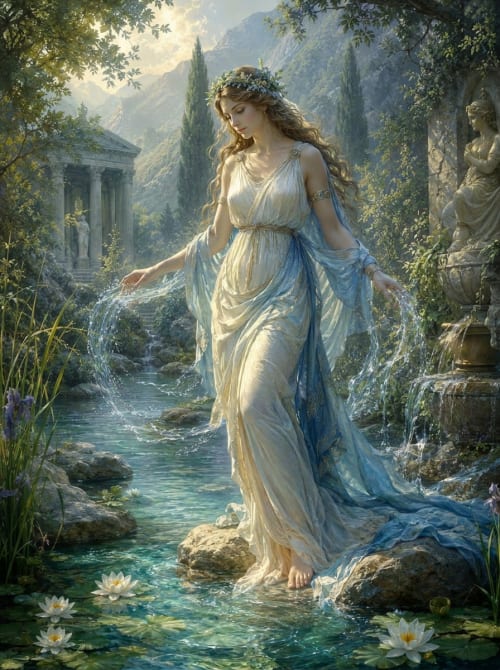
Naiad
Freshwater Nymph of Greek Mythology

Ignis Fatuus
Latin 'Foolish Fire,' Scientific Name for Will-o'-the-Wisp

Ariel
Air Spirit from Shakespeare's The Tempest

Phoenix Spirit
Spirit Form of the Immortal Phoenix

Gnome
Earth Spirit of Paracelsus
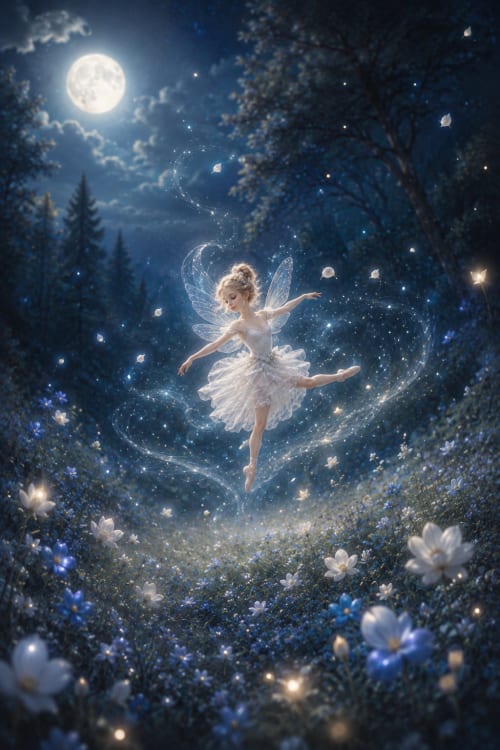
Sylphide
Small Sylph from Pope's The Rape of the Lock

Will-o'-the-Wisp
English Folk Marsh Spirit

Salamander
Fire Spirit of Paracelsus

Jack Frost
Personification of Frost in English/Norse Folklore