Ignis Fatuus
Latin 'Foolish Fire,' Scientific Name for Will-o'-the-Wisp
Names in Other Languages
 이그니스 파투스한국어
Ignis Fatuus · 라틴어 '어리석은 불', 도깨비불의 학명
 イグニス・ファトゥス日本語
Ignis Fatuus · イグニス — 光の精霊王
 伊格尼斯·費特斯繁體中文
Ignis Fatuus · 伊格尼斯 — 光之精靈王
 Ignis FatuusDeutsch
Ignis Fatuus · Ignis — Lichtgeisterkönig
 Ignis FatuusFrançais
Ignis Fatuus · Ignis — Roi Esprit de Lumière
 Ignis FatuusEspañol
Ignis Fatuus · Ignis — Rey Espíritu de Luz
 Ignis FatuusPortuguês
Ignis Fatuus · Ignis — Rei Espírito da Luz
 Ignis FatuusPolski
Ignis Fatuus · Ignis — Król Duchów Światła
 Игнис ФатуусРусский
Ignis Fatuus · Игнис — Король Духов Света
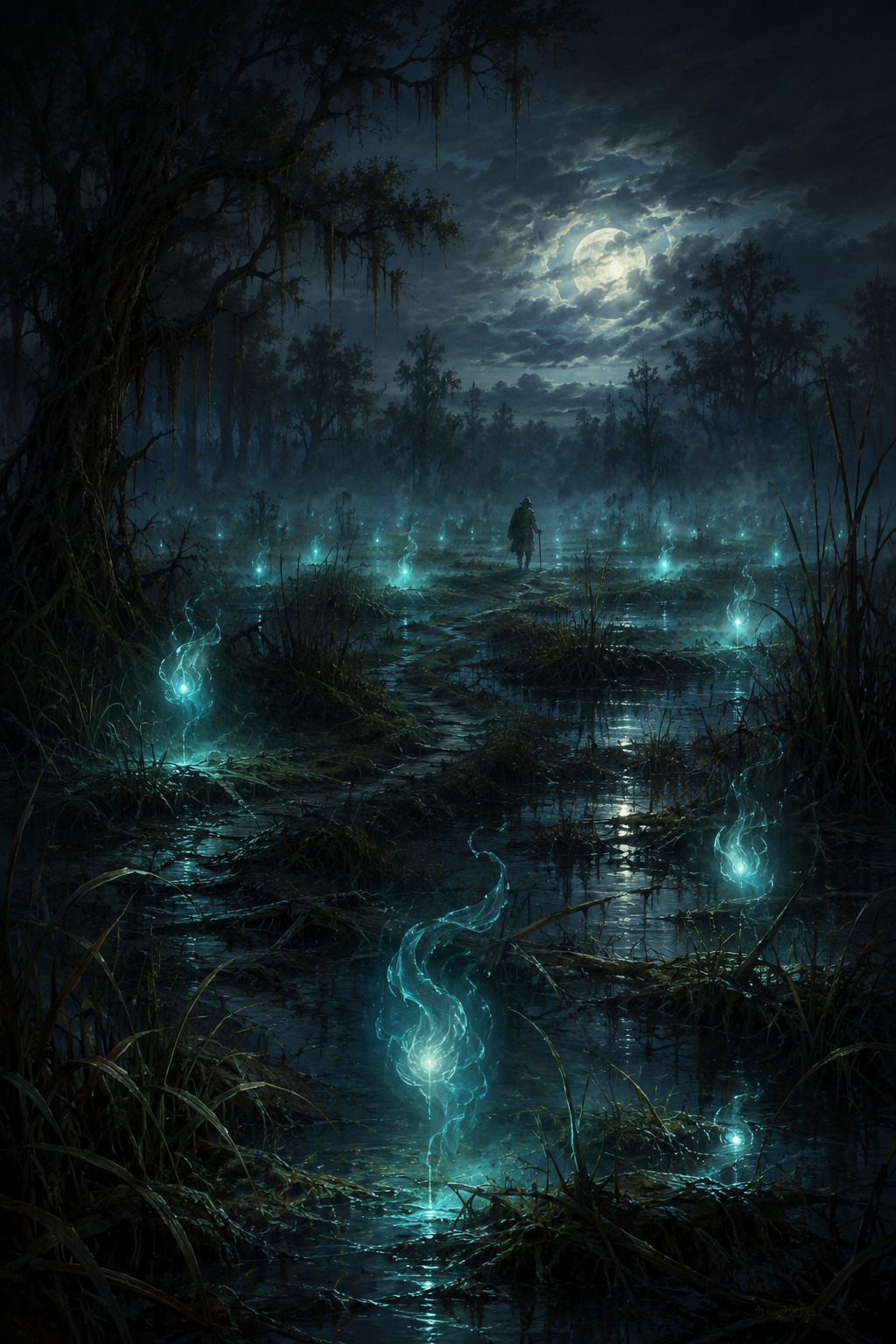
The Ignis Fatuus (Latin ignis fatuus, English ignis fatuus/will-o'-the-wisp, German Irrlicht, French feu follet) is the canonical scientific name for the natural-phosphorescence phenomenon in marshes — Latin 'foolish fire' (ignis 'fire' + fatuus 'foolish') — and the canonical iconography of medieval European folklore and English literature, the blue light presumed to be the natural ignition of marsh methane (CH4) and phosphine (PH3) that lures travelers and causes them to lose their way. The etymology is the combination of the Latin ignis ('fire') and fatuus ('foolish'), and since appearing in the Natural History (Naturalis Historia) of the Roman naturalist Pliny the Elder (Plinius Maior, 23-79 CE) of the 1st century, it settled as the decisive scientific name in 16th-18th-century natural histories. The decisive textual canon is the canon of Act 3 Scene 3 of the historical play Henry IV, Part 1 of the British William Shakespeare (1564-1616) of 1597 — in which Sir Falstaff compares Bardolph's red nose to 'ignis fatuus or a ball of wildfire' — the decisive English-literary entry, and the decisive poetic canon is the canon of lines 634-642 of Book 9 of the epic Paradise Lost of the British poet John Milton (1608-1674) of 1667 — comparing Satan's seduction of Eve to the marsh ignis fatuus — the decisive English-literary canon. The Will-o-Wisp of the 1977 D&D Monster Manual by Gygax of TSR in the USA — consistent through to 5e (5th Edition) of 2014 — is the decisive canon of the modern fantasy RPG will-o'-the-wisp.
Origin
The iconographic origin is the fusion of (1) the natural-ignition phenomenon canon of the Natural History (Naturalis Historia, 37 books in total, 77 CE) of the Roman naturalist Pliny the Elder (Gaius Plinius Secundus, 23-79 CE) of the 1st century, and (2) the folk will-o'-the-wisp traditions of medieval European marshlands — the Fens of eastern Britain, the northern German plain, the Irish bogs, and the Scandinavian marshes. The first decisive textual record of the Latin ignis fatuus ('foolish fire') — in Latin — settled in 16th-century Renaissance natural histories, and since the decisive English-literary entry in Act 3 Scene 3 of the historical play Henry IV, Part 1 of the British William Shakespeare (1564-1616) of 1597 — in which Sir Falstaff compares Bardolph's red nose to 'ignis fatuus or a ball of wildfire' — became the English-literary canon. The decisive poetic canon is the canon of lines 634-642 of Book 9 of the epic Paradise Lost (10 books in total in the 1667 first edition, 12 books in the 1674 revised edition) of the British poet John Milton (1608-1674) of 1667 — depicting Satan's seduction of Eve in Eden through the metaphor of 'the marsh ignis fatuus that lures night-travelers into ponds and bogs' — the decisive English-literary canon, and the August 1670 Royal Society report of the British chemist Robert Boyle (1627-1691) — which attempted a chemical analysis of the phosphorescence phenomenon — became the decisive natural-philosophy canon. The Opticks (Opticks) of the British natural philosopher Isaac Newton (1643-1727) of 1704 and the discovery of the element phosphorus ('light-bringer') by the German chemist Hennig Brandt (c. 1630-1710) of c. 1672 were established as the chemical canon of the marsh ignis fatuus.
Features
- Blue phosphorescence of marshes and wetlands
- Presumed natural ignition of marsh methane
- Visible only on dark nights
- Disappears or moves away when approached
- Lures travelers and causes them to lose their way
- Disappears in sunlight and strong wind
Stories
The Natural History canon of the 1st-century Roman naturalist Pliny the Elder is the decisive origin, and the Latin ignis fatuus settled as the decisive scientific name in 16th-century Renaissance natural histories. The decisive English-literary canons are the ignis fatuus comparison of Sir Falstaff in Act 3 Scene 3 of the 1597 Shakespeare's Henry IV, Part 1 and the decisive comparison of Satan and Eve in lines 634-642 of Book 9 of the 1667 John Milton's Paradise Lost, and the August 1670 Royal Society report of the British chemist Robert Boyle (1627-1691) became the canon of chemical analysis of the phosphorescence phenomenon. The Opticks of the British natural philosopher Isaac Newton (1643-1727) of 1704 and the discovery of the element phosphorus by the German chemist Hennig Brandt (c. 1630-1710) of c. 1672 became the 17th-18th-century natural-philosophy canon, and the will-o'-the-wisp tradition of the Kinder- und Hausmaerchen of the German Grimm Brothers (Jacob and Wilhelm) of 1812-1815 and Chapter 17 of Volume 1 of the 1835 Jacob Grimm's scholarly work Deutsche Mythologie systematised the decisive canon of the Germanic folk will-o'-the-wisp (Irrlicht). The Irrlicht appears in the Walpurgis Night scene of the Faust I (published in 1808) of the German poet Johann Wolfgang von Goethe (1749-1832), and the decisive modern canon is the canon of the Dead Marshes (Dead Marshes) of Volume 4 of The Two Towers of The Lord of the Rings of the British author J. R. R. Tolkien (1892-1973) of 1954-1955 — the faces of the dead lured by the will-o'-the-wisp — the decisive canon, and the Will-o-Wisp of the 1977 D&D Monster Manual by Gygax of TSR in the USA — consistent through to 5e (5th Edition) of 2014 — is the decisive canon of the modern fantasy RPG will-o'-the-wisp.
Weakness
The ignis fatuus's weaknesses are: (1) sunlight — the decisive natural canon that, as a natural phosphorescence phenomenon, it disappears immediately in sunlight; (2) strong wind — the decisive natural canon that, as a marsh-methane ignition phenomenon, it scatters in strong wind; (3) firm will — the decisive folk canon in medieval European folklore that a traveler who ignores the will-o'-the-wisp with firm will does not lose his way; (4) faith — the canon in medieval European Catholicism that the cross and faith neutralise the will-o'-the-wisp; (5) not approaching — the decisive canonical iconography that the will-o'-the-wisp disappears or moves away when approached; (6) sacred light — the canon in the canon of Book 9 of Milton's 1667 Paradise Lost and the canon of Goethe's 1808 Faust I that sacred light weakens the will-o'-the-wisp; (7) preservation of the natural environment — the environmental weakness that the will-o'-the-wisp phenomenon persists only when the natural environment of the marsh is preserved; (8) chemical understanding — through the August 1670 Royal Society report of Robert Boyle and the discovery of the element phosphorus by Hennig Brandt of c. 1672, the canon of the Opticks of Isaac Newton of 1704, the natural ignition of marsh methane (CH4) and phosphine (PH3) of the will-o'-the-wisp became the 17th-18th-century natural-philosophy canon, weakening the supernatural canon. The decisive modern canonical finale is the decisive canon of the Dead Marshes of Volume 4 of The Two Towers of Tolkien's 1954-1955 The Lord of the Rings — in which Gollum warns Frodo and Sam not to look at the faces of the dead in the will-o'-the-wisp.
Cultural Significance
The ignis fatuus is not merely a will-o'-the-wisp icon but the canonical iconographic figure of the Western natural-phosphorescence canon traversing the 1st-century Roman Pliny the Elder's Natural History, the 1597 Shakespeare's Henry IV, Part 1, the 1667 John Milton's Paradise Lost, the 1670 Robert Boyle's Royal Society report, the 1704 Isaac Newton's Opticks, the 1808 Goethe's Faust I, the 1835 Jacob Grimm's Deutsche Mythologie, the 1954-1955 Tolkien's The Lord of the Rings, and the 1977 D&D Will-o-Wisp. The Latin ignis fatuus — meaning 'foolish fire' (ignis 'fire' + fatuus 'foolish') in Latin — settled as the decisive scientific name in 16th-century Renaissance natural histories, and the comparison of Sir Falstaff in Act 3 Scene 3 of the historical play Henry IV, Part 1 (first performed at the Globe Theatre in London c. 1597) of the British Shakespeare (1564-1616) of 1597 — to ignis fatuus or a ball of wildfire — is the decisive English-literary entry, and the canon of lines 634-642 of Book 9 of the epic Paradise Lost (10 books in total in the 1667 first edition, 12 books in the 1674 revised edition) of the British poet John Milton (1608-1674) of 1667 — depicting Satan's seduction of Eve in Eden through the metaphor of the marsh ignis fatuus — became the decisive English-literary canon. The decisive chemical event in which the German alchemist Hennig Brandt (c. 1630-1710) of Hamburg, Germany, of c. 1672 — discovered the element phosphorus ('light-bringer') from human urine — and the British chemist Robert Boyle (1627-1691) of Oxford, Britain, in August 1670 — analysed the chemical properties of phosphorus in a Royal Society report — became the decisive canon of 17th-18th-century chemistry and natural philosophy. The canon of the will-o'-the-wisp (Irrlicht) in the Walpurgis Night scene of the Faust I published by Cotta'sche Verlagsbuchhandlung in Tuebingen, Germany in April 1808, and Chapter 17 of Volume 1 of the 1835 scholarly work Deutsche Mythologie by Jacob Grimm — the decisive scholarly canon of the Germanic folk will-o'-the-wisp — became the decisive German canon of the 19th century, and the canon of the Dead Marshes of Volume 4 of The Two Towers of The Lord of the Rings of the British author J. R. R. Tolkien (1892-1973) of 1954-1955 — the faces of the dead lured by the will-o'-the-wisp — became the decisive culminating work of the 20th-century global fantasy will-o'-the-wisp.
In Popular Culture
- Pliny the Elder, Natural History (1st century) — Roman natural-philosophy canon
- Shakespeare, Henry IV, Part 1, Act 3 Scene 3 (1597) — decisive English-literary entry
- John Milton, Paradise Lost, Book 9 lines 634-642 (1667) — decisive English-literary poetic canon
- Robert Boyle, Royal Society report (1670) — chemistry canon
- Hennig Brandt, discovery of element phosphorus (c. 1672) — decisive chemical canon
- Isaac Newton, Opticks (1704) — decisive natural-philosophy canon
- Goethe, Faust I (1808) — decisive German canon
- Jacob Grimm, Deutsche Mythologie, Volume 1 Chapter 17 (1835) — decisive Germanic folk canon
- Tolkien, The Lord of the Rings, The Two Towers, Volume 4 Dead Marshes (1954-1955) — decisive fantasy canon
- Gygax, D&D Monster Manual, Will-o-Wisp (1977) — decisive RPG canon
Trivia
The etymology of ignis fatuus — the Latin ignis ('fire') and fatuus ('foolish') — meaning 'foolish fire' or 'fire that calls fools' — settled as the decisive scientific name in 16th-century Renaissance natural histories. English will-o'-the-wisp (literally 'wisp of the will'), jack-o'-lantern (literally 'jack's lantern'), German Irrlicht (literally 'light of misguidance'), French feu follet (literally 'mad fire'), Swedish lyktgubbe (literally 'lantern old man'), and Korean dokkaebi-bul are canonical vocabulary referring to the same natural phenomenon. In Act 3 Scene 3 of the 1597 historical play Henry IV, Part 1 of the British Shakespeare (1564-1616) — in which Sir Falstaff compares the drunken red nose of Bardolph (Bardolph) to 'ignis fatuus or a ball of wildfire' — is the decisive English-literary entry, and in lines 634-642 of Book 9 of the epic Paradise Lost (10 books in total in the 1667 first edition, 12 books in the 1674 revised edition) of John Milton (1608-1674) of 1667 — depicting Satan's seduction of Eve through the metaphor of 'a soft flame made of clammy vapor risen from the low marshes — the ignis fatuus calls — and the night-traveler loses his way and falls into deep ponds and bogs' — is the decisive canon of English-literary poetry. The decisive chemical event in which the German alchemist Hennig Brandt (c. 1630-1710) of Hamburg, Germany, of c. 1672 — evaporated 60 buckets of human urine to discover the element phosphorus (from Greek phos 'light' + phoros 'bringing') — was the decisive discovery of the chemical canon of the marsh ignis fatuus, and on 30 November 1672 in the British Royal Society — Hennig Brandt's discovery of the element phosphorus was decisively publicised. In the Walpurgis Night scene (lines 3,835-4,222) of the Faust I (6,036 lines in total) of Goethe (1749-1832) published in April 1808 by Cotta'sche Verlagsbuchhandlung in Tuebingen, Germany, the will-o'-the-wisp (Irrlicht) appears as a decisive canonical character with Mephistopheles and Faust. The canon of the Dead Marshes (The Passage of the Marshes) of Chapter 2 of Volume 4 of The Two Towers of The Lord of the Rings of the British J. R. R. Tolkien (1892-1973) published in Britain on 29 July 1954 — the faces of the dead lured by the will-o'-the-wisp — is evaluated as the decisive canon inspired by Tolkien's direct combat experience at the Battle of the Somme (July-November 1916) in Britain, and the 18 December 2002 USA-released film The Lord of the Rings: The Two Towers of director Peter Jackson (worldwide box office about 947 million dollars) became the decisive visual canon.
Related

Phoenix Spirit
Spirit Form of the Immortal Phoenix

Oread
Mountain Nymph of Greek Mythology

Will-o'-the-Wisp
English Folk Marsh Spirit
Naiad
Freshwater Nymph of Greek Mythology

Ariel
Air Spirit from Shakespeare's The Tempest
Dryad
Tree Nymph of Greek Mythology
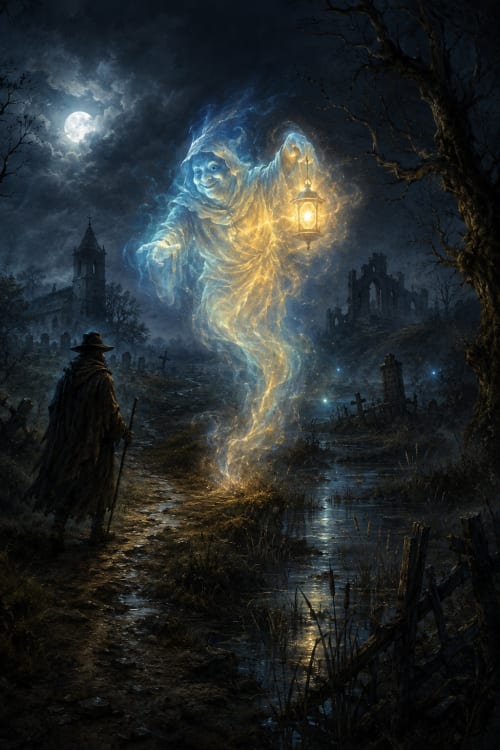
Friar's Lantern
English Folk Will-o'-the-Wisp

Salamander
Fire Spirit of Paracelsus

Fire-drake
Fire Dragon of Beowulf and Norse Myth

Nymph
General Term for Greek Nature Spirits

Sylphide
Small Sylph from Pope's The Rape of the Lock

Gnome
Earth Spirit of Paracelsus