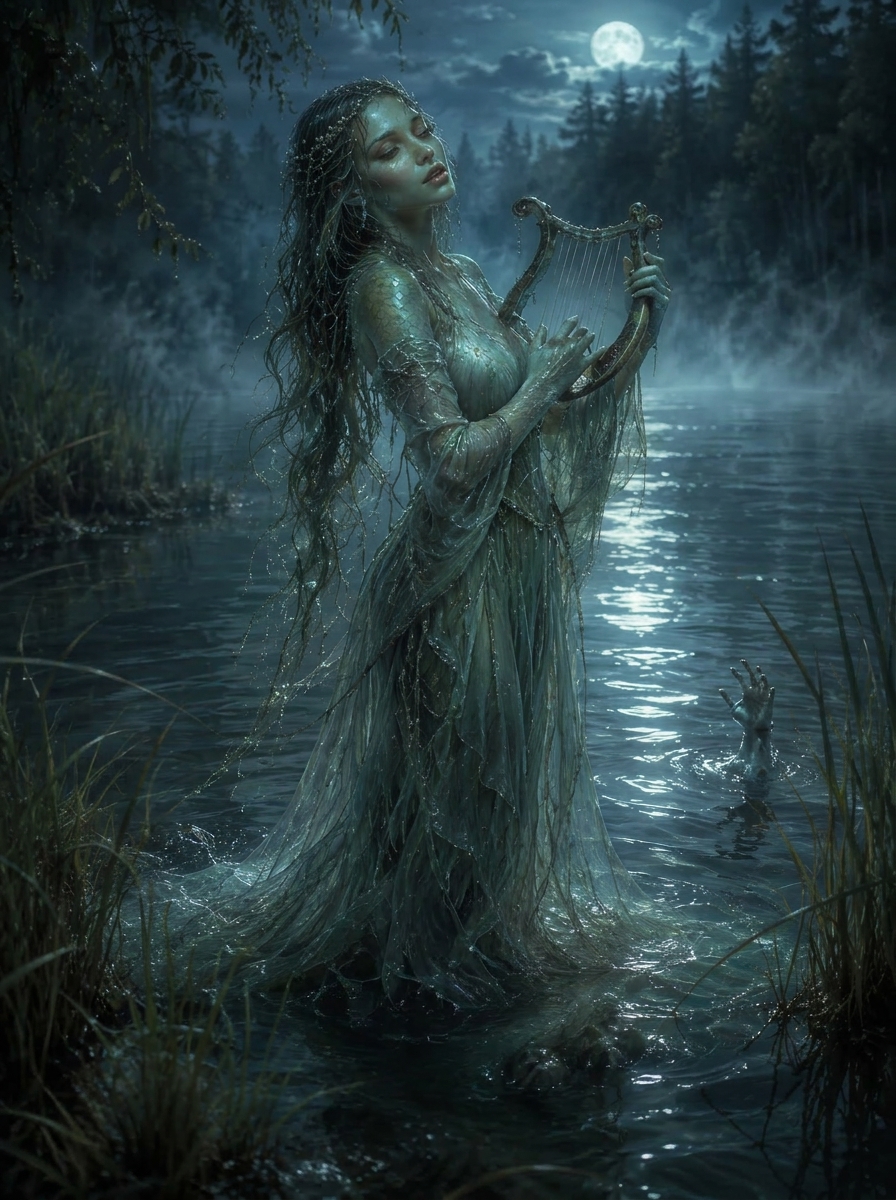
Nix
Water Spirit of Germanic/Slavic Folklore
Names in Other Languages
 닉스한국어
닉스한국어Nix · 게르만·슬라브 민담의 물의 정령
 ニクス日本語
Nix · ナイアス · ウンディーネ — 下位の水の精霊
 尼克斯繁體中文
Nix · 奈阿斯 · 溫蒂妮 — 下位水之精靈
 NixDeutsch
Nix · Naias · Undine — Niederer Wassergeist
 NixFrançais
Nix · Naias · Ondine — Esprit d'Eau Inférieur
 NixEspañol
Nix · Naias · Undine — Espíritu de Agua Menor
 NixPortuguês
Nix · Naias · Ondina — Espírito d'Água Menor
 NixPolski
Nix · Naias · Undine — Niższy Duch Wody
 НиксРусский
Никс · Наяда · Ундина — Низший Дух Воды
The Nix (Old English nicor, Old Norse nykr, German Nix/Nixe, English Nix or Nixie) is the canonical iconographic figure of the water spirit of Germanic and Slavic folklore dwelling in fresh water — rivers, lakes, and wells — appearing in alluring human form (mostly as beautiful women or handsome men) and luring humans into the water through music and song, with the true form being canonical iconography of a fish-tail, fish-scales, or green skin. The etymology derives from the Proto-Indo-European *neigw- ('to wash, purify') through the Proto-Germanic *nikwiz — the canonical vocabulary of Old English nicor, Old Norse nykr, and Old High German nihhus. The decisive textual canon is line 422 of Book 1 and line 1427 of Book 2 of the Old English epic Beowulf (Beowulf) by an anonymous author of the 8th-10th centuries — the water-monsters 'nicras' in the lake where the hero Beowulf fights Grendel's mother with the sword Hrunting — the decisive origin of the Germanic canon, and the canon of tale 79 The Nixie of the Mill-Pond (Die Nixe im Teich) of the Kinder- und Hausmaerchen of the German Grimm Brothers (Jacob and Wilhelm) of 1812-1815 is the decisive canon of the 19th-century German fairy-tale Nix. The 1779 poem The Fisherman (Der Fischer) of the German poet Johann Wolfgang von Goethe (1749-1832) and the 1824 poem The Loreley (Die Loreley) of the German poet Heinrich Heine (1797-1856) established the 19th-century German Romantic Nix poetic canon, and the opera Rusalka by the Czech composer Antonin Dvorak (1841-1904), premiered on 31 March 1901 at the National Theatre in Prague, is the decisive musical canon of the Slavic Nix canon.
Origin
The iconographic origin derives from the Proto-Germanic *nikwiz ('water spirit'), and the earliest textual canon is the canon of line 422 of Book 1 of the Old English epic Beowulf (Beowulf) by an anonymous author of the 8th-10th centuries — in which the hero Beowulf fights the 'nicras' (water monsters) — and the canon of line 1427 of Book 2 — the water-monsters in the lake where Grendel's mother dwells. The 8th-10th-century Old English nicor and the canon of the Skaldskaparmal (Language of Poetry) of the Prose Edda (Snorra Edda) of the Icelandic poet Snorri Sturluson (1179-1241) of c. 1230 — the Old Norse nykr (water spirit) — are the decisive origin of the Germanic Nix iconography. The decisive textual canon is tale 79 The Nixie of the Mill-Pond (Die Nixe im Teich) of the Kinder- und Hausmaerchen of the German Grimm Brothers (Jacob 1785-1863, Wilhelm 1786-1859) of 1812-1815 — the canon in which the son of a poor miller, taken by the Nix of the lake through his father's promise, and his faithful wife deceive the Nix with a magic comb, flute, and golden thread and escape — and Chapter 17 of Volume 1 of the 1835 scholarly work Deutsche Mythologie (German Mythology) by Jacob Grimm systematised the decisive canon of the Germanic folk Nix-Nichu-Neuk-Nickelmann. The 21 August 1779 poem The Fisherman (Der Fischer) of the German poet Johann Wolfgang von Goethe (1749-1832) — in which the fisherman is drawn by the alluring water-spirit of the lake — and the 1824 poem The Loreley (Die Loreley) of the German poet Heinrich Heine (1797-1856) — in which a blonde beauty on the rocks of the Rhine lures sailors with her song — decisively established the 19th-century German Romantic Nix poetic canon.
Features
- Alluring human form (mostly beautiful women or handsome men)
- True form has fish-tail, fish-scales, or green skin
- Lures humans into the water through music and song
- Collects the souls of the drowned
- Shapeshifting ability
- Weak outside the water
Stories
The canon of line 422 of Book 1 and line 1427 of Book 2 of Beowulf by an anonymous author of the 8th-10th centuries — the Germanic nicor canon — is the decisive origin, and the canon of Old Norse nykr in the Skaldskaparmal of Snorri's Prose Edda of c. 1230 is the decisive canon of the Germanic Nix iconography. The decisive textual canon is the Nix canon of tale 79 The Nixie of the Mill-Pond of the 1812-1815 Grimm Brothers' Kinder- und Hausmaerchen and Chapter 17 of Volume 1 of the 1835 Jacob Grimm's scholarly work Deutsche Mythologie, and the 21 August 1779 poem The Fisherman of Goethe (1749-1832) and the 1824 poem The Loreley of Heinrich Heine (1797-1856) — about a 130-meter-high slate rock near Boppard on the German Rhine — established the 19th-century German Romantic Nix poetic canon. The 7 April 1837 The Little Mermaid (Den lille Havfrue) of the Danish fairy-tale writer Hans Christian Andersen (1805-1875) — adapting the Nix canon into Andersen's sad fairy tale — became the decisive Andersen canon, and the opera Rusalka (opus 114, 3 acts, libretto by Jaroslav Kvapil) of the Czech composer Antonin Dvorak (1841-1904), premiered at the National Theatre in Prague on 31 March 1901 — based on the Slavic folk Rusalka (a Slavic variant of the Nix) — is the decisive Slavic Nix musical canon. The decisive modern visual canon is the 1907 painting The Water Nymphs of the British Pre-Raphaelite painter John William Waterhouse (1849-1917) and his 1909 A Mermaid (held by the Royal Academy of Arts in Britain), establishing the Victorian Nix visual canon, and the Nixie of the 1977 D&D Monster Manual by Gygax of TSR in the USA — consistent through to 5e (5th Edition) of 2014 — is the modern fantasy RPG Nix canon.
Weakness
The Nix's weaknesses are: (1) weak outside the water — the decisive environmental-binding canon in Germanic and Slavic folklore that the Nix weakens when she leaves her water (fresh water), and the decisive canon in tale 79 of the 1812-1815 Grimm Brothers' Kinder- und Hausmaerchen that the Nix cannot leave the lake; (2) iron — the decisive canon in Germanic folklore that the Nix fears iron — a general weakness canon in Western fairy iconography; (3) salt — the canon in Germanic folklore that the Nix fears salt; (4) cross and sacred song — the canon in medieval European Catholicism — and the Grimm Brothers' canon — that the cross and hymns can drive away the Nix; (5) magical implements — the decisive canonical weakness in tale 79 The Nixie of the Mill-Pond of the 1812-1815 Grimm Brothers' Kinder- und Hausmaerchen that the faithful wife deceives the Nix with a magic comb (hair), flute (song), and golden thread (yarn) to save her husband; (6) broken promises — the canon in the Grimm Brothers that humans who break promises with the Nix are punished but ultimately the promise is undone; (7) true love — the decisive Andersen tragic canon in the 1837 Andersen's The Little Mermaid that the Nix (the mermaid) does not receive the true love of the human prince and transforms into foam; (8) the light of dawn — the canon in Germanic folklore that the Nix weakens in the light of dawn. The decisive Romantic canonical finale of the 1824 The Loreley of the German poet Heinrich Heine (1797-1856) — in which a blonde beauty on the rocks of the Rhine lures sailors with her song and their boat runs aground and they die — is the decisive canon of the 19th-century German Nix tragedy, and the canonical finale of the 1837 Andersen's The Little Mermaid — in which the mermaid transforms into foam — is the decisive finale of the 19th-century Danish Nix canon.
Cultural Significance
The Nix is not merely a water-spirit icon but the canonical iconographic figure of the Germanic-Slavic water-spirit canon traversing the 8th-10th-century Old English Beowulf's nicor, c. 1230 Snorri's Prose Edda's nykr, the 1812-1815 Grimm Brothers' Kinder- und Hausmaerchen, the 1835 Jacob Grimm's Deutsche Mythologie, the 1779 Goethe's The Fisherman, the 1824 Heinrich Heine's The Loreley, the 1837 Andersen's The Little Mermaid, the 1901 Dvorak's opera Rusalka, the 1907-1909 Waterhouse's paintings, and the 1977 D&D fantasy RPG. The canonical vocabulary of Old English nicor, Old Norse nykr, Old High German nihhus, and Middle High German nickes, derived from the Proto-Germanic *nikwiz ('water spirit'), is the decisive canon of Germanic folklore, and tale 79 The Nixie of the Mill-Pond of the Kinder- und Hausmaerchen (7 editions, 200+ tales by 1857) of the Grimm Brothers (Jacob 1785-1863, Wilhelm 1786-1859) first published on 20 December 1812 in Kassel, Germany, is the decisive culminating work of the 19th-century German fairy-tale Nix canon. Chapter 17 of Volume 1 of the 1835 scholarly work Deutsche Mythologie of Jacob Grimm — Jacob Grimm's systematisation of comparative-mythological study of Germanic mythology and folklore — became the decisive scholarly canon and the decisive canon of 19th-century German folklore studies. The 21 August 1779 poem The Fisherman (Der Fischer) of Goethe (1749-1832) and the 1824 poem The Loreley of Heine (1797-1856) (about a 130-meter-high slate rock near Boppard on the German Rhine) are the decisive canons of 19th-century German Romantic poetry, and the 7 April 1837 The Little Mermaid (Den lille Havfrue) of Andersen (1805-1875) published in Copenhagen — adapting the Nix canon into Andersen's sad fairy tale — became the decisive canon of 19th-century Danish fairy tale, and the 1989 Disney animation The Little Mermaid (worldwide box office of about 211 million dollars) achieved a 20th-century global adaptation.
In Popular Culture
- Beowulf, Book 1 line 422 and Book 2 line 1427 (8th-10th centuries) — decisive Germanic nicor canonical origin
- Snorri, Prose Edda, Skaldskaparmal (c. 1230) — decisive Old Norse nykr canon
- Grimm Brothers, Kinder- und Hausmaerchen, tale 79 The Nixie of the Mill-Pond (1812-1815) — decisive German fairy-tale canon
- Jacob Grimm, Deutsche Mythologie, Volume 1 Chapter 17 (1835) — decisive Germanic mythological Nix canon
- Goethe, poem The Fisherman (1779) — German Romantic poetic canon
- Heinrich Heine, poem The Loreley (1824) — decisive Rhine poetic canon
- Andersen, The Little Mermaid (1837) — decisive Danish fairy-tale canon
- Dvorak, opera Rusalka (1901) — decisive Slavic musical canon
- Waterhouse, paintings The Water Nymphs and A Mermaid (1907-1909) — Victorian visual canon
- Gygax, D&D Monster Manual, Nixie (1977) — fantasy RPG canon
Trivia
The etymology of Nix — the Proto-Germanic *nikwiz, derived from the Proto-Indo-European *neigw- ('to wash, purify') — is the canonical vocabulary of Old English nicor, Old Norse nykr, and Old High German nihhus, and the English Nix (first attested in 1833) and Nixie (1816) and the German Nix/Nixe (settled from Middle High German nickes) are canonical vocabulary. In line 422 of Book 1 and line 1427 of Book 2 of the Old English epic Beowulf (3,182 lines in total) composed in the 8th-10th centuries — the decisive canonical record of the hero Beowulf fighting the 'nicras' (water monsters) in the lake where Grendel's mother dwells — is the decisive origin of the Germanic Nix iconography. Tale 79 The Nixie of the Mill-Pond (Die Nixe im Teich) of the Kinder- und Hausmaerchen of the Grimm Brothers first published on 20 December 1812 in Kassel, Germany — the Grimm Brothers organising the folklore around Kassel in Hesse — is the decisive canonical fairy tale in which the faithful wife deceives the Nix with a magic comb, flute, and golden thread to save her husband taken by the lake. The 32-line poem The Fisherman (Der Fischer) written on 21 August 1779 by the German poet Johann Wolfgang von Goethe (1749-1832) at age 23 for the composer Korumuna Neumann's music — in which the fisherman is drawn by the alluring water-spirit of the lake — is the 19th-century German Romantic decisive canonical poem, and Franz Schubert (1797-1828) composed it as art song D.225 in 1815 at age 18. The 1824 poem The Loreley (Die Loreley) of the German poet Heinrich Heine (1797-1856) — about a 130-meter-high slate rock near Boppard on the German Rhine where a blonde beauty lures sailors with her song — became the decisive canonical poem and the decisive German canonical folk song set to music in 1837 by Friedrich Silcher (1789-1860). The opera Rusalka (opus 114, 3 acts, libretto by Jaroslav Kvapil) of the Czech composer Antonin Dvorak (1841-1904), premiered at the National Theatre in Prague on 31 March 1901 — a decisive musical canon of the Slavic folk Rusalka (a Slavic variant of the Nix) — has the aria 'Song to the Moon' (Mesicku na nebi hlubokem) as the decisive aria.
Related

Naiad
Freshwater Nymph of Greek Mythology

Nereid
Fifty Sea Nymph Sisters of Greek Mythology

Undine
Water Spirit of Paracelsus

Nymph
General Term for Greek Nature Spirits

Sylphide
Small Sylph from Pope's The Rape of the Lock

Oread
Mountain Nymph of Greek Mythology

Will-o'-the-Wisp
English Folk Marsh Spirit

Ignis Fatuus
Latin 'Foolish Fire,' Scientific Name for Will-o'-the-Wisp

Salamander
Fire Spirit of Paracelsus

Ariel
Air Spirit from Shakespeare's The Tempest

Dryad
Tree Nymph of Greek Mythology

Gnome
Earth Spirit of Paracelsus