Friar's Lantern
English Folk Will-o'-the-Wisp
Names in Other Languages
 프라이어즈 랜턴한국어
Friar's Lantern · 영국 민담의 도깨비불
 フライアーズ・ランタン日本語
Friar's Lantern · ジャック・オー・ランタン — 下位光の精霊
 修士提燈繁體中文
Friar's Lantern · 傑克南瓜燈 — 下位光之精靈
 Friar's LanternDeutsch
Friar's Lantern · Jack-o'-lantern — Niederer Lichtgeist
 Friar's LanternFrançais
Friar's Lantern · Jack-o'-lantern — Esprit de lumière mineur
 Friar's LanternEspañol
Friar's Lantern · Jack-o'-lantern — Espíritu de luz menor
 Friar's LanternPortuguês
Friar's Lantern · Jack-o'-lantern — Espírito de luz menor
 Friar's LanternPolski
Friar's Lantern · Jack-o'-lantern — Niższy duch światła
 Фонарь МонахаРусский
Friar's Lantern · Джек-о'-фонарь — Низший дух света
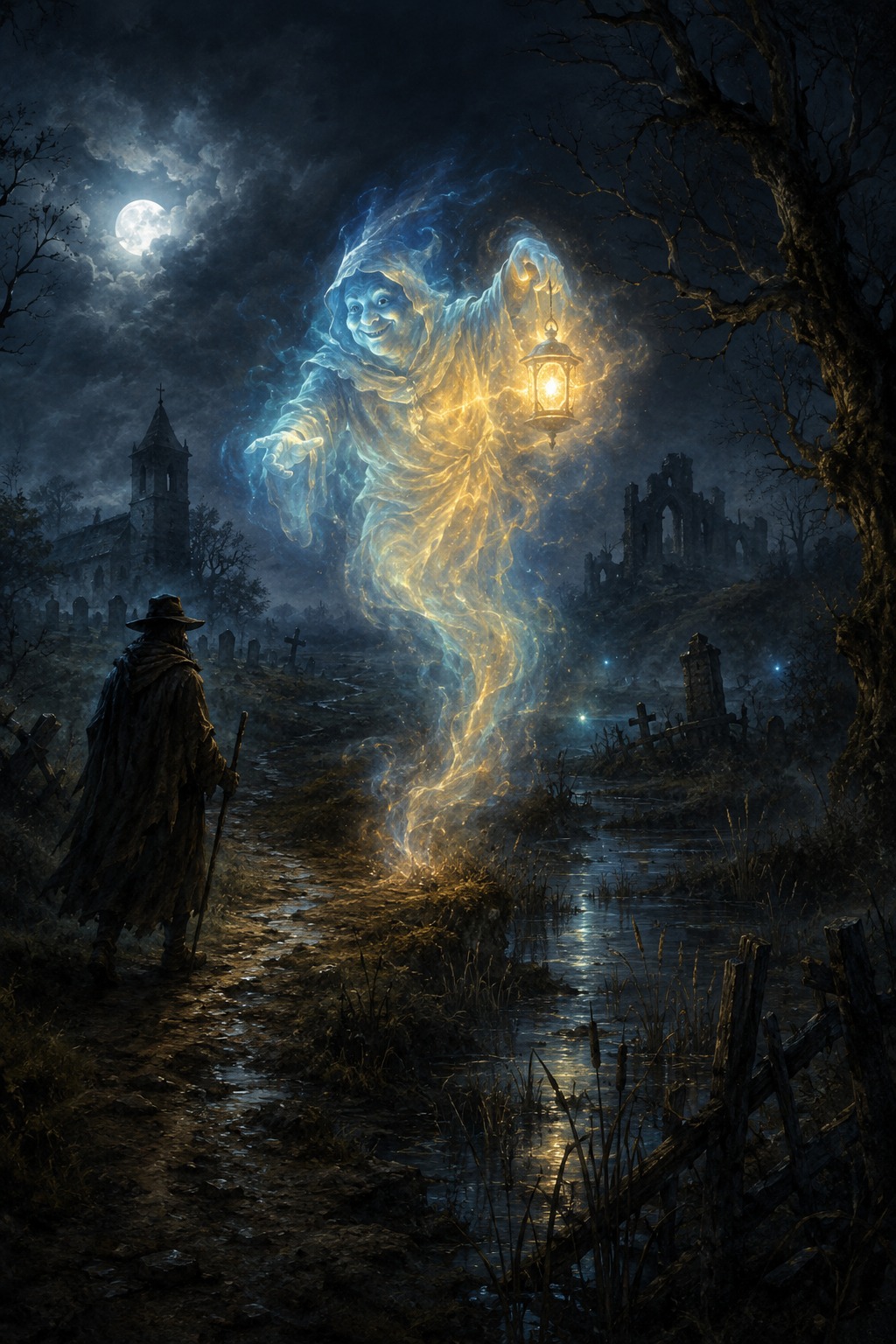
The Friar's Lantern (English Friar's Lantern, 'lantern of the friar') is the decisive canonical variant name of the will-o'-the-wisp of English folklore, with the c. 1568 anonymous prose narrative The History of Friar Rush (The History of Friar Rush) published in England — about the mischievous monk-spirit Friar Rush of 16th-century England — as the decisive etymological canon. It appears as a small flickering light in marshes, moors, and churchyards — in the form of a monk holding a torch or lantern — that lures travellers off their path — the decisive canonical iconography. The decisive literary canon is the 1631 poem L'Allegro (L'Allegro) of the British poet John Milton (John Milton, 1608-1674) line 104 — 'led by the Friar's Lantern' — the decisive event of vocabulary canonisation in English literature, and Act 2 Scene 1 of the 1595-1596 play A Midsummer Night's Dream (A Midsummer Night's Dream) of William Shakespeare (William Shakespeare, 1564-1616) — in which Puck, who is Robin Goodfellow (Robin Goodfellow), says 'I am that merry wanderer of the night' and describes himself as a spirit who misleads travellers — is the decisive English-literary precursor canon to the 1631 Milton canon. It is the decisive will-o'-the-wisp spirit of the same family as the Jack-o'-lantern.
Origin
The iconographic origin combines the will-o'-the-wisp (ignis fatuus) natural phenomenon of English marshes and moors with the mischievous monk-spirit Friar Rush (Friar Rush) of 16th-century England — the decisive canonical variant. The decisive etymological canon is the c. 1568 anonymous prose narrative The History of Friar Rush (The History of Friar Rush) published in England — about the mischievous monk-spirit Friar Rush who infiltrated 16th-century English monasteries — and the 1602 satirical collection Greene's Ghost Haunting Coney-Catchers (Greene's Ghost Haunting Coney-Catchers) of the British writer Samuel Rowlands (Samuel Rowlands, 1573-1630) is the decisive canon of Friar Rush literary adaptation. The decisive literary canon is Act 2 Scene 1 of A Midsummer Night's Dream of the British Shakespeare (William Shakespeare, 1564-1616) of 1595-1596 — in which Puck, who is Robin Goodfellow, says 'I am that merry wanderer of the night. I jest to Oberon' and describes himself as a spirit who misleads travellers — the decisive English-literary canon, and the 1631 poem L'Allegro (L'Allegro) line 104 of John Milton (John Milton, 1608-1674) — 'led by the Friar's Lantern' — first appearing as the decisive English-literary vocabulary canon.
Features
- Small light in moors, meadows, and churchyards
- Form of a monk holding a torch or lantern
- Misleads travellers off their path
- Mischievous and prankish disposition
- Vanishes at dawn
- Can be ignored with firm will
Stories
The c. 1568 English anonymous prose narrative The History of Friar Rush (The History of Friar Rush) — about the mischievous monk-spirit — is the decisive etymological canon, and Act 2 Scene 1 of Shakespeare's A Midsummer Night's Dream of 1595-1596 — the Robin Goodfellow/Puck canon — is the decisive English-literary precursor canon. The decisive vocabulary canon is the 1631 poem L'Allegro (L'Allegro) line 104 of the British poet John Milton (John Milton, 1608-1674) — 'led by the Friar's Lantern' — the decisive event of vocabulary canonisation. The 1602 Samuel Rowlands's Greene's Ghost, the 1828 Letters on Demonology and Witchcraft (Letters on Demonology and Witchcraft) of the British writer Walter Scott (Walter Scott, 1771-1832) — the decisive systematisation of English folk will-o'-the-wisp — and the 1881 Notes on the Folk-Lore of the Northern Counties of England (Notes on the Folk-Lore of the Northern Counties of England) of the British folklorist William Henderson (William Henderson, 1813-1891) are the decisive 19th-century folklore canons. The will-o'-the-wisp synonyms — Jack-o'-lantern (USA), Hobbedy's Lantern (England), Peg-a-Lantern (England), Jenny Burnt-tail (England), Joan-in-the-Wad (Cornwall), Spunkie (Scotland), Hinky Punk (southwest England) — are the decisive British-American canonical vocabulary.
Weakness
The Friar's Lantern's weaknesses are: (1) dawn sunlight — the decisive canonical weakness that the will-o'-the-wisp vanishes at the first sunlight of dawn — the decisive canon; (2) firm will — the canon in Milton's 1631 L'Allegro and English folk canon that if a traveller ignores the will-o'-the-wisp's lure and goes straight, the will-o'-the-wisp's power is dispelled; (3) cross and holy water — the ironic decisive weakness that, despite being in monk form, it is weak against the cross and holy water — the English Catholic folk canon; (4) sacred prayer — the English Catholic folk canon that the Latin Pater noster (Our Father) and Ave Maria (Hail Mary) make the Friar's Lantern vanish; (5) turning a coat inside out — the decisive English folk canonical weakness that wearing one's clothes inside out breaks the will-o'-the-wisp's illusion and allows return to the original path; (6) environmental binding — weakens when leaving marshes or churchyards; (7) the essence of fickleness — cannot stay in one place; (8) human kindness — the canon of duality in Samuel Rowlands's 1602 Greene's Ghost that Friar Rush guides those who are kind to him. The decisive finale is line 104 of Milton's 1631 L'Allegro — the 17th-century English-literary decisive canon in which a traveller is led astray by the Friar's Lantern.
Cultural Significance
The Friar's Lantern is not merely a will-o'-the-wisp icon but the canonical iconographic figure of the decisive English will-o'-the-wisp canon traversing the c. 1568 English anonymous prose The History of Friar Rush, the 1595-1596 Shakespeare's A Midsummer Night's Dream, the 1602 Samuel Rowlands's Greene's Ghost, the 1631 John Milton's L'Allegro, the 1828 Walter Scott's Letters on Demonology and Witchcraft, and the 1881 William Henderson's Notes on the Folk-Lore of the Northern Counties of England. The c. 1568 anonymous prose narrative The History of Friar Rush (The History of Friar Rush) published in England — about the mischievous monk-spirit who infiltrated 16th-century English monasteries — is the decisive etymological canon, and the satirical climate towards Catholic monks immediately after the Reformation had a decisive influence on the establishment of the Friar Rush (Friar Rush) figure. The decisive English-literary canon is the Robin Goodfellow/Puck canon of Act 2 Scene 1 of William Shakespeare's (William Shakespeare, 1564-1616) A Midsummer Night's Dream (A Midsummer Night's Dream) of 1595-1596, and the vocabulary canon of 'And by the Friar's Lantern led' in line 104 of the twin poem L'Allegro (L'Allegro) and Il Penseroso of John Milton (John Milton, 1608-1674) of 1631 became the decisive canon of 17th-century English literature. The 1828 Letters on Demonology and Witchcraft (Letters on Demonology and Witchcraft) of the British writer Walter Scott (Walter Scott, 1771-1832) — the decisive systematisation of English folk will-o'-the-wisp — and the 1881 Notes on the Folk-Lore of the Northern Counties of England (Notes on the Folk-Lore of the Northern Counties of England) of the British folklorist William Henderson (William Henderson, 1813-1891) are the decisive Victorian folklore canons.
In Popular Culture
- Anonymous, The History of Friar Rush (c. 1568) — decisive etymological canon
- Shakespeare, A Midsummer Night's Dream Act 2 Scene 1 (1595-1596) — decisive English-literary canon
- Samuel Rowlands, Greene's Ghost (1602) — decisive satirical canon
- John Milton, L'Allegro line 104 (1631) — decisive vocabulary canon
- Walter Scott, Letters on Demonology and Witchcraft (1828) — decisive folk systematisation
- William Henderson, Notes on the Folk-Lore of the Northern Counties of England (1881) — decisive folklore canon
- Thomas Keightley, The Fairy Mythology (1828) — decisive comparative folklore
- Joseph Jacobs, English Fairy Tales (1890) — Victorian fairy-tale canon
Trivia
The English etymology Friar of Friar's Lantern is derived from the Latin frater ('brother') through Middle English frere — the decisive canonical vocabulary for a Catholic mendicant monk — and Lantern is the decisive canonical vocabulary through the Greek lampter ('torch') and the Latin lanterna. The will-o'-the-wisp synonyms — Will-o'-the-wisp (England), Ignis fatuus (Latin scientific name), Jack-o'-lantern (USA), Hobbedy's Lantern (Warwickshire, England), Peg-a-Lantern (Lancashire, England), Jenny Burnt-tail (Oxfordshire, England), Joan-in-the-Wad (Cornwall), Spunkie (Scotland), Hinky Punk (Somerset, Devon, England), Coalpit (England), Pinket (Warwickshire, England) — are the decisive English regional canonical vocabulary. The c. 1568 anonymous prose narrative The History of Friar Rush (The History of Friar Rush) published in England — in the satirical climate towards Catholic monks after the Reformation (begun in 1517) — became the decisive canon, and line 104 of the twin poem L'Allegro (L'Allegro) of the British poet John Milton (John Milton, born 9 December 1608 in London, died 8 November 1674 in London), written at age 21 while at Christ's College, Cambridge in 1631 — 'led by the Friar's Lantern' — is the decisive canon. Shakespeare's A Midsummer Night's Dream (A Midsummer Night's Dream) (written 1595-1596) Act 2 Scene 1 lines 32-57 — in which a fairy asks Puck, who is Robin Goodfellow (Robin Goodfellow), 'Are not you he that frights the maidens of the villagery, mislead night-wanderers, laughing at their harm?' — is the decisive English-literary canon compatible with the Friar Rush canon.
Related

Ignis Fatuus
Latin 'Foolish Fire,' Scientific Name for Will-o'-the-Wisp

Will-o'-the-Wisp
English Folk Marsh Spirit

Nymph
General Term for Greek Nature Spirits
Sylphide
Small Sylph from Pope's The Rape of the Lock

Oread
Mountain Nymph of Greek Mythology
Naiad
Freshwater Nymph of Greek Mythology

Salamander
Fire Spirit of Paracelsus

Ariel
Air Spirit from Shakespeare's The Tempest
Dryad
Tree Nymph of Greek Mythology

Gnome
Earth Spirit of Paracelsus

Jack Frost
Personification of Frost in English/Norse Folklore

Fire-drake
Fire Dragon of Beowulf and Norse Myth