Blue Dragon
Lightning Lord of the Desert
Names in Other Languages
 블루 드래곤한국어
Blue Dragon · 사막의 번개 영주
 ブルードラゴン日本語
Blue Dragon · 砂漠の雷の君主
 藍龍繁體中文
Blue Dragon · 沙漠的雷霆之主
 Blauer DracheDeutsch
Blue Dragon · Blitzfürst der Wüste
 Dragon BleuFrançais
Blue Dragon · Seigneur de la foudre du désert
 Dragón AzulEspañol
Blue Dragon · Señor del relámpago del desierto
 Dragão AzulPortuguês
Blue Dragon · Senhor do relâmpago do deserto
 Niebieski SmokPolski
Blue Dragon · Władca błyskawic pustyni
 Синий драконРусский
Blue Dragon · Повелитель молний пустыни
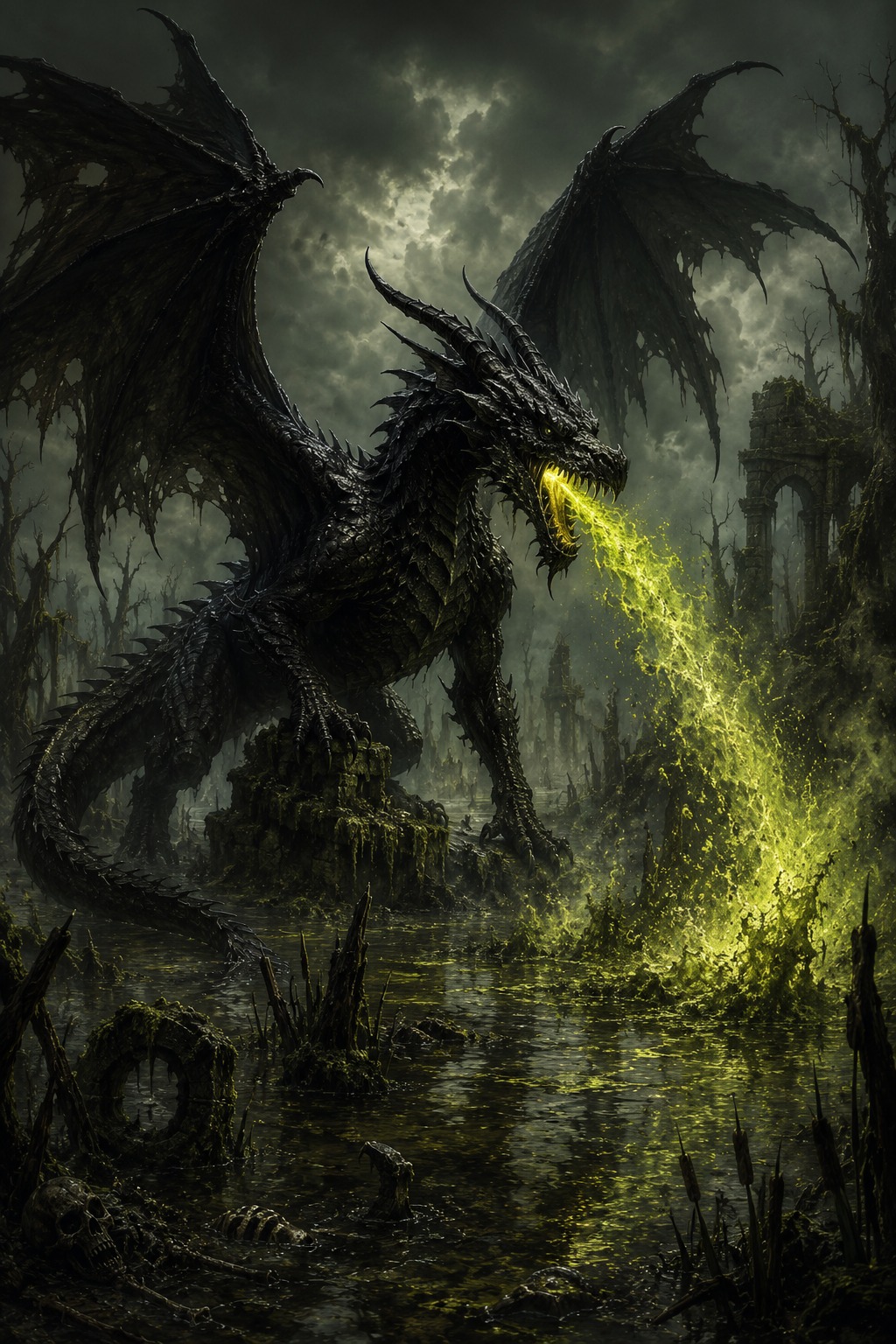
The Blue Dragon is one of the five chromatic (evil) dragons in Dungeons & Dragons, introduced in the 1974 original boxed set by Gary Gygax and Dave Arneson and locked to Lawful Evil alignment from the 1977 AD&D Monster Manual onward. It is recognised by its azure scales and the single massive horn rising from its snout, and it exhales a 60-foot line of lightning rated at 12d10 damage in the 2014 fifth-edition Monster Manual. Among the chromatic dragons it is the most territorial and methodical, ruling desert tribes and nomadic peoples through hallucinations, mirages and divine impersonation in canon supplements from AD&D through fifth edition. The same creature appears in Mike Carr's 'In Search of the Unknown' (1979), the Dragonlance Chronicles by Tracy Hickman and Margaret Weis, and the desert encounters of Baldur's Gate 3 (2023) with consistent silhouette and lore.
Origin
The direct source is the 1974 Dungeons & Dragons 'Monsters & Treasure' booklet from TSR, where Gygax and Arneson distributed five evil dragons by colour and assigned the desert role to the blue variant. The 1977 AD&D Monster Manual fixed its lightning breath, single horn and Lawful Evil alignment, and the 1983 Dragonlance Chronicles popularised the desert-overlord image through named individuals such as Skie. The deeper mythic substrate is the storm-god complex of the ancient Near East — Mesopotamian Adad and Iškur, Ugaritic Baʿal Hadad — and Saharan-Arabian sandstorm folklore, fused into a single chromatic archetype. 'Fizban's Treasury of Dragons' (2021) added a creation-myth ancestor named Sakrasar to formalise the species' cosmology.
Features
- Solitary overlord of vast deserts and arid wastes
- Azure scales and a single massive horn on the snout, with sand-coloured belly
- 60-foot line of lightning breath, 12d10 damage in fifth edition
- Master of illusion, mirage and mind-control magic, posing as a god to desert tribes
- Swims through sand by burrowing, preferring ambush and assassination
- Lawful Evil alignment that pulls it into politics, intrigue and slave trade
Stories
A classic high-tier solo encounter in tabletop campaigns set in deserts, used as the apex antagonist of an arid region. From AD&D through fifth edition it has been the textbook 'schemer' chromatic dragon, leading with illusion, interrogation and theocratic politics rather than open melee.
Weakness
Water and humid climates dampen its flight and burrow speed, and divination magic such as detect truth dismantles its illusion and impersonation strategies. The single horn doubles as a vulnerable target in close combat.
Cultural Significance
Sand-storm and lightning deities of the ancient Near East, together with Bedouin desert-demon traditions, were absorbed into D&D's colour-coded taxonomy and produced the modern Anglo-fantasy 'desert overlord' boss archetype.
In Popular Culture
TSR D&D original set (1974), AD&D Monster Manual (1977), Dragonlance Chronicles (1983-85), fifth-edition Monster Manual (2014), Fizban's Treasury of Dragons (2021) and Baldur's Gate 3 (2023).
Trivia
Fizban's Treasury names Sakrasar as the mythic ancestor of blue dragons, while Skie from Dragonlance remains the most famous named individual of the species.