Red Dragon
The Tyrant of Flame
Names in Other Languages
 레드 드래곤한국어
Red Dragon · 화염을 뿜는 폭군
 レッドドラゴン日本語
Red Dragon · 炎を吐く暴君
 紅龍繁體中文
Red Dragon · 噴吐烈焰的暴君
 Roter DracheDeutsch
Red Dragon · Flammenspeiender Tyrann
 Dragon RougeFrançais
Red Dragon · Tyran cracheur de flammes
 Dragón RojoEspañol
Red Dragon · Tirano que escupe llamas
 Dragão VermelhoPortuguês
Red Dragon · Tirano que cospe chamas
 Czerwony SmokPolski
Red Dragon · Tyran zionący ogniem
 Красный драконРусский
Red Dragon · Изрыгающий пламя тиран
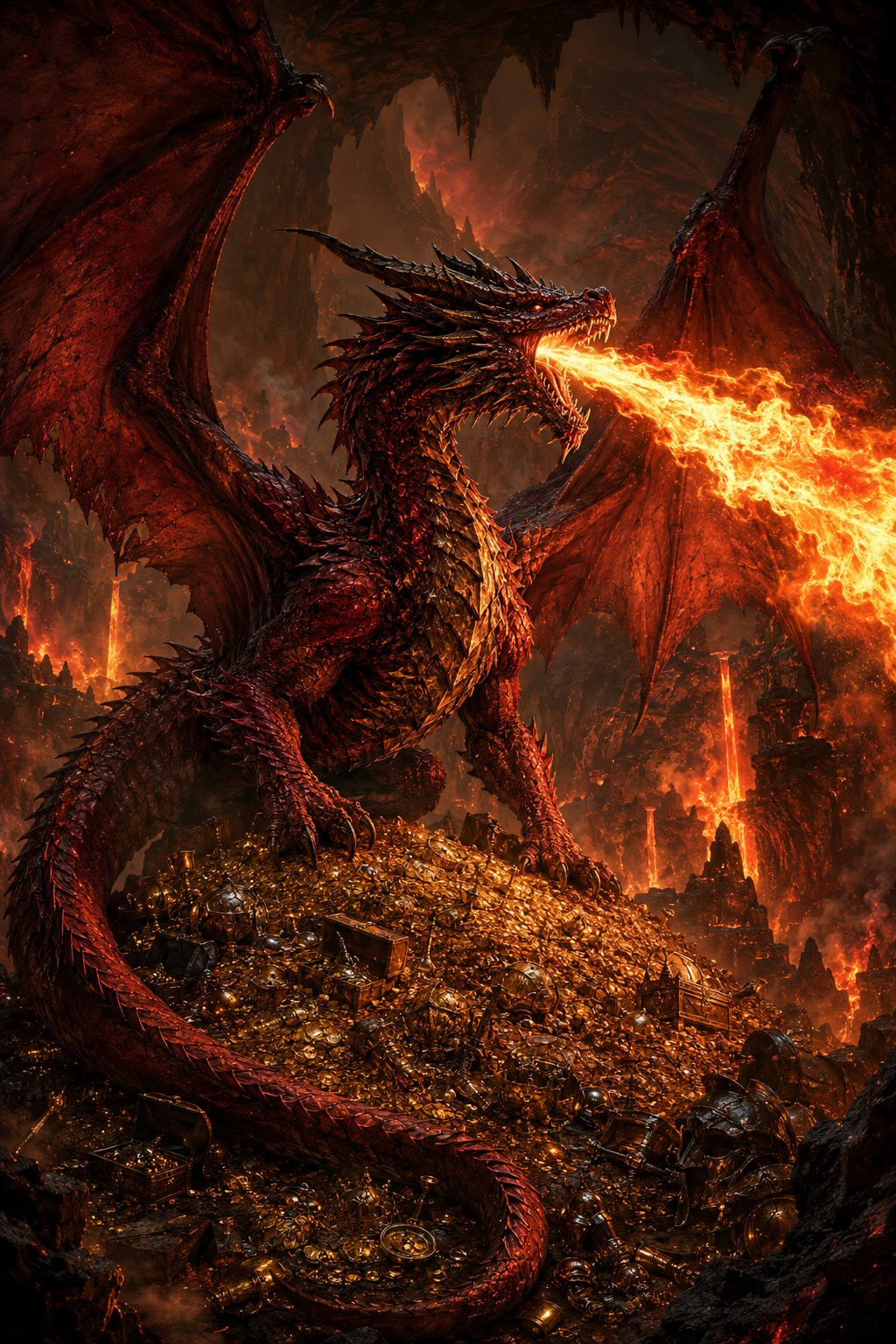
The Red Dragon is the apex of the five chromatic (evil) dragons in Dungeons & Dragons and the most iconic dragon image of Western fantasy. Introduced as the volcanic, mountain-dwelling apex in the 1974 D&D original boxed set's 'Monsters & Treasure' booklet by Gary Gygax and Dave Arneson, it has been locked to Chaotic Evil alignment since the 1977 AD&D Monster Manual. In the 2014 fifth-edition Monster Manual an Adult Red Dragon is 25 to 30 metres long, challenge rating 17, with a sixty-foot cone of fire breath dealing 18d6 damage, while the Ancient Red Dragon is CR 24 with a ninety-foot cone and 26d6 damage. The modern canonical image is Smaug from J.R.R. Tolkien's 'The Hobbit' (1937) — the crimson dragon coiled on the treasure-heap of the Lonely Mountain (Erebor) — and the AD&D colour-coded taxonomy is widely held to take Smaug as its direct visual template. The same lineage carries through Takhisis, the Dark Queen of Dragonlance, the Shivan Dragon of 'Magic: The Gathering' (1993- ) and the Ancient Red Dragon encounters of Baldur's Gate 3 (2023).
Origin
The direct source is the 'Monsters & Treasure' booklet of the 1974 Dungeons & Dragons original boxed set, in which Gygax and Arneson assigned the red variant the apex fire-breathing role among the five evil dragons. Gygax's 1977 AD&D Monster Manual fixed the fire breath, crimson scales, Chaotic Evil alignment and the wyrmling / adult / ancient age tier. The modern visual archetype is Smaug from J.R.R. Tolkien's 'The Hobbit' (1937); Tolkien's own painting 'Smaug Above the Treasure Heap' (1937, Tolkien Collection, Bodleian Library, Oxford) shows the crimson-scaled, gold-hoarding silhouette. James Ward's 'Deities & Demigods' (1980) installed Takhisis as the chromatic mother-goddess, and the second-edition 'Draconomicon' (1990) by Nigel Findley and others fixed the taxonomy. The deeper mythic ancestry runs back to Fáfnir in Norse legend, Illuyanka in Hittite Anatolia, Ladon in Greek myth and Mušḫuššu in Mesopotamia.
Features
- Twenty-five to thirty metres long, crimson-scaled fire-breather at the apex of the chromatic taxonomy
- Sixty- to ninety-foot cone of fire breath, 18d6 to 26d6 damage in fifth edition
- Chaotic Evil alignment with extreme pride, greed and vindictiveness
- Obsessed with gold and gems, sleeps on a vast treasure hoard
- Highly intelligent, speaks human tongues and casts magic up to ninth level in fifth edition
- Lifespan beyond twelve hundred years; scales darken and flame strengthens with age
Stories
The standard image of the campaign-end boss in tabletop role-playing games, with the mountain-cave lair, the treasure-hoard and the tribute extracted from human settlements as a pattern codified in the 1977 Monster Manual. From Tolkien's Smaug onwards it has been the most universal fire-dragon template in English-language fantasy — Drogon of 'Game of Thrones', Alduin of 'Skyrim', the boss dragons of the Elder Scrolls and the Dragon Age series all draw on the same silhouette.
Weakness
Its extreme pride leaves it open to flattery and parley tactics; the Bilbo-Smaug conversation in 'The Hobbit' is the canonical scene, and the 1990 AD&D 'Draconomicon' codifies the same trait as a rules-level weakness. It is vulnerable to cold magic such as Cone of Cold, and its fire resistance does not extend to cold damage in fifth edition.
Cultural Significance
The image is a layered synthesis of Germanic-Norse hoard-dragon mythology (Fáfnir), Anatolian Illuyanka, medieval European bestiaries (the Aberdeen Bestiary, twelfth century) and Tolkien's Smaug, absorbed into D&D and from there projected back across all post-1980 English-language fantasy as the canonical 'boss dragon' image.
In Popular Culture
TSR D&D original set (1974), AD&D Monster Manual (1977), Smaug in Tolkien's 'The Hobbit' (1937), Takhisis in 'Deities & Demigods' (1980), 'Draconomicon' (1990), the Dragonlance Chronicles (1984- ) of Margaret Weis and Tracy Hickman, Shivan Dragon of 'Magic: The Gathering' (1993- ), fifth-edition Monster Manual (2014), 'Fizban's Treasury of Dragons' (2021) and Baldur's Gate 3 (2023).
Trivia
'Fizban's Treasury of Dragons' (2021) names Infernus as the mythic ancestor of the red dragons, and Gary Gygax acknowledged Smaug's influence on the D&D colour taxonomy in Dragon Magazine issue 31 (1979). The 1993 Alpha-set Shivan Dragon was the first 5/5 flying dragon in 'Magic: The Gathering' history.