Black Dragon
Acidic Tyrant of the Swamps
Names in Other Languages
 블랙 드래곤한국어
Black Dragon · 늪지대의 산성 폭군
 ブラックドラゴン日本語
Black Dragon · 沼地の酸の暴君
 黑龍繁體中文
Black Dragon · 沼澤的強酸暴君
 Schwarzer DracheDeutsch
Black Dragon · Säuretyrann der Sümpfe
 Dragon NoirFrançais
Black Dragon · Tyran acide des marais
 Dragón NegroEspañol
Black Dragon · Tirano ácido de los pantanos
 Dragão NegroPortuguês
Black Dragon · Tirano ácido dos pântanos
 Czarny SmokPolski
Black Dragon · Kwasowy tyran bagien
 Чёрный драконРусский
Black Dragon · Кислотный тиран болот
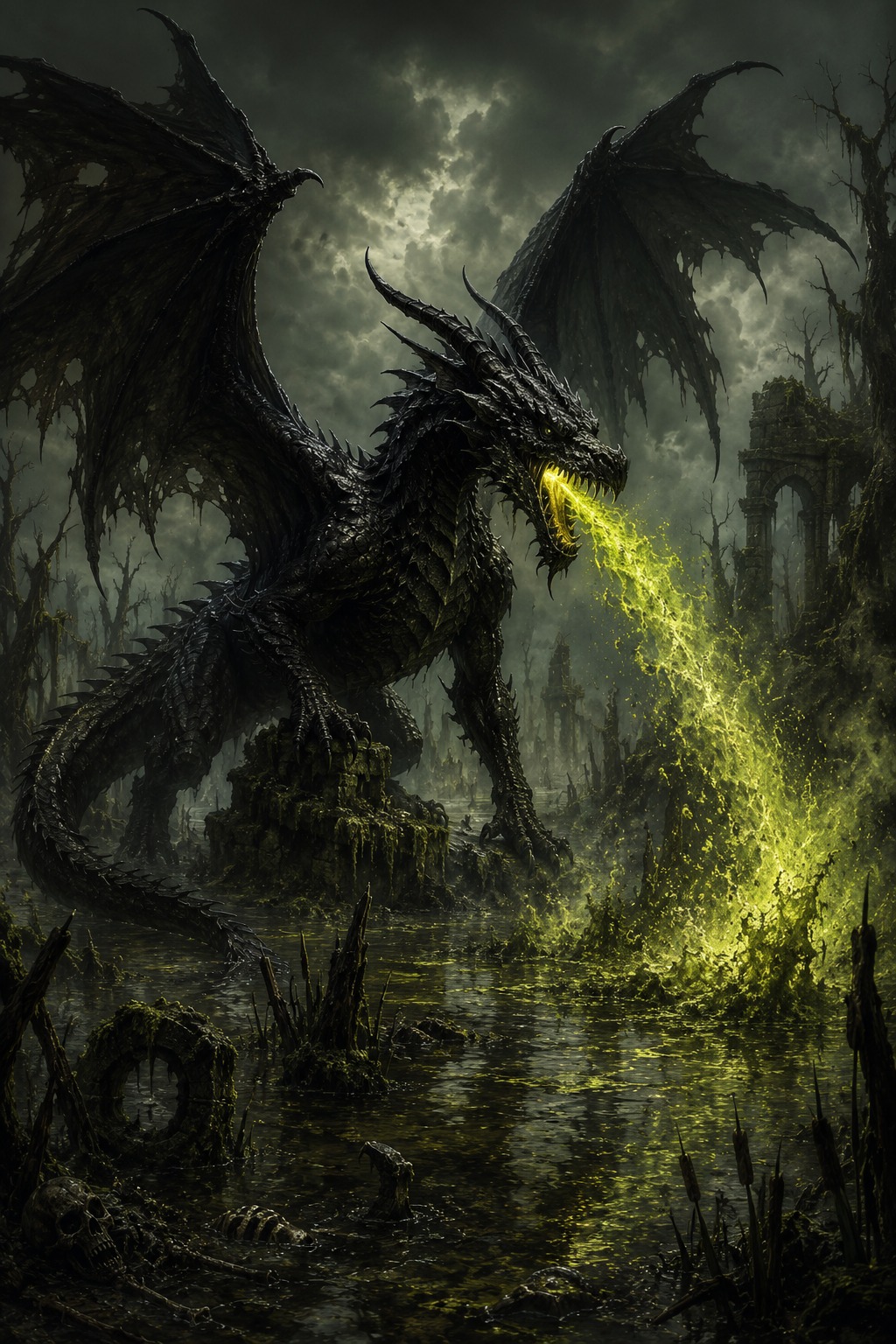
The Black Dragon is one of the branches of the chromatic dragons that took root in the 1974 first edition of Dungeons & Dragons by Gary Gygax and Dave Arneson, a great evil-aligned lizard ruling the rotted seats of swamp and marshland. Scales black as lacquer, two long horns that curve back as they grow, and narrow yellow eyes that gleam through the mist are the clearest mark of one seat, and from its mouth it breathes a single straight line of strong acid that corrodes even a steel harness in a single pass. It knows every seat of its territory exactly, and the sadistic habit of not killing a man at one stroke but tormenting him slowly and drinking in his pain stands out the most among the other chromatic dragons of the same seat. Its lair is a sunken old temple or a narrow, dark cave in the heart of a swamp, where it sets human slaves and lizardfolk to weave the seat of a labyrinth.
Origin
The Black Dragon first appeared in Monsters & Treasure in the boxed set of the original 1974 Dungeons & Dragons, and stood in the seat of one of the five chromatic dragons that took root at the same time, black, blue, green, red, and white. In the Monster Manual of Advanced Dungeons & Dragons 1e in 1977 the same seat was firmly canonized, and it ran in a single line through the Monster Manuals of AD&D 2e (1989), 3e (2000), 3.5 (2003), 4e (2008), and 5e (2014). The writer Gary Gygax later said in interview that he had drawn inspiration for that seat from Tony Roberts' swamp-lizard art and from the black snake tales of British and Irish folklore, but the acid breath, the swamp dwelling, and the sadistic habit are a canon that grew up in earnest within D&D itself. The same seat was set down as a mark of one seat through the campaign settings of Forgotten Realms, Greyhawk, and Dragonlance.
Features
- Scales black as lacquer and two long horns that curve back as they grow
- A single straight line of strong acid breath that corrodes even steel
- An amphibious habit, swimming freely between swamp and river without staying at one seat
- A sadistic temper that does not kill a man at one stroke but torments him slowly
- Eight stages of growth in D&D canon, from wyrmling to ancient
- The skill of setting lizardfolk and human slaves to weave a labyrinth lair in the heart of a swamp
Stories
In the seat of D&D, the Black Dragon often takes its place as a great enemy of a campaign. A young black dragon is a single stage of fearsome enemy that takes the cattle and the men of a village and makes the swamp its own seat, and as it grows to the adult and the ancient stage, it grows into a great enemy that casts a shadow over a whole city. In the Forgotten Realms, named black dragons such as Despayr and Aurgloroasa filled campaigns, and in Dragonlance the name of Sheevrian was set down clearly at the same seat. In video games the same beast takes its place as a great boss in the Baldur's Gate series, Icewind Dale, Neverwinter Nights, Pillars of Eternity, and Baldur's Gate 3, and the same beast also sits in places throughout the dungeons of the MMORPGs Neverwinter and Dungeons & Dragons Online. The game master often pairs the acid breath range (60 to 120 feet in 5e of 2014) and the labyrinth seat of the lair into a single test of one seat for the adventurers.
Weakness
The weakness of the Black Dragon grows straight out of the weave of one seat. The same beast is at home in the damp seat of swamp and river, so under a strong sun and in a dry seat its acid dries quickly and the scales between split, and the strength of one seat falls at a stroke. In D&D canon, the black dragon is immune to acid damage, but it is greatly shaken at one seat by holy light, purification magic, and radiant damage, and its wyrmling and young stages are weak enough that a single magic weapon in the hand of one adventurer can bring it down at a stroke. The same beast's sadistic temper is also a weakness of one seat, for in tormenting the adventurer breath by breath rather than killing him at once, the adventurer often finds the gap of one seat and drives the sword into the same beast's flank, an event that often happens in the seat of a campaign. The same beast, unlike the other chromatic dragons that hoard gold and treasure in a clean seat, often piles the treasure together in a rotted seat of mud, corpses, and submerged ground, and so the lair of one beast is sometimes found by adventurers earlier than expected.
Cultural Significance
The Black Dragon has become the most sadistic and cunning symbol of one seat among the five chromatic dragons of D&D canon, and has left its mark in the fantasy literature and the video games of the same seat. The five chromatic dragons, black, blue, green, red, and white, gather the evil alignment of D&D at one point, and the figure of all five colors gathered at one seat is drawn as the five heads of the great goddess Tiamat at one seat. The black dragon has also become a mark of the fantasy miniature market since the 1980s, and the plates of Ral Partha, Reaper Miniatures, and WizKids have set down a single symbol at the seat of collection of an age. In the American metalcore band Divine Heresy, in Japanese urban-fantasy light novels, and in the web fiction and manga and light novels of Korea, China, and Japan, the same beast often appears as a great enemy of one seat.
In Popular Culture
The Black Dragon appears in every D&D rulebook and its expansion campaigns since the first edition of 1974. The same beast takes its place as an enemy in R. A. Salvatore's Forgotten Realms novels, and the same seat is set down in the campaigns woven by Margaret Weis and Tracy Hickman of Dragonlance. In video games the same beast takes its place as a great boss in Baldur's Gate (1998), Icewind Dale (2000), Neverwinter Nights (2002), Pillars of Eternity (2015), and Baldur's Gate 3 (2023), and the same beast sits in places throughout the dungeons of the MMORPGs Neverwinter and Dungeons & Dragons Online. The same seat has also become the most familiar enemy of one seat in the web fiction, the manga, and the light novels of Korea, China, and Japan, and has left its mark in Delicious in Dungeon, Sword Art Online, and countless Korean fantasy web novels.
Trivia
- The Black Dragon first appeared in Monsters & Treasure of the original 1974 Dungeons & Dragons boxed set by Gary Gygax and Dave Arneson, in the seat of one of the five chromatic dragons that took root at the same time, black, blue, green, red, and white, and the figure of all five colors gathered at one seat is drawn as the five heads of the great goddess Tiamat.
- In D&D canon, the black dragon grows in eight stages, from wyrmling to ancient, and an ancient black dragon, by the 5e Monster Manual of 2014, has a Challenge Rating of 21 and stands at the seat of an enemy that sits at the heart of a great campaign.
- Unlike the other chromatic dragons that hoard gold and treasure in a clean seat, the black dragon often piles the treasure together in a rotted seat, of mud, corpses, and submerged ground, and so the adventurer who reaches one beast's lair often cleans the same seat once with purification magic before carrying the treasure out at one seat.