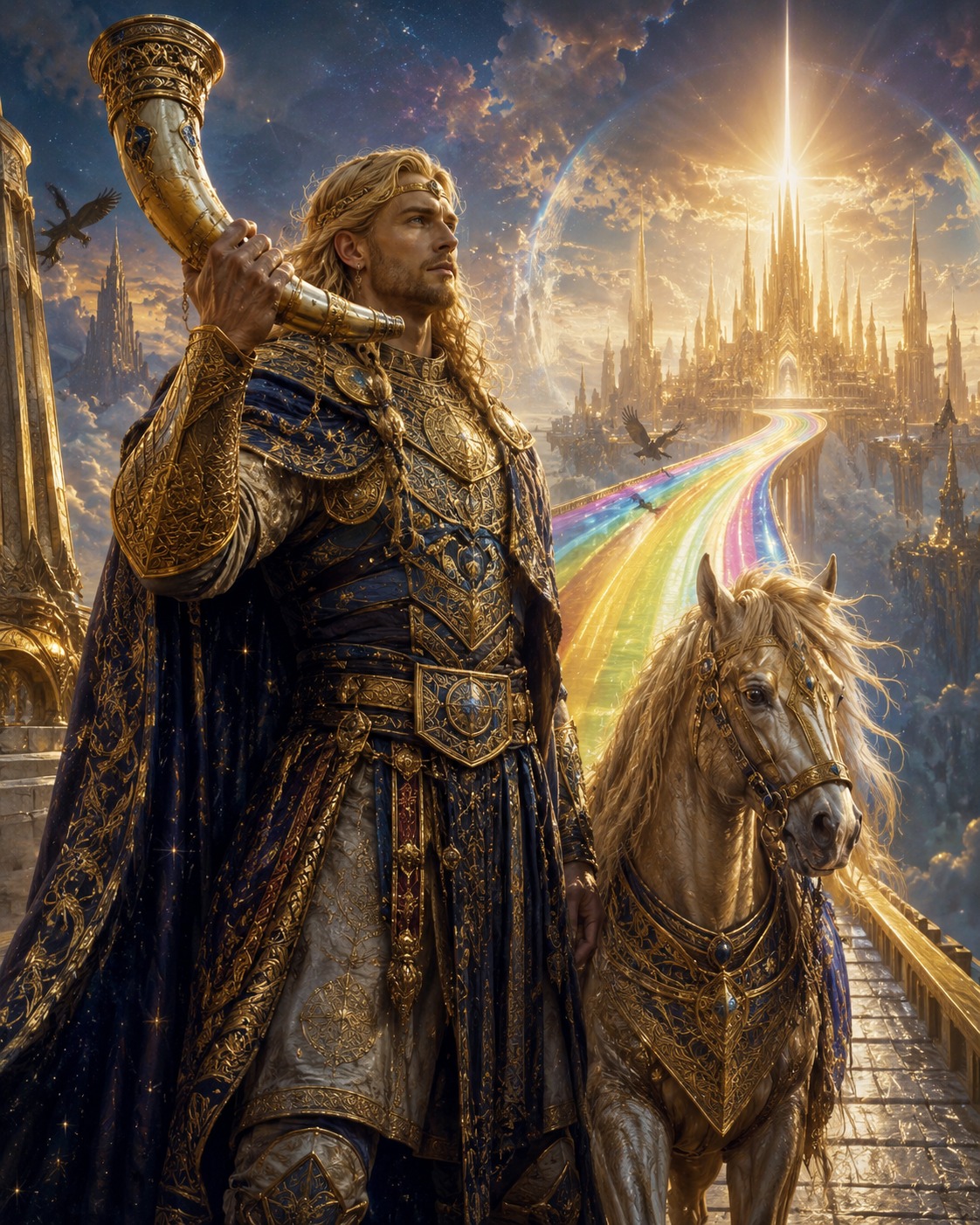
Heimdall
Heimdall · Watchman of Bifröst — Trumpeter of Ragnarök
Names in Other Languages
 헤임달한국어
Heimdall · 비프로스트의 파수꾼 — 라그나로크의 나팔수
 ヘイムダル日本語
Heimdall · ビフレストの番人 — ラグナロクの角笛吹き
 海姆達爾繁體中文
Heimdall · 彩虹橋之守望者 — 諸神黃昏的號角手
 HeimdallDeutsch
Heimdall · Wächter der Bifröst — Bläser des Ragnarök
 HeimdallFrançais
Heimdall · Gardien du Bifröst — Sonneur du Ragnarök
 HeimdallEspañol
Heimdall · Guardián del Bifröst — Trompetero del Ragnarök
 HeimdallPortuguês
Heimdall · Guardião de Bifröst — Trompetista do Ragnarök
 HeimdallPolski
Heimdall · Strażnik Bifröstu — Trębacz Ragnaröku
 ХеймдалльРусский
Heimdall · Страж Биврёста — Трубач Рагнарёка
Heimdall (Old Norse Heimdallr, 'shining one of the world' or 'pillar of the world') is the decisive canonical god of light, vigilance, and watching of the Aesir (Aesir) in Norse mythology, and the decisive canonical iconographic figure of the eternal watchman of the rainbow bridge Bifrost (Bifrost). The etymology is the Old Norse compound of heim ('world, home') and dallr ('shining one' or 'pillar') — meaning 'shining one of the world' — the decisive canonical vocabulary, and the aliases Gullintanni (Gullintanni, 'the one with golden teeth') — the god with golden teeth — and Vitli (Vitli, 'the white one') and Hallinskidi (Hallinskidi) are the decisive canonical vocabulary. The decisive textual canon is the Prose Edda (Prose Edda) of c. 1220 of the early 13th-century Icelandic poet-historian Snorri Sturluson (Snorri Sturluson, 1179-1241) — chapter 27 of Gylfaginning (Gylfaginning) — the decisive Heimdall canon — and chapter 51 — the Ragnarok canon — and the Voluspa (Voluspa), Grimnismal (Grimnismal) stanza 13, Thrymskvida (Thrymskvida) stanza 15, and Rigsthula (Rigsthula, Lay of Rig) of the Poetic Edda (Poetic Edda) of the c. 1270 Codex Regius (Codex Regius) manuscript are the decisive poetic canon of Heimdall. The decisive canon of mysterious birth from nine mothers (nine waves, nine sisters), and the decisive canonical iconographic figure who at Ragnarok blows the great horn Gjallarhorn (Gjallarhorn) to wake the gods and mutually destroys with Loki (Loki).
Origin
The iconographic origin is the watchman-god worship of the 9th-11th-century Norse Viking mythology, and the etymology Old Norse Heimdallr is the compound of heim ('world, home') and dallr ('shining one' or 'pillar') — the decisive canonical vocabulary. The decisive textual canon is the Prose Edda (Prose Edda) of c. 1220 of the early 13th-century Icelandic — Reykholt — Snorri Sturluson (Snorri Sturluson, 1179-1241) — chapter 27 of Gylfaginning (Gylfaginning) — the decisive canon in which Heimdall, as 'the white god (hviti ass)', is born from nine mothers, has golden teeth (Gullintanni), and possesses superhuman senses capable of hearing grass growing and wool growing. The Voluspa (Voluspa) stanza 27 of the Poetic Edda (Poetic Edda) of the c. 1270 Codex Regius (Codex Regius) manuscript is the decisive canon that Heimdall's hearing is hidden beneath Mimir's well of Odin, and Grimnismal (Grimnismal) stanza 13 is the decisive canon of Heimdall's dwelling Himinbjorg (Himinbjorg, 'mountain of heaven'), and Rigsthula (Rigsthula, Lay of Rig) is the decisive mythological canon in which Heimdall, under the name of Rig (Rigr), visits the human world and becomes the ancestor of the three classes (slave Thrall, freeman Karl, noble Jarl).
Features
- God of light with golden teeth (Gullintanni)
- Mysterious birth from nine mothers
- Eternal watchman of the rainbow bridge Bifrost
- Does not sleep and wakes faster than a bird
- Gjallarhorn — horn heard in all worlds
- Golden-maned warhorse Gulltoppr
Stories
The watchman-god worship of the 9th-11th-century Norse Viking mythology is the decisive origin, and the decisive textual canon is chapters 27 and 51 of Snorri Sturluson Prose Edda Gylfaginning of c. 1220 and the Voluspa, Grimnismal stanza 13, Thrymskvida stanza 15, and Rigsthula (Rigsthula) of the Poetic Edda of the c. 1270 Codex Regius manuscript. The 19th-century Germanic-nationalism revival — the 1835 Deutsche Mythologie of Jacob Grimm and the 1856 German prose Edda translation of Karl Simrock — is the decisive 19th-century scholarly canon, and the 13-17 August 1876 Bayreuth Festspielhaus premiere of Richard Wagner's opera tetralogy Der Ring des Nibelungen is the decisive 19th-century musical canon. The decisive modern canon is the Heimdall (Heimdall) of the 1980 D&D Deities & Demigods (Deities & Demigods) by TSR in the USA, and the Heimdall played by the British actor Idris Elba (Idris Elba) in the Marvel Studios film Thor (Thor) (directed by Kenneth Branagh) released in the USA on 6 May 2011 is the 21st-century decisive global film canon. The sequels Thor: The Dark World (Thor: The Dark World) on 8 November 2013, Thor: Ragnarok (Thor: Ragnarok) on 3 November 2017, and Avengers: Infinity War (Avengers: Infinity War) on 27 April 2018 — Heimdall dies in the opening of Infinity War — are the decisive Marvel canon. The main antagonist Heimdall played by Scott Porter (Scott Porter) of God of War Ragnarok (God of War Ragnarok) (directed by Eric Williams) released by Sony Interactive Entertainment in the USA on 9 November 2022 is the 21st-century decisive video-game canon.
Weakness
Heimdall's weaknesses are: (1) constant state of vigilance — the decisive canonical weakness in chapter 27 of the 1220 Snorri Gylfaginning canon, in which he does not sleep and wakes faster than a bird — forced eternal vigilance through superhuman senses — the decisive canon; (2) mutual destruction with Loki — the most decisive canonical weakness in chapter 51 of the 1220 Snorri Gylfaginning and the Voluspa canon of the 1270 Poetic Edda, in which at Ragnarok he mutually destroys with the trickster god Loki (Loki) — the decisive mythological canon; (3) destruction of Bifrost — the decisive canon that at Ragnarok the rainbow bridge Bifrost (Bifrost) is destroyed by the fire giant Surtr (Surtr) of Muspelheim; (4) Mimir's well — the decisive canonical weakness in the 1270 Voluspa stanza 27 canon that Heimdall's hearing is hidden beneath Mimir's well; (5) birth from nine mothers — the canon of mysterious birth; (6) dependence on Gjallarhorn — Ragnarok warning depends on Gjallarhorn — the decisive canonical dependence; (7) Odin's authority — Heimdall is under Odin's authority among the Aesir — the decisive canon; (8) binding of honour — sacred honour — the decisive canon. The decisive canonical finale is the decisive mythological canon of chapter 51 of the 1220 Snorri Gylfaginning and the Voluspa of 1270 — at Ragnarok Heimdall and Loki kill each other — mutual destruction.
Cultural Significance
Heimdall is not merely a watchman icon but the canonical iconographic figure of the decisive Norse canon, traversing the early 13th-century c. 1220 Snorri Sturluson Prose Edda, the c. 1270 Codex Regius manuscript Poetic Edda, the Rigsthula, the 1835 Jacob Grimm Deutsche Mythologie, the 1876 Wagner Der Ring des Nibelungen, the 1980 D&D Deities & Demigods, the 2011 Marvel film Thor, and the 2022 God of War Ragnarok. The watchman-god worship of the 9th-11th-century Norse Viking mythology settled as the decisive canon in chapter 27 of Gylfaginning (Gylfaginning) of the Prose Edda (Prose Edda) of c. 1220 of the early 13th-century Icelandic — Reykholt — Snorri Sturluson (Snorri Sturluson, born c. 1179 in Hvammur, Iceland, assassinated 23 September 1241 at Reykholt, Iceland by order of King Haakon IV of Norway) — in which Heimdall, as 'the white god (hviti ass)', is born from nine mothers, has golden teeth (Gullintanni), and possesses superhuman senses capable of hearing grass growing and wool growing — the decisive canon of superhuman senses. Rigsthula (Rigsthula, Lay of Rig) of the Poetic Edda of the c. 1270 Codex Regius manuscript — the decisive mythological canon in which Heimdall, under the name of Rig (Rigr), visits the human world and becomes the ancestor of the three classes (slave Thrall, freeman Karl, noble Jarl) — is the decisive canon of the mythological justification of Norse social classes. The decisive 21st-century canon is the Heimdall played by the British actor Idris Elba (Idris Elba, b. 1972) in the Marvel Studios film Thor (Thor) (directed by Kenneth Branagh, worldwide box office about 449 million dollars) released in the USA on 6 May 2011 — the 21st-century decisive global film canon — and Thor: The Dark World on 8 November 2013, Thor: Ragnarok on 3 November 2017, and Avengers: Infinity War on 27 April 2018 — Heimdall dies in the opening to Thanos (Thanos) — the decisive Marvel canon. The main antagonist Heimdall played by Scott Porter (Scott Porter, b. 1979) of God of War Ragnarok (God of War Ragnarok) (directed by Eric Williams, Metacritic 94, worldwide sales about 15 million) released by Sony Interactive Entertainment in the USA on 9 November 2022 is the 21st-century decisive video-game canon.
In Popular Culture
- Snorri Sturluson Prose Edda Gylfaginning chapters 27 and 51 (c. 1220) — decisive origin canon
- Codex Regius manuscript Poetic Edda Voluspa, Grimnismal stanza 13, Thrymskvida stanza 15, Rigsthula (c. 1270) — decisive poetic canon
- Jacob Grimm Deutsche Mythologie (1835) — decisive 19th-century scholarly canon
- Richard Wagner Der Ring des Nibelungen (1876) — decisive 19th-century musical canon
- TSR D&D Deities & Demigods, Heimdall (1980) — decisive fantasy RPG canon
- Marvel film Thor, Idris Elba (2011) — 21st-century decisive global film canon
- Marvel film Thor: Ragnarok (2017) — 21st-century decisive film canon
- Marvel film Avengers: Infinity War, Heimdall's death (2018) — 21st-century decisive film canon
- Sony God of War Ragnarok, Heimdall (2022) — 21st-century decisive video-game canon
Trivia
The etymology Old Norse Heimdallr of Heimdall is the compound of heim ('world, home') and dallr ('shining one' or 'pillar') — meaning 'shining one of the world' or 'pillar of the world' — the decisive canonical vocabulary, and the aliases Gullintanni (Gullintanni, 'the one with golden teeth'), Vitli (Vitli, 'the white one'), and Hallinskidi (Hallinskidi) are the decisive canonical vocabulary. The decisive textual canon is the Prose Edda (Prose Edda) of c. 1220 of the early 13th-century Icelandic — Reykholt — Snorri Sturluson (Snorri Sturluson, born c. 1179, died 23 September 1241) — chapter 27 of Gylfaginning (Gylfaginning) — the decisive canon in which Heimdall is born from nine mothers (nine waves, nine sisters), has golden teeth, and possesses superhuman senses capable of hearing grass growing and wool growing. Heimdall's dwelling is — the 1270 Grimnismal stanza 13 canon — Himinbjorg (Himinbjorg, 'mountain of heaven') at the end of Bifrost (Bifrost, rainbow bridge) — and his golden-maned warhorse is — Gulltoppr (Gulltoppr, 'golden mane') — the decisive canon. At Ragnarok he blows the great horn Gjallarhorn (Gjallarhorn, 'resounding horn') to wake the gods of all 9 worlds — the decisive canon, and in chapter 51 of the 1220 Snorri Gylfaginning and the Voluspa of the 1270 Poetic Edda, at Ragnarok he mutually destroys with the trickster god Loki (Loki) — the decisive mythological canon. The Heimdall played by the British actor Idris Elba (Idris Elba, born 6 September 1972 in Hackney, London, England) in the Marvel Studios film Thor (Thor) (directed by Kenneth Branagh, worldwide box office about 449 million dollars) released in the USA on 6 May 2011 is the 21st-century decisive global film canon, and Heimdall's death to Thanos (Thanos) in the opening of Avengers: Infinity War released on 27 April 2018 is the decisive canon. The main antagonist Heimdall played by Scott Porter (Scott Porter, born 14 July 1979 in Omaha, Nebraska, USA) of God of War Ragnarok (God of War Ragnarok) (directed by Eric Williams, Metacritic 94) released by Sony Interactive Entertainment in the USA on 9 November 2022 is the 21st-century decisive video-game canon.
Related
Tyr
Tyr · Norse God of War, Justice, and Oaths
Baldr
Baldr · God of Light and Purity — Tragedy of the Beloved
Athena
Athena · Goddess of Wisdom, Strategy, and Craft
Artemis
Artemis · Goddess of the Hunt, Moon, and Maidenhood
Apollo
Apollo · God of Sun, Music, Prophecy, and Healing
Hera
Hera · Queen of Olympus — Goddess of Marriage
Odin
Odin · Allfather of Norse Myth — God of Wisdom, War, and Death
Thor
Thor · Norse God of Thunder — Protector of Mankind
Loki
Loki · Norse God of Mischief and Shape — The Trigger of Ragnarök
Freya
Freya · Norse Goddess of Love, Fertility, War, and Seiðr
Jade Emperor
Jade Emperor · Supreme Deity of Daoism — Emperor of Heaven
Amaterasu
Amaterasu · Japanese Sun Goddess — Ancestress of the Imperial House