LoreArc

Eastern Dragon

6 items tagged with "Eastern Dragon"

🐉Dragons(6)
yamata-no-orochi

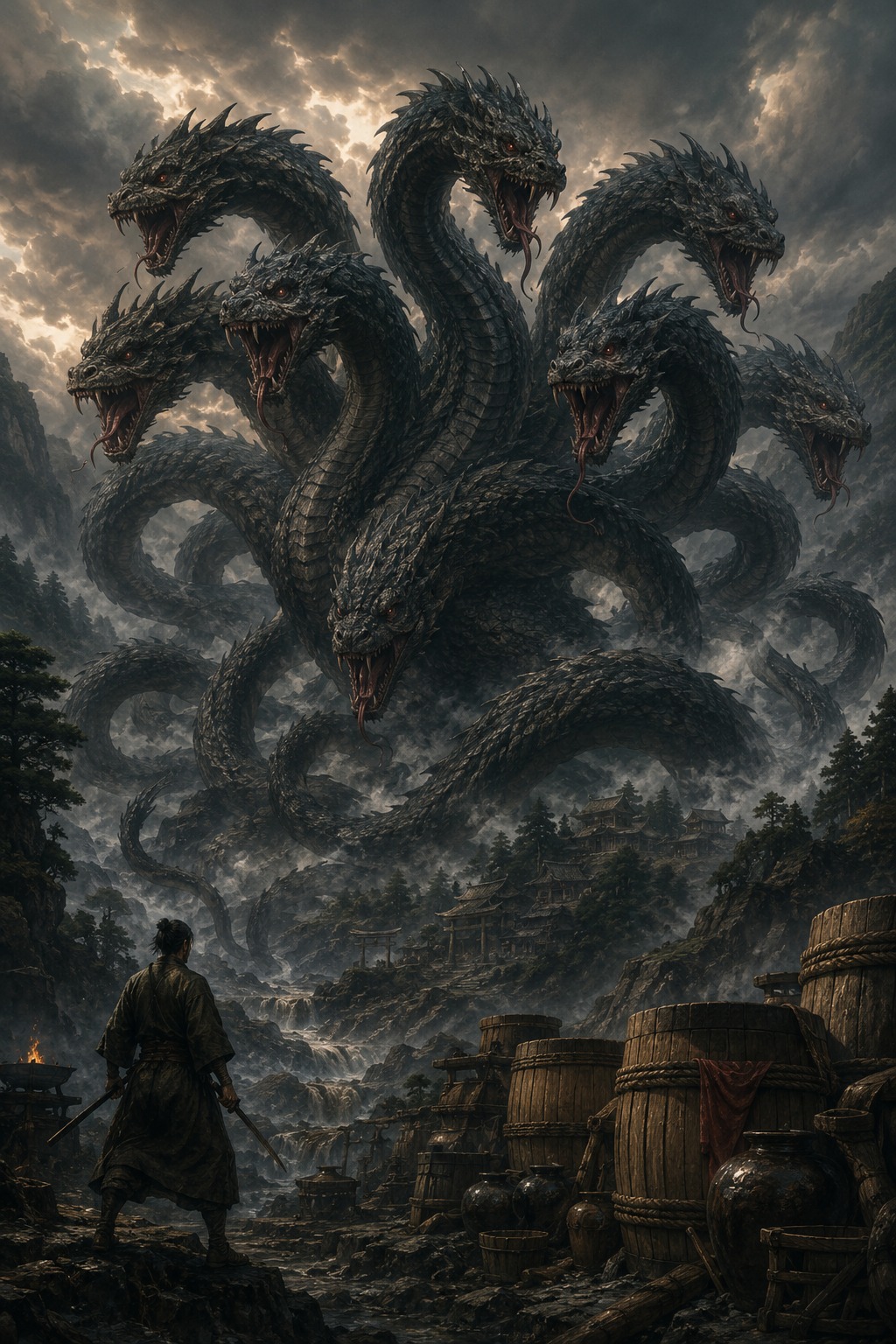
Yamata-no-Orochi

八岐大蛇 · Eight-Headed Serpent of Japanese Myth

Yamata-no-Orochi ('eight-forked great serpent') is the most iconic many-headed dragon-serpent of Japanese myth, recorded in the early eighth century in the two foundational chronicles of the Japanese state: the 'Kojiki' (712) compiled by Ō no Yasumaro and the 'Nihon Shoki' (720) compiled under Prince Toneri. The serpent has eight heads and eight tails, and its body is so vast that it covers 'eight valleys and eight ridges, with cypress and cedar growing on its back and its belly always inflamed and bleeding'. It appears each year along the Hi no Kawa (today's Hii River) in the Izumo region (eastern Shimane prefecture) and demands one of the daughters of the old couple Ashinazuchi and Tenazuchi as tribute. After devouring seven of their eight daughters, it returns for the last, Kushinada-hime, when the storm-god Susanoo, banished from heaven, descends to Izumo. Susanoo prepares yashiori-no-sake (a wine brewed and refined eight times, sometimes called 'eight-fold wine'), pours it into eight large vats placed before eight gates so that each of Orochi's eight heads will drink from a separate vat, and waits until the eight heads are dead drunk. He then severs all eight heads and eight tails with the divine sword Totsuka-no-Tsurugi (a sword 'ten hand-spans long'). When one tail dulls his blade, he finds inside it another, finer sword — the Kusanagi-no-Tsurugi (also Ame-no-Murakumo-no-Tsurugi), one of the Three Sacred Treasures of the Japanese imperial house, today enshrined at Atsuta Shrine in Nagoya, Aichi prefecture.

azure-dragon

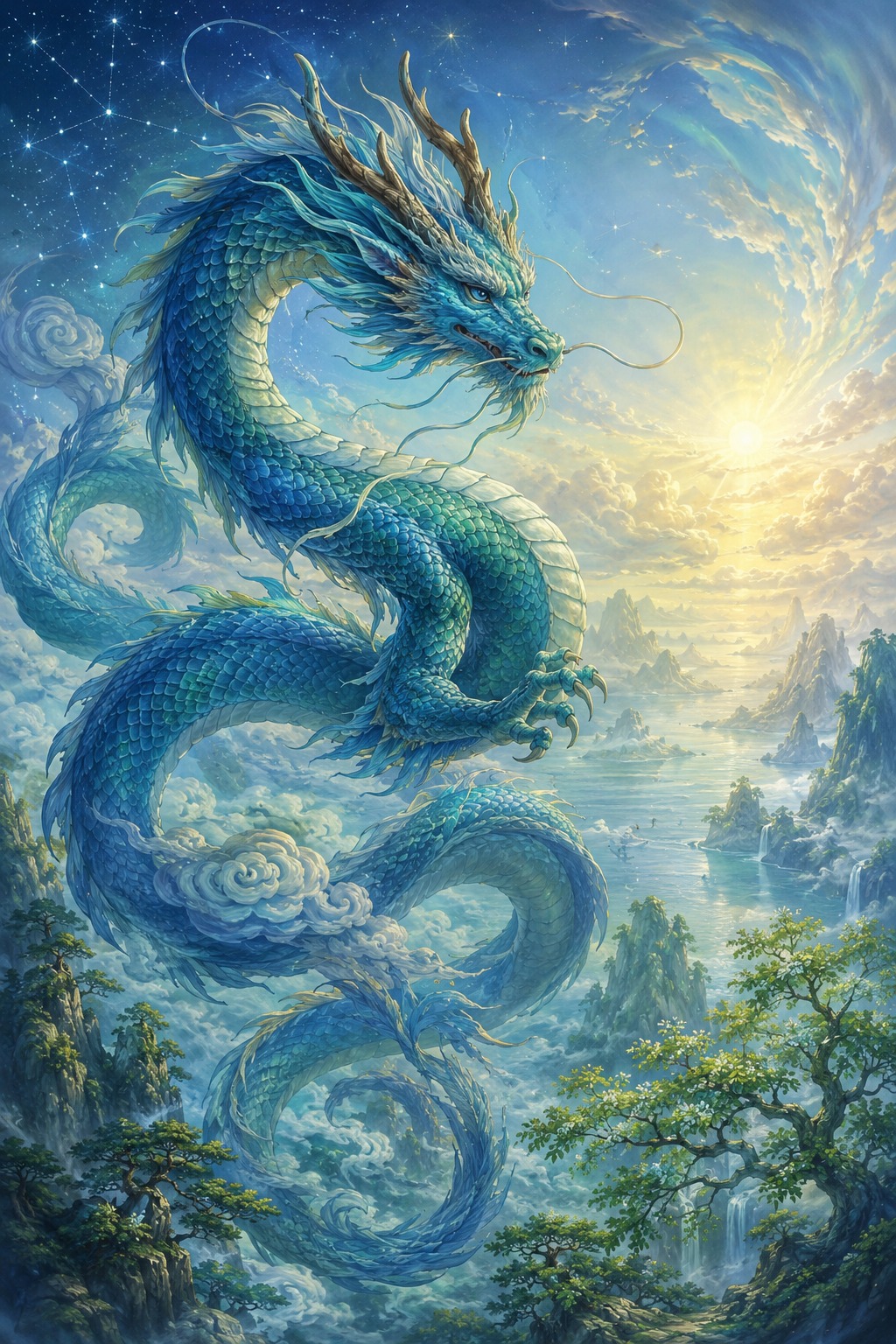
Azure Dragon

靑龍 · Eastern Guardian of the Four Symbols

The Azure Dragon (Chinese 'Qinglong', Korean 'Cheongnyong', Japanese 'Seiryu') is the eastern guardian of the East-Asian Four Symbols (sasin / Sishen), the celestial dragon governing the East, the spring, the Wood phase of the five elements and the colour green-blue. The system — Azure Dragon of the East, White Tiger of the West, Vermilion Bird of the South, Black Tortoise of the North — was codified under the Han dynasty, in particular the 'Huainanzi' (c. 139 BCE) of Liu An and Wang Chong's 'Lunheng' (c. 80 CE), and unifies the seven lunar mansions of the eastern quadrant (Jiao, Kang, Di, Fang, Xin, Wei, Ji). Visually the Azure Dragon is distinguished from the imperial yellow long by a slimmer, more serpentine body, a green-blue scale-pattern, branched deer-style antlers and carp scales; it is the canonical image of the geomantic principle that the dragon of the East guards the left side of a settlement. The best-preserved early representations are the eastern murals of the Goguryeo tombs Gangseo Daemyo and Jungmyo (late sixth century, South Pyongan, North Korea) and the late-seventh- to early-eighth-century Kitora Tomb (Asuka village, Nara prefecture, Japan, recognised as a National Treasure in 1998). The Azure Dragon also names the Cheongwadae presidential residence in Korea ('house of green tiles', built 1939) and watches over the Eastern Flowery Gate (Donghuamen) of the Forbidden City completed in 1420.