Long
The Imperial Dragon of Chinese Myth
Names in Other Languages
 황룡한국어
황룡한국어Long · 중국 신화의 황제 용
 中国龍日本語
Long · 中国神話の皇帝の龍
 中國龍繁體中文
Long · 中國神話的帝王之龍
 LóngDeutsch
Kaiserdrache der chinesischen Mythologie
 LóngFrançais
Dragon impérial de la mythologie chinoise
 LóngEspañol
Dragón imperial de la mitología china
 LóngPortuguês
Dragão imperial da mitologia chinesa
 LongPolski
Cesarski smok mitologii chińskiej
 ЛунРусский
Long · Императорский дракон китайской мифологии
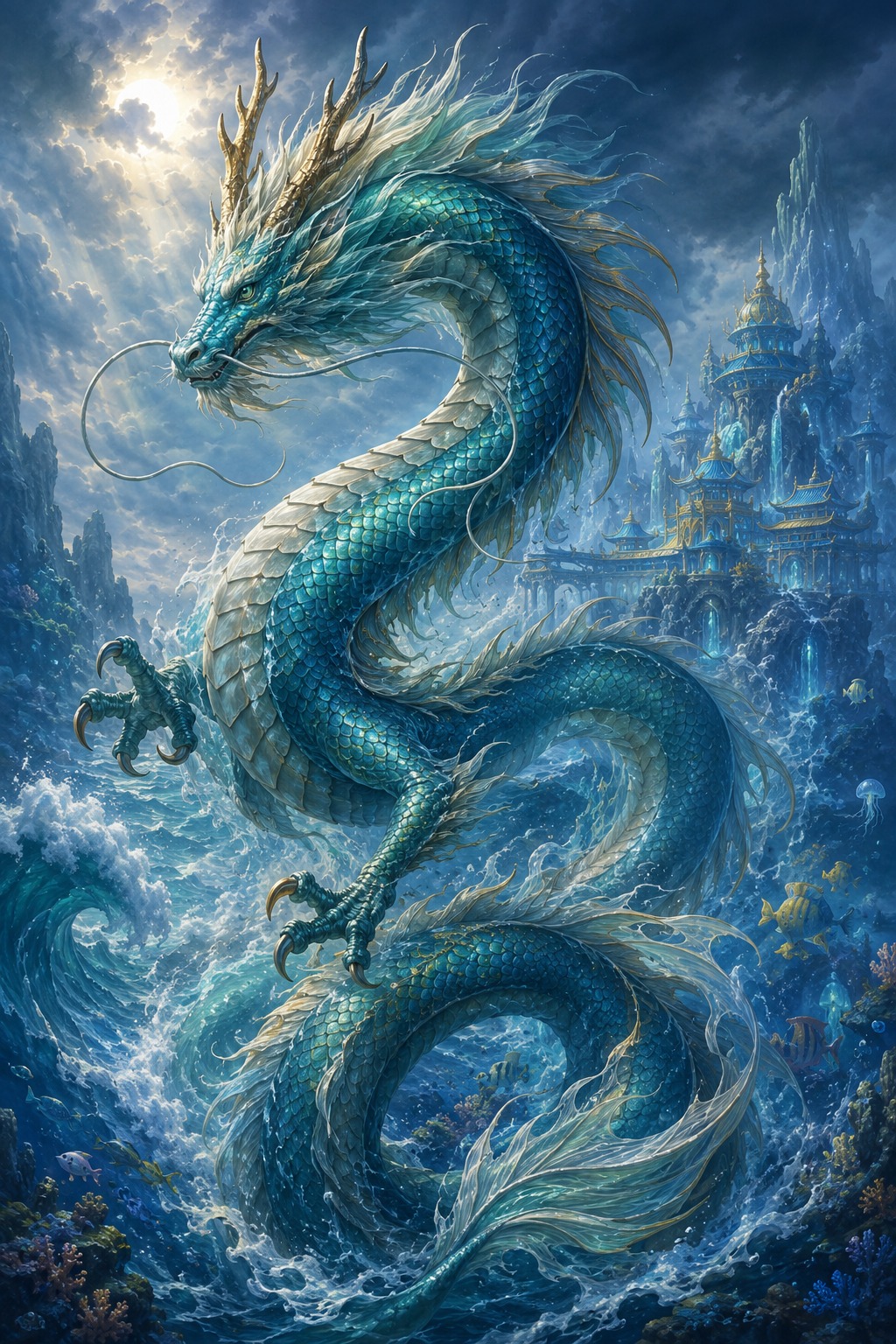
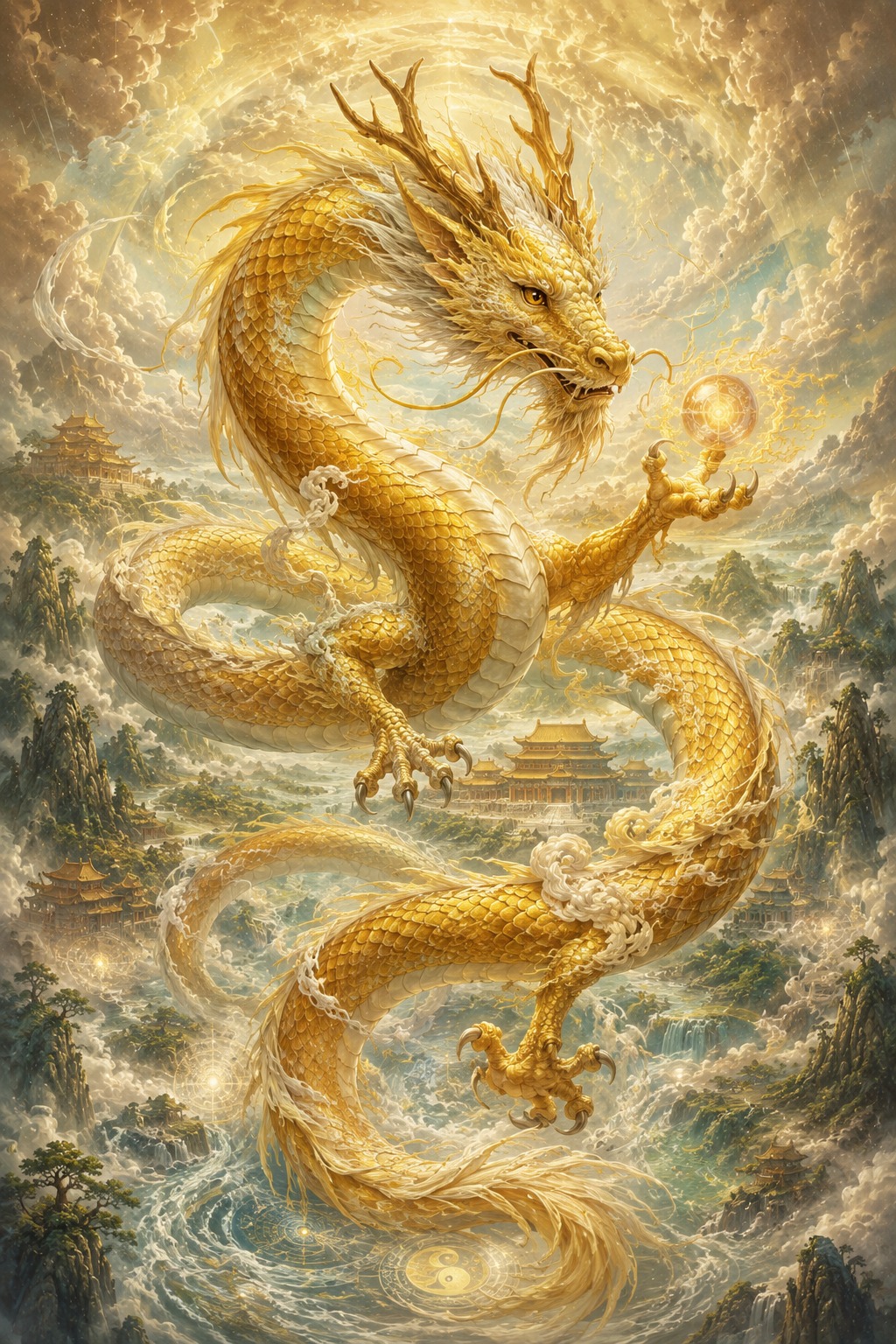
The Chinese long is the archetypal East-Asian dragon, the source from which the Korean cheongnyong, the Japanese ryu and the Vietnamese long descend. Its image runs unbroken from the Neolithic — the C-shaped jade dragon of Hongshan culture (c. 3500-3000 BCE, excavated at Ongniud Banner, Inner Mongolia, in 1971, now a national first-class cultural relic in the National Museum of China) and the shell-mosaic dragon at the Xishuipo site of the Yangshao culture in Puyang (excavated 1987, c. 5300 BCE) — through Xu Shen's 'Shuowen Jiezi' (100 CE), which defined the dragon as 'chief of the scaled creatures', Wang Fu's 'Qianfu Lun' of the late Han, which first codified the 'nine resemblances' (deer antlers, camel head, rabbit eyes, snake neck, clam belly, carp scales, eagle talons, tiger soles), and Li Shizhen's 'Bencao Gangmu' (1578). The five-toed foot was fixed as the imperial monogram by an edict of the Hongwu emperor in 1393 and remained so through the Qing; princes were limited to four toes and commoners to three. The long is arranged in a five-direction colour system — Azure Dragon (East), White (West), Vermilion (South), Black (North), Yellow (Centre) — and is held to bring rain, govern rivers and embody cosmic justice; it is the only mythical creature in the twelve-animal cycle, and a child born in a Dragon year is reckoned to share the emperor's auspice.
Origin
The archaeological prototype is the Hongshan C-shaped jade dragon (c. 3500-3000 BCE, Ongniud Banner, Inner Mongolia, 1971), now held as a national first-class artefact in the National Museum of China in Beijing, with the Xishuipo shell-mosaic dragon at Puyang (c. 5300 BCE, excavated 1987) as a contemporary witness. The textual origin runs through Xu Shen's 'Shuowen Jiezi' (100 CE), Wang Fu's 'Qianfu Lun' (late first century) — which first lists the nine resemblances — Guo Pu's (276-324) commentary on the 'Classic of Mountains and Seas' (Shanhaijing), which fixes the taxonomy of yinglong, zhulong, jiaolong and chilong subspecies, and Song-Ming compendia such as the 'Taiping Yulan' (983) and Li Shizhen's 'Bencao Gangmu' (1578). The five-toed imperial regulation dates from the Hongwu emperor's ritual edict of 1393.
Features
- Nine resemblances: deer antlers, camel head, rabbit eyes, snake neck, clam belly, carp scales, eagle talons, tiger soles, and the dragon body itself
- Five-toed foot for the emperor, four for princes, three for commoners — fixed by the Hongwu edict of 1393
- Five-direction colour system: Azure (East), White (West), Vermilion (South), Black (North), Yellow (Centre)
- The wish-fulfilling pearl held in its jaws, the symbol of wisdom, power and the moon
- Brings rain and storm clouds in flight, central to imperial rain rites and to the popular Dragon King temple cult
- The only mythical creature in the twelve-animal cycle; Dragon years are imperial years
Stories
Functions as the absolute emblem of imperial authority on the dragon robe (longpao), on the throne of the Forbidden City and on the imperial seal, and as the focal image of popular rain rituals, Dragon King temples and the lion-style dragon dance. Its iconography is the model from which the Korean cheongnyong, Japanese ryu and Vietnamese long all derive.
Weakness
Within the mythic frame the dragon is paired with the phoenix, the qilin and the Black Tortoise; when their balance is broken the cosmic order is disturbed. The Mandate of Heaven doctrine ties the long's sacred authority directly to imperial virtue — corrupt rule weakens the dragon's standing.
Cultural Significance
The long is a fourfold symbol of imperial authority, cosmic order, fertility and justice; the most elaborate surviving canon is the Ming-Qing dragon-robe and the dragon reliefs of the Forbidden City (Palace Museum, Beijing). Notable works include Ma Yuan's Song-dynasty 'Water Studies' and the Qing court paintings by Giuseppe Castiglione (Lang Shining).
In Popular Culture
Hongshan C-shaped jade dragon (c. 3500-3000 BCE), Xu Shen's 'Shuowen Jiezi' (100 CE), Wang Fu's 'Qianfu Lun' (late first century), Guo Pu's commentary on the Shanhaijing (fourth century), the Song encyclopaedia 'Taiping Yulan' (983), Li Shizhen's 'Bencao Gangmu' (1578), the Forbidden City dragon reliefs (1406-1420), the divine dragon Shenlong in 'Dragon Ball' (Akira Toriyama, 1984- ), Mushu in Disney's 'Mulan' (1998), and D&D's 'Oriental Adventures' (1985).
Trivia
The Forbidden City is traditionally said to contain exactly 9999 dragon carvings (nine being the maximal yang number), and the imperial longpao shows nine canonical dragon postures — frontal, walking, ascending and so on — on its chest, back and sleeves. The five-toed rule was codified by the Hongwu emperor in 1393 and survived to the end of the Qing.