Azure Dragon
靑龍 · Eastern Guardian of the Four Symbols
Names in Other Languages
 청룡한국어
청룡한국어Azure Dragon · 靑龍 — 동아시아 사신 중 동방 수호신
 青龍日本語
青龍日本語Azure Dragon · 東アジア四神の東方守護神
 青龍繁體中文
Azure Dragon · 東亞四象的東方守護神
 QinglongDeutsch
靑龍 · Östlicher Wächter der Vier Symbole
 QinglongFrançais
靑龍 · Gardien oriental des Quatre Symboles
 QinglongEspañol
靑龍 · Guardián oriental de los Cuatro Símbolos
 QinglongPortuguês
靑龍 · Guardião oriental dos Quatro Símbolos
 QinglongPolski
靑龍 · Wschodni strażnik Czterech Symboli
 ЦинлунРусский
靑龍 · Восточный страж Четырёх символов
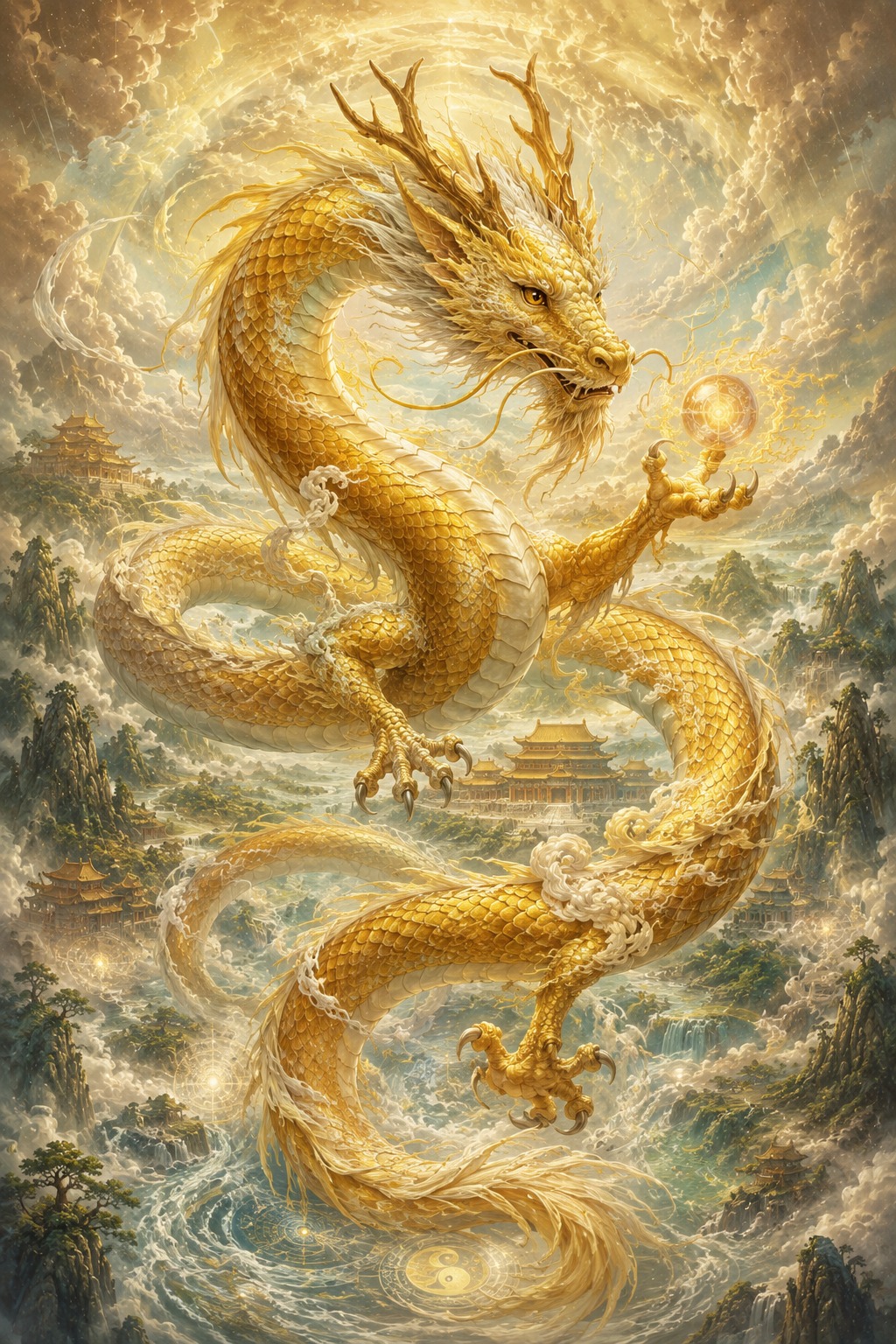
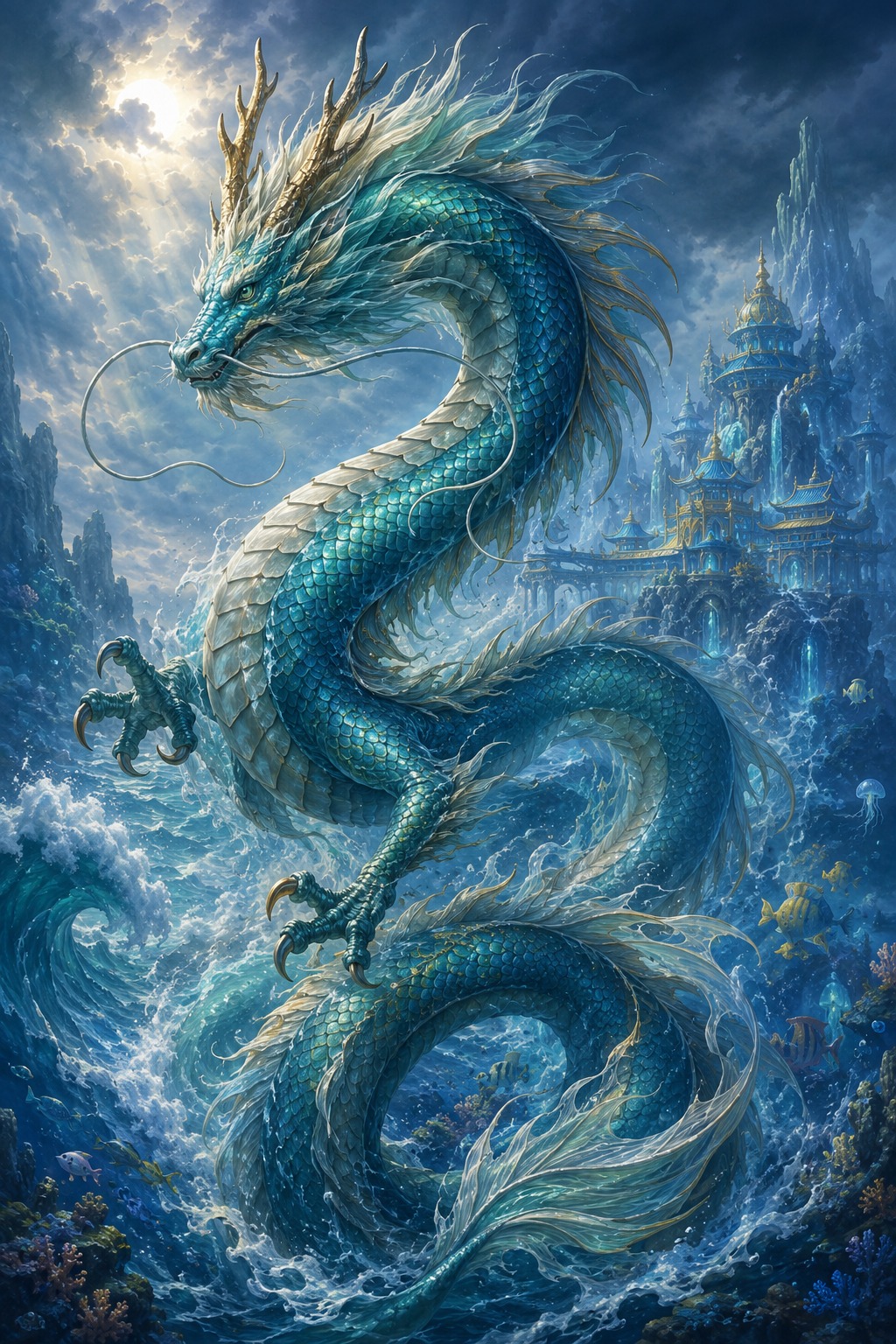
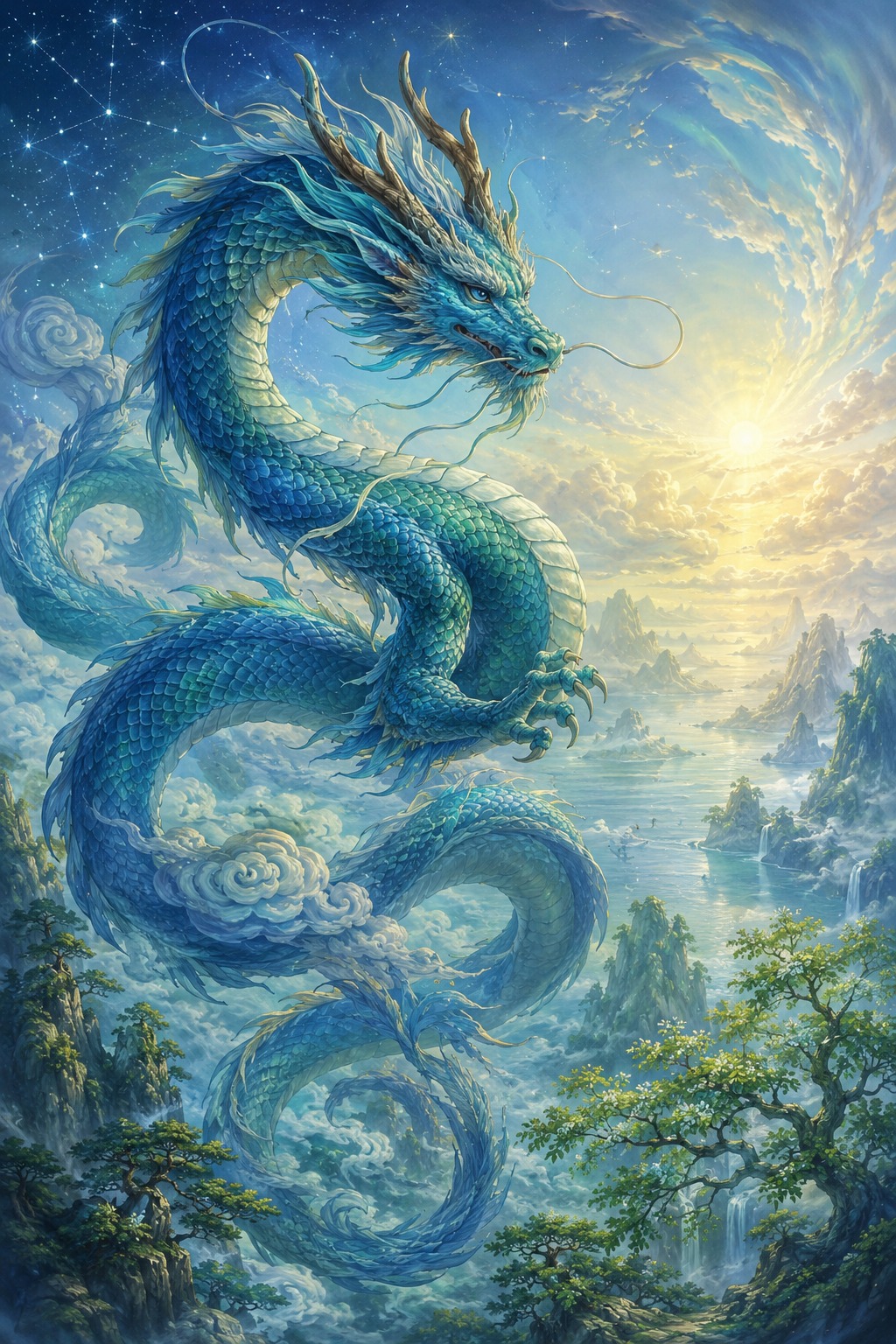
The Azure Dragon (Chinese 'Qinglong', Korean 'Cheongnyong', Japanese 'Seiryu') is the eastern guardian of the East-Asian Four Symbols (sasin / Sishen), the celestial dragon governing the East, the spring, the Wood phase of the five elements and the colour green-blue. The system — Azure Dragon of the East, White Tiger of the West, Vermilion Bird of the South, Black Tortoise of the North — was codified under the Han dynasty, in particular the 'Huainanzi' (c. 139 BCE) of Liu An and Wang Chong's 'Lunheng' (c. 80 CE), and unifies the seven lunar mansions of the eastern quadrant (Jiao, Kang, Di, Fang, Xin, Wei, Ji). Visually the Azure Dragon is distinguished from the imperial yellow long by a slimmer, more serpentine body, a green-blue scale-pattern, branched deer-style antlers and carp scales; it is the canonical image of the geomantic principle that the dragon of the East guards the left side of a settlement. The best-preserved early representations are the eastern murals of the Goguryeo tombs Gangseo Daemyo and Jungmyo (late sixth century, South Pyongan, North Korea) and the late-seventh- to early-eighth-century Kitora Tomb (Asuka village, Nara prefecture, Japan, recognised as a National Treasure in 1998). The Azure Dragon also names the Cheongwadae presidential residence in Korea ('house of green tiles', built 1939) and watches over the Eastern Flowery Gate (Donghuamen) of the Forbidden City completed in 1420.
Origin
The direct textual sources are the 'Huainanzi' (c. 139 BCE), in particular its 'Tianwen Xun' (Treatise on the Patterns of Heaven), compiled under Prince Liu An, and Wang Chong's 'Lunheng' (c. 80 CE), both of which fix the four-direction system of Azure Dragon, White Tiger, Vermilion Bird and Black Tortoise as a pillar of Han cosmology. The earliest visual record is the lacquered clothes chest from the tomb of Marquis Yi of Zeng (Zeng Hou Yi mu, fifth century BCE, excavated 1978, Hubei Provincial Museum), which paints the dragon and tiger together with the twenty-eight lunar mansions. In Korea the Gangseo Daemyo and Gangseo Jungmyo Goguryeo tombs of late sixth-century South Pyongan (reported by Sekino Tadashi for the Japanese government-general in 1912) preserve the full four-symbol wall programme; in Japan the Kitora Tomb murals (late seventh to early eighth century, Asuka village, Nara prefecture; identified via infrared survey in 1983; National Treasure since 1998) preserve the Azure Dragon and an accompanying star chart on the ceiling. The iconography is then maintained without interruption through Qin and Han roof-tile ends, Tang bronze mirrors and the Song-Yuan-Ming-Qing imperial ritual.
Features
- Eastern guardian of the East-Asian Four Symbols — spring, Wood phase, green-blue
- Slimmer, more serpentine body than the imperial yellow long, with green-blue scales
- Branched deer-style antlers, carp scales; unites the seven eastern lunar mansions
- The geomantic 'left-side dragon' that guards the east of a settlement
- The Wood-East-spring deity of Daoist five-element cosmology, paired with the Azure Emperor (Qingdi)
- Canonical east-wall image of the Goguryeo Gangseo tombs and Japan's Kitora Tomb
Stories
Central image of East-Asian geomancy, astrology and palace architecture, taking the role of guardian of the eastern side of cities, royal tombs and palaces; the green-tile presidential residence of Korea (Cheongwadae), the Donghuamen gate of the Forbidden City and the eastern axis of Heian-kyo all carry this iconography. It is a stock figure of wuxia novels (Jin Yong) and of the Four Symbols bosses in East-Asian games such as 'Megami Tensei' and 'Chronicle of Genesis'.
Weakness
Daoist five-element doctrine binds the Azure Dragon to the other three symbols: if one of the Four Symbols — especially the White Tiger of the West — weakens, the cosmic order is disturbed and the Azure Dragon weakens with it. This balance principle is the basis of the geomantic 'left dragon, right tiger' theory of mountain layout.
Cultural Significance
The Azure Dragon image is the core visual asset of East-Asian cosmology — four directions, four seasons, five elements, twenty-eight lunar mansions — and fuses with the Daoist Azure Emperor (Qingdi), with the Buddhist eastern guardian and with the Shinto Seiryu to form the unified visual theology of north-east Asia. It survives in present-day naming on the Cheongwadae, the Seiryu shrines of Kyoto and Kamakura and the Qinglong temples of Guangxi.
In Popular Culture
Lacquered clothes chest of the tomb of Marquis Yi of Zeng (fifth century BCE), 'Huainanzi' Tianwen Xun (c. 139 BCE), Wang Chong's 'Lunheng' (c. 80 CE), the Gangseo Daemyo and Jungmyo Goguryeo tombs (late sixth century), the Kitora Tomb murals (late seventh to early eighth century, Japan's National Treasure), the Donghuamen gate of the Forbidden City (1420), the Cheongwadae presidential residence (1939), Jin Yong's 'Heaven Sword and Dragon Sabre' (1961) and the Four Symbols bosses of Atlus's 'Shin Megami Tensei' series.
Trivia
The Korean Cheongwadae owes its name to its blue tiles, but in popular geomantic reading the 'azure' character carries the eastern Azure Dragon meaning. The Kitora Tomb in Asuka village was identified by infrared survey in 1983 and listed as a Japanese National Treasure in 1998; its Azure Dragon, in the centre of the east wall, is the finest preserved single image of the figure. The Korean baseball team LG Twins also takes its mascot, 'Lucky', from the Azure Dragon.