Yamata-no-Orochi
八岐大蛇 · Eight-Headed Serpent of Japanese Myth
Names in Other Languages
 야마타노 오로치한국어
Yamata-no-Orochi · 八岐大蛇 — 일본 신화의 8머리 거대 뱀
 ヤマタノオロチ日本語
八岐大蛇 — 日本神話の八つ首の大蛇
 八岐大蛇繁體中文
Yamata-no-Orochi · 日本神話的八首巨蛇
 Yamata no OrochiDeutsch
八岐大蛇 · Achtköpfige Riesenschlange der japanischen Mythologie
 Yamata no OrochiFrançais
八岐大蛇 · Serpent géant à huit têtes de la mythologie japonaise
 Yamata no OrochiEspañol
八岐大蛇 · Serpiente gigante de ocho cabezas de la mitología japonesa
 Yamata no OrochiPortuguês
八岐大蛇 · Serpente gigante de oito cabeças da mitologia japonesa
 Yamata no OrochiPolski
八岐大蛇 · Ośmiogłowy wąż olbrzymi mitologii japońskiej
 Ямата-но оротиРусский
八岐大蛇 · Восьмиглавый змей японской мифологии
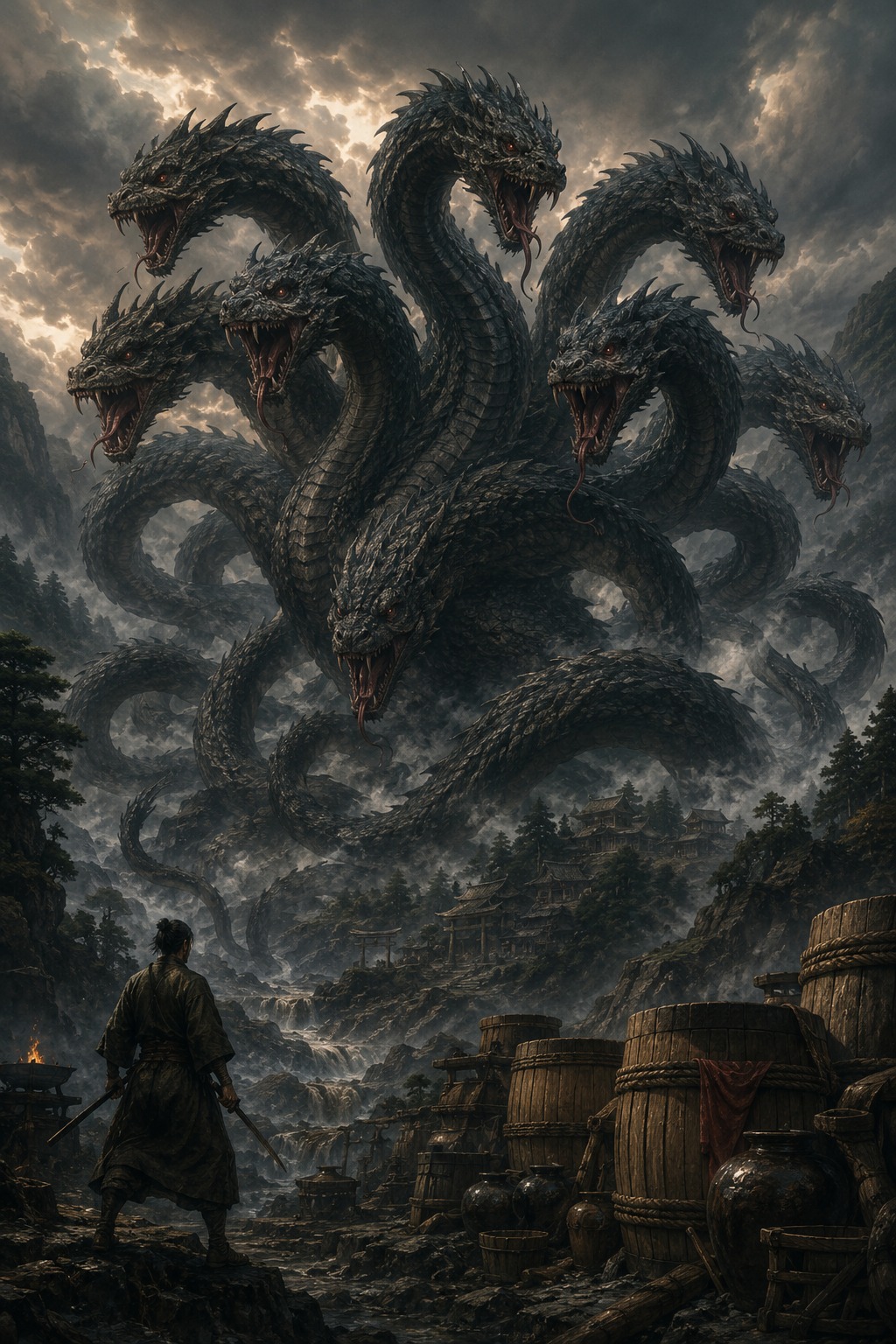
Yamata-no-Orochi ('eight-forked great serpent') is the most iconic many-headed dragon-serpent of Japanese myth, recorded in the early eighth century in the two foundational chronicles of the Japanese state: the 'Kojiki' (712) compiled by Ō no Yasumaro and the 'Nihon Shoki' (720) compiled under Prince Toneri. The serpent has eight heads and eight tails, and its body is so vast that it covers 'eight valleys and eight ridges, with cypress and cedar growing on its back and its belly always inflamed and bleeding'. It appears each year along the Hi no Kawa (today's Hii River) in the Izumo region (eastern Shimane prefecture) and demands one of the daughters of the old couple Ashinazuchi and Tenazuchi as tribute. After devouring seven of their eight daughters, it returns for the last, Kushinada-hime, when the storm-god Susanoo, banished from heaven, descends to Izumo. Susanoo prepares yashiori-no-sake (a wine brewed and refined eight times, sometimes called 'eight-fold wine'), pours it into eight large vats placed before eight gates so that each of Orochi's eight heads will drink from a separate vat, and waits until the eight heads are dead drunk. He then severs all eight heads and eight tails with the divine sword Totsuka-no-Tsurugi (a sword 'ten hand-spans long'). When one tail dulls his blade, he finds inside it another, finer sword — the Kusanagi-no-Tsurugi (also Ame-no-Murakumo-no-Tsurugi), one of the Three Sacred Treasures of the Japanese imperial house, today enshrined at Atsuta Shrine in Nagoya, Aichi prefecture.
Origin
The direct textual sources are the 'Kojiki' (712), Japan's oldest surviving chronicle, compiled by Ō no Yasumaro, and the 'Nihon Shoki' (720), compiled under Prince Toneri by imperial command; a regional variant appears in the 'Izumo no kuni Fudoki' (733), under the Ou district section. The mythic geography points to the Hii River valley around modern Unnan city, Shimane prefecture, where the Yaegaki Shrine of Kakeya enshrines Kushinada-hime and the Sase Shrine of Kisuki celebrates the Orochi rite. In comparative mythology Georges Dumézil (1898-1986) and Mircea Eliade (1907-1986) classify the episode as the East-Asian variant of the Indo-European Chaoskampf (storm god versus many-headed serpent), alongside Indra against Vritra, Thor against Jörmungandr, Marduk against Tiamat and Heracles against the Lernaean Hydra; the classification was refined in the 1970s by Japanese comparativists Matsumoto Nobuhiro and Mishina Shōei.
Features
- An eight-headed, eight-tailed colossal serpent-dragon
- Body large enough to span eight valleys and eight ridges, with cypress and cedar on its back
- Appears each year in the Hii River valley of Izumo, demanding a virgin tribute
- Defeated by Susanoo who used eight vats of yashiori-no-sake to intoxicate the eight heads
- From its tail emerged the Kusanagi-no-Tsurugi, one of Japan's Three Sacred Treasures
- Starting point of the Susanoo - Kushinada-hime marriage myth
Stories
The model boss figure of Japanese heroic mythology, enshrined and re-enacted at the Yaegaki, Sase and Inata shrines around Unnan city in Shimane prefecture, where an annual Orochi festival in July re-stages the myth. The figure has been borrowed in modern popular culture by characters such as Orochi in 'Dragon Ball' (Akira Toriyama, 1984- ), Orochimaru in 'Naruto' (Masashi Kishimoto, 1999-2014), the Orochi line of Atlus's 'Megami Tensei' series and the Gigantamax form of Pokemon Duraludon in 'Pokemon Sword & Shield' (Nintendo, 2019).
Weakness
Canonically the decisive weakness is alcohol — when all eight heads have drunk the yashiori-no-sake and fallen asleep, the serpent is helpless. Lethal damage is inflicted only by the divine Totsuka-no-Tsurugi; ordinary blades dull or snap, as Susanoo's own sword did when it struck the Kusanagi inside the eighth tail.
Cultural Significance
The story is regularly cited in comparative mythology as the East-Asian variant of the Indo-European Chaoskampf — Indra against Vritra, Thor against Jörmungandr, Marduk against Tiamat, Heracles against the Lernaean Hydra. The yashiori-no-sake strategem is read as a mythic foundation for Japanese sake brewing culture.
In Popular Culture
Ō no Yasumaro's 'Kojiki' (712), the imperial 'Nihon Shoki' (720), the 'Izumo no kuni Fudoki' (733), the enshrinement at the Yaegaki, Sase and Inata shrines in Unnan city, Shimane prefecture, the Orochi of 'Dragon Ball' (1984- ), Orochimaru of 'Naruto' (1999-2014), the Orochi line of Atlus's 'Megami Tensei' series and the Gigantamax Duraludon of 'Pokemon Sword & Shield' (2019).
Trivia
The Hii River valley around Unnan city in Shimane prefecture is dotted with archaeological and ritual sites identified with the Orochi myth; the annual Sase festival on 14-15 July at Sase Shrine in Kisuki ward stages a kagura re-enactment. The Kusanagi-no-Tsurugi is enshrined at Atsuta Shrine in Nagoya, Aichi prefecture; the Three Sacred Treasures of Japan are seen in public only at the emperor's enthronement, and even then not by the priests themselves — the actual blades are kept under strict secrecy.