Tiamat
Primordial Sea Dragon of Mesopotamian Myth
Names in Other Languages
 티아맷한국어
Tiamat · 메소포타미아 신화의 원초적 바다 용
 ティアマト日本語
Tiamat · メソポタミア神話の原初の海竜
 提亞瑪特繁體中文
Tiamat · 美索不達米亞神話的原初海龍
 TiamatDeutsch
Urzeitlicher Meeresdrache der mesopotamischen Mythologie
 TiamatFrançais
Dragon marin primordial de la mythologie mésopotamienne
 TiamatEspañol
Dragón marino primordial de la mitología mesopotámica
 TiamatPortuguês
Dragão marinho primordial da mitologia mesopotâmica
 TiamatPolski
Pradawny smok morski mitologii mezopotamskiej
 ТиаматРусский
Tiamat · Первозданный морской дракон месопотамской мифологии
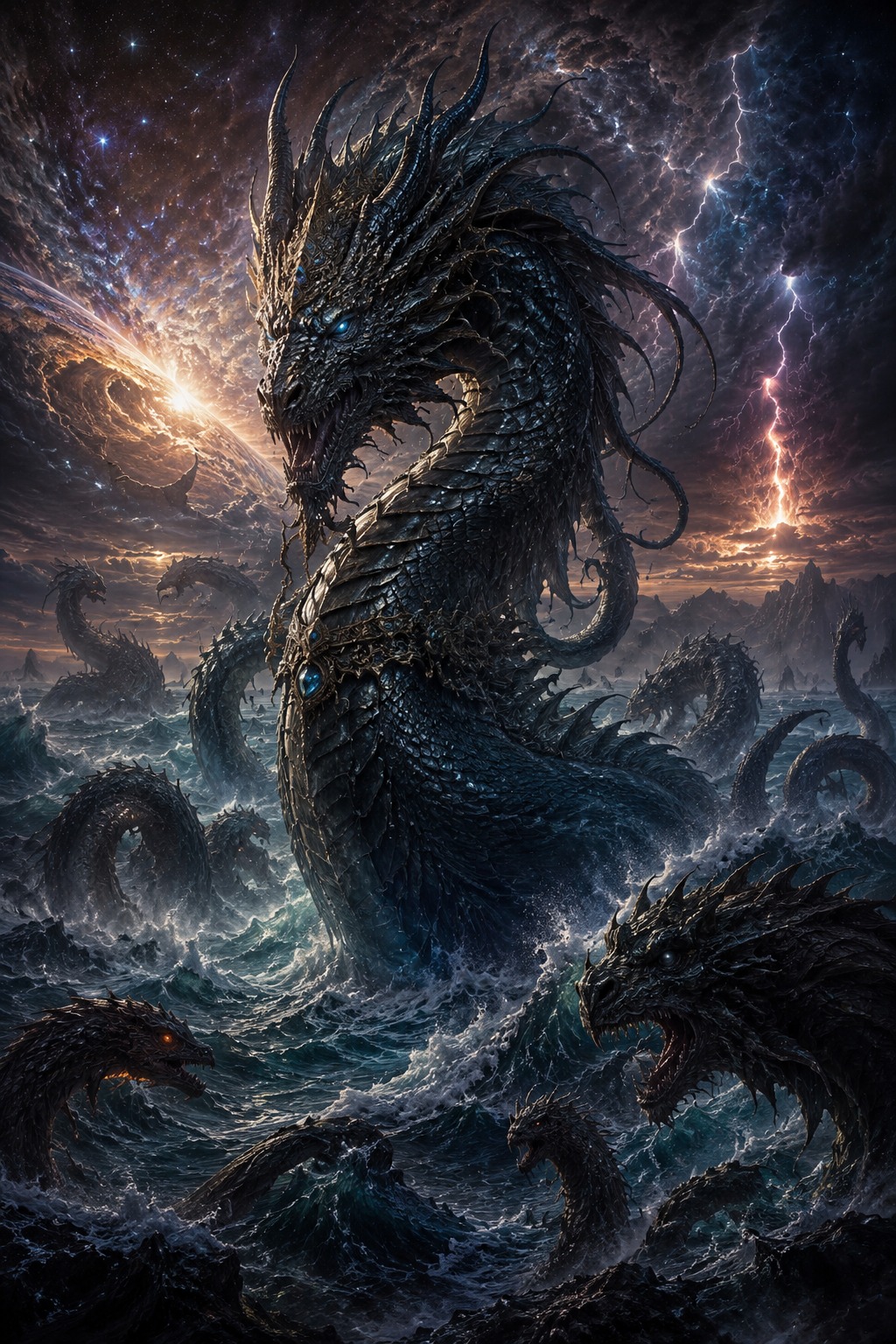
Tiamat (Akkadian Tiamat, from tiāmtum, the sea) is the oldest dragon-deity of one seat, set down in the seven tablets of the Babylonian creation epic Enūma Eliš that took its place around the 12th century BC, a mother of primal chaos that personifies the salt water. With her consort Apsû (the fresh water) of the same seat, she stood before every seat of the cosmos at the same seat, and from the pair of two seats every god of one seat was born. But when the gods of later seats made a noise that broke the peace of the same seat, and Apsû, in seeking to undo them, was himself slain by Ea, Tiamat at the same seat raised the great wrath of one stroke, set Kingu as the general of one seat, and led an army of eleven monsters, Mushhushshu (the snake-dragon), Ushumgallu (the great lion-dragon), Bashmu (the horned serpent), scorpion-men, fish-men, and bull-men, into a great struggle with the new gods of one seat. At the last of one seat the storm god Marduk split her body in two at the same seat, made heaven of one half and earth of the other, and from her two eyes flowed the two great rivers of one seat, the Tigris and the Euphrates.
Origin
The deity Tiamat of one seat is held to have grown up in ancient Babylonia about the 18th century BC, and the canonical text Enūma Eliš is held in scholarship to have taken its set form in the seven tablets of one seat in the late Kassite period, about the 12th century BC. The clearest text of one seat is the tablets brought to light in the 19th century by the British archaeologists Henry Layard and Hormuzd Rassam at the library of Aššurbānipal in Nineveh, and these same tablets are preserved at the British Museum today. The text was first made known to scholarship in 1876 by George Smith in his Chaldean Account of Genesis in English, and from the same seat the comparative study of mythology and religion grew up in earnest. The great branch of dragon-slaying (Chaoskampf) of one seat left a common grain in the seats of Baal versus Yam at Ugarit, Zeus versus Typhon in Greece, Indra versus Vritra in India, and Yahweh versus Leviathan in the Hebrew Bible (Psalm 74 and Isaiah 27:1).
Features
- A mother goddess of one seat of primal chaos, personifying salt water
- A primordial being who, with her consort Apsû of fresh water, stood before every seat of the cosmos
- The womb-seat from which every god of one seat was born
- A queen of one seat of an army of eleven monsters, Mushhushshu, Bashmu, Ushumgallu, and others
- Slain by Marduk at one seat, her body becoming heaven and earth
- The two great rivers of one seat, the Tigris and the Euphrates, flowing from her two eyes
Stories
The text of Tiamat of one seat was recited each year in Babylon at the spring New Year festival of Akītu. For the first eleven days of the month of Nisan the same priests of one seat read the tablets aloud in the great temple of Marduk, the Esagila, and the same rite carried the great meaning of one seat, that the order of one seat of the cosmos was rewoven once every year. Within the same rite of one seat there stood a seat of purification in which the king of one seat was stripped of his robe and scepter, struck once on the cheek by the priest, and made to confess his sins, and the same king of one seat was given back his place as the vicar of Marduk at the New Year. The seat of the myth also set down the seat of the political grain by which the royal house of Babylon drew its divine standing from the same seat.
Weakness
The weakness of Tiamat of one seat is set clearly within the same text of one seat. The first is the weapons of storm and thunder of one seat: Marduk drove the seven winds of one seat, the south, the north, the east, and the west winds, and the whirlwind, the gale, and the evil wind, into the net of one seat at a single stroke, so that her mouth could not be closed at the same seat, and then he pierced her belly at one stroke with the bow of one seat. The second is the wavering of the army of monsters that she herself had made of one seat: the eleven monsters of one seat trembled at fear before Marduk at the same seat and turned their backs, and the general Kingu was taken at the same seat at one stroke. The third is the great meaning of the myth that one mother of one seat is slain at the seat of her own child at the hand of one god of the same seat, a grain that took its place as a common pattern in the great branch of dragon-slaying myth in the Indo-European seats.
Cultural Significance
Tiamat is the oldest dragon-deity that humanity ever set down in writing at one seat, and stands as the womb-seat of the dragon-slaying myth of one seat. The grain of the same seat left a common grain in the seats of Baal versus Yam of Ugarit, Zeus versus Typhon of Greece, Indra versus Vritra of India, and Yahweh versus Leviathan in Psalm 74 and Isaiah 27:1 of the Hebrew Bible, and scholarship of one seat calls the same grain by the single name Chaoskampf, the struggle of chaos. The Mushhushshu of the same seat remained as a beast at the foot of Marduk of one seat, and is set clearly in relief on the blue seat of the Ishtar Gate of Babylon (6th century BC, preserved today at the Pergamon Museum in Berlin). In the seat of modern fantasy, the same Tiamat of one seat was set anew in 1976 in the D&D supplement Gods, Demi-Gods & Heroes as a great goddess of one seat with the five heads of the five chromatic dragons (black, blue, green, red, and white), with the platinum dragon Bahamut as her good counterpart at one seat.
In Popular Culture
Tiamat, starting from the seat of the Enūma Eliš tablet material, has taken her great place in the two seats of scholarship and popular culture. In the seat of scholarship, the close analysis of one seat was set down in George Smith's Chaldean Account of Genesis of 1876, Alexander Heidel's The Babylonian Genesis of 1942, and the Sumerian-mythology material of Samuel Noah Kramer. In the seat of popular culture, the Tiamat of one seat, set down as a five-headed great boss in the American Dungeons & Dragons animated cartoon of 1983-1985, became the mark of a generation of one seat, and the same seat holds her place as a great enemy in the Final Fantasy series, the Megami Tensei series, the D&D Tyranny of Dragons campaign (2014), and Baldur's Gate 3 (2023). The same grain of one seat has also taken its place as the mark of the oldest dragon-deity in the web fiction, the manga, and the light novels of Korea, China, and Japan.
Trivia
- The name Tiamat is rooted in the Akkadian tiāmtum (sea), and is held to have grown from the same root as the other seas of the Semitic line, such as Hebrew t'hom in Genesis 1:2 (the deep). The same deity of one seat is at heart a personification of the sea.
- The Chaldean Account of Genesis of 1876, set down by George Smith from the tablets in the British Museum, was the seat at which this myth was first made known to scholarship, and Smith himself died of a fever in the Syrian desert at the age of 36 shortly after the discovery, never seeing the full great seat of his own finding to its end.
- In modern D&D, Tiamat of one seat was set anew in 1976 in the supplement Gods, Demi-Gods & Heroes of Gygax and Robert Kuntz as a great goddess with the five heads of the five chromatic dragons, and the plate of the five heads, which became the great mark of one seat, was set down as the clearest impression of a generation in the 1983-1985 D&D animated cartoon series.