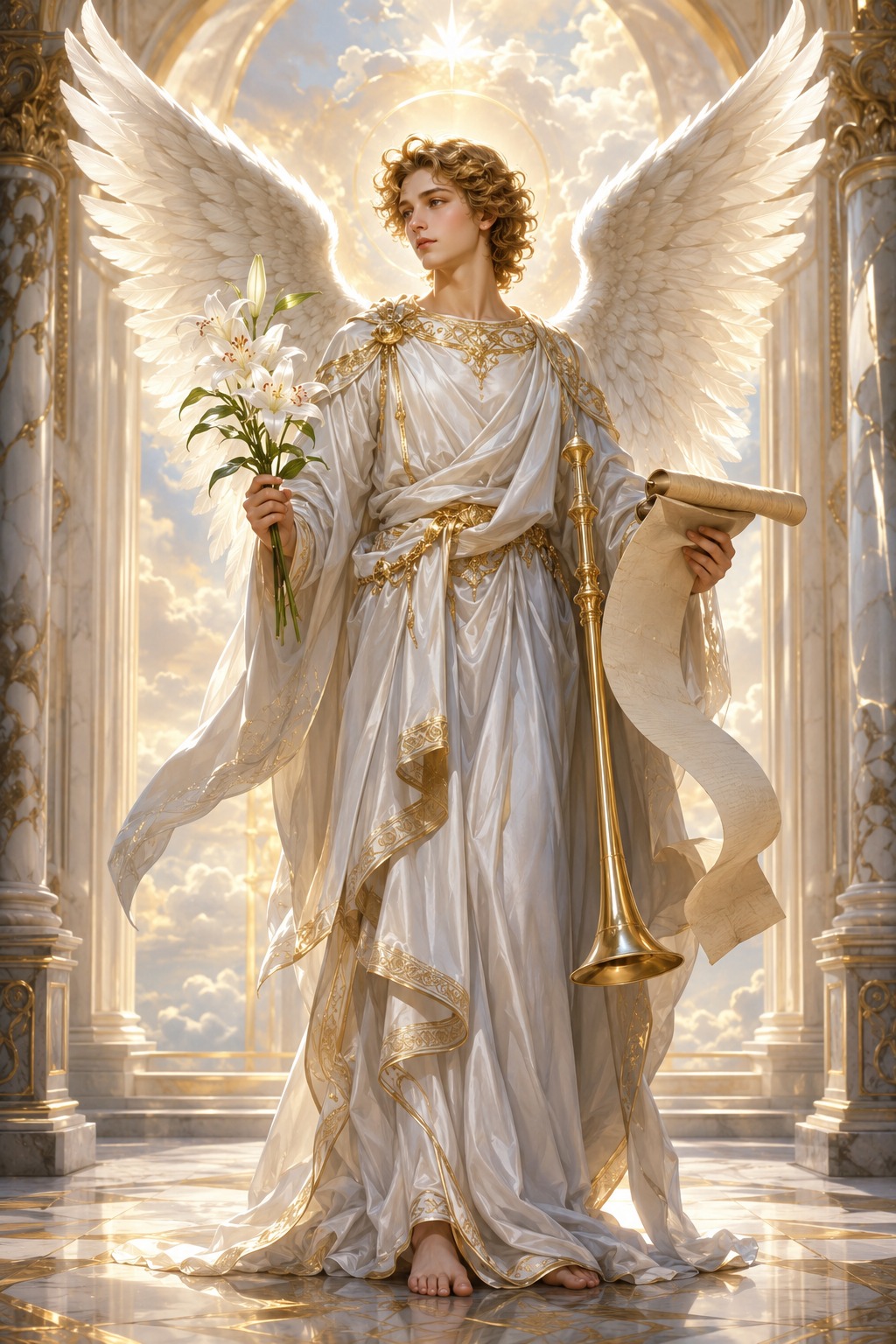
Gabriel
Gabriel · Archangel — Messenger of God, Bearer of the Annunciation
Names in Other Languages
 가브리엘한국어
Gabriel · 대천사 — 신의 전령, 수태고지의 사자
 ガブリエル日本語
Gabriel · 大天使 — 神の伝令、受胎告知の使者
 加百列繁體中文
Gabriel · 大天使 — 神之信使,天使報喜之使者
 GabrielDeutsch
Gabriel · Erzengel — Bote Gottes, Verkünder der Verkündigung
 GabrielFrançais
Gabriel · Archange — Messager de Dieu, héraut de l'Annonciation
 GabrielEspañol
Gabriel · Arcángel — Mensajero de Dios, heraldo de la Anunciación
 GabrielPortuguês
Gabriel · Arcanjo — Mensageiro de Deus, arauto da Anunciação
 GabrielPolski
Gabriel · Archanioł — Posłaniec Boga, herold Zwiastowania
 ГавриилРусский
Gabriel · Архангел — Вестник Бога, провозвестник Благовещения
Gabriel (Hebrew Gavri'el, Greek Gabriel, Latin Gabriel, Arabic Jibril) is the decisive canonical archangel of Judaism, Christianity, and Islam — three decisive canonical religions. The etymology is the decisive canonical vocabulary of the Hebrew 'God's strength' (geber + El) or 'man of God'. The decisive textual canon is the Old Testament Book of Daniel (Daniel) 8:15-26 of c. 2nd century BCE — 167-164 BCE — the decisive canon in which Gabriel interprets Daniel's vision — and 9:21-27 — the decisive canon of the 70-weeks prophecy. The Gospel of Luke (Luke) 1:11-20 of the c. 1st-century-CE New Testament — the decisive canon in which Gabriel announces the conception of John the Baptist to the priest Zechariah (Zechariah) — and 1:26-38 — the decisive canon of the Annunciation, the announcement of Jesus's conception to Mary — are the decisive canon. The Qur'an (Qur'an) 2:97-98 of c. 7th century — 610-632 CE — the decisive canon in which Jibril (Jibril) revealed the Qur'an to Muhammad over 23 years — is the decisive canonical iconography. The decisive canonical iconography of the graceful angel holding a lily, the golden trumpet, white silk robes, and large white feathered wings.
Origin
The iconographic origin is the Persian-angel-faith influence of the c. 6th century BCE Babylonian Exile period, and the decisive textual canon is the Book of Daniel (Daniel) 8:15-26 of c. 2nd century BCE — 167-164 BCE — Old Testament — the decisive origin canon in which after Daniel saw a vision by the Ulai River, Gabriel appeared in 'the appearance of a man (kemar'eh-geber)' and interpreted the meaning of the vision — and 9:21-27 — the decisive canon in which Gabriel 'flew swiftly at the time of the evening sacrifice' and delivered the prophecy of 70 weeks (70 weeks). The Gospel of Luke (Luke) 1:11-20 of the c. 1st-century-CE New Testament — the decisive canon in which Gabriel announced the conception of John the Baptist (John the Baptist) to the priest Zechariah (Zechariah) at the right side of the altar of incense in the Temple of Jerusalem, and as a result of Zechariah doubting, became mute — and 1:26-38 — the decisive canon of the Annunciation (Annunciation), in which 'in the sixth month' Gabriel appeared to the virgin Mary in Nazareth in Galilee and greeted her with 'Hail, full of grace, the Lord is with thee' and announced the conception of Jesus. The c. 3rd-1st-century-BCE apocryphal 1 Enoch (1 Enoch) 9:1, 10:9, 20:7 — the decisive canon establishing Gabriel as one of the four archangels (along with Michael, Raphael, and Uriel), and the Qur'an (Qur'an) 2:97-98, 26:192-195, and 53:5-18 of c. 7th century — 610-632 CE — Islam — is the decisive Islamic canon.
Features
- Graceful angel holding a lily
- Long scroll (message) and golden trumpet
- White silk robes and curly hair
- Large white feathered wings
- Patron saint of communications, postal, and diplomatic services
- Feast of the Annunciation on 25 March
Stories
The Persian-angel-faith influence of the c. 6th century BCE Babylonian Exile period is the decisive origin, and the decisive textual canon is the Old Testament Book of Daniel chapters 8 and 9 of c. 2nd century BCE and the New Testament Gospel of Luke 1:11-20 and 1:26-38 (Annunciation) of c. 1st century CE. The decisive Islamic canon of Jibril (Jibril) revealing the Qur'an to Muhammad over 23 years from the first revelation in the Cave of Hira (Cave of Hira) in 610 CE to the death of Muhammad in 632 of c. 7th century, and the 9-rank angel canon of the De Caelesti Hierarchia (De Caelesti Hierarchia) of Pseudo-Dionysius the Areopagite (Pseudo-Dionysius the Areopagite) of c. 5th century Syria is the decisive canon. The Annunciation (Annunciazione) fresco of the Convento di San Marco (Convento di San Marco) in Florence, Italy by Fra Angelico (Fra Angelico, c. 1395-1455) of 1438-1445 and the Annunciation of Urbino by Raphael Sanzio (Raffaello Sanzio, 1483-1520) of 1485 and the woodcut of Albrecht Durer (Albrecht Durer, 1471-1528) of 1510 are the decisive art canon. The Gabriel of Paradise Lost (Paradise Lost) of the British poet John Milton (John Milton, 1608-1674) of 1667 is the decisive 17th-century canon, and the Gabriel of the 1980 D&D Deities & Demigods (Deities & Demigods) by TSR in the USA and the angel Moroni (interpreted as Gabriel) of the 1843 American Mormonism are the decisive religious canon. The decisive 21st-century canon is the Gabriel of the film Noah (Noah) (directed by Darren Aronofsky, Paramount) released in the USA on 26 February 2014, and the Gabriel (played by Conor Trinneer) of Season 5 (2020) of the Amazon Prime Video series Lucifer (Lucifer) started in the USA in 2017 are the 21st-century decisive video canon.
Weakness
Gabriel's weaknesses are: (1) lack of free will — the decisive canonical weakness in the c. 2nd-century-BCE Daniel and c. 1st-century-CE Luke canon — the decisive canon that as God's messenger he must deliver God's message accurately and cannot act with his own will; (2) weight of the message — the decisive canon in the c. 1st-century-CE Luke 1:11-20 in which Zechariah (Zechariah) doubted Gabriel's message and became mute — and 1:29-30 — the decisive canon in which Mary 'was afraid'; (3) heaviness of mission — the decisive canon in the 7th-century Qur'an in which when Muhammad received Jibril's first revelation in the Cave of Hira, he 'trembled with fear'; (4) between God and humans — the decisive canon; (5) weight of 70 weeks — Daniel 9:24 — the decisive canon of the weight of the prophecy of 70 weeks; (6) the virgin Mary's doubt — the decisive canon of resolving Mary's doubt 'How shall this be, since I do not know a man?'; (7) binding of the sacred domain — the decisive canon; (8) binding of hierarchy — the decisive canon of the hierarchy beneath Michael. The decisive canonical finale is Mary's response in Luke 1:38 — 'Behold the handmaid of the Lord; let it be unto me according to thy word (fiat mihi secundum verbum tuum)' — the decisive canon, and the c. 7th-century Qur'an — up to chapter 110 — the 23 years of revelation — the decisive canon.
Cultural Significance
Gabriel is not merely an angel icon but the canonical iconographic figure of the decisive Judaism-Christianity-Islam canon, traversing the c. 2nd-century-BCE Old Testament Daniel chapters 8-9, the c. 3rd-1st-century-BCE apocryphal 1 Enoch, the c. 1st-century-CE New Testament Luke 1:11-20 (Zechariah) and 1:26-38 (Annunciation), the c. 5th-century Pseudo-Dionysius De Caelesti Hierarchia, the 7th-century Qur'an, the 1438-1445 Fra Angelico Annunciation, the 1485 Raphael Annunciation, the 1510 Durer woodcut, the 1667 Milton Paradise Lost, and the 1980 D&D Deities & Demigods. The Persian-angel-faith influence of the c. 6th-century-BCE Babylonian Exile (Babylonian Exile, 586-538 BCE) period settled as the decisive canon in the Book of Daniel (Daniel) 8:15-26 of c. 2nd century BCE — 167-164 BCE — the persecution period of Antiochus IV Epiphanes. The c. 1st-century-CE — c. 4 BCE — New Testament Gospel of Luke (Luke) 1:26-38 — the decisive canon in which 'in the sixth month' Gabriel appeared to the virgin Mary in Nazareth in Galilee and greeted her with 'Hail, full of grace (chaire kecharitomene)' and announced the conception of Jesus — is the decisive canon of the Annunciation (Annunciation), and the Feast of the Annunciation of the Lord (Annunciation of the Lord) on 25 March is the decisive canon. The c. 7th-century — 610 CE Ramadan (Ramadan) — 27th — Cave of Hira (Cave of Hira) near Mecca (Mecca) — the decisive Islamic canon in which Muhammad (Muhammad, c. 570-632) received Jibril's (Jibril) first revelation ('Iqra' — recite — Qur'an 96:1-5) and over 23 years until Muhammad's death on 8 June 632 — Jibril revealed the entire Qur'an of 114 chapters and 6,236 verses. The 1438-1445 Annunciation (Annunciazione) fresco — about 230x321cm — by Fra Angelico (Fra Angelico) of the Convento di San Marco in Florence, Italy and the 1485 Annunciation by Raphael Sanzio are the decisive art canon, and the Gabriel of the 1980 D&D Deities & Demigods by TSR in the USA is the decisive fantasy RPG canon.
In Popular Culture
- Old Testament Book of Daniel 8:15-26, 9:21-27 (c. 2nd century BCE) — decisive origin canon
- Apocryphal 1 Enoch 9, 10, 20 (c. 3rd-1st century BCE) — decisive apocryphal canon
- New Testament Gospel of Luke 1:11-20 (Zechariah), 1:26-38 (Annunciation) (c. 1st century CE) — decisive New Testament canon
- Qur'an 2:97-98, 26:192-195, 53:5-18 (7th century) — decisive Islamic canon
- Pseudo-Dionysius De Caelesti Hierarchia (c. 5th century) — decisive angelology canon
- Fra Angelico Annunciation, Convento di San Marco (1438-1445) — decisive art canon
- Raphael Annunciation (1485) — decisive Renaissance canon
- Albrecht Durer Annunciation woodcut (1510) — decisive art canon
- John Milton Paradise Lost (1667) — decisive 17th-century literary canon
- TSR D&D Deities & Demigods, Gabriel (1980) — decisive fantasy RPG canon
Trivia
The etymology of Gabriel (Gabriel) is the decisive canonical vocabulary of the Hebrew Gavri'el — the compound of 'gever' (man or strength) and 'El' (God) — 'God's strength' or 'man of God', and the Greek Gabriel, Latin Gabriel, and Arabic Jibril are the decisive canonical vocabulary. The decisive textual canon is the Book of Daniel (Daniel) 8:15-26 of c. 2nd century BCE — 167-164 BCE — the persecution period of Antiochus IV Epiphanes (Antiochus IV Epiphanes) — the decisive canon in which after Daniel saw a vision of 'a ram and a goat' by the Ulai River (Ulai), Gabriel appeared in 'the appearance of a man' and interpreted the vision. 9:21-27 — the decisive canon in which Gabriel 'flew swiftly at the time of the evening sacrifice' and delivered the prophecy of 70 weeks (490 years) — predicting the coming of the Messiah and the rebuilding of the Temple. The c. 1st-century-CE — c. 6-4 BCE — New Testament Gospel of Luke (Luke) 1:26-38 — the decisive canon of the Annunciation (Annunciation) in which 'in the sixth month (en de to meni to hekto)' Gabriel appeared to the virgin Mary (Mary) in Nazareth (Nazareth) in Galilee and greeted her with 'Hail, full of grace (chaire kecharitomene), the Lord is with thee' and announced the conception of Jesus with 'The Holy Spirit shall come upon thee', and Mary's response 'Behold the handmaid of the Lord; let it be unto me according to thy word (fiat mihi secundum verbum tuum)' is the decisive canon. The Feast of the Annunciation of the Lord (Annunciation of the Lord) on 25 March — 9 months before Jesus's birth on 25 December — is the decisive canon, and the c. 7th-century — 610 CE August-September Ramadan (Ramadan) — 27th 'Night of Power (Laylat al-Qadr)' — Cave of Hira (Cave of Hira) near Mecca (Mecca) — the decisive Islamic canon in which Muhammad (Muhammad ibn Abdullah, c. 570 born in Mecca, died 8 June 632 in Medina) at age 40 received Jibril's (Jibril) first revelation 'Iqra' (recite) — Qur'an 96:1-5 — and over 23 years revealed the entire Qur'an of 114 chapters and 6,236 verses.
Related
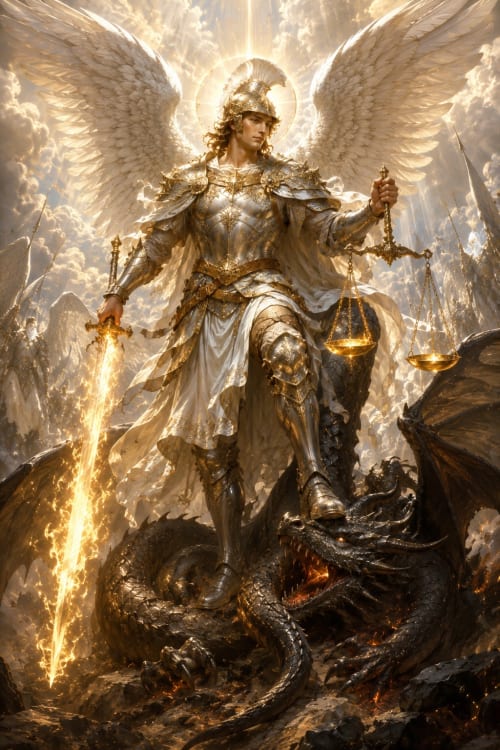
Michael
Michael · Archangel — Captain of the Heavenly Host, Vanquisher of Satan
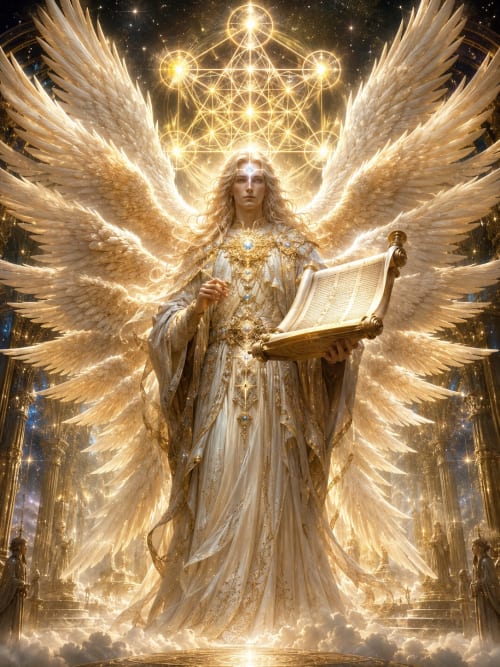
Metatron
Metatron · Scribe of Heaven — Voice of God and Recorder of Divine Acts
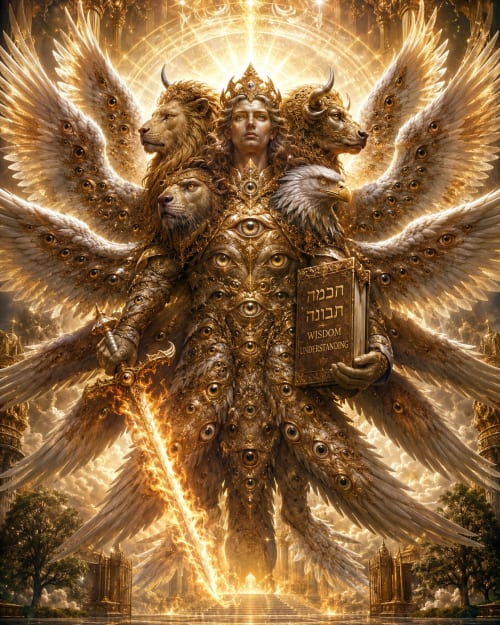
Cherubim
Cherubim · Second of the Nine Angelic Choirs — Guardians of Divine Wisdom and the Throne
Ophanim
Ophanim · Third of the Nine Angelic Choirs — Wheels of God, Throne of Justice
Sandalphon
Sandalphon · Angel of Prayer — Bearer of Mortal Prayers to God
Orobas
Orobas · 55th of Solomon's 72 Spirits — Horse-Headed Prince of Truth
Ra
Ra · Egyptian Sun God — Creator and King of the Gods
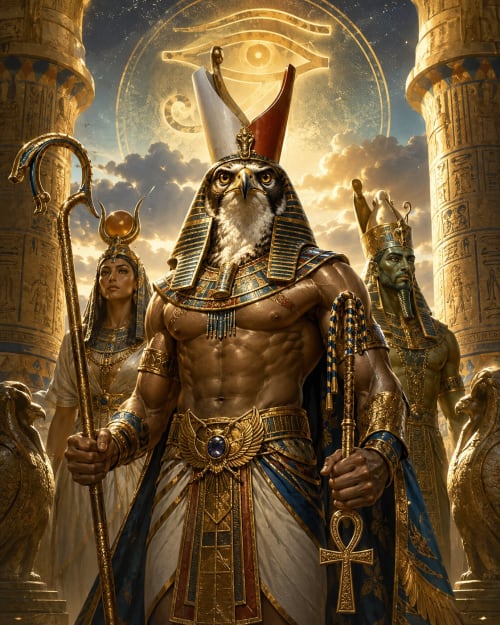
Horus
Horus · Egyptian God of Sky and Kingship — Falcon-Eyed Restorer of Justice
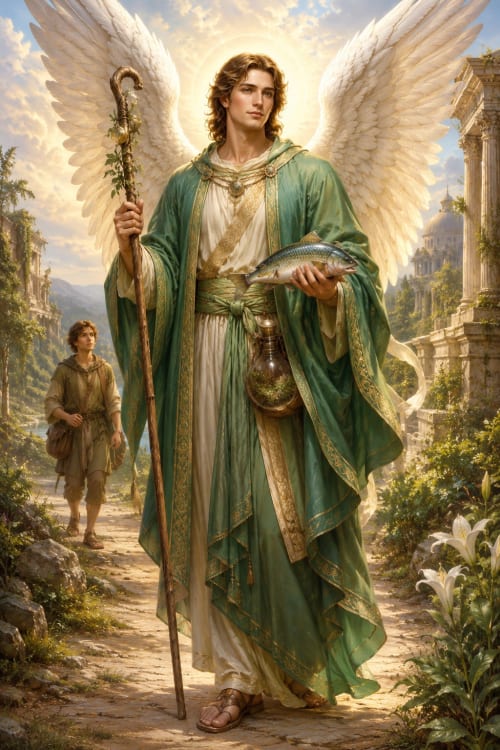
Raphael
Raphael · Archangel — Angel of Healing and Guide of Travelers
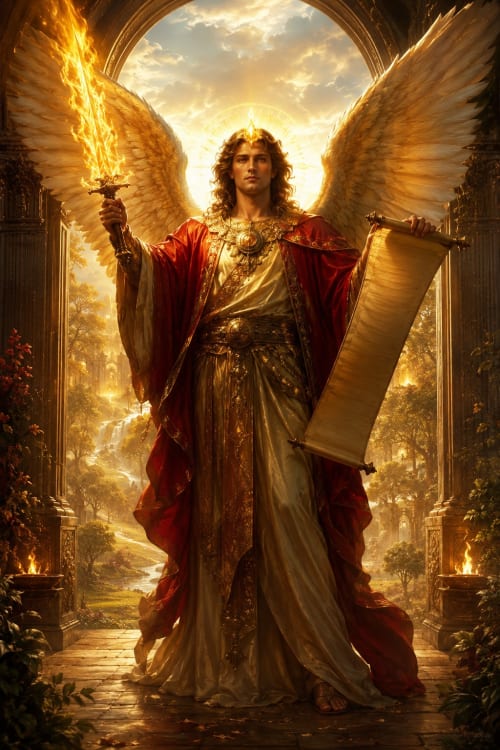
Uriel
Uriel · Archangel — Light of God, Angel of Wisdom and Repentance
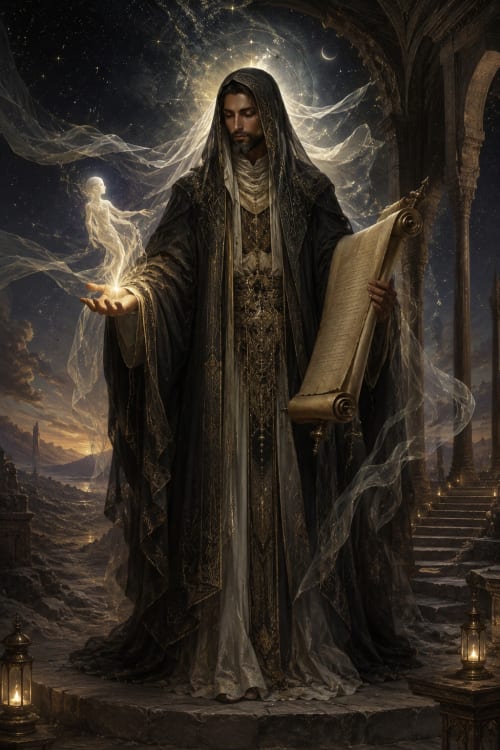
Azrael
Azrael· Angel of Death Reaper of Souls
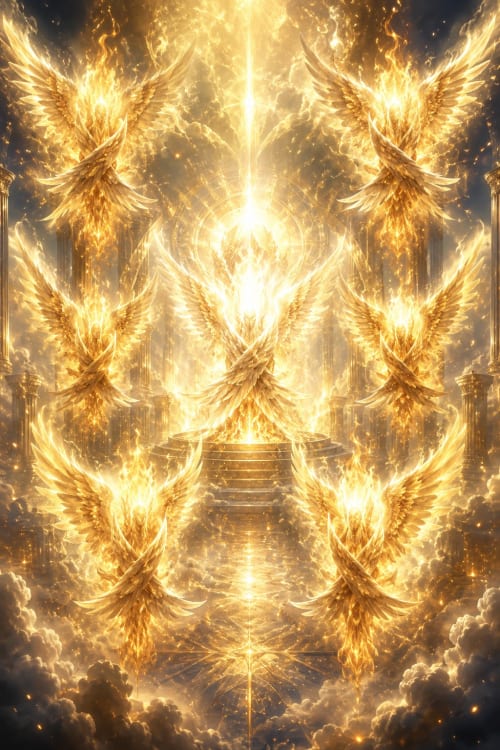
Seraphim
Seraphim · Highest Order of the Nine Angelic Choirs — The Burning Ones Around God