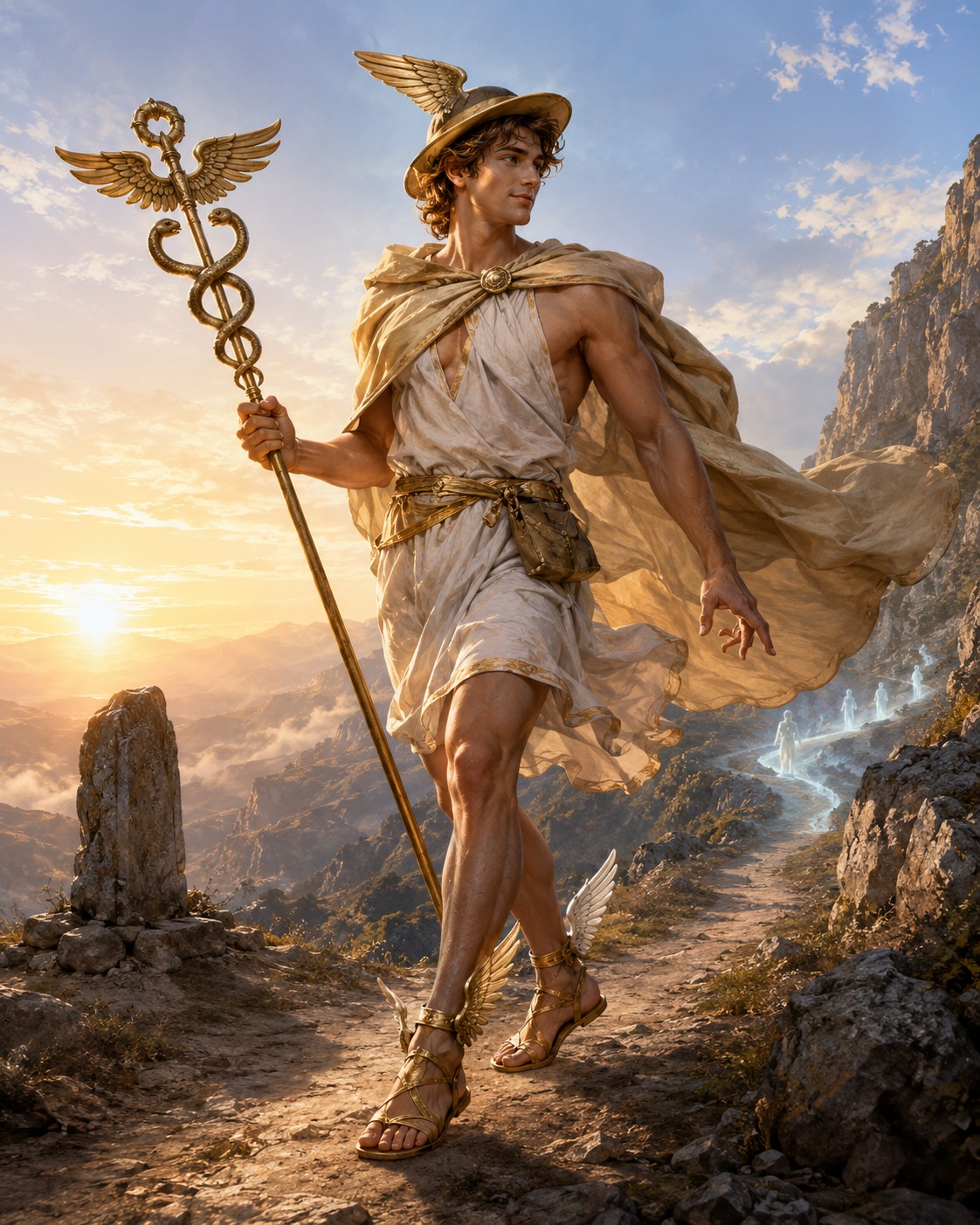
Hermes
Hermes · God of Travel, Trade, Thieves, and Messengers
Names in Other Languages
 헤르메스한국어
Hermes · 전령·여행·상업·도둑의 신
 ヘルメス日本語
Hermes · 伝令・旅・商業・盗賊の神
 赫密斯繁體中文
Hermes · 信使、旅行、貿易、盜賊之神
 HermesDeutsch
Hermes · Gott der Reise, Händler, Diebe und Boten
 HermèsFrançais
Hermès · Dieu du voyage, du commerce, des voleurs et messager
 HermesEspañol
Hermes · Dios del viaje, comercio, ladrones y mensajero
 HermesPortuguês
Hermes · Deus do viagem, comércio, ladrões e mensageiro
 HermesPolski
Hermes · Bóg podróży, handlu, złodziei i posłaniec
 ГермесРусский
Hermes · Бог путешествий, торговли, воров и вестник
Hermes (Ancient Greek Hermes, Latin Mercurius) is the decisive canonical god of messengers, travel, commerce, thieves, gambling, oratory, and borders among the 12 Olympian gods of Greek mythology, and the decisive canonical iconographic figure who, as the son of Zeus (Zeus) and Maia (Maia, eldest of the Pleiades), was born in a cave on Mount Cyllene (Kyllene) — on the day of his birth — invented the lyre (lyra) from a tortoise shell — and stole the sacred 50 cattle of Apollo (Apollo). The etymology Greek Hermes is derived from herma (herma, 'pile of stones, boundary stone') — the decisive canonical vocabulary, and the aliases Argeiphontes (Argeiphontes, 'slayer of Argos'), Diaktoros (Diaktoros, 'guide'), Psychopompos (Psychopompos, 'soul guide'), and Soter (Soter, 'saviour') are the decisive canonical vocabulary. The decisive textual canon is the Homeric Hymns (Homeric Hymns) No. 4 — Hymn to Hermes — 580 lines of c. 7th-6th century BCE — the decisive canon of Hermes's birth, lyre invention, and Apollo's cattle theft — and Theogony (Theogony) lines 938-939 of Hesiod of c. 8th-7th century BCE — the decisive canon of Hermes's birth as the son of Zeus and Maia.
Origin
The iconographic origin is the Bronze Age Mycenaean civilisation (c. 1600-1100 BCE) Mycenaean Linear B clay tablet inscription 'e-ma-a' (Hermes) — the decisive origin canon, and the decisive textual canon is the Homeric Hymns (Homeric Hymns) No. 4 — Hymn to Hermes (Hymn to Hermes) 580 lines of c. 7th-6th century BCE — the decisive canon in which Hermes, born in a cave on Mount Cyllene (Kyllene) in the Peloponnese as the son of Zeus (Zeus) and Maia (Maia), eldest of the seven Pleiades (Pleiades) sisters — on the day of his birth — invented the lyre (lyra) from a tortoise (chelys) shell — and reversely stole the sacred 50 cattle of his elder brother Apollo (Apollo) leaving the footprints in reverse — and after being discovered, reconciled by giving the lyre to Apollo. The Theogony (Theogony) lines 938-939 of Hesiod (Hesiod) of c. 8th-7th century BCE — the decisive canon of Hermes's birth as the son of Zeus and Maia — and the Iliad (Iliad) Book 24 lines 339-468 of Homer (Homer) of c. 8th century BCE — the decisive canon in which Hermes guides the Trojan king Priam (Priam) to the camp of Achilles (Achilles) — and the Odyssey (Odyssey) Book 5 lines 43-148 — the decisive canon in which Hermes delivers Zeus's message to Calypso (Calypso).
Features
- Young clever beautiful boy and youth god
- Winged hat Petasos (petasos) and winged sandals Talaria (talaria)
- Caduceus (kerykeion) staff with two intertwined snakes
- Symbols of the twin lamb and tortoise
- Born in a cave on Mount Cyllene
- Psychopompos (soul guide)
Stories
The Bronze Age Mycenaean 'e-ma-a' (Hermes) inscription is the decisive origin, and the decisive textual canon is the Homeric Hymns No. 4 Hymn to Hermes 580 lines of c. 7th-6th century BCE, Hesiod Theogony lines 938-939 of c. 8th-7th century BCE, and Homer Iliad Book 24 lines 339-468, Odyssey Book 5, and Book 24 lines 1-14 (Psychopompos — guiding the souls of the suitors to the underworld) of c. 8th century BCE. The Herma (Herma) — stone pillars with the face of Hermes carved — of Greece of c. 5th-3rd century BCE is the decisive religious canon of the Greek polis, and the marble statue Hermes and the Infant Dionysus (Hermes and the Infant Dionysus) — c. 2.13m, excavated at the Heraion of Olympia in 1877 — by the Greek sculptor Praxiteles (Praxiteles) of c. 340 BCE is the decisive art canon. The Metamorphoses (Metamorphoses) Book 1 lines 668-721 of Ovid (Publius Ovidius Naso) of c. 1st century CE — the decisive canon of the Argos (Argos) killing — and the Corpus Hermeticum (Corpus Hermeticum) of Hermes Trismegistus (Hermes Trismegistus) of the 2nd-3rd century Greco-Egyptian fusion — is the decisive religious canon. The Hermes (Hermes) of the 1980 D&D Deities & Demigods (Deities & Demigods) by TSR in the USA and the decisive 21st-century canon — the Hermes of Percy Jackson & the Olympians: The Lightning Thief (The Lightning Thief) of Rick Riordan published in the USA on 28 June 2005 — is the 21st-century decisive young-adult novel canon, and the sequel The Heroes of Olympus (The Heroes of Olympus) published in the USA in August 2010 is the decisive canon.
Weakness
Hermes's weaknesses are: (1) mischief and trickster nature — the decisive canonical weakness in the c. 7th-6th-century-BCE Homeric Hymns No. 4 Hymn to Hermes canon — on the day of his birth, the decisive canon of reversely stealing Apollo's cattle — that drops trust — the decisive canon; (2) non-absolute authority — like other Olympian gods, the authority is not absolute and Hermes is treated as an errand-runner by various gods — the decisive canon; (3) Zeus's command — as messenger of Zeus, must follow command — the decisive canon; (4) elder brother Apollo — authority — the decisive canon; (5) thief nature — the unofficial canon weakness of being thieves and gamblers; (6) binding of borders — the binding of the decisive canon of Herma (stone pillars); (7) binding of soul guidance — the duty of Psychopompos (soul guide) with the dead — the decisive canon; (8) binding of the sacred domain — the decisive canon. The decisive canonical finale is the decisive mythological canon of the c. 7th-6th-century-BCE Homeric Hymns No. 4 Hymn to Hermes — Hermes reconciles by giving the lyre to Apollo — and the decisive canon in which Hermes receives the Caduceus (kerykeion) — staff with two intertwined snakes.
Cultural Significance
Hermes is not merely a messenger icon but the canonical iconographic figure of the decisive Greek-Roman-Hermetic canon, traversing the Bronze Age Mycenaean 'e-ma-a' inscription, the c. 8th-7th-century-BCE Hesiod Theogony, the c. 8th-century-BCE Homer Iliad and Odyssey, the c. 7th-6th-century-BCE Homeric Hymns No. 4 Hymn to Hermes, the c. 5th-3rd-century-BCE Herma (stone pillars), the c. 340 BCE Praxiteles Hermes and the Infant Dionysus, the c. 1st-century-CE Ovid Metamorphoses, and the 2nd-3rd-century Hermes Trismegistus and Corpus Hermeticum. The Bronze Age Mycenaean civilisation (c. 1600-1100 BCE) Mycenaean Linear B clay tablet inscription 'e-ma-a' (Hermes) is the decisive origin, and the decisive textual canon is the Homeric Hymns (Homeric Hymns) No. 4 Hymn to Hermes 580 lines of c. 7th-6th century BCE — the decisive canon in which Hermes, born in a cave on Mount Cyllene in the Peloponnese as the son of Zeus and Maia, eldest of the Pleiades — on the day of his birth — invents the lyre from a tortoise shell, steals the sacred 50 cattle of Apollo, and after being discovered, reconciles by giving the lyre to Apollo. The Odyssey (Odyssey) Book 24 lines 1-14 of Homer of c. 8th century BCE — the decisive canon in which Hermes, as Psychopompos (soul guide), leads the souls of the suitors to the underworld — and the Corpus Hermeticum (Corpus Hermeticum) of Hermes Trismegistus (Hermes Trismegistus) of the 2nd-3rd-century Greco-Egyptian fusion — 18 Greek texts — is the decisive religious and philosophical canon of Hermeticism. The Hermes of the 1980 D&D Deities & Demigods by TSR in the USA is the decisive fantasy RPG canon, and Percy Jackson & the Olympians: The Lightning Thief of Rick Riordan published in the USA on 28 June 2005 and the 2010 film Percy Jackson & the Olympians: The Lightning Thief (directed by Chris Columbus) are the decisive global canon.
In Popular Culture
- Mycenaean Linear B 'e-ma-a' (Bronze Age) — decisive origin canon
- Hesiod Theogony lines 938-939 (c. 8th-7th century BCE) — decisive birth canon
- Homer Iliad Book 24 lines 339-468 and Odyssey Books 5 and 24 (c. 8th century BCE) — decisive heroic-epic canon
- Homeric Hymns No. 4 Hymn to Hermes (c. 7th-6th century BCE) — decisive birth, lyre, and cattle-theft canon
- Praxiteles Hermes and the Infant Dionysus (c. 340 BCE) — decisive art canon
- Ovid Metamorphoses Book 1 Argos killing (c. 1st century CE) — decisive Latin canon
- Hermes Trismegistus Corpus Hermeticum (2nd-3rd centuries) — decisive Hermeticism canon
- TSR D&D Deities & Demigods, Hermes (1980) — decisive fantasy RPG canon
- Rick Riordan Percy Jackson & the Olympians (2005-2024) — 21st-century decisive young-adult novel and film canon
Trivia
The etymology Greek Hermes is derived from herma (herma, 'pile of stones, boundary stone') — the decisive canonical vocabulary, and the aliases Argeiphontes (Argeiphontes, 'slayer of Argos'), Diaktoros (Diaktoros, 'guide'), Psychopompos (Psychopompos, 'soul guide'), Soter (Soter, 'saviour'), Logios (Logios, 'of oratory'), and Dorios (Dorios, 'of gifts') are the decisive canonical vocabulary. The decisive textual canon is the Homeric Hymns (Homeric Hymns) No. 4 — Hymn to Hermes (Hymn to Hermes) 580 lines of c. 7th-6th century BCE — the decisive canon in which Hermes, born in a cave on Mount Cyllene (Kyllene) in the Peloponnese as the son of Zeus (Zeus) and Maia (Maia), eldest of the seven Pleiades (Pleiades) sisters — on the day of his birth — invents the 7-stringed lyre (lyra) from a tortoise (chelys) shell — and reversely steals the sacred 50 cattle of his elder brother Apollo (Apollo) from Pieria (Pieria) leaving the footprints in reverse. After being discovered, the decisive canon in which he reconciles by giving the lyre to Apollo and receives the Caduceus (kerykeion) — staff with two intertwined snakes. Hermes's winged hat Petasos (petasos) and winged sandals Talaria (talaria) are the decisive canon, and the Odyssey (Odyssey) Book 24 lines 1-14 of Homer of c. 8th century BCE — the decisive canon in which Hermes, as Psychopompos (soul guide), leads the souls of the suitors to the underworld. The Corpus Hermeticum (Corpus Hermeticum) of Hermes Trismegistus (Hermes Trismegistus) of the 2nd-3rd-century Greco-Egyptian fusion — 18 Greek texts — is the decisive religious and philosophical canon of Hermeticism.