Paimon
Paimon · Ninth of Solomon's 72 Spirits — King of Arts and Knowledge
Names in Other Languages
 파이몬한국어
Paimon· 솔로몬의 72귀신 제9위 예술과 학문의 왕
 パイモン日本語
Paimon· ソロモンの72魔神第9位 芸術と学問の王
 派蒙繁體中文
Paimon· 所羅門72魔神第9位 藝術與學問之王
 PaimonDeutsch
Paimon · Neunter der 72 Geister Salomos — König der Künste und der Wissenschaft
 PaimonFrançais
Paimon · Neuvième des 72 esprits de Salomon — Roi des arts et du savoir
 PaimonEspañol
Paimon · Noveno de los 72 espíritus de Salomón — Rey de las artes y el saber
 PaimonPortuguês
Paimon · Nono dos 72 espíritos de Salomão — Rei das artes e do saber
 PaimonPolski
Paimon · Dziewiąty z 72 duchów Salomona — Król sztuk i wiedzy
 ПаймонРусский
Paimon · Девятый из 72 духов Соломона — Царь искусств и знания
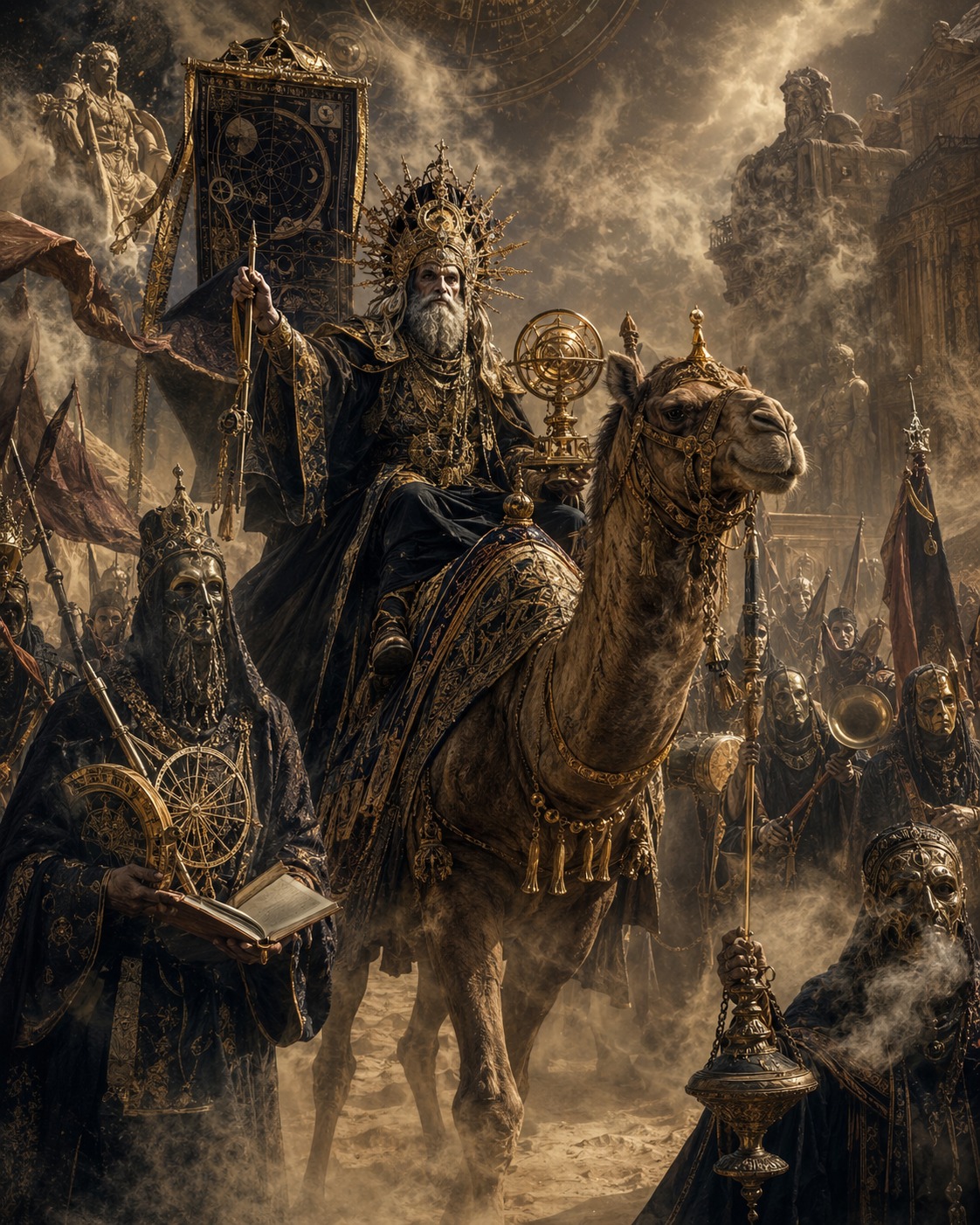
Paimon (Latin Paimon, English Paimon) is the powerful king of the 9th rank among the 72 demons in Book 1 of the 17th-century grimoire — the decisive canon — The Lesser Key of Solomon (Lemegeton Clavicula Salomonis) — Ars Goetia (Ars Goetia) — commanding 200 legions (legions) of demons — the decisive canonical iconographic figure. Aliases — Paimaim, King Paimon, King of Camels, King of Arts and Sciences — are the decisive canonical vocabulary. The decisive textual canon is the decisive origin canon of Paimon in Pseudomonarchia Daemonum (Pseudomonarchia Daemonum) of Johann Weyer (Johann Weyer) of 1563 and the decisive canon of the 9th rank king of the 72 demons in Book 1 Ars Goetia (Ars Goetia) of The Lesser Key of Solomon (Lemegeton Clavicula Salomonis) of the 17th century. The decisive grimoire canon of Paimon in The Magus (The Magus) of Francis Barrett (Francis Barrett) of 1801 of England, and the decisive art canon of the Paimon iconography depicting a crowned man on a camel in the Dictionnaire Infernal (Dictionnaire Infernal) of Collin de Plancy (Collin de Plancy) of 1863, and the decisive 21st-century film canon of 'Hail Paimon' in the film Hereditary (Hereditary) (directed by Ari Aster (Ari Aster), A24) released in the USA on 8 June 2018.
Origin
The etymological origin is the decisive canon of the theory derived from the Hebrew verb 'to make a sound', and the decisive textual canon is the decisive origin canon of Paimon, who first systematically appeared as a king commanding 200 legions of spirits, in Pseudomonarchia Daemonum (Pseudomonarchia Daemonum) of the Dutch Johann Weyer (Johann Weyer, 1515-1588) of 1563. The decisive grimoire canon is the decisive canon of the 9th rank king of the 72 demons in Book 1 Ars Goetia (Ars Goetia) of The Lesser Key of Solomon (Lemegeton Clavicula Salomonis) of the 17th century — 'Paimon is a great king and when he appears he comes in the form of a man wearing a glittering crown, riding a camel (dromedary), and before him go many musicians with trumpets and cymbals and all other instruments in a great ceremony, and his voice is great but at first hoarse'. Paimon is the decisive canon teaching humans all arts and sciences and secret knowledge, all secrets of the earth, the secrets of the wind, and the courses of the celestial bodies, and the decisive canon recommending that the conjuror call him before other demons because he gives the most direct answers.
Features
- Appearance of a crowned man on a camel (dromedary)
- Accompanied by a great musical procession with trumpets and cymbals
- Hoarse yet great voice
- Powerful king commanding 200 legions of demons
- Main axis 9th rank of Solomon's 72 demons King of the East
- Teaches knowledge of arts, sciences, secrets, wind, and celestial bodies
Stories
Paimon in Johann Weyer's Pseudomonarchia Daemonum of 1563 is the decisive origin, and the decisive textual canon is the 9th rank king of the 72 demons in Book 1 Ars Goetia of The Lesser Key of Solomon of the 17th century, The Magus of Francis Barrett of 1801, and the iconography of the Dictionnaire Infernal of Collin de Plancy of 1863. The decisive canon known to teach the secrets of learning, art, astronomy, geology, and wind in Solomon's magic, and the decisive canon in which the conjuror was recommended to call him before other demons. The decisive canon as one of the most popular demons in modern occult and horror genres, and the decisive canon of the apocryphal tradition that he was originally an angel but fell with Lucifer. The decisive 21st-century film canon is the decisive canon of 'Hail Paimon' as the demon causing the tragedy of the protagonist's family in the USA horror film Hereditary (Hereditary) (directed by Ari Aster (Ari Aster, born 15 July 1986 in New York, USA), A24, worldwide box office about 82 million dollars) released in the USA on 8 June 2018 — the decisive canon of Paimon's descent at the treehouse at the end of the film, and the decisive 21st-century global game canon of the companion character Paimon (Paimon) in the video game Genshin Impact (Genshin Impact) released on 28 September 2020 by Chinese miHoYo (miHoYo).
Weakness
Paimon's weaknesses are: (1) ritual of acknowledging his dignity — the decisive canonical weakness — angers if summoned without a ritual sufficiently acknowledging his dignity; (2) East-West direction — the decisive canonical weakness — the conjuror must accurately align the East-West direction; (3) incense — the decisive canonical weakness — must burn appropriate incense (frankincense) for him to show favor; (4) God's name — the decisive canonical weakness — powerless before God's name and Christ's authority like all other demons; (5) binding of summoning — must obey the conjuror's command; (6) binding of Solomon's seal — controlled by Solomon's seal; (7) binding of the sacred domain — the decisive canon; (8) binding of 200 legions — the decisive canon of the responsibility of commanding 200 legions. The decisive canonical finale is the decisive mythological canon of being one of the 72 demons bound by Solomon's seal, eternally responding to the conjuror's call.
Cultural Significance
Paimon is not merely a demon icon but the canonical iconographic figure of the decisive grimoire canon, traversing Johann Weyer's Pseudomonarchia Daemonum of 1563, the 9th rank of the 72 demons in Book 1 Ars Goetia of The Lesser Key of Solomon of the 17th century, Francis Barrett's The Magus of 1801, Collin de Plancy's Dictionnaire Infernal of 1863, the 2018 film Hereditary, and the 2020 game Genshin Impact. The etymological origin is the decisive canon of the theory derived from the Hebrew verb 'to make a sound' — connected to his great voice and musical procession — and the decisive textual canon settled as the decisive origin canon of Pseudomonarchia Daemonum (Pseudomonarchia Daemonum) of the Dutch Johann Weyer (Johann Weyer, 1515-1588) of 1563. The decisive grimoire canon is the decisive canon of the 9th rank king of the 72 demons in Book 1 Ars Goetia (Ars Goetia) of The Lesser Key of Solomon (Lemegeton Clavicula Salomonis) of the 17th century — 'Paimon is a great king and appears in the form of a man wearing a glittering crown, riding a camel (dromedary), with a great ceremony of trumpets and cymbals and other instruments before him'. Paimon is the decisive canon teaching humans all arts and sciences and secret knowledge, all secrets of the earth, the secrets of the wind, and the courses of the celestial bodies, and the decisive 19th-century art canon of the Paimon iconography depicting a crowned man on a camel in the Dictionnaire Infernal (Dictionnaire Infernal) of the French Collin de Plancy (Collin de Plancy, 1793-1881) of 1863. The decisive 21st-century film canon is the decisive canon of 'Hail Paimon' as the demon causing the tragedy of the protagonist Graham family in the USA horror film Hereditary (Hereditary) (directed by Ari Aster (Ari Aster, born 15 July 1986 in New York, USA), A24, worldwide box office about 82 million dollars) released in the USA on 8 June 2018 — the decisive canon of Paimon's descent at the treehouse at the end of the film, and the decisive 21st-century global game canon of the companion character Paimon (Paimon) in the open-world video game Genshin Impact (Genshin Impact) released on 28 September 2020 by Chinese miHoYo (miHoYo).
In Popular Culture
- Johann Weyer Pseudomonarchia Daemonum Paimon (1563) — decisive origin canon
- The Lesser Key of Solomon Book 1 Ars Goetia 9th rank king of the 72 demons (17th century) — decisive grimoire canon
- Francis Barrett The Magus (1801) — decisive grimoire canon
- Collin de Plancy Dictionnaire Infernal 1863 edition crowned man on camel — decisive 19th-century art canon
- TSR D&D Monster Manual (1977) — decisive fantasy RPG canon
- Film Hereditary directed by Ari Aster 'Hail Paimon' (2018) — decisive 21st-century film canon
- Game Genshin Impact Paimon companion (2020) — 21st-century decisive global game canon
Trivia
The etymology of Paimon (Latin Paimon, English Paimon) is the decisive canonical vocabulary of the theory derived from the Hebrew verb 'to make a sound (to make a sound)' — connected to his great voice and musical procession — and aliases Paimaim, King Paimon (King Paimon), King of Camels, and King of Arts and Sciences are the decisive canonical vocabulary. The decisive textual canon is the decisive origin canon of Paimon, who first systematically appeared as a king commanding 200 legions of spirits, in Pseudomonarchia Daemonum (Pseudomonarchia Daemonum) of the Dutch physician and occult scholar Johann Weyer (Johann Weyer, born 1515 in Grave, Netherlands, died 24 February 1588 in Tecklenburg, Germany) of 1563. The decisive grimoire canon is the decisive canon of the 9th rank king of the 72 demons (72 demons) in Book 1 Ars Goetia (Ars Goetia) of The Lesser Key of Solomon (Lemegeton Clavicula Salomonis) of the 17th century — 'Paimon is a great king and when he appears he comes in the form of a man wearing a glittering crown, riding a camel (dromedary), and before him go many musicians with trumpets and cymbals and all other instruments in a great ceremony, and his voice is great but at first hoarse. He teaches humans all arts and sciences and secret knowledge, all secrets of the earth, the secrets of the wind, and the courses of the celestial bodies'. The decisive canon recommending that the conjuror call him before other demons because he gives the most direct answers, and the decisive canon of the apocryphal tradition that he was originally an angel but fell with Lucifer. The Magus (The Magus) of the English Francis Barrett (Francis Barrett) of 1801, and the decisive 19th-century art canon of the Paimon iconography depicting a crowned man on a camel in the Dictionnaire Infernal (Dictionnaire Infernal) of the French Collin de Plancy (Collin de Plancy, 1793-1881) of 1863. The decisive 21st-century film canon is the decisive canon of Paimon's descent and 'Hail Paimon (Hail Paimon)' at the treehouse at the end of the USA horror film Hereditary (Hereditary) (directed by Ari Aster (Ari Aster, born 15 July 1986 in New York, USA), A24, worldwide box office about 82 million dollars) released in the USA on 8 June 2018, and the decisive 21st-century global game canon of the companion character Paimon (Paimon) of the protagonist in the open-world video game Genshin Impact (Genshin Impact) released on 28 September 2020 by Chinese miHoYo (miHoYo, now HoYoverse).