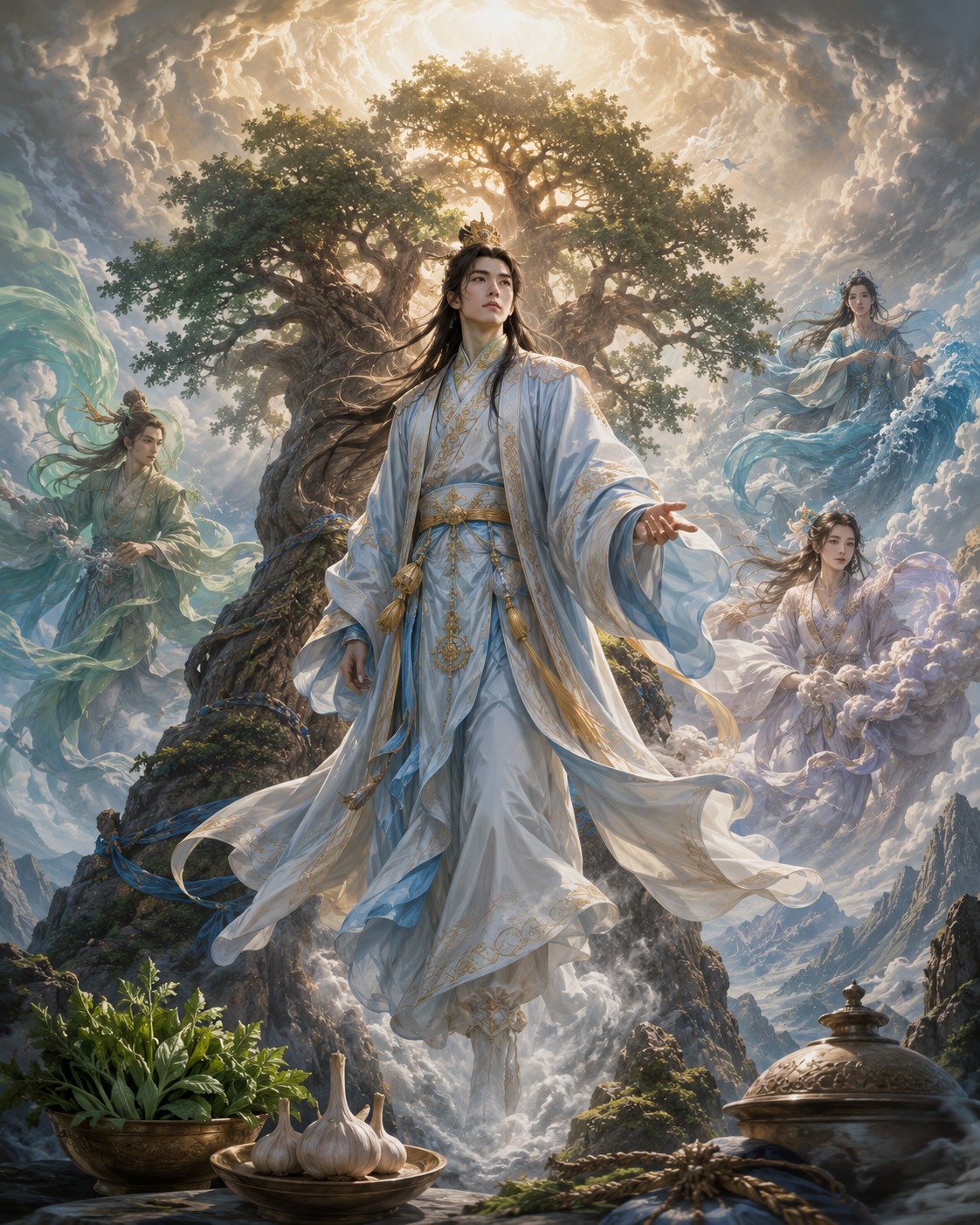
Hwanung
Hwanung· Korean Sky God Father of Dangun
Names in Other Languages
 환웅한국어
환웅한국어Hwanung· 한국 신화의 천신 단군의 아버지
 桓雄日本語
桓雄日本語Hwanung· 朝鮮神話の天神 檀君の父
 桓雄繁體中文
Hwanung· 朝鮮神話之天神 檀君之父
 HwanungDeutsch
Hwanung · Koreanischer Himmelsgott — Vater des Dangun
 HwanungFrançais
Hwanung· Dieu coréen du ciel Père de Dangun
 HwanungEspañol
Hwanung· Dios coreano del cielo Padre de Dangun
 HwanungPortuguês
Hwanung· Deus coreano do céu Pai de Dangun
 HwanungPolski
Hwanung· Koreański bóg nieba Ojciec Danguna
 ХванунРусский
Hwanung· Корейский бог неба Отец Тангуна
Hwanung (Hanja Hwanung) is the heavenly god of Korean mythology — the decisive canon, the son of Hwanin (Hwanin), the heavenly god, and the father of Dangun Wanggeom (Dangun Wanggeom) — the decisive canonical iconographic figure who descended to the human world and founded the divine city of Sinsi (Sinsi). The etymology is the decisive canonical vocabulary of Hwan ('brightness') + Ung ('male, hero'), and the aliases Cheonwang ('Heavenly King'), Hwanung Cheonwang (Hwanung Cheonwang), Sinung ('divine hero'), and Ungsang (Ungsang) are the decisive canonical vocabulary. The decisive textual canon is the Samguk Yusa (Memorabilia of the Three Kingdoms) Volume 1 'Gi-i (Strange Events)' chapter 'Old Joseon Wanggeom Joseon' of c. 1281 — the 7th year of King Chungnyeol of Goryeo — by the monk Iryeon (1206-1289) — the decisive canon in which the illegitimate son of Hwanin, Hwanung, asked to rule the human world, and his father Hwanin looked down upon Mount Samwi-Taebaek (Samwi-Taebaek) and determined it as a place where one could 'broadly benefit humans (Hongik Ingan)', and gave Hwanung three Cheonbuin (Heavenly Seal) and 3,000 followers to descend. The Jewang Ungi (Songs of Emperors and Kings) Volume 2 of Yi Seunghyu (Yi Seunghyu, 1224-1300) of 1287 — the 13th year of King Chungnyeol of Goryeo — is the decisive canon.
Origin
The iconographic origin is the heavenly-descendant faith and bear totem of the Bronze Age Korean peninsula — the decisive origin canon, and the decisive textual canon is the Samguk Yusa (Memorabilia of the Three Kingdoms) Volume 1 'Gi-i (Strange Events)' chapter 'Old Joseon Wanggeom Joseon' of c. 1281 by the monk Iryeon, citing the Old Record (Gogi) — 'In ancient times, the illegitimate son of Hwanin (Hwanin), Hwanung (Hwanung), always had ambition in the world below and longed for the human world. Hwanin, knowing his ambition, looked down upon Mount Samwi-Taebaek and saw it as a place where humans could be broadly benefited (Hongik Ingan), so he gave him three Cheonbuin (Heavenly Seals) and let him go and rule. Hwanung descended with 3,000 followers under the Sindansu (Sacred Altar Tree) of Mount Taebaek (Taebaek) and called the place Sinsi (Divine City) and called himself Hwanung Cheonwang (Hwanung the Heavenly King)' — the decisive canon. The decisive canon in which he commanded the three gods of Pungbaek (Wind Master), Usa (Rain Master), and Unsa (Cloud Master) and presided over the 360 affairs of humans, such as grain, life, disease, punishment, and good and evil (Jugok, Jumyeong, Jubyeong, Juhyeong, Juseonak). The decisive canon in which a bear and a tiger prayed to become human, and Hwanung gave them a bunch of sacred mugwort (mugwort) and 20 garlic cloves (garlic), saying that if they did not see the sun for 100 days, they would become human. The bear became a woman, Ungnyeo (Ungnyeo), in 21 days (samchil-il), but the tiger could not endure and failed.
Features
- Young and dignified Cheonson (heavenly-descendant) youth
- Three Cheonbuin (Heavenly Seals) — presumed to be bronze sword, bronze mirror, and bronze bell
- Capital of Sinsi (Divine City) under the Sindansu (Sacred Altar Tree) of Mount Taebaek
- Commands the three gods of Pungbaek (Wind Master), Usa (Rain Master), and Unsa (Cloud Master)
- Turns a bear into the woman Ungnyeo with mugwort and garlic
- Main axis — presides over 360 affairs of humans (grain, life, disease, punishment, good and evil)
Stories
The heavenly-descendant faith and bear totem of the Bronze Age Korean peninsula is the decisive origin, and the decisive textual canon is the Samguk Yusa Volume 1 'Gi-i' chapter 'Old Joseon Wanggeom Joseon' by Iryeon of c. 1281 and the Jewang Ungi Volume 2 by Yi Seunghyu of 1287. The decisive canon as the founding god of the Korean people and the core of Dangun thought, and the decisive canon of Gaecheonjeol (National Foundation Day), first established by Na Cheol (Na Cheol, 1863-1916) of Daejonggyo (Daejonggyo) on the 3rd day of the 10th lunar month of 1909, when Hwanung's descent is commemorated, and the decisive canon of the designation of Gaecheonjeol as a national holiday of the Republic of Korea on the 3rd day of October by the solar calendar on 1 October 1949. The decisive canon called upon as the heavenly god in village faith and seonangdang (village shrine) and sotdae (pole shrine), and the decisive canon of Mount Taebaek being worshipped as a sacred mountain (Mount Taebaek is identified with the current Mount Taebaek of Gangwon Province, or Mount Baekdu (Baekdu), or Mount Myohyang (Myohyang)). The decisive canon in which the ideology of 'Hongik Ingan (Broadly Benefit Humans)' became the decisive canonical educational ideology of the Education Law (Law No. 86) of the Republic of Korea of 31 December 1949. The reincarnated Hwanung-as the Goguryeo king Gwanggaeto the Great Damdeok (Damdeok) played by Bae Yong-joon (Bae Yong-joon) of the KBS 2TV Korean drama The Legend (Tae Wang Sa Shin Gi) (24 episodes) of September 2007 is the 21st-century decisive Korean video canon.
Weakness
Hwanung's weaknesses are: (1) binding of the power of his father Hwanin — the decisive canonical weakness — the decisive canon of the 1281 Samguk Yusa — limited authority compared to the power of his father Hwanin; (2) being bound to the human world — the decisive canonical weakness — the decisive canon of being partially bound to the limits of humans as he descended to rule the human world; (3) binding of Sinsi — the decisive canon of being bound to the capital of Sinsi (Divine City); (4) binding of the 360 affairs — the decisive canon of presiding over the 360 affairs of humans, such as grain, life, disease, punishment, and good and evil; (5) binding of the bear's trial — the decisive canon of the 100-day trial of mugwort and garlic; (6) binding of transformation into a human — the decisive canon of temporarily transforming into a human to marry Ungnyeo; (7) binding of the sacred domain — the decisive canon of the Sindansu of Mount Taebaek; (8) binding of the three Cheonbuin — the decisive canon of ruling only by the power of the Cheonbuin (Heavenly Seals). The decisive canonical finale is the decisive mythological canon of the 1281 Samguk Yusa — Hwanung temporarily transformed into a human, married Ungnyeo, and gave birth to Dangun Wanggeom, becoming the founding ancestor of the Korean people.
Cultural Significance
Hwanung is not merely a heavenly-god icon but the canonical iconographic figure of the decisive Korean canon, traversing the Bronze Age Korean peninsula heavenly-descendant faith, the c. 1281 Goryeo Iryeon Samguk Yusa Volume 1 'Gi-i' chapter 'Old Joseon Wanggeom Joseon', the 1287 Yi Seunghyu Jewang Ungi Volume 2, the 1909 Daejonggyo Na Cheol's establishment of Gaecheonjeol, the 1949 Republic of Korea's designation of Gaecheonjeol as a national holiday, the 1949 Republic of Korea Education Law's 'Hongik Ingan' educational ideology, and the 2007 KBS The Legend. The heavenly-descendant faith and bear totem of the Bronze Age Korean peninsula settled as the decisive canon in the Samguk Yusa (Memorabilia of the Three Kingdoms) Volume 1 'Gi-i (Strange Events)' chapter 'Old Joseon Wanggeom Joseon' of c. 1281 — the 7th year of King Chungnyeol of Goryeo — by the monk Iryeon (1206-1289). The decisive mythological canon is the citation of the Old Record (Gogi) of the c. 1281 Samguk Yusa — 'In ancient times, the illegitimate son of Hwanin, Hwanung, had ambition in the world below and longed for the human world' — and the decisive canon in which Hwanung descended with 3,000 followers under the Sindansu of Mount Taebaek and called it Sinsi and called himself Hwanung the Heavenly King. The decisive canon in which he commanded the three gods of Pungbaek, Usa, and Unsa and presided over the 360 affairs of humans, such as grain, life, disease, punishment, and good and evil. The decisive modern canon is the Gaecheonjeol (National Foundation Day) first established by Na Cheol (Na Cheol, 1863-1916) of Daejonggyo on the 3rd day of the 10th lunar month of 1909, the designation of Gaecheonjeol as a national holiday of the Republic of Korea on the 3rd day of October by the solar calendar on 1 October 1949, and the 'Hongik Ingan' educational ideology of the Education Law (Law No. 86) of the Republic of Korea of 31 December 1949. The decisive 21st-century canon is the reincarnated Hwanung as the Goguryeo king Gwanggaeto the Great Damdeok played by Bae Yong-joon (Bae Yong-joon, born 29 August 1972 in Seoul) of the KBS 2TV Korean drama The Legend (Tae Wang Sa Shin Gi) (24 episodes, directed by Kim Jong-hak, screenplay by Song Ji-na, production cost about 43 billion won) from 11 September to 5 December 2007 — the 21st-century decisive Korean video canon.
In Popular Culture
- Bronze Age Korean peninsula heavenly-descendant faith and bear totem — decisive origin canon
- Iryeon Samguk Yusa Volume 1 'Gi-i' chapter 'Old Joseon Wanggeom Joseon' (c. 1281) — decisive origin canon
- Yi Seunghyu Jewang Ungi Volume 2 (1287) — decisive Goryeo canon
- Joseon Wangjo Sillok King Sejong year 7 Dangun shrine (1425) — decisive Joseon religious canon
- Daejonggyo Na Cheol's establishment of Gaecheonjeol (1909) — decisive modern religious canon
- Republic of Korea national holiday Gaecheonjeol 3 October solar calendar (1949) — decisive national canon
- Republic of Korea Education Law 'Hongik Ingan' educational ideology (1949) — decisive educational canon
- KBS 2TV drama The Legend (Tae Wang Sa Shin Gi) Bae Yong-joon (2007) — 21st-century decisive Korean video canon
Trivia
The etymology of Hwanung (Hanja Hwanung) is the decisive canonical vocabulary of Hwan ('brightness') + Ung ('male, hero'), and the aliases Cheonwang ('Heavenly King'), Hwanung Cheonwang, Sinung ('divine hero'), and Ungsang (Ungsang) are the decisive canonical vocabulary. The decisive textual canon is the Samguk Yusa (Memorabilia of the Three Kingdoms) Volume 1 'Gi-i (Strange Events)' chapter 'Old Joseon Wanggeom Joseon' of c. 1281 — the 7th year of King Chungnyeol of Goryeo — by the monk Iryeon (1206-1289), citing the Old Record (Gogi) — the decisive canon. The decisive canon in which the illegitimate son of Hwanin (Hwanin), Hwanung, asked to rule the human world, and his father Hwanin looked down upon Mount Samwi-Taebaek and determined it as a place where one could 'broadly benefit humans (Hongik Ingan)', and gave Hwanung three Cheonbuin (Heavenly Seals — presumed to be bronze sword, bronze mirror, and bronze bell) and 3,000 followers to descend. The decisive canon in which Hwanung descended with 3,000 followers under the Sindansu (Sacred Altar Tree) of Mount Taebaek (Taebaek) and called the place Sinsi (Divine City) and called himself Hwanung Cheonwang (Hwanung the Heavenly King), and commanded the three gods of Pungbaek (Wind Master), Usa (Rain Master), and Unsa (Cloud Master) and presided over the 360 affairs of humans, such as grain, life, disease, punishment, and good and evil (Jugok, Jumyeong, Jubyeong, Juhyeong, Juseonak). The decisive canon in which a bear and a tiger prayed to become human, and Hwanung gave them a bunch of sacred mugwort and 20 garlic cloves, saying that if they did not see the sun for 100 days, they would become human. The bear became a woman, Ungnyeo, in 21 days (samchil-il), but the tiger could not endure and failed, and the decisive canon in which Ungnyeo had no one to marry and prayed under the Sindansu, and Hwanung temporarily transformed into a human and married her and gave birth to Dangun Wanggeom (Dangun Wanggeom). The Jewang Ungi (Songs of Emperors and Kings) Volume 2 of Yi Seunghyu (Yi Seunghyu, 1224-1300) of 1287 — the 13th year of King Chungnyeol of Goryeo — is the decisive canon, and the Gaecheonjeol (National Foundation Day) first established by Na Cheol of Daejonggyo on the 3rd day of the 10th lunar month of 1909, the designation of Gaecheonjeol as a national holiday of the Republic of Korea on the 3rd day of October by the solar calendar on 1 October 1949, and the 'Hongik Ingan' educational ideology of the Education Law of the Republic of Korea of 31 December 1949 — the decisive modern canon.