Tengu
Tengu · The Japanese Mountain Yokai — Master of Martial Arts and Punisher of Pride
Names in Other Languages
 텐구한국어
텐구한국어Tengu · 일본 산의 요괴 — 무술의 달인이자 오만의 징벌자
 天狗日本語
天狗日本語Tengu · 日本の山の妖怪 — 武術の達人にして傲慢の懲罰者
 天狗繁體中文
Tengu · 日本山中妖怪 — 武術達人與傲慢懲罰者
 TenguDeutsch
Tengu · Der japanische Berg-Yokai — Meister der Kampfkünste und Bestrafer des Hochmuts
 TenguFrançais
Tengu · Le yokai des montagnes du Japon — Maître des arts martiaux et châtieur de l'orgueil
 TenguEspañol
Tengu · El yokai de las montañas de Japón — Maestro de las artes marciales y castigador del orgullo
 TenguPortuguês
Tengu · O yokai das montanhas do Japão — Mestre das artes marciais e punidor do orgulho
 TenguPolski
Tengu · Japoński yokai gór — mistrz sztuk walki i karzący pychę
 ТэнгуРусский
Tengu · Японский горный ёкай — мастер боевых искусств и каратель гордыни
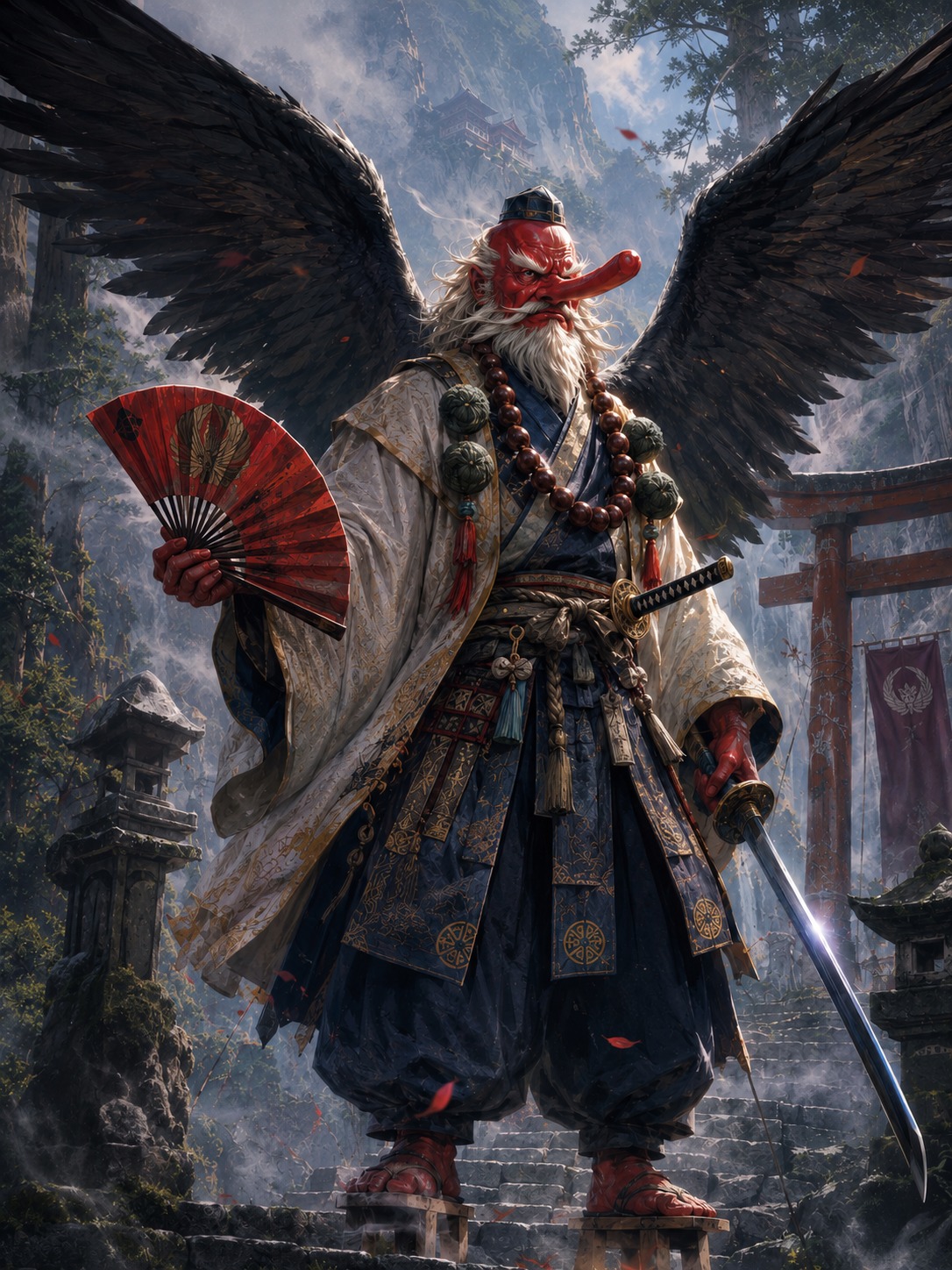
The Tengu (Japanese tengu, 'celestial dog') is a yokai of Japan's deep mountains, depicted with the head of a crow or a red face with a long nose, with wings on its back. A master of swordsmanship, martial arts, and supernatural power, the tengu tests ascetics in the mountains or transmits secret techniques to the worthy. The etymology comes from the Han-period Chinese Tian-gou ('celestial dog') of the Shanhaijing, but the figure was decisively reshaped in Japan from the eighth century onward. The Nihon Shoki of 720 records the first Japanese reference, but the canonical iconography crystallised in the twelfth-century Konjaku Monogatari-shu as the avatar of a corrupt monk. Kamakura-era tales such as the Heike Monogatari fixed the tengu as a martial-arts master, with Sojobo of Mount Kurama said to have taught swordsmanship to Minamoto no Yoshitsune. The crow-headed Karasu-tengu represents the earlier iconography, while the red-faced, long-nosed Daitengu in yamabushi (mountain ascetic) garb crystallised in the Muromachi period. The tengu punishes the proud and teaches the humble.
Origin
The etymology of tengu is the Han-period Chinese Tian-gou ('celestial dog'), a mythic beast in the Shanhaijing said to devour stars; the characters for tengu passed directly into Japanese. The earliest Japanese reference is in the Nihon Shoki of 720, compiled by Prince Toneri, in which the entry for the ninth year of Emperor Jomei (637) records a great star falling to the east, called tengu. The canonical iconography, however, crystallised in the Konjaku Monogatari-shu, book 20, of the twelfth century, where the tengu is the avatar of a corrupt monk or yamado ('mountain follower'). Kamakura-period works such as the Heike Monogatari (thirteenth century) and the Yamai no Soshi scroll of the Saikyoji manuscript (fourteenth century) established the Karasu-tengu (crow-headed tengu) iconography. From the Muromachi period (fifteenth and sixteenth centuries) onward, fusion with the Shugendo school of mountain asceticism added the red-faced, long-nosed Daitengu in yamabushi (mountain ascetic) garb. The Edo-period ukiyo-e of Hokusai and Kuniyoshi established the modern visual canon.
Features
- Karasu-tengu (crow-headed tengu), the earlier iconography
- Daitengu (red-faced, long-nosed) in yamabushi attire, the later iconography
- Yamabushi robes and geta (wooden clogs) of mountain ascetics
- Black or red wings on the back, flying freely through the mountains
- Absolute mastery of swordsmanship, martial arts, and supernatural power
- Punishes the proud and transmits secret techniques to the humble
Stories
Since the Konjaku Monogatari-shu of the twelfth century, the tengu has been at the heart of Japanese yokai iconography. The Kamakura-period Heike Monogatari, in which Sojobo of Mount Kurama is said to have taught swordsmanship to Minamoto no Yoshitsune, established the tengu as the canonical master of the martial arts. From the Muromachi period onward, the tengu fused deeply with the Shugendo school of mountain asceticism, and the canonical hierarchy of eight great mountain tengu was established: Sojobo of Mount Kurama, Taroba of Mount Atago, Jiroba of Mount Hira, Hogiboo of Mount Hiko, Myogiboo of Mount Koya, Hokibo of Mount Daisen, Sagamibo of Mount Ubu, and Bozobo of Mount Shoraku. The Edo-period ukiyo-e of Katsushika Hokusai (1830s) and Utagawa Kuniyoshi (1850s) established the visual canon. The tengu now appears throughout Japanese and Western popular culture in Ninja Gaiden, the Teenage Mutant Ninja Turtles series, the Demon Slayer manga and anime characters' iconography, and many other works.
Weakness
The tengu's decisive weakness is its own pride. From the Konjaku Monogatari-shu onward, the tengu has traditionally been understood as a deceased proud monk reincarnated in a paradoxical theological position: the figure whose nature is pride is paradoxically vulnerable to the sin of pride itself. Tales from the Kamakura and Muromachi periods often feature humble practitioners outsmarting the tengu's pride to extract secret techniques. The tengu is also vulnerable to the mantras and mudras of Japanese Buddhism, especially those of Fudo Myo-o (Acala) and Bishamonten (Vaisravana), the wrathful protectors. Shugendo yamabushi rituals to subdue tengu have been preserved as a tradition, and Japanese mountain temples retain dedicated tengu masks as votive offerings. The modern Japanese idiom hana ga takaku naru (literally 'the nose grows tall', meaning 'to become arrogant') derives directly from the daitengu's long nose, showing how the tengu's weakness has entered the language itself.
Cultural Significance
The tengu is not merely a yokai but the visual embodiment of Japanese mountain religion and the Shugendo school of mountain asceticism. Beginning with the astronomical phenomenon of the eighth-century Nihon Shoki, the figure was iconicised in the twelfth-century Konjaku Monogatari-shu as the avatar of a corrupt monk, then fused with Shugendo in the Muromachi period to become the visual icon of the yamabushi school. The coexistence of the Karasu-tengu and Daitengu forms is one of the most refined cases of Japanese yokai iconography, and the canonical hierarchy of eight great mountain tengu (Mount Kurama, Mount Atago, Mount Hira, and so on) reflects the geographical system of Japanese mountain religion directly. Edo-period ukiyo-e by Hokusai and Kuniyoshi, the kabuki tengu mask, and the votive tengu paintings of mountain temples established the visual canon. The modern Japanese idiom hana ga takaku naru ('the nose grows tall', meaning 'to become arrogant') shows the linguistic penetration of the iconography.
In Popular Culture
- Prince Toneri (ed.), Nihon Shoki, book 23 (720) — earliest Japanese reference to tengu
- Konjaku Monogatari-shu, book 20 (12th c.) — establishment as avatar of the corrupt monk
- Heike Monogatari (13th c.) — Sojobo of Mount Kurama teaches Yoshitsune swordsmanship
- Yamai no Soshi, Saikyoji manuscript (14th c.) — Karasu-tengu iconography
- Katsushika Hokusai, tengu ukiyo-e (1830s) — Edo visual canon
- Utagawa Kuniyoshi, double-sided tengu print (1850s) — ukiyo-e canon
- Tsujita Shunkyu, Nihon Yokai Daijiten (2005) — modern scholarly canon
Trivia
The kanji for tengu originally referred in Han-period Chinese to a star-devouring mythic beast in the Shanhaijing, but the figure was completely transformed after passing into Japan and became the mountain crow yokai or long-nosed daitengu. The modern Japanese idiom hana ga takaku naru ('the nose grows tall', meaning 'to become arrogant') derives directly from the long nose of the daitengu and the pride associated with it; the expression remains current in modern Japanese. The canonical hierarchy of eight great mountain tengu — Sojobo of Mount Kurama, Taroba of Mount Atago, Jiroba of Mount Hira, Hogiboo of Mount Hiko, Myogiboo of Mount Koya, Hokibo of Mount Daisen, Sagamibo of Mount Ubu, and Bozobo of Mount Shoraku — reflects the geographical system of Japanese mountain religion. The Heike Monogatari tradition that Sojobo of Mount Kurama taught swordsmanship to Minamoto no Yoshitsune has become the mythic canon of modern Japanese kendo and bushido iconography, and Hokusai's 1837 tengu series established the ukiyo-e visual canon.