Wight
Wight · The Barrow Dead — A Cursed Corpse Guarding the Tomb's Treasure
Names in Other Languages
 와이트한국어
Wight · 고분의 망자 — 무덤의 보물을 지키는 저주받은 시체
 ワイト日本語
Wight · 古墳の死者 — 墓の宝を守る呪われた死体
 屍鬼繁體中文
Wight · 古墳之死者 — 守護墓中寶藏的受詛咒屍體
 WichtDeutsch
Wight · Der Hügelgrab-Tote — Ein verfluchter Leichnam, der den Schatz des Grabes hütet
 WightFrançais
Wight · Le mort du tumulus — Un cadavre maudit gardant le trésor du tombeau
 Espectro de túmuloEspañol
Wight · El muerto del túmulo — Un cadáver maldito que guarda el tesoro de la tumba
 Espectro de túmuloPortuguês
Wight · O morto do túmulo — Um cadáver amaldiçoado que guarda o tesouro da tumba
 Upiór kurhanuPolski
Wight · Zmarły z kurhanu — przeklęty trup strzegący skarbu grobowca
 Курганный умертвиеРусский
Wight · Мертвец кургана — проклятый труп, стерегущий сокровище гробницы
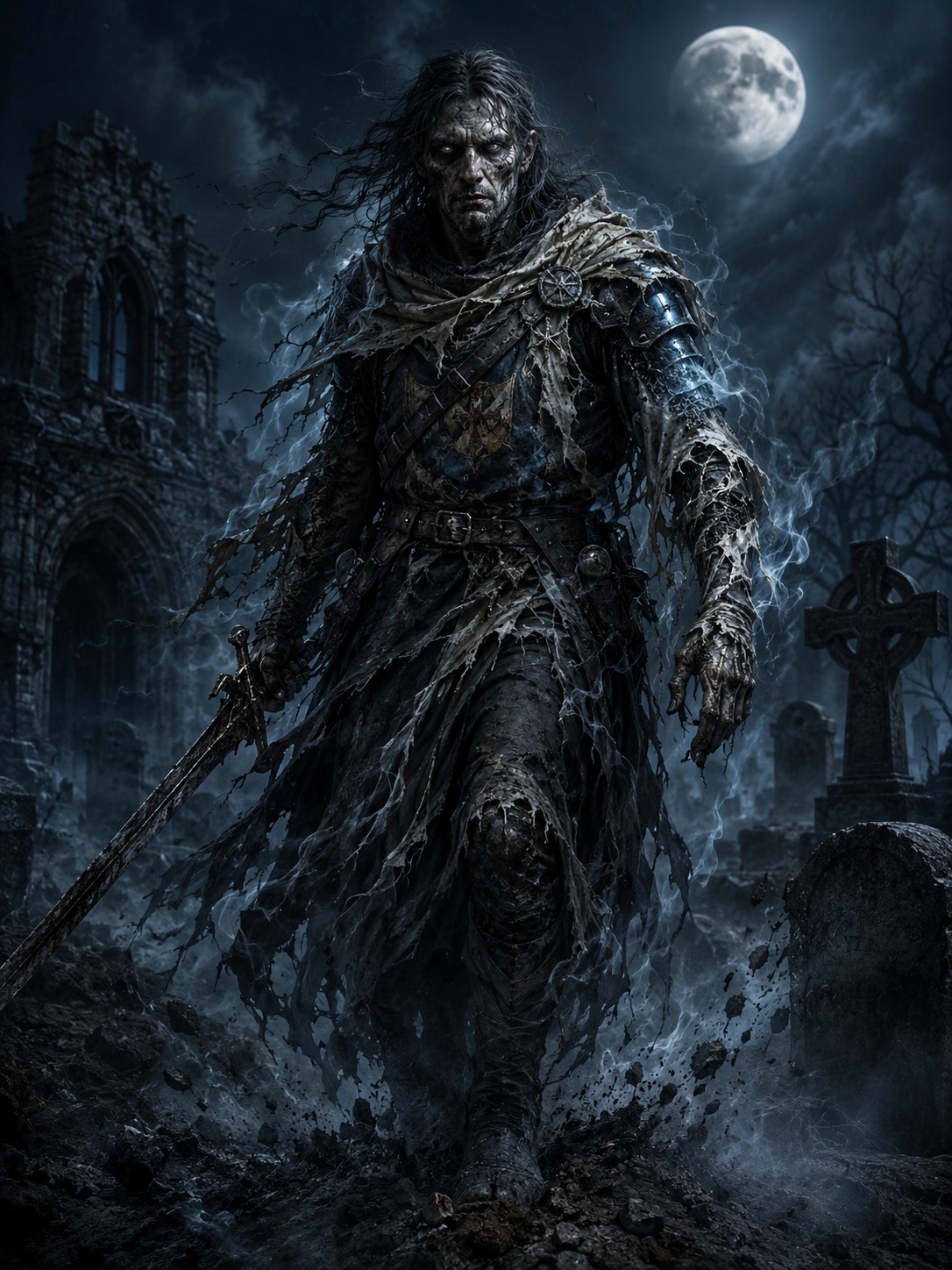
The Wight (English Wight, the barrow-dwelling variant being the Barrow-wight) is the graveyard undead in which a corpse buried in a barrow or burial mound has risen by reason of obsession with treasure and curse, and is the canonical iconographic figure of the self-aware corpse-form undead, in contrast to the incorporeal wraith. The etymology lies in the Old English wiht ('creature, being'), and the general 'being' sense that appears in the eighth-century Old English epic Beowulf was later specified as the graveyard-undead meaning. The iconographic origin is the draugr ('walking corpse') and haugbui ('mound-dweller') of the thirteenth- and fourteenth-century Icelandic family sagas, and the decisive English-literary canon is the Barrow-wight that appears in J.R.R. Tolkien's The Fellowship of the Ring (Allen and Unwin, July 1954), Book One Chapter 8 'Fog on the Barrow-Downs', in which Frodo and the hobbits are captured by a Barrow-wight in the Barrow-downs east of the Old Forest and are to be buried with grave-goods but are rescued by Tom Bombadil's song. Gary Gygax's first edition AD&D Monster Manual of January 1977 added the wight as the undead canon of modern fantasy role-playing games, with the energy-draining ability by which the slain becomes a new wight.
Origin
The iconographic origin is the draugr and haugbui of the thirteenth- and fourteenth-century Icelandic family sagas (Islendingasogur). The decisive saga text is the figure of Glam in the thirteenth-century Grettis saga, the draugr who, after being buried in a barrow, rose again to lay waste to a farm before being beheaded by the hero Grettir, and the figure of Angantyr in the fourteenth-century Hervarar saga ok Heidreks, in which the daughter Hervor enters her father Angantyr's barrow and demands the magical sword Tyrfing, the dead father answering from within the barrow: these are canonical of the Northern European wight iconography. The thirteenth-century Eyrbyggja saga, with the passage in which Thorolf Baegifot rises as a draugr after death and torments the village, is also canonical. The Old English wiht ('being, creature') in the eighth-century Old English epic Beowulf is the lexical origin — a general vocabulary item, but became the etymology of the graveyard undead in later English literature. The decisive modern canonisation is the Barrow-wight that appears in Book One Chapter 8 'Fog on the Barrow-Downs' of The Fellowship of the Ring of The Lord of the Rings by J.R.R. Tolkien, published by Allen and Unwin in Britain on 29 July 1954: the hobbits Frodo, Sam, Merry, and Pippin are captured by a Barrow-wight in the Barrow-downs east of the Old Forest, are to be buried with golden grave-goods, but are rescued by Tom Bombadil's song, establishing the decisive modern English-literary canon of the wight iconography.
Features
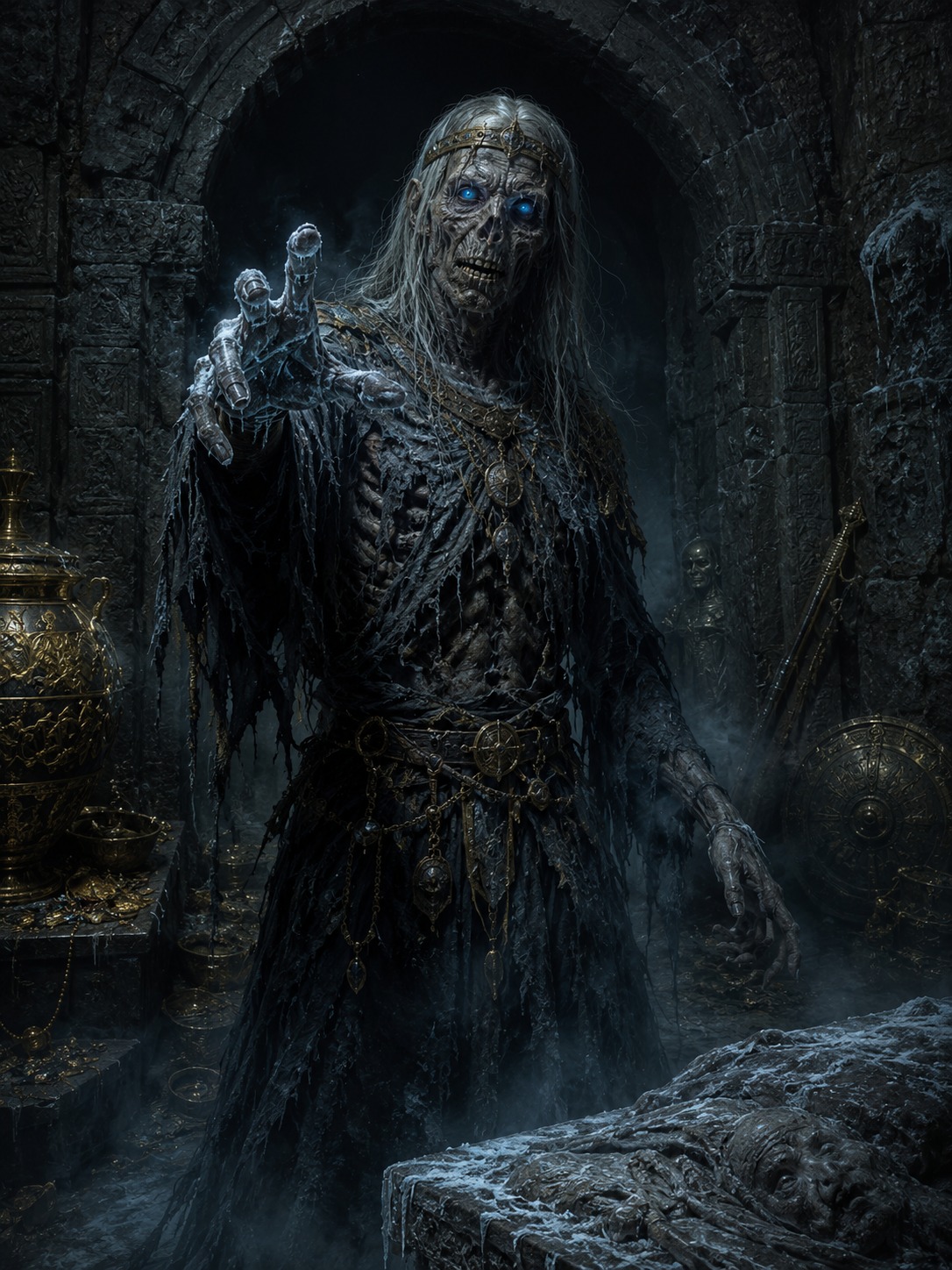
- Withered corpse and coldly glinting eyes
- Ice-cold hand and touch of curse
- Guards the grave-goods of barrows and burial mounds
- Absorption ability draining the vitality of the living to turn them into fellow wights
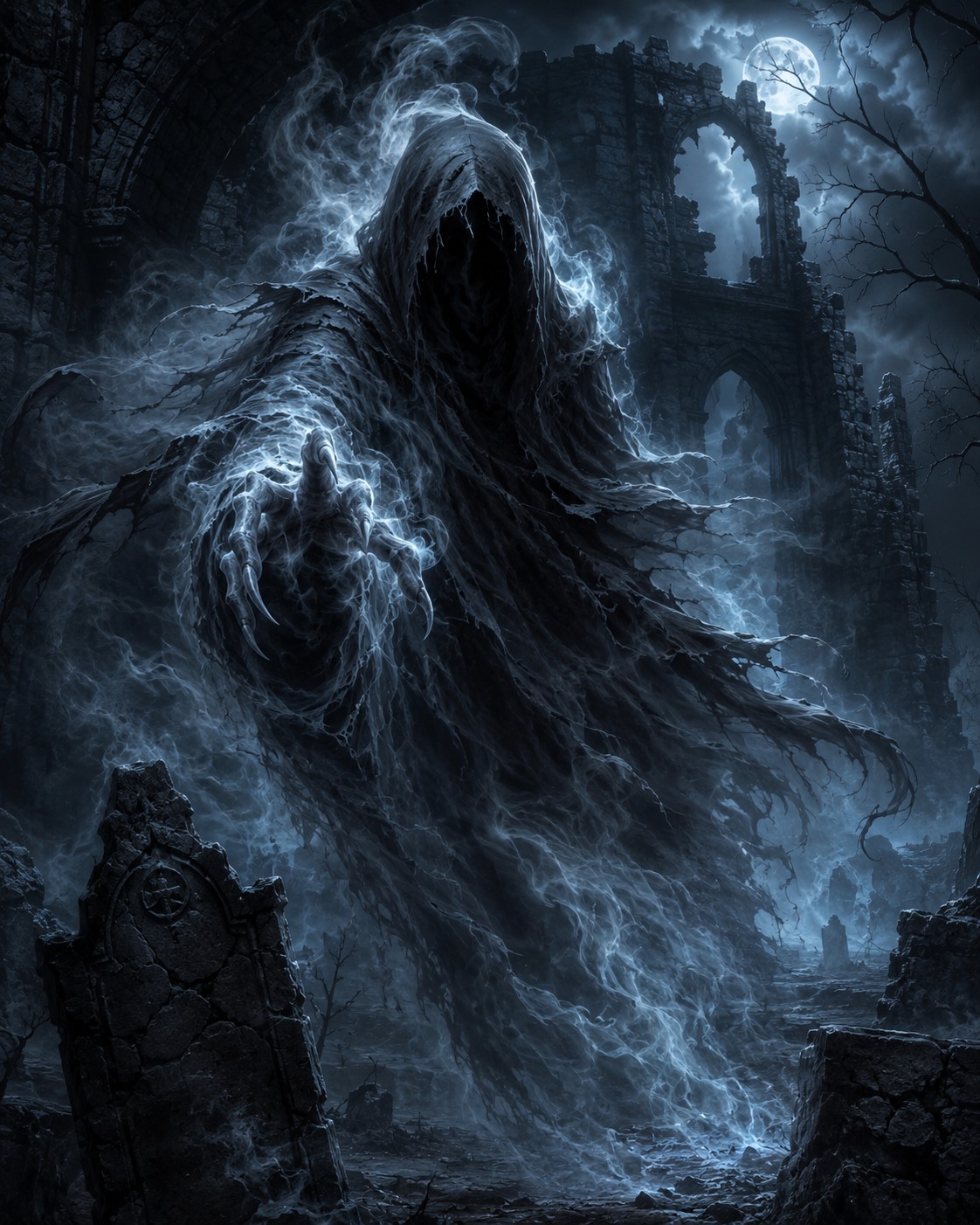
- Unlike the incorporeal wraith, retains the form of the corpse
- Curse-punishment for barrow intruders
Stories
Book One Chapter 8 'Fog on the Barrow-Downs' of J.R.R. Tolkien's 1954 The Lord of the Rings is the decisive canon of the modern English-literary wight iconography — the narrative in which Frodo and his hobbit company are captured by a Barrow-wight, are to be buried with golden grave-goods, but are rescued by Tom Bombadil singing 'Get out, you old Wight! Vanish in the sunlight!' became the prototype of all subsequent fantasy wight representations. Tolkien's wight — reprinted in his 1923 poem The Hoard and his 1962 poetry collection The Adventures of Tom Bombadil — is the canonical case of scholarly borrowing in which Tolkien, as professor of English literature at Oxford, revived the thirteenth- and fourteenth-century Icelandic-saga draugr as the English-literary wight vocabulary. The first edition of Gary Gygax's AD&D Monster Manual of January 1977, page 100, added the wight with the ability that contact drains the vitality level of the living, the slain rising as a new wight, with weakness to sunlight and damage only from magical weapons: this became the modern fantasy RPG canon. George R.R. Martin's 1996 A Song of Ice and Fire series and the 2011 HBO drama Game of Thrones — in which the wight horde of the White Walkers beyond the northern Wall absorbs the living to turn them into fellows — established the decisive twenty-first-century canon, and the draugr of Bethesda's 2011 video game The Elder Scrolls V: Skyrim is the canonical Nordic-tomb wight.
Weakness
The wight's weaknesses are: (1) sunlight — in the 1954 Tolkien canon Tom Bombadil's 'vanish in the sunlight' song dispels the wight, and in the 1977 D&D canon the wight is set to weaken and flee instantly when exposed to sunlight; (2) sanctified and consecrated weapons — the motif in 1977 D&D that ordinary weapons cannot harm the wight and only magical or silver weapons can; (3) fire — the canon in the thirteenth-century Icelandic sagas that cremating the draugr's corpse pacifies it, inherited by George R.R. Martin's 1996 A Song of Ice and Fire setting in which wights are vulnerable to Valyrian steel, dragonglass (obsidian), and fire; (4) the return of treasure and the placation of the tomb — when the grave-goods guarded by the wight are returned to their rightful owner, or when the tomb receives a rightful placation rite, the wight rests — in the thirteenth-century Hervarar saga, the canon that Angantyr surrenders the sword Tyrfing to his daughter Hervor when she demands it as rightful heir; (5) sacred song and prayer — Tom Bombadil's song in Tolkien is the canonical iconography of pacifying the wight.
Cultural Significance
The wight is the canonical iconographic figure of the graveyard undead in which Northern-European saga literature, nineteenth- and twentieth-century English literature, and contemporary fantasy gaming converge. The draugr canon of the thirteenth- and fourteenth-century Icelandic family sagas is anthropologically analysed as the literary condensation of the Viking-Age (eighth to eleventh century) practice of barrow burial and the cult of grave-goods, and about two thousand cases of Bronze-to-Iron-Age barrow excavations across Norway, Iceland, and Denmark form the archaeological foundation of the wight cult. J.R.R. Tolkien's 1954 The Lord of the Rings is the decisive case of an Oxford professor of English literature reviving the thirteenth-century Icelandic-saga draugr as the twentieth-century English-literary wight through scholarly borrowing, and Tolkien's self-statement in his 1953 letter to his friend W.H. Auden that 'my Wights are modelled on the Icelandic draugr' is canonical. George R.R. Martin's 1996 A Song of Ice and Fire series revived Tolkien's wight canon as the central iconography of twenty-first-century fantasy literature, and the wight-horde assault on Winterfell at the end of Season 8 (April-May 2019) of the HBO drama Game of Thrones — surpassing eighteen million viewers, the highest in HBO history — became the twenty-first-century global canon of wight iconography. From the 1977 D&D to the 2011 Skyrim, gaming canons established the wight as the standard undead iconography of RPGs and MMORPGs.
In Popular Culture
- Old English Beowulf (c. 8th century) — etymological origin of wiht
- Grettis saga, Glam (13th century) — Icelandic-saga draugr canon
- Eyrbyggja saga, Thorolf Baegifot (13th century) — saga draugr canon
- Hervarar saga, Angantyr (14th century) — barrow-dweller canon (daughter Hervor's demand for the sword Tyrfing)
- J.R.R. Tolkien, The Lord of the Rings, 'Fog on the Barrow-Downs' (1954) — decisive English-literary wight canon
- Tolkien poems The Hoard (1923) and The Adventures of Tom Bombadil (1962) — Tolkien poetic wight canon
- Gary Gygax, AD&D Monster Manual (1977) — canonisation of the wight in modern RPGs
- George R.R. Martin, A Song of Ice and Fire (1996-) — decisive twenty-first-century fantasy wight canon
- Bethesda, The Elder Scrolls V: Skyrim (2011) — canonical gaming Nordic draugr
Trivia
The etymology of wight, the Old English wiht, is the general vocabulary item meaning 'being, creature, thing' — the first attestation in the Oxford English Dictionary being from the eighth century — and originally had no graveyard-undead meaning. The English wight retained the general sense of 'person, being' through the seventeenth to nineteenth centuries, as in Shakespeare's Love's Labour's Lost (1597) phrase 'a high hope for a low wight', and only when J.R.R. Tolkien revived the thirteenth-century Icelandic-saga draugr as the English-literary wight in The Lord of the Rings of 1954 did the vocabulary meaning diverge into the decisive canon of the graveyard undead. The Isle of Wight in southern England derives from the Celtic 'Vectis', a separate etymology unrelated to the graveyard wight. The Barrow-downs in Tolkien's 1954 The Lord of the Rings are modelled on the Neolithic and Bronze-Age barrow cluster of Wiltshire in southern England — a real archaeological site clustering about three hundred and fifty barrows buried about two thousand five hundred years ago — according to the canonical view of the Tolkien Society. The 28 April 2019 Season 8 Episode 3 'The Long Night' of HBO's Game of Thrones — the Battle of Winterfell against the wight horde and White Walkers — set the highest ratings in HBO history with seventeen million ninety thousand simultaneous viewers, and the episode's eighty-two-minute length is recorded as the longest single battle scene in American television drama history.