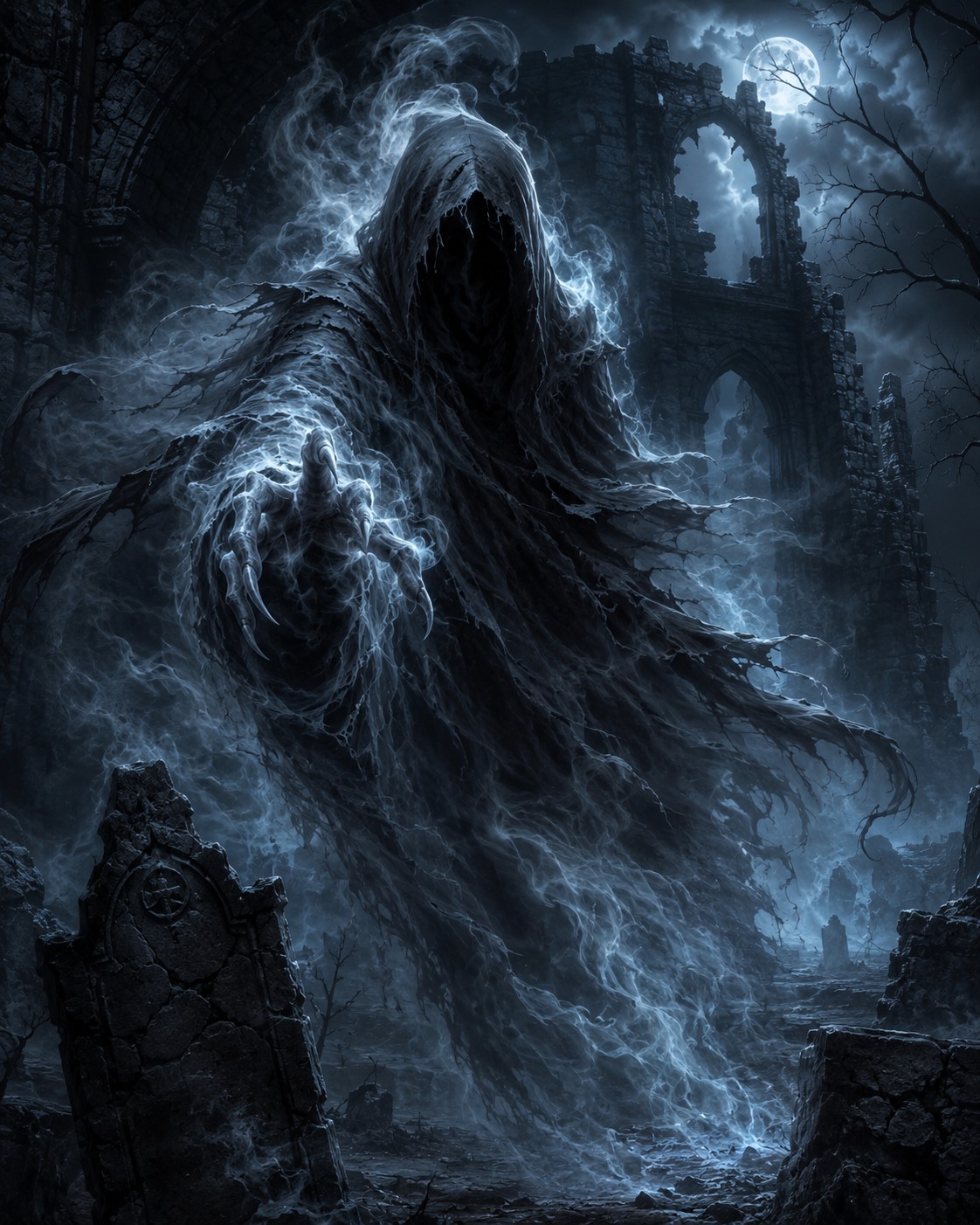
Wraith
Wraith · The Vengeful Specter — A Dark Spirit That Lost Its Form, Leaving Only Hatred
Names in Other Languages
 레이스한국어
Wraith · 원혼의 망령 — 증오만 남아 형체를 잃은 어둠의 영
 レイス日本語
Wraith · 怨霊の亡霊 — 憎しみだけ残し形を失った闇の霊
 怨靈繁體中文
Wraith · 怨魂亡靈 — 僅存憎恨而失去形體的暗影之靈
 SchemenDeutsch
Wraith · Das rachsüchtige Gespenst — Ein dunkler Geist, der seine Form verlor und nur Hass behielt
 SpectreFrançais
Wraith · Le spectre vengeur — Un esprit ténébreux ayant perdu sa forme, ne gardant que la haine
 EspectroEspañol
Wraith · El espectro vengador — Un espíritu oscuro que perdió su forma, dejando solo el odio
 EspectroPortuguês
Wraith · O espectro vingador — Um espírito sombrio que perdeu sua forma, restando apenas o ódio
 ZjawaPolski
Wraith · Mściwa zjawa — mroczny duch, który utracił formę, zachowując tylko nienawiść
 ПризракРусский
Wraith · Мстительный призрак — тёмный дух, утративший форму, сохранив лишь ненависть
The Wraith is an incorporeal undead spirit born from an intense grudge, hatred, or unfinished business, drifting as a shadowy or misty form after the loss of its body. The word first appears in English in 1513, in the Scottish translation of Virgil's Aeneid by Gavin Douglas, where it denotes a doppelganger-apparition signalling imminent or recent death. Through eighteenth- and nineteenth-century Scottish Gothic literature, especially Robert Burns and Sir Walter Scott, the wraith became established as a death-omen and avenging spirit of unfulfilled fate. J. R. R. Tolkien's The Lord of the Rings (1954-1955) decisively redefined the figure as the Nazgul or Ringwraiths, the nine human kings whose souls were drained by Sauron's rings of power, and the 1974 first edition of Dungeons and Dragons canonised the wraith as an incorporeal undead monster vulnerable only to enchanted weapons. The wraith now stands as the archetype of the cold-radiating, life-draining, mostly intangible undead across modern fantasy gaming, action RPGs, and horror fiction.
Origin
The earliest English-language record of wraith is in Gavin Douglas's 1513 Scottish translation of Virgil's Aeneid, designating the doppelganger-spectre that appears at or just before death. Two etymologies compete: the Oxford English Dictionary's standard reading, deriving it from Old English wrad ('wrathful, enraged'), and a nineteenth-century minority hypothesis linking it to Old Norse vorr ('guardian') through Scottish Celtic transmission. Robert Burns's Tam o' Shanter (1791) and Sir Walter Scott's The Heart of Midlothian (1818) and The Bride of Lammermoor (1819) embedded the wraith in English literature as a Scottish folk-Gothic figure of death and unresolved grievance. J. R. R. Tolkien's The Lord of the Rings (1954-1955) gave the figure its modern fantasy form as the Nazgul or Ringwraiths, the nine former human kings hollowed by Sauron's rings. The first edition of Dungeons and Dragons (Gary Gygax and Dave Arneson, 1974 boxed set) canonised the wraith as a standard incorporeal undead monster, with the game-mechanical rule that only enchanted weapons of +1 or higher can damage it.
Features
- Incorporeal form of shadow and mist
- An aura of intense, freezing cold
- Drains life-force from the living with its touch
- Bound spiritually to places of grudge or cursed ruins
- Physical attacks pass through; only enchanted weapons wound it
- Born of intense hatred, grievance, or unfinished business
Stories
Through the eighteenth and nineteenth centuries the wraith became a fixture of Scottish Gothic literature: Walter Scott's The Heart of Midlothian, The Bride of Lammermoor, Robert Louis Stevenson's The Body Snatcher (1884), and the wider tradition of Victorian ghost stories. J. R. R. Tolkien's Nazgul (Ringwraiths) in The Lord of the Rings (1954-1955) decisively translated the wraith into modern fantasy iconography, and Gary Gygax's 1974 Dungeons and Dragons first-edition boxed set canonised it as a standard incorporeal undead monster. Diablo (1996 onward), World of Warcraft (2004 onward), the Elder Scrolls series, Path of Exile, Dark Souls, God of War (2018 onward), and Bloodborne all employ the wraith as a recurring enemy archetype. Recent uses include the Nordic wraith enemies of Assassin's Creed Valhalla (2020) and the gang named 'Wraiths' in Cyberpunk 2077 (2020). Beyond gaming, the wraith remains a horror-fiction staple for the unresolved grievance figure.
Weakness
The wraith's defining weakness is the inverse of its incorporeality: light, the sacred, and magic. Ordinary physical attacks pass through the wraith's body of shadow and mist, but enchanted blades, silver or blessed weapons, holy water, blessed fire, and powerful purification rites cut decisively. In The Lord of the Rings, Boromir threatens the Nazgul with a torch in Moria, and the Witch-King of Angmar is finally felled by the combined blow of Eowyn and Merry, with their respective weapons of significant lineage. Since Gygax's 1974 Dungeons and Dragons rules, only enchanted weapons of +1 or higher can damage a wraith, and exposure to direct sunlight destroys it on the spot, a convention adopted by most subsequent fantasy games. At the deepest level, the wraith vanishes forever once the grudge that bound it is resolved, or the place or relic anchoring it is destroyed.
Cultural Significance
The wraith stands at the iconographic relay from Scottish folklore through nineteenth-century Gothic literature to modern fantasy gaming. The doppelganger-spectre of the 1513 Scottish translation of the Aeneid, the death-omens of Burns and Scott, and the Gothic spectres of Stevenson all built the wraith into the English-language imagination of unresolved grievance. Tolkien's Nazgul (Ringwraiths) of 1954-1955 carried the figure into modern fantasy, and the 1974 Dungeons and Dragons canon placed it among the standard incorporeal undead. Diablo, World of Warcraft, the Elder Scrolls, Path of Exile, Dark Souls, God of War, and Bloodborne deploy the wraith as a fixed enemy archetype, while horror cinema (the Paranormal Activity cycle, 2007 onward) uses it as the figure of the unresolved grievance. Among Western ghost-words (wraith, spectre, shade, ghost, phantom), wraith carries the most distinct connotation of hatred and grudge.
In Popular Culture
- Gavin Douglas, Scottish translation of Virgil's Aeneid (1513) — earliest English-language record
- Robert Burns, Tam o' Shanter (1791) — Scottish folk-Gothic iconography
- Sir Walter Scott, The Heart of Midlothian (1818) and The Bride of Lammermoor (1819) — Gothic canon
- J. R. R. Tolkien, The Lord of the Rings (1954-1955) — decisive redefinition as Nazgul (Ringwraiths)
- Gary Gygax and Dave Arneson, Dungeons and Dragons first-edition boxed set (1974) — gaming canon
- Diablo (1996) and World of Warcraft (2004) — recurring enemy in modern action RPGs
- Assassin's Creed Valhalla (2020) — Nordic wraith variants in contemporary gaming
Trivia
The etymology of wraith remains debated. The Oxford English Dictionary derives it from Old English wrad ('wrathful, enraged'), while a nineteenth-century minority traces it to Old Norse vorr ('guardian') through Scottish Celtic transmission. The etymological obscurity itself, paired with the creature's nature as shadow and mist, has shaped the word's literary appeal. Tolkien's coinage Nazgul, for the Ringwraiths, is from his invented Black Speech: nazg ('ring') plus gul ('wraith of magic'), with Ringwraith as the standard English rendering. The 1974 Dungeons and Dragons first-edition rule that only enchanted weapons of +1 or higher damage a wraith has remained the default convention of fantasy gaming for half a century. The wraith's vulnerability to direct sunlight is not from Tolkien but is a Dungeons and Dragons innovation of 1974, since adopted by most descendant games.