Undine
Water Spirit of Paracelsus
Names in Other Languages
 운디네한국어
Undine · 파라켈수스의 물의 정령
 ウンディーネ日本語
Undine — 中位の水の精霊
 溫蒂妮繁體中文
Undine — 中位水之精靈
 UndineDeutsch
Undine — Mittlerer Wassergeist
 OndineFrançais
Ondine — Esprit d'Eau Intermédiaire
 OndinaEspañol
Ondina — Espíritu de Agua Intermedio
 OndinaPortuguês
Ondina — Espírito d'Água Intermediário
 UndinePolski
Undine — Pośredni Duch Wody
 УндинаРусский
Ундина — Средний Дух Воды
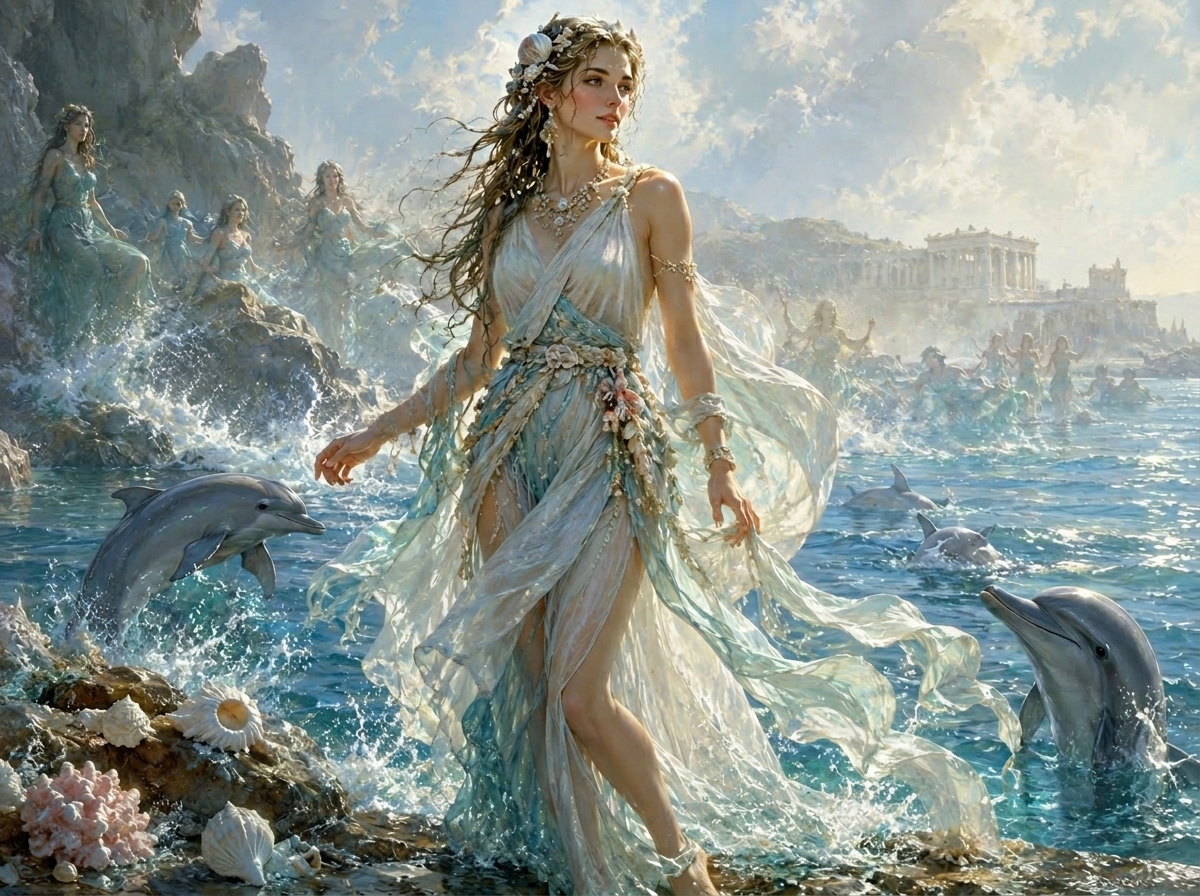
The Undine (Latin Undina, German Undine, English Undine) is the decisive canonical spirit of water (Aqua) among the four element spirits (Elemental Spirits) in the posthumous 1566 Latin treatise A Book of Nymphs, Sylphs, Pygmies, and Salamanders (Liber de Nymphis, Sylphis, Pygmaeis et Salamandris) by the Swiss physician-alchemist Paracelsus (Theophrastus Bombastus von Hohenheim, 1493-1541). The etymology is the canonical vocabulary of the Paracelsian coinage Undina derived from the Latin unda ('wave, billow'), and the decisive canonical iconography depicts her as a beautiful human female figure — dwelling in fresh water such as waterfalls, lakes, and springs — originally without a soul but acquiring one through marriage to a human. The decisive literary canon is the novella Undine (Undine) of 1811 by the German Romantic author Friedrich de la Motte Fouque (1777-1843) — the decisive Romantic tragic canon in which the Undine, who acquires a soul by marrying the human knight Huldbrand (Huldbrand), comes to death through her husband's betrayal — and the opera Undine premiered at the Royal Theatre in Berlin on 3 August 1816 by E. T. A. Hoffmann (E. T. A. Hoffmann, 1776-1822) — with libretto by Fouque himself — is the decisive canon of German Romantic opera. The ballet Undine of the German composer Hans Werner Henze (1926-2012), premiered at the Royal Opera House Covent Garden in London on 27 October 1958 (choreographed by Frederick Ashton, with Margot Fonteyn as Undine) is the decisive canon of 20th-century ballet.
Origin
The iconographic origin is the fusion of (1) the four-element-spirit canon — Water (Undine/Aqua), Air (Sylph), Earth (Gnomus), Fire (Salamander) — of the Latin treatise A Book of Nymphs, Sylphs, Pygmies, and Salamanders of Paracelsus (Theophrastus Bombastus von Hohenheim, 1493-1541, born in Switzerland) of 1566 and (2) the indigenous water-spirit beliefs of medieval Europe — Germanic Nix, Slavic Rusalka, and Greek Nereid. In the four-element-spirit theory of Paracelsus's A Book of Nymphs, Sylphs, Pygmies, and Salamanders, posthumously published in Basel, Switzerland in 1566 — written in the 1530s in Salzburg, Innsbruck, and other Austrian-Swiss regions — the Undine is the Paracelsian coinage Undina derived from the Latin unda ('wave'), and established the decisive theological-alchemical canon that the water spirit acquires a soul (anima) through marriage to a human. The decisive literary canon is the novella Undine published in Berlin, Germany in 1811 by Friedrich de la Motte Fouque (1777-1843) — the decisive Romantic tragic canon in which the Undine, who marries the human knight Huldbrand and acquires a soul, is cursed by her uncle Kuehleborn (Kuehleborn) — the decisive canon of water-spirit — when the husband betrays her with Bertalda (Bertalda), and the Undine kills her husband and returns to the water. The opera Undine premiered at the Royal Theatre in Berlin on 3 August 1816 by E. T. A. Hoffmann (Ernst Theodor Amadeus Hoffmann, 1776-1822) — with libretto by Fouque himself — is the decisive canon of German Romantic opera, and The Little Mermaid (Den lille Havfrue) of Hans Christian Andersen (1805-1875) published in Copenhagen on 7 April 1837 is evaluated as the decisive Andersen adaptation of the Undine canon.
Features
- Form of a beautiful human female
- Dwelling in fresh water such as waterfalls, lakes, and springs
- Originally soulless — acquires a soul through marriage to a human
- Sad and mystical song
- Can walk on water
- Weakens far from the water
Stories
The canon of water (Undine/Aqua) among the four element spirits of Paracelsus's 1566 A Book of Nymphs, Sylphs, Pygmies, and Salamanders is the decisive origin, and the Le Comte de Gabalis (first published in 1671) of the French writer Montfaucon de Villars (1635-1673) of 1690 — adapting the four-element-spirit theory into 17th-century French salon literature — is the decisive event of 17th-18th-century European popularisation of Undine iconography. The decisive literary canon is the novella Undine published in Berlin, Germany in 1811 by Friedrich de la Motte Fouque (1777-1843) — the decisive Romantic canon in which the Undine, who marries the human knight Huldbrand and acquires a soul, comes to tragedy through her husband's betrayal — and the opera Undine (3 acts) premiered at the Royal Theatre in Berlin on 3 August 1816 by E. T. A. Hoffmann (1776-1822) settled as the decisive canon of German Romantic opera. Andersen's The Little Mermaid published in Copenhagen on 7 April 1837 settled as the decisive Andersen adaptation of the Undine canon, and the opera Rusalka of Antonin Dvorak (1841-1904) premiered at the National Theatre in Prague on 31 March 1901 — the Slavic-variant Undine canon — is the decisive Slavic musical canon. The play Ondine of Jean Giraudoux (1882-1944) premiered at the Theatre de l'Athenee in Paris on 4 May 1939 (directed by Louis Jouvet, with Madeleine Ozeray as Ondine) is the decisive 20th-century French theatrical canon, and the decisive ballet canon is the ballet Undine of Hans Werner Henze (1926-2012) premiered at the Royal Opera House Covent Garden in London on 27 October 1958 (choreographed by Frederick Ashton, with Margot Fonteyn as Undine) — the decisive canon of 20th-century ballet. The Undine of the 1977 D&D Monster Manual by Gygax of TSR in the USA and the Disney animation The Little Mermaid (worldwide box office about 211 million dollars) released on 17 November 1989 in the USA are the 20th-century global Undine-adaptation canon.
Weakness
The Undine's weaknesses are: (1) being far from the water — the decisive environmental-binding canon in Paracelsus's 1566 canon that the Undine weakens when she leaves her water; (2) betrayal by the beloved human — the decisive Romantic canon in Fouque's 1811 Undine that when the human knight Huldbrand (Huldbrand) betrays her with Bertalda (Bertalda), the Undine loses her soul and comes to tragedy; (3) the Undine's kiss — the decisive tragic canonical finale in Fouque's 1811 Undine that the Undine kills the betraying husband with a kiss, the canon of the English phrase 'undine's kiss' (the kiss of death given to the unfaithful husband); (4) marriage to a human — the decisive canonical weakness that an Undine married to a human can die like a human; (5) lack of soul — the decisive theological weakness in the Paracelsian canon and Fouque's Undine canon that the Undine is originally without a soul; (6) Undine's syndrome — the decisive medical canon in which the American doctors Severinghaus (Severinghaus) and Mitchell (Mitchell) of 1962, inspired by Fouque's 1811 Undine canon — in which the unfaithful husband loses the ability to breathe autonomously — medically canonised as 'Ondine's Curse' (Congenital Central Hypoventilation Syndrome); (7) Paracelsian four-element binding — the Undine is environmentally bound to her water element and cannot leave; (8) strong fire flow — the weak opposition of Water (Aqua) and Fire (Ignis) in the 1566 Paracelsus four-element-spirit canon, by which strong fire weakens the Undine. The decisive canonical finale of Fouque's 1811 Undine — in which the Undine becomes a small spring next to the grave of the human knight Huldbrand, eternally embracing him — is the decisive Romantic tragic canon.
Cultural Significance
The Undine is not merely a water-spirit icon but the canonical iconographic figure of the Western water-spirit canon traversing Paracelsus's four-element-spirit theory of 1566, Montfaucon de Villars's Le Comte de Gabalis of 1690, Fouque's Undine of 1811, Hoffmann's opera Undine of 1816, Andersen's The Little Mermaid of 1837, Dvorak's opera Rusalka of 1901, Jean Giraudoux's play Ondine of 1939, Henze's ballet Undine of 1958, the 1962 Undine's syndrome medical naming, and the 1977 D&D fantasy RPG. Paracelsus's 1566 A Book of Nymphs, Sylphs, Pygmies, and Salamanders — as the decisive event of Renaissance European natural philosophy and alchemy — coined Undine — derived from the Latin unda ('wave') — as the decisive canonical vocabulary. The decisive literary canon is the novella Undine (about 100 pages) by Friedrich de la Motte Fouque (1777-1843) published by Hitzig publishing house in Berlin, Germany in 1811 — the decisive canon of 19th-century German Romanticism — and Fouque himself, of Huguenot French descent in Prussian nobility from Brandenburg, Germany, wrote it in Berlin from 1810 to 1813. The opera Undine premiered at the Royal Theatre in Berlin on 3 August 1816 by E. T. A. Hoffmann (1776-1822) — with libretto by Fouque himself, 3 acts — is the decisive canon of German Romantic opera, and the ballet Undine premiered at the Royal Opera House Covent Garden in London on 27 October 1958 by Hans Werner Henze (1926-2012) (choreographed by Frederick Ashton, with Margot Fonteyn as Undine, about 90 minutes) became the decisive canon of the 20th-century British Royal Ballet. The decisive event in 1962 in which the American doctors John Severinghaus (1922-2021) and Robert Mitchell, inspired by Fouque's canon — in which the unfaithful husband loses the ability to breathe autonomously — medically canonised Congenital Central Hypoventilation Syndrome (CCHS) as 'Ondine's Curse', and the Disney The Little Mermaid (worldwide box office about 211 million dollars) released on 17 November 1989 in the USA settled the 20th-century global Undine-adaptation canon.
In Popular Culture
- Paracelsus, A Book of Nymphs, Sylphs, Pygmies, and Salamanders (1566) — decisive canon of the four element spirits Undine
- Montfaucon de Villars, Le Comte de Gabalis (1690) — French salon-literary Undine canon
- Fouque, Undine (1811) — decisive Romantic literary canon
- E. T. A. Hoffmann opera Undine (1816) — decisive German Romantic opera canon
- Andersen, The Little Mermaid (1837) — decisive Andersen adaptation
- Dvorak opera Rusalka (1901) — decisive Slavic musical canon
- Jean Giraudoux play Ondine (1939) — decisive French theatrical canon
- Henze ballet Undine (1958) — decisive 20th-century ballet canon
- Undine's syndrome medical naming (1962) — decisive medical canon
- Gygax, D&D Monster Manual, Undine (1977) — fantasy RPG canon
Trivia
The Latin etymology Undina of Undine — coined by Paracelsus in 1566 from the Latin unda ('wave, billow') — is the decisive canonical vocabulary, and the English Undine (first attested in 1789), the German Undine, the French Ondine, and the Italian Ondina are canonical vocabulary. The 1566 A Book of Nymphs, Sylphs, Pygmies, and Salamanders of Paracelsus posthumously published in Basel, Switzerland — written in the 1530s in Salzburg, Innsbruck, and other Austrian-Swiss regions — is the decisive canon of four-element-spirit theory, and the Undine handles Water (Aqua) among the four element spirits. The novella Undine (about 100 pages) of Friedrich de la Motte Fouque (Friedrich de la Motte Fouque, born 12 February 1777 in Brandenburg, died 23 January 1843 in Berlin) published by Hitzig publishing house in Berlin, Germany in 1811 — the decisive canon of German Romantic literature — was written by Fouque, of Huguenot French descent in Prussian nobility, in Berlin from 1810 to 1813. The opera Undine (3 acts) premiered at the Royal Theatre in Berlin on 3 August 1816 by E. T. A. Hoffmann (Ernst Theodor Amadeus Hoffmann, born 24 January 1776 in Koenigsberg, died 25 June 1822 in Berlin) — with libretto by Fouque himself — is the decisive canon of German Romantic opera, and the ballet Undine (Undine) premiered at the Royal Opera House Covent Garden in London on 27 October 1958 by Hans Werner Henze (Hans Werner Henze, born 1 July 1926 in Guetersloh, Germany, died 27 October 2012 in Dresden) (choreographed by Frederick Ashton, with Margot Fonteyn as Undine, about 90 minutes) is the decisive canon of the 20th-century British Royal Ballet. The decisive medical event in 1962 in which the American doctors John Severinghaus (1922-2021) and Robert Mitchell, inspired by Fouque's 1811 canon — in which the unfaithful husband loses the ability to breathe autonomously — medically named Congenital Central Hypoventilation Syndrome (CCHS) as 'Ondine's Curse'. The play Ondine (3 acts) premiered at the Theatre de l'Athenee in Paris on 4 May 1939 by Jean Giraudoux (1882-1944) (directed by Louis Jouvet, with Madeleine Ozeray as Ondine) is the decisive 20th-century French theatrical canon, and the Alfred Lunt staging premiered at the 46th Street Theatre in New York, USA on 18 February 1954 — starring Audrey Hepburn as Undine — won the Tony Award for Best Actress in 1954.