Nereid
Fifty Sea Nymph Sisters of Greek Mythology
Names in Other Languages
 네레이드한국어
Nereid · 그리스 신화의 50명 바다 님프
 ネレイド日本語
Nereid · シクエル · エンダイロン — 上位の水の精霊
 涅瑞伊德繁體中文
Nereid · 西奎爾 · 恩代龍 — 上位水之精靈
 NereidDeutsch
Nereid · Ciquel · Endairon — Überlegener Wassergeist
 NéréideFrançais
Néréide · Ciquel · Endairon — Esprit d'Eau Supérieur
 NereidaEspañol
Nereida · Ciquel · Endairon — Espíritu de Agua Superior
 NereidaPortuguês
Nereida · Ciquel · Endairon — Espírito d'Água Superior
 NereidaPolski
Nereida · Ciquel · Endairon — Wyższy Duch Wody
 НереидаРусский
Нереида · Сикель · Эндайрон — Высший Дух Воды
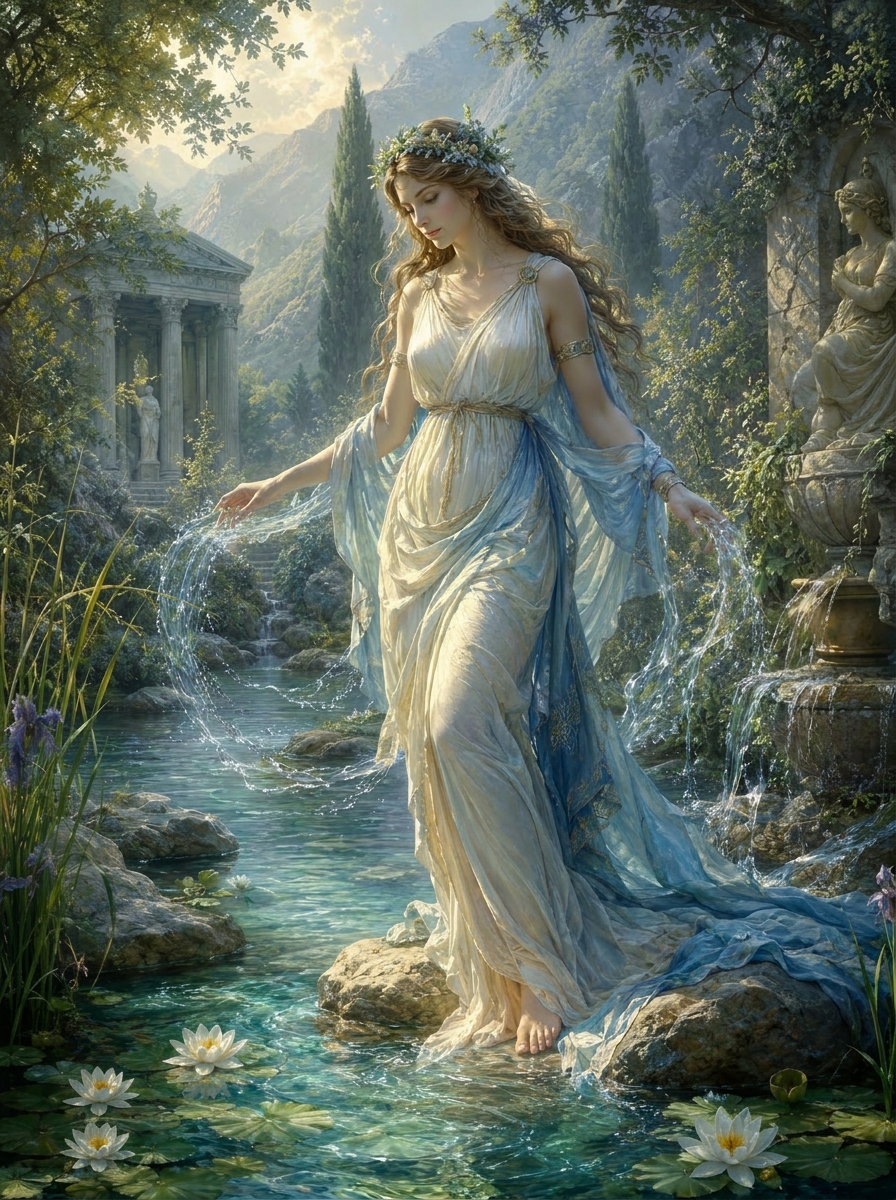
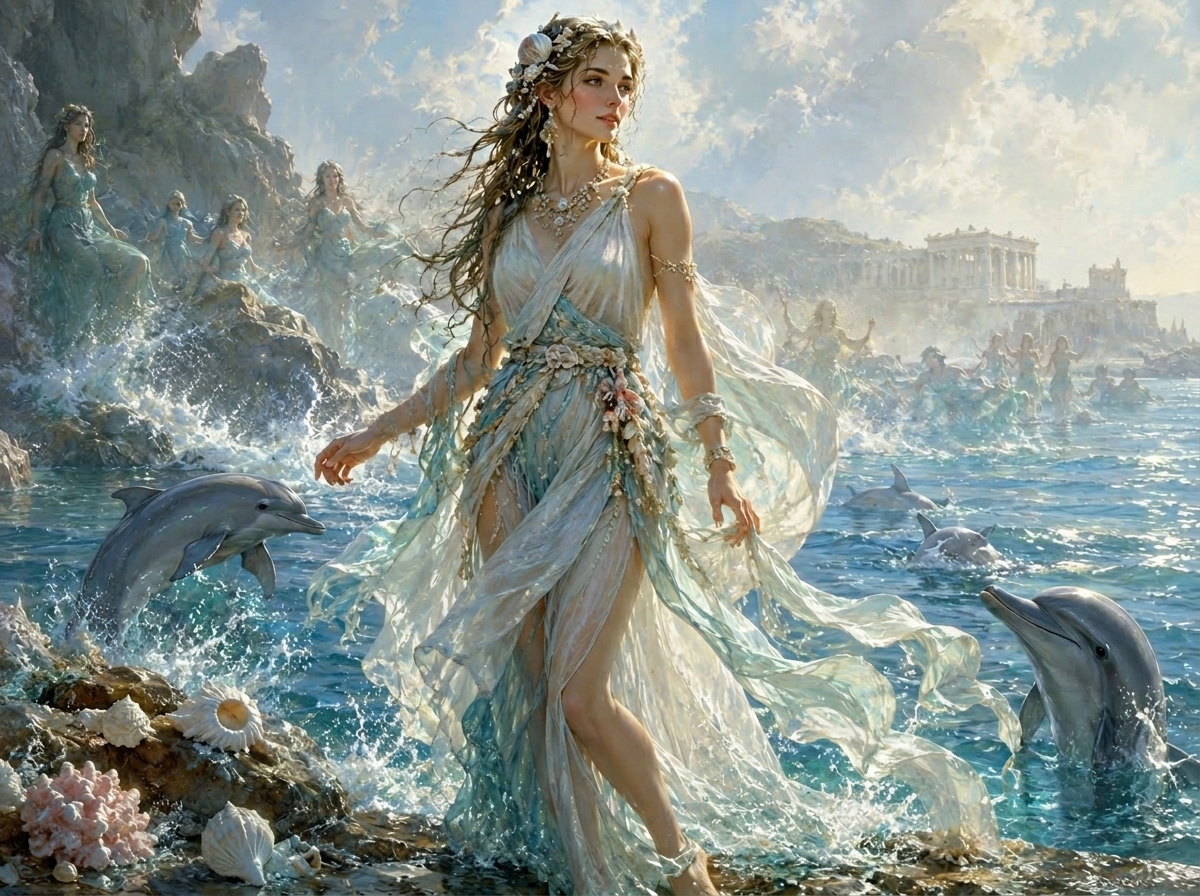
The Nereid (Greek Nereis, plural Nereides, English Nereid) is the canonical iconographic figure of the fifty sea-nymph sisters (nymphe) born to the sea-god Nereus (Nereus, 'wet one') and the Oceanid Doris (Doris) of Greek mythology. Within the classification of nymphs — Naiad (freshwater), Oceanid (ocean), Nereid (salt sea), Dryad (tree), Oread (mountain) — the Nereid is the decisive canon of salt sea, and the decisive textual canon is the canon of lines 240-264 of the Theogony (Theogonia) of the Greek poet Hesiod (Hesiodos) of c. 700 BCE — naming all fifty Nereids — the decisive canon. The most decisive Homeric canon is the canon of lines 35-64 of Book 18 of the Iliad of the eighth-century-BCE Homer (Homeros) — when the Nereid Thetis (Thetis), mother of the hero Achilles, grieves over the death of her son's friend Patroclus, thirty-three Nereid sisters rise from the deep-sea cave to comfort her — the decisive canonical scene of Greek epic, and the most decisive visual canon is the c. 1512 painting The Triumph of Galatea (Trionfo di Galatea) by the Italian Renaissance painter Raphael (Raffaello Sanzio da Urbino, 1483-1520) — held by the Villa Farnesina in Rome — the decisive culminating work of the Renaissance Nereid visual canon.
Origin
The iconographic origin is (1) the canon of lines 35-64 of Book 18 and lines 84-98 of Book 24 of the Iliad of the eighth-century-BCE Homer (Homeros) — the canon of the Nereid Thetis, mother of the hero Achilles, and her sister Nereids — and (2) the canon of lines 240-264 of the Theogony (Theogonia) of the Greek poet Hesiod (Hesiodos) of c. 700 BCE — naming all fifty Nereids. Lines 240-264 of Hesiod's Theogony name all fifty Nereids — Amphitrite (wife of Poseidon), Thetis (mother of Achilles), Galateia (loved by the Cyclops Polyphemus), Doto, Proto, Pherousa, and others — the decisive canon, and lines 35-64 of Book 18 of Homer's Iliad name thirty-three Nereid sisters — Glauke, Thaleia, Kymodoke, Nesaie, Speio, Thoe, Halie, Kymothoe, Aktaie, and others. The Greek tragedy The Nereids (Nereides, fragmentarily preserved) of the fifth-century-BCE Greek tragedian Aeschylus (525-456 BCE) and the canon of lines 859-964 of Book 4 of the Argonautica (Argonautika) of the fourth- and third-century-BCE Alexandrian poet Apollonius Rhodius (Apollonios Rhodios, 295-215 BCE) — when the Argo ship of the hero Jason (Iason) is in danger, the Nereid sisters, on Thetis's order, safely guide the ship — are the decisive Alexandrian-school Nereid canon.
Features
- Fifty sisters preside over various aspects of the sea
- Form of a beautiful human woman
- Befriends dolphins and sea creatures
- Skilled in music and dance
- Friendly to sailors and heroes
- Weakens far from the sea
Stories
The Nereid canon of Book 18 lines 35-64 of the eighth-century-BCE Homer's Iliad and lines 240-264 of Hesiod's c. 700 BCE Theogony is the decisive origin, and the Greek tragedy The Nereids of the fifth-century-BCE Aeschylus and Book 4 of the fourth- and third-century-BCE Apollonius Rhodius's Argonautica extended the Alexandrian-school canon. The canon of lines 738-897 of Book 13 of the Metamorphoses of the Roman poet Ovid (Publius Ovidius Naso, 43 BCE - 17 CE) of c. 8 CE — the love of the Nereid Galatea (Galateia) and the shepherd youth Acis (Acis) and the unrequited love of the one-eyed giant Cyclops Polyphemus (Polyphemos) leading to the murder of Acis by jealousy — is the decisive Latin-literary canon, and the Bibliotheca of the second-century-CE Greek Apollodorus (Apollodoros) systematised the Nereid-myth system. The decisive Renaissance visual canon is the c. 1486 painting The Birth of Venus (La Nascita di Venere) of the Italian painter Sandro Botticelli (1445-1510, held by the Uffizi Gallery in Florence), which gave decisive Nereid iconographic influence, and the c. 1512 The Triumph of Galatea (Trionfo di Galatea) of Raphael (Raffaello Sanzio, 1483-1520, held by the Villa Farnesina in Rome) — depicting the Nereid Galatea riding a shell-chariot drawn by two dolphins — is the decisive culminating work of the Renaissance Nereid visual canon. The 1873 painting Triton and Nereid (Triton und Nereide) of the Swiss Symbolist painter Arnold Boecklin (1827-1901, held by the Neue Pinakothek in Munich, Germany) and the 1905 painting The Sea Maiden of the British Pre-Raphaelite painter Herbert James Draper (1863-1920) settled the nineteenth- and twentieth-century Nereid visual canon, and the Nereid of the 1977 D&D Monster Manual by Gary Gygax of TSR in the USA — consistent through to 5e (5th Edition) of 2014 — is the modern fantasy RPG canon.
Weakness
The Nereid's weaknesses are: (1) being far from the sea — the decisive environmental-binding canon of the Greek-mythological nature-spirit canon that the Nereid weakens when she leaves her sea (salt sea); (2) separation from sister bonds — in the Book 18 canon of Homer's Iliad the Nereid acts in groups with her sisters, and is weakened when separated from her sisters; (3) human pride — the decisive retributive canon of lines 670-764 of Book 4 of Ovid's c. 8 CE Metamorphoses — when Queen Cassiopeia (Kassiopeia), mother of Andromeda (Andromede), boasts that her beauty exceeds that of the Nereids, the Nereids appeal to Poseidon, who sends the sea-monster Cetus (Ketos) to devastate Ethiopia; (4) Polyphemus's jealousy — the decisive tragic canon in the Book 13 canon of Ovid's Metamorphoses that the Cyclops Polyphemus, who loved Galatea, crushed the shepherd youth Acis to death with a rock; (5) Achilles's fate — the decisive tragic canon in Books 18 and 24 of Homer's Iliad and in the fourth- and third-century-BCE Apollonius Rhodius canon that the Nereid Thetis cannot prevent her son Achilles's death in the Trojan War; (6) tragic fate — the canonical weakness in Greek mythology that the Nereid cannot prevent the tragic fate of gods and heroes; (7) storms and tempests — the Greek-mythological canon that the storms of Poseidon's wrath weaken the Nereid; (8) gods and fate — the Greek-mythological canon that the Nereid yields to Zeus's decisions and the decisions of the goddesses of fate, the Moirai. The decisive canonical finale of Book 13 of Ovid's c. 8 CE Metamorphoses — Galatea's beloved Acis is crushed by Polyphemus's rock and Acis's blood becomes a river to be eternally united with Galatea — is the decisive canon of the Latin-literary Nereid tragedy.
Cultural Significance
The Nereid is not merely a sea-spirit icon but the canonical iconographic figure of the Greek sea canon traversing the eighth-century-BCE Homer's Iliad, c. 700 BCE Hesiod's Theogony, fifth-century-BCE Aeschylus's The Nereids, third-century-BCE Apollonius Rhodius's Argonautica, c. 8 CE Ovid's Metamorphoses, fifteenth- and sixteenth-century Renaissance Botticelli and Raphael, nineteenth-century Boecklin and Draper, and twentieth-century D&D fantasy RPG. In the Greek-mythological nature-spirit belief of the Mycenaean civilization of the Greek Bronze Age (3000-1200 BCE), the fifty Nereid sisters became the decisive canon of the Aegean Sea, the Ionian Sea, and the Mediterranean — the decisive canon of nature-spirit belief of the Greek Bronze Age. The canon of lines 35-64 of Book 18 of Homer's Iliad — in which thirty-three Nereid sisters rise from the deep-sea cave to comfort the grieving Thetis — is the decisive masterpiece scene of Greek epic, and the decisive Renaissance visual canon is the c. 1512 painting The Triumph of Galatea by Raphael (1483-1520, held by the Villa Farnesina in Rome, 295 x 225 cm) — depicting the Nereid Galatea riding a shell-chariot drawn by two dolphins, surrounded by cupids — the decisive culminating work of the Renaissance Nereid iconography. The 1873 painting Triton and Nereid (Triton und Nereide) of the Swiss Symbolist painter Arnold Boecklin (1827-1901, held by the Neue Pinakothek in Munich, Germany, 105 x 194 cm) and the 1905 painting Ulysses and the Sirens of the British Pre-Raphaelite painter Herbert James Draper (1863-1920, held by the Ferens Art Gallery, Britain) — although the Sirens are a decisive adaptation of Nereid iconography — and other nineteenth- and twentieth-century paintings settled the Nereid visual canon. The Nereid of the 1977 D&D Monster Manual by Gygax of TSR in the USA — consistent through to 5e (5th Edition) of 2014 — is the decisive canon of the modern fantasy RPG sea-spirit, and the sea (Te Fiti) of the Disney animation Moana, released on 23 November 2016 in the USA, and the twenty-first-century Polynesian-myth adaptation are evaluated as the decisive modern adaptation of the Nereid canon.
In Popular Culture
- Homer, Iliad, Book 18, lines 35-64 (eighth century BCE) — decisive Nereid canonical scene
- Hesiod, Theogony, lines 240-264 (c. 700 BCE) — decisive canon naming all fifty Nereids
- Aeschylus, tragedy The Nereids (fifth century BCE) — Greek-tragedy canon
- Apollonius Rhodius, Argonautica, Book 4, lines 859-964 (fourth-third century BCE) — Alexandrian-school canon
- Ovid, Metamorphoses, Book 13, lines 738-897 (c. 8 CE) — Galatea-Acis decisive Latin canon
- Apollodorus, Bibliotheca (second century CE) — Nereid-myth systematisation
- Raphael, The Triumph of Galatea (c. 1512) — decisive Renaissance visual canon
- Boecklin, Triton and Nereid (1873) — nineteenth-century Symbolist canon
- Draper paintings (1905) — British Pre-Raphaelite canon
- Gygax, D&D Monster Manual, Nereid (1977) — fantasy RPG canon
Trivia
The Greek etymology Nereis of Nereid — the substantival form of the sea-god Nereus (Nereus, 'wet one') — means 'daughter of Nereus', and the plural Nereides and English Nereid (first attested in 1605) settled as canonical vocabulary. In lines 240-264 of Hesiod's c. 700 BCE Theogony — naming all fifty Nereids — the decisive canon established the Greek-mythological fifty-sister canon, and the most famous Nereids are (1) Thetis — mother of the hero Achilles — (2) Amphitrite — wife of Poseidon — and (3) Galatea — loved by the Cyclops Polyphemus — the decisive three sisters. In lines 35-64 of Book 18 of Homer's eighth-century-BCE Iliad — for the sake of Achilles, who is grieving over the death of his friend Patroclus, his mother Thetis is comforted by thirty-three Nereid sisters who rise from the deep-sea cave — the decisive masterpiece scene of Greek epic. The Galatea-Acis-Polyphemus canon of lines 738-897 of Book 13 of Ovid's c. 8 CE Metamorphoses became the Baroque opera canon with the 1718 English masque opera Acis and Galatea of George Frideric Handel (1685-1759), premiered at Cannons in Canonbury, Britain. The decisive Renaissance visual canon, Raphael's (1483-1520) The Triumph of Galatea (Trionfo di Galatea) of c. 1512, held by the rural villa Villa Farnesina in Rome — painted as a villa wall fresco for the Sienese banker Agostino Chigi — is a 295 x 225 cm fresco painting, and is the decisive culminating work of the Renaissance Nereid iconography. The Nereid of the 1977 D&D Monster Manual by Gygax of TSR in the USA has been — consistent through to 5e (5th Edition) of 2014 — the decisive consistent canon of the fantasy RPG sea-spirit for forty years, and the Disney animation Moana, released on 23 November 2016 in the USA (directed by John Musker and Ron Clements, worldwide box office of about 640 million dollars) — although a Polynesian-myth adaptation — is evaluated as the decisive modern twenty-first-century adaptation of the Nereid canon.