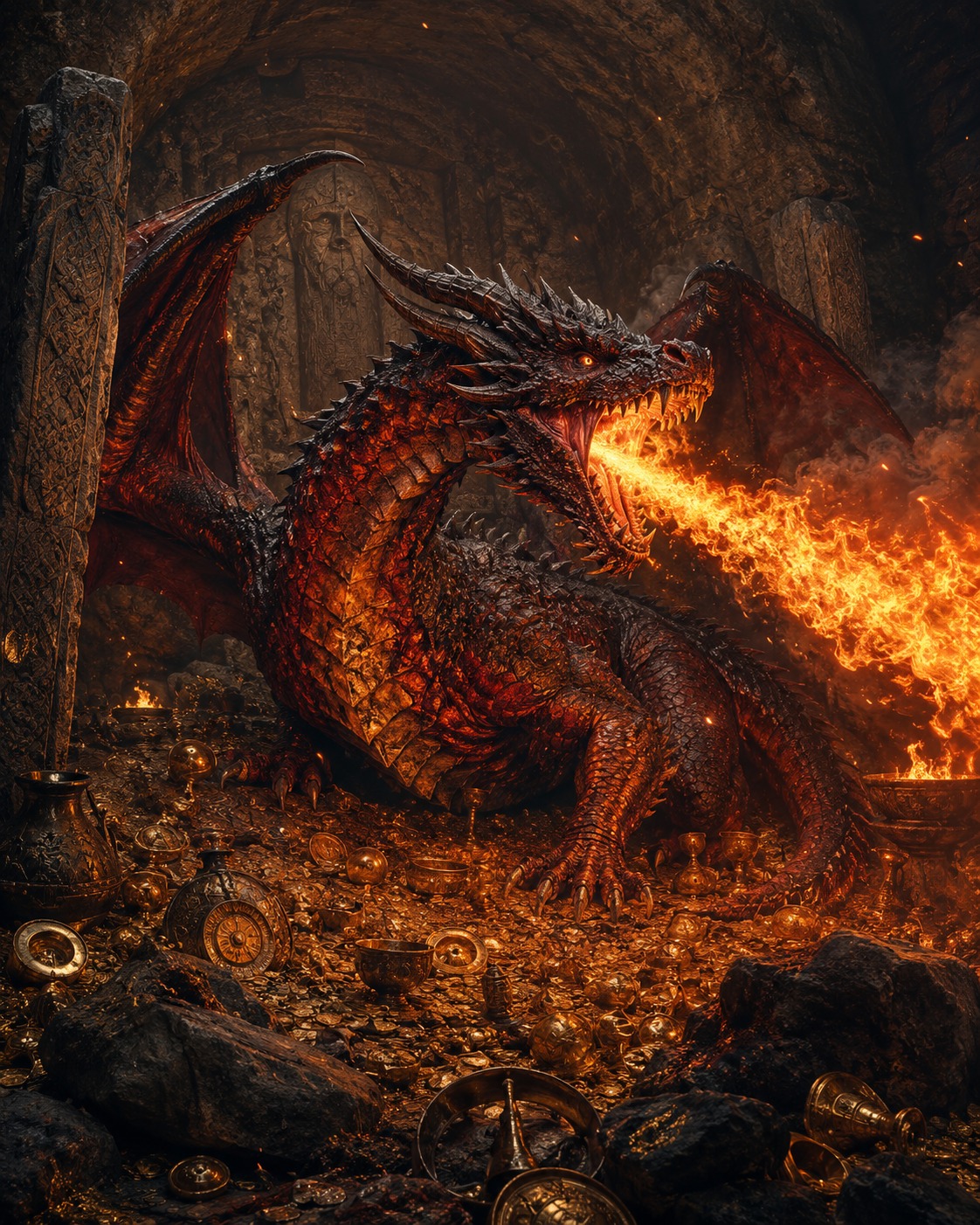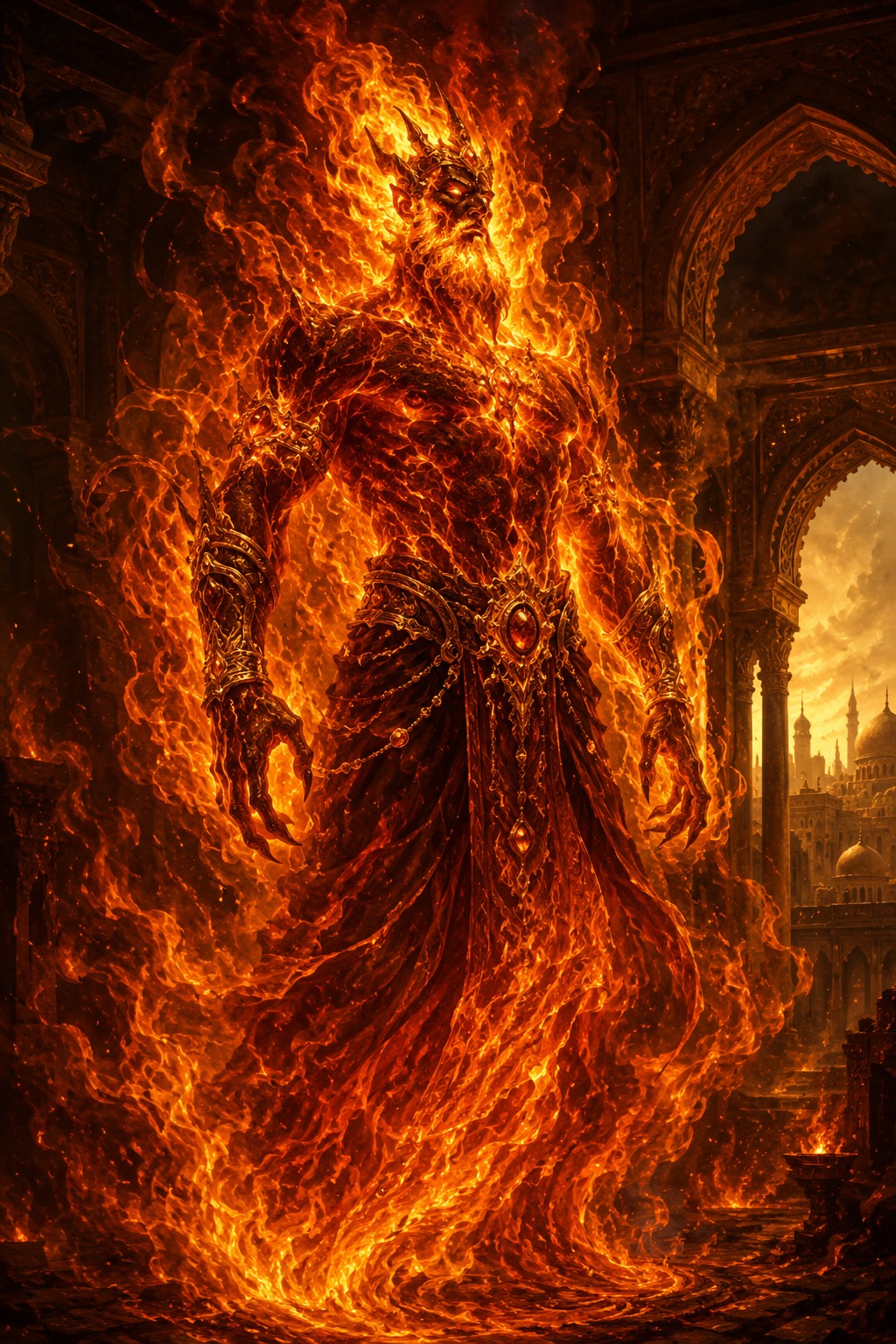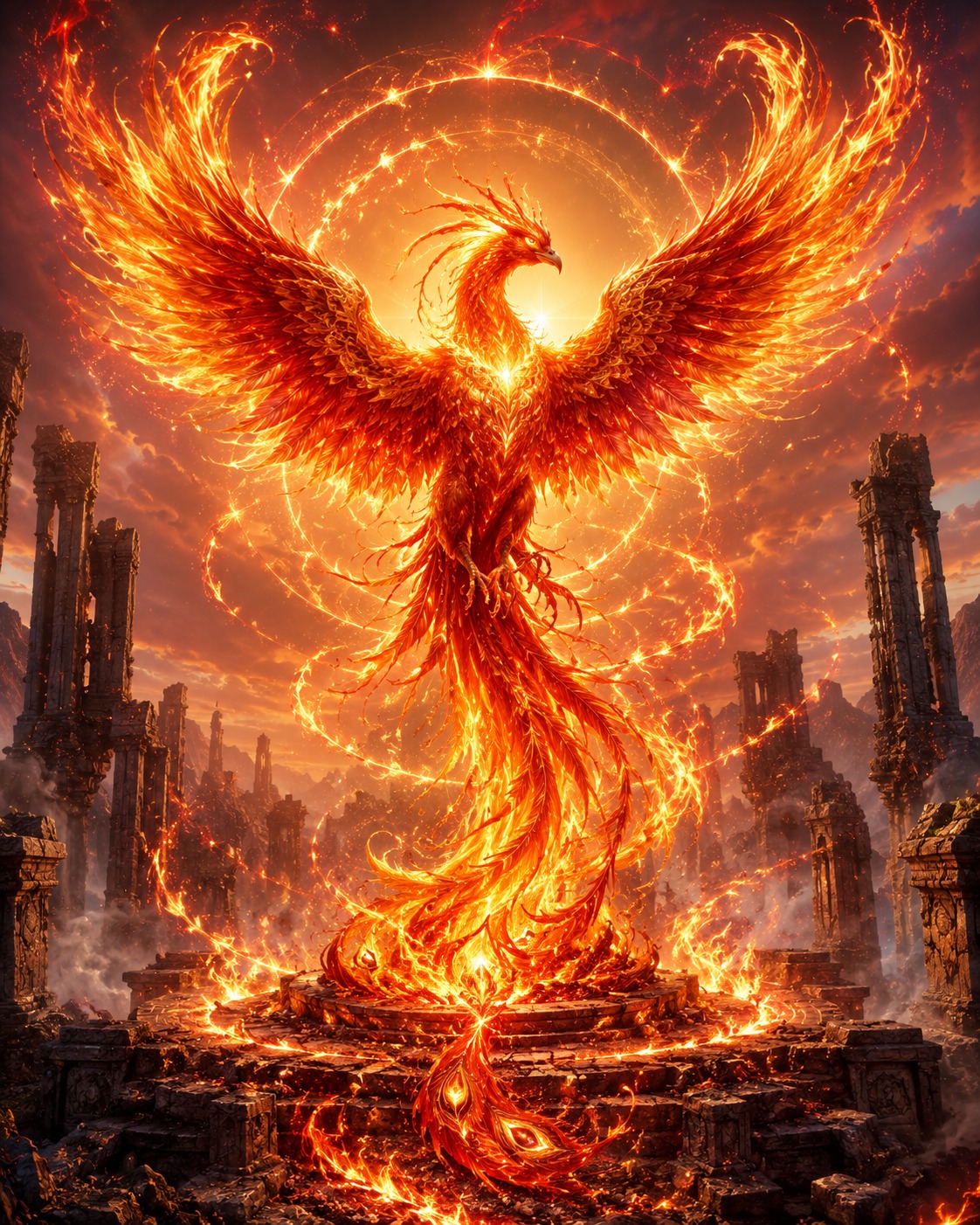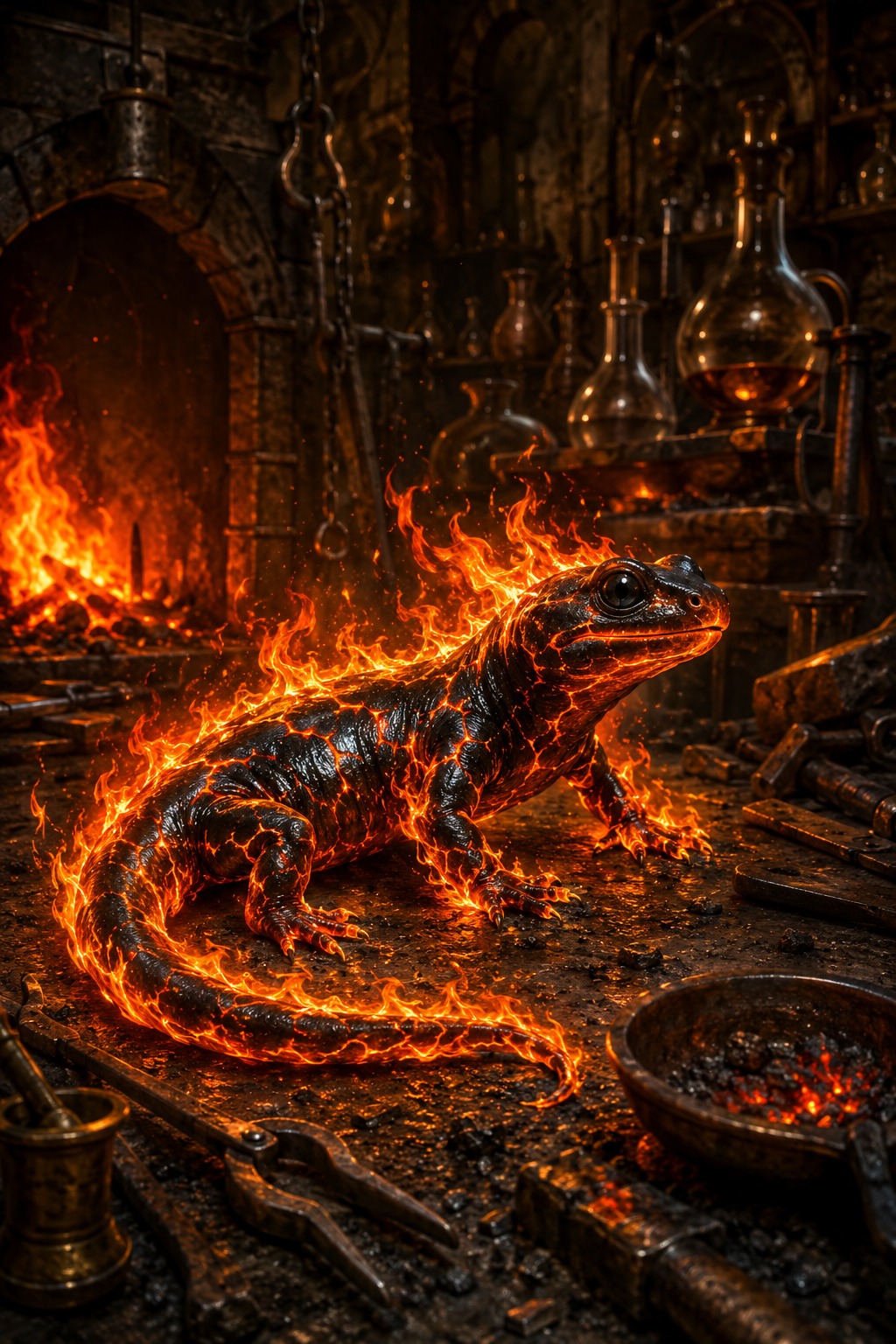
Salamander
Fire Spirit of Paracelsus
Names in Other Languages
 살라만더한국어
Salamander · 파라켈수스의 불의 정령
 サラマンダー日本語
Salamander · 火車(Kasha) — 下位の炎の精霊
 蠑螈精靈繁體中文
Salamander · 火車(Kasha) — 下位火焰精靈
 SalamanderDeutsch
Salamander · Kasha — Niederer Feuergeist
 SalamandreFrançais
Salamandre · Kasha — Esprit du Feu Inférieur
 SalamandraEspañol
Salamandra · Kasha — Espíritu del Fuego Inferior
 SalamandraPortuguês
Salamandra · Kasha — Espírito do Fogo Inferior
 SalamanderPolski
Salamander · Kasha — Niższy Duch Ognia
 СаламандраРусский
Саламандра · Каша — Низший Дух Огня
The Salamander (Latin Salamandra, Greek salamandra, English Salamander) is the decisive canonical spirit of fire (Ignis) among the four element spirits (Elemental Spirits) in the posthumous 1566 Latin treatise A Book of Nymphs, Sylphs, Pygmies, and Salamanders (Liber de Nymphis, Sylphis, Pygmaeis et Salamandris) by the Swiss physician-alchemist Paracelsus (1493-1541), a small spirit in the form of a salamander wholly enveloped in flame, dwelling in the hearth and furnace, canonised as the decisive guardian spirit of the blacksmith and the alchemist. The iconographic origin is (1) the canonical record in Book 5, Chapter 19 of the Historia Animalium of the fourth-century BCE Greek philosopher Aristotle (Aristoteles, 384-322 BCE), that the salamandra walks through fire and extinguishes it, and (2) the canonical misunderstanding in Book 10, Chapter 86 of the Natural History (Naturalis Historia) of the Roman naturalist Pliny the Elder (Gaius Plinius Secundus, 23-79 CE) of 77 CE, that the salamandra is born by fire. The decisive canon is the four-element-spirit theory of Paracelsus of 1566 — Undine (Water), Sylph (Air), Gnome (Earth), and Salamander (Fire) — by which the Salamander became the decisive canon of the European Renaissance fire spirit. The Salamander monster of the 1977 D&D Monster Manual by Gary Gygax (1938-2008) of TSR in the USA — consistent through to 5e (5th Edition) of 2014 — is the decisive canon of the modern fantasy RPG fire spirit.
Origin
The iconographic origin is the canonical misunderstanding of the Salamander in (1) the Historia Animalium of Aristotle of the fourth century BCE and (2) the Natural History of Pliny the Elder of 77 CE. In Book 5, Chapter 19, lines 552b15-17, of the natural-history Historia Animalium of the fourth-century BCE Greek philosopher Aristotle (384-322 BCE), the canonical record that the salamandra (salamandra) walks through fire and extinguishes it with its footprints is the origin of the Salamander canon. The canonical record of Book 10, Chapter 86, line 188, of the Natural History (Naturalis Historia, 37 books) of the Roman naturalist Pliny the Elder (Gaius Plinius Secundus, 23-79 CE) of 77 CE — that the salamandra is a cold animal that can survive in fire and extinguishes it — is the decisive origin of the Latin-literary Salamander canon. The natural-historical misunderstanding that the actual newt (Salamandridae) — emerging from damp logs or rotten wood when a fire is lit, covered with the sticky slime of its skin — is 'an animal born from fire' was canonised in the first-century Greek Physiologus, the seventh-century Etymologiae of Isidore of Seville (Isidorus Hispalensis, 560-636), and the 1298 Travels of Marco Polo (Marco Polo, 1254-1324) of Venice — in which Polo misidentified the asbestos of the Xinjiang Uyghur mines of China as the 'fur of the salamander'. The decisive modern canonisation is the posthumous Latin treatise A Book of Nymphs, Sylphs, Pygmies, and Salamanders (Liber de Nymphis, Sylphis, Pygmaeis et Salamandris) of Paracelsus (Theophrastus Bombastus von Hohenheim, 1493-1541) published in Basel, Switzerland in 1566 — written in the 1530s — the canon of the four element spirits (Elemental Spirits), in which the Salamander, as the spirit of fire (Ignis) in the canon of the four elements (Water Undine, Air Sylph, Earth Gnome, Fire Salamander), became the decisive canon.
Features
- Small spirit in the form of a salamander
- Body wholly enveloped in flame
- Survives in fire and travels through fire
- Dwelling in hearth, furnace, and smithy
- Guardian spirit of the blacksmith and the alchemist
- Weakness to water and the extinguishing of the hearth
Stories
Book 5 of Aristotle's Historia Animalium of the fourth century BCE and Book 10 of Pliny the Elder's Natural History of 77 CE are the origins of the Salamander canon, and the seventh-century Etymologiae of Isidore of Seville and the 1298 Travels of Marco Polo extended the medieval Salamander canon. The decisive canon is the four-element-spirit canon of Paracelsus of 1566, and the personal heraldic device of the sixteenth-century French king Francis I (Francois I, 1494-1547) — crowned in 1515 — adopted the Salamander (with the motto Nutrisco et extinguo, 'I nourish and extinguish') as the decisive visual canon of the French Renaissance royal house, and his Salamander devices are decisively carved on the Chateau de Chenonceau and the Chateau de Chambord in France. Around 1500, the Codex Atlanticus of Leonardo da Vinci (1452-1519) recorded the natural-historical canon of the Salamander's relation to fire, and the 1797 poem The Rime of the Ancient Mariner by the British poet Samuel Taylor Coleridge (1772-1834) settled the English-literary Salamander canon. The Salamander monster of the 1977 D&D Monster Manual by Gygax of TSR in the USA — consistent through to 5e (5th Edition) of 2014 — is the decisive canon of the modern fantasy RPG fire spirit, and the Fire magic of the Black Mage in Square's Final Fantasy released in Japan on 17 December 1986 and the summon Ifrit (citing the Arab-mythological canon) of Final Fantasy IV released on 19 April 1991 are the canon of the Japanese RPG fire spirit. The Fire Lord of Blizzard's Diablo of 31 December 1996 and Warcraft III of 2002 and the Fire Elemental of World of Warcraft of 2004 are the global video-game fire-spirit canon of the twenty-first century, and the Salamander iconography has extended to twenty-first-century global children's popular culture.
Weakness
The Salamander's weaknesses are: (1) water — the decisive weakness canonised as the elemental opposition (Mutual Restraint) of Fire and Water in the four-element-spirit canon of Paracelsus of 1566, and as the damage-type compatibility of the D&D system canon of 1977 — consistent through to 5e (5th Edition) of 2014 — the decisive weakness of the fire-spirit Salamander; (2) complete extinguishing of the hearth — the decisive weakness in the Paracelsus canon that the elemental spirit vanishes with the extinction of its element, and the Salamander vanishes with the complete extinguishing of its hearth fire; (3) cold metal and ice — the decisive weakness of the Salamander to Cold damage in the D&D system canon of 1977, the canon since the first publication of Gygax's D&D Monster Manual; (4) strong wind — the canon of weak opposition with the Sylph (Air) in the four-element-spirit canon of Paracelsus of 1566, by which the flame is scattered and the Salamander weakened; (5) sacred sealing rite — the sealing rite of the eternal Sacred Flame equivalent to that of the Temple of Vesta in ancient Rome; (6) environmental binding — the environmental-binding canon of the elemental spirit of Paracelsus of 1566, that the Salamander is bound to its own hearth and furnace and cannot leave; (7) alchemical purification — the canon that the Purificatio rite of Renaissance alchemy pacifies the Salamander; (8) sacred light and Catholic exorcism — the medieval Catholic canon that the Catholic exorcism rite can seal elemental spirits such as the Salamander. The natural-historical fact that the actual newt (Salamandridae) — by the slime of its skin — survives for a brief time in fire is the natural-historical foundation of the canonical misunderstanding of Pliny the Elder.
Cultural Significance
The Salamander is not merely a fire-spirit icon but the canonical iconographic figure of the Western fire-spirit canon, traversing the fourth-century BCE Aristotelian Greek natural history, the first-century Plinian Roman natural history, the medieval Etymologiae of Isidore and the Travels of Marco Polo, Paracelsus's four-element-spirit theory of 1566, the heraldic device of the sixteenth-century French king Francis I, the twentieth-century D&D fantasy RPG, and the twenty-first-century global video game. The 1566 A Book of Nymphs, Sylphs, Pygmies, and Salamanders of Paracelsus (Theophrastus Bombastus von Hohenheim, born in Switzerland) — the decisive event of Renaissance European natural philosophy and alchemy — had decisive influence on nineteenth-century European fantasy literature, including the 1690 Le Comte de Gabalis by the French author Montfaucon de Villars (1635-1673), the 1797 The Rime of the Ancient Mariner by the British poet Coleridge, and the 1811 Undine by the German author Friedrich de la Motte Fouque (1777-1843). The Salamander heraldic device of the sixteenth-century French king Francis I (Francois I, reigned 1515-1547) — with the Latin motto Nutrisco et extinguo ('I nourish and extinguish') — is the decisive visual canon of the French Renaissance royal house, and is carved on the decisive French Renaissance architecture of the Chateau de Chenonceau and the Chateau de Chambord in the Loire Valley. The Salamander monster of the 1977 Gygax D&D Monster Manual — consistent through to 5e (5th Edition) of 2014 — is the decisive canon of the modern fantasy RPG fire spirit, and the fire spirits of Blizzard's 1996 Diablo (25 million units sold worldwide) and the 2004 World of Warcraft (cumulative 100 million subscribers worldwide) became the decisive canon of the global video-game market of the twenty-first century. The Paris bistro hearth iconography of Pixar's July 2007 Ratatouille is the decisive adaptation of the twenty-first-century global household-hearth canon.
In Popular Culture
- Aristotle, Historia Animalium, Book 5, Chapter 19 (fourth century BCE) — origin of the Salamander canon
- Pliny the Elder, Natural History, Book 10, Chapter 86 (77 CE) — decisive Latin-literary Salamander canon
- Isidore of Seville, Etymologiae (seventh century) — medieval Salamander canon
- Marco Polo, Travels (1298) — canon of asbestos as 'fur of the Salamander'
- Leonardo da Vinci, Codex Atlanticus (c. 1500) — Renaissance natural-history canon
- Paracelsus, A Book of Nymphs, Sylphs, Pygmies, and Salamanders (1566) — decisive canon of the four element spirits
- Francis I of France, Salamander heraldic device (1515) — French Renaissance royal canon
- Coleridge, The Rime of the Ancient Mariner (1797) — English-literary Salamander canon
- Gygax, D&D Monster Manual, Salamander (1977) — decisive fantasy RPG fire-spirit canon
- Blizzard, World of Warcraft, Fire Elemental (2004) — twenty-first-century video-game canon
Trivia
The Greek salamandra of Salamander — of unclear origin — is a Greek natural-history vocabulary that settled as canonical vocabulary through the Latin salamandra and first attested in Middle English as salamander around 1340. The canonical record of the salamandra walking through fire and extinguishing it with its footprints in lines 552b15-17 of Book 5, Chapter 19 of Aristotle's Historia Animalium of the fourth century BCE, and the Latin canonical record of Book 10, Chapter 86, line 188 of Pliny the Elder's Natural History of 77 CE that the salamandra is a cold animal that extinguishes fire, are the decisive canon of the misunderstanding (the natural-historical misunderstanding of the appearance of the newt emerging from a log, covered with slime, when the fire is lit). The 1298 Travels of the Venetian merchant Marco Polo (1254-1324) — which misidentified the asbestos (Greek asbestos, 'unquenchable') of the Xinjiang Uyghur mines of China as the fur of the salamander — is the decisive thirteenth-century canonical record, and Polo described the asbestos tablecloths he saw at the Mongol imperial court at Karakorum as salamander hide. The 1566 Latin treatise A Book of Nymphs, Sylphs, Pygmies, and Salamanders of Paracelsus (Basel, Switzerland) — written in the 1530s in Salzburg, Innsbruck, and elsewhere — is the decisive canon of four-element-spirit theory, and had decisive influence on the 1690 Le Comte de Gabalis of Montfaucon de Villars and the 1811 Undine of Fouque. The personal Salamander heraldic device of the sixteenth-century French king Francis I (1494-1547, reigned 1515-1547) — born 12 September 1494 at Cognac — with the Latin motto Nutrisco et extinguo ('I nourish and extinguish'), is carved on the decisive French Renaissance architecture of the Chateau de Chenonceau and the Chateau de Chambord built in 1519-1547, and was the decisive heraldic device of the Valois royal house until his grandson Henry III (Henri III). The Salamander monster of the 1977 D&D Monster Manual by Gygax of TSR (Lake Geneva, Wisconsin, USA) — consistent through to 5e (5th Edition) of 2014, for forty years — is the decisive canon of the modern fantasy RPG fire spirit.