Ifrit
Fire Jinn of Arab/Islamic Mythology
Names in Other Languages
 이프리트한국어
Ifrit · 아랍·이슬람 신화의 불의 진
 イフリート日本語
Ifrit · サリスト(Sallist) — 中位の炎の精霊
 伊芙利特繁體中文
Ifrit · 薩利斯特(Sallist) — 中位火焰精靈
 IfritDeutsch
Ifrit · Sallist — Mittlerer Feuergeist
 IfritFrançais
Ifrit · Sallist — Esprit du Feu Intermédiaire
 IfritEspañol
Ifrit · Sallist — Espíritu del Fuego Intermedio
 IfritPortuguês
Ifrit · Sallist — Espírito do Fogo Intermediário
 IfritPolski
Ifrit · Sallist — Średni Duch Ognia
 ИфритРусский
Ифрит · Саллист — Средний Дух Огня
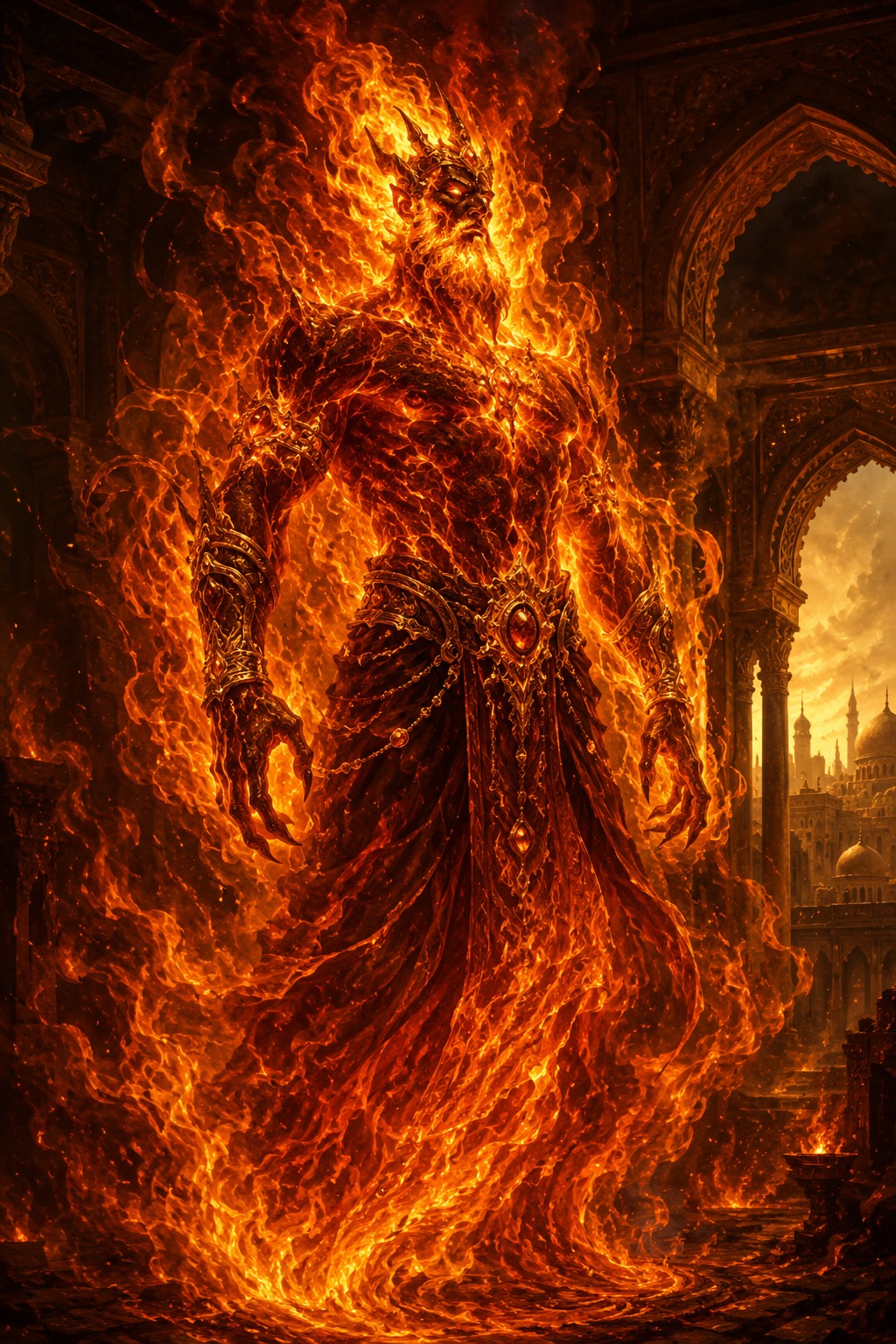
The Ifrit (Arabic ifrit, English Ifrit or Efreet) is the canonical iconographic figure of the powerful fire-jinn among the five-type classification of jinn — Jann, Jinn, Shaytan, Ifrit, Marid — in Arab-Islamic mythology. The etymology is the canonical vocabulary derived from the Arabic root ayn-F-R-T ('strong and evil, cunning'), and the canonical iconography depicts an Ifrit with a giant humanoid body wholly composed of flame — with distinct will and intelligence, more ferocious in disposition than other jinn. The decisive textual canon is verse 39 of Chapter 27 (An-Naml) of the Quran (Qur'an) revealed to the prophet Muhammad (Muhammad, c. 570-632) by the angel Gabriel c. 610-632 CE — in which when King Solomon (Sulayman) commanded the throne of the Queen of Sheba (Bilqis) to be brought, a powerful Ifrit (ifrit min al-jinn, 'an Ifrit of the jinn') volunteered, 'I will bring it to you before you rise from your place' — the decisive canon, and the Fisherman and the Ifrit canon of the One Thousand and One Nights (Alf Layla wa-Layla) compiled in the Mamluk dynasty of Arab Syria and Egypt in the 14th-15th centuries — the decisive Arabic-literary canon in which the Ifrit sealed by Solomon is released by the fisherman and tries to kill him — is the decisive canon. The decisive modern canon is the Efreeti of the D&D Monster Manual of 1977 by Gary Gygax (1938-2008) of TSR in the USA — consistent through to 5e (5th Edition) of 2014 — and the summoned beast Ifrit of Final Fantasy III (Final Fantasy III) by Square in Japan released on 18 December 1987 — the series-integrated canon — the decisive culminating work of the modern global Ifrit canon.
Origin
The iconographic origin began with the fire-spirit worship of the pre-Islamic Arab polytheism (Jahiliyya) and was systematised through the Islamic revelation to the prophet Muhammad c. 610-632 CE as the fire-jinn among the five-type classification of jinn — Jann, Jinn, Shaytan, Ifrit, Marid — in Islamic theology. The decisive textual canon is verse 39 of Chapter 27 (An-Naml) of the Quran of c. 610-632 CE — in which when King Solomon (Sulayman) commanded the throne of the Queen of Sheba (Bilqis) to be brought from Saba a thousand miles away, a powerful Ifrit (ifrit min al-jinn) volunteered, 'I will bring it to you before you rise from your place; indeed I am, for this, strong and trustworthy' — but Solomon's servant Asaf bin Barakhiya, who had sacred knowledge, brought it more quickly — the decisive canon of Ifrit appearance. The Book of Animals (Kitab al-Hayawan) of the 9th-century Abbasid-dynasty Islamic theologian Al-Jahiz (c. 776-868) and The Wonders of Creation (Aja'ib al-Makhluqat) of the 13th-century Al-Qazwini (Zakariyya al-Qazwini, 1203-1283) established the decisive canon of the five-type jinn classification — Jann, Jinn, Shaytan, Ifrit, Marid. The Fisherman and the Ifrit canon of the One Thousand and One Nights compiled in the Mamluk dynasty of Arab Syria and Egypt in the 14th-15th centuries — the decisive Arabic-literary canon in which Solomon's Ifrit sealed in a jar is released by the fisherman — is the decisive canon, and the French translation Les Mille et une Nuits (12 volumes) of the French Orientalist Antoine Galland (1646-1715) of 1704-1717 and the English translation (16 volumes) of the British Richard Francis Burton (1821-1890) of 1885-1888 settled the Western Ifrit canon.
Features
- Giant humanoid body, wholly composed of flame
- Powerful magic and transformation ability
- More ferocious disposition than other jinn
- Distinct will and intelligence
- Later canon that they dwell in hell
- Can be sealed by Solomon's seal
Stories
Verse 39 of Chapter 27 (An-Naml) of the Quran of c. 610-632 CE — the Solomon-and-Ifrit canon — is the decisive origin, and the Book of Animals of the 9th-century Al-Jahiz and The Wonders of Creation of the 13th-century Al-Qazwini systematised the Ifrit canon among the five-type jinn classification. The decisive Arabic-literary canon is the Fisherman and the Ifrit canon of the One Thousand and One Nights compiled in the Mamluk dynasty of the Arabs in the 14th-15th centuries — the decisive canon in which the Ifrit sealed in Solomon's jar is released by the fisherman and tries to kill him, but the fisherman, by his wisdom, re-seals the Ifrit in the jar — and the French translation of Galland of 1704-1717 and the English translation (16 volumes) of the British Richard Burton (1821-1890) of 1885-1888 settled the 18th-19th-century Western Ifrit canon. The 1819 Tales of the Alhambra of the American writer Washington Irving (1783-1859) settled the Ifrit iconography in American literature, and the 1816 Kubla Khan of the British poet Samuel Taylor Coleridge (1772-1834) and the 1834 poems of Robert Southey (1774-1843) established the 19th-century British Romantic Ifrit poetic canon. The decisive modern canon is the Efreeti of the D&D Monster Manual of 1977 by Gary Gygax (1938-2008) of TSR in the USA — consistent through to 5e (5th Edition) of 2014 — the decisive canon of the modern fantasy RPG Ifrit, and the decisive culminating work of the modern video-game Ifrit canon is the summoned beast Ifrit (Ifrit) of Final Fantasy III (Super Famicom) by Square of Japan released on 18 December 1987 — the series-integrated decisive flame summon. The decisive final of the 1992 Disney film Aladdin (released 25 November 1992 in the USA, directed by John Musker and Ron Clements) — in which Jafar transforms into a final Ifrit-like jinn — is the global Ifrit visual canon.
Weakness
The Ifrit's weaknesses are: (1) Solomon's seal — the decisive sealing canon in verse 39 of Chapter 27 (An-Naml) of the Quran of c. 610-632 CE and the Fisherman and the Ifrit canon of the 14th-15th-century One Thousand and One Nights, in which King Solomon's (Sulayman's) magical seal can seal the Ifrit in a jar or lamp; (2) the name of God (Allah) — the decisive canon in Islamic theology that a devout prayer invoking the name of God weakens and seals the Ifrit; (3) water — the canon in the 14th-15th-century One Thousand and One Nights and the 1977 D&D, that the Ifrit as fire-jinn is weak against water according to the four-element canonical opposition; (4) devout humans — the canon in the Quran and the 1819 Washington Irving's Tales of the Alhambra that the Ifrit is weak before the prayer of devout humans and Solomon's sacred knowledge; (5) sealed vessels — the decisive canonical weakness in the 14th-15th-century One Thousand and One Nights that the Ifrit trapped in a jar, lamp, or brass bottle must grant the wishes of the one who frees it, but is re-sealed by the fisherman's wisdom; (6) sacred verses — Islamic amulets (ta'widh) and Quranic verses weaken the Ifrit; (7) contract with a powerful magician — the canon in the 14th-15th-century One Thousand and One Nights that the Ifrit contracted with a powerful magician is bound by the contract and obeys commands; (8) greater theological binding than other jinn — in the five-type classification canon of the 9th-century Al-Jahiz and the 13th-century Al-Qazwini, the Ifrit has greater theological binding than other jinn — yielding before God's omnipotence. The decisive canonical finale of the Fisherman and the Ifrit of the 14th-15th-century One Thousand and One Nights — in which the fisherman re-seals the Ifrit in the jar — is the decisive finale of the Arabic-literary Ifrit canon, and the canonical finale of the 1992 Disney Aladdin — in which Aladdin seals Jafar in a lamp by the 'eternal sealing of a jinn less free than a jinn' after Jafar transforms into a jinn — is the decisive finale of the 20th-century global Ifrit canon.
Cultural Significance
The Ifrit is not merely a fire-jinn icon but the canonical iconographic figure of the Arab-Western fire-jinn canon, traversing the pre-Islamic Arab polytheistic desert-fire-spirit belief, the Quran of the prophet Muhammad c. 610-632 CE, the 9th-century Al-Jahiz's Book of Animals, the 13th-century Al-Qazwini's Wonders of Creation, the 14th-15th-century One Thousand and One Nights, the 1704-1717 French Galland translation, the 1885-1888 British Burton translation, the 1818 Samuel Taylor Coleridge's poetry, the 1819 Washington Irving's Tales of the Alhambra, the 1977 D&D Monster Manual, the 1987 Japanese Square's Final Fantasy III, and the 1992 Disney Aladdin. The Quran revealed to the prophet Muhammad (c. 570-632, active in Mecca and Medina) by the angel Gabriel c. 610-632 CE — 114 chapters in total — is the decisive scripture of Islam, and the Solomon canon of verse 39 of Chapter 27 (An-Naml) is the decisive canon of Ifrit iconography. The Fisherman and the Ifrit canon (Nights 2-4) of the One Thousand and One Nights (Alf Layla wa-Layla) compiled in the Mamluk dynasty of Arab Syria and Egypt in the 14th-15th centuries — as the decisive canon of medieval Arabic literature — is the decisive Arabic-literary canon in which the fisherman releases the Ifrit sealed in Solomon's jar but, through his wisdom, re-seals the Ifrit. The 1816 poem Kubla Khan of the British poet Samuel Taylor Coleridge (Samuel Taylor Coleridge, 1772-1834) and the 1834 poems of the British poet Robert Southey (1774-1843) established the 19th-century British Romantic Ifrit canon, and the decisive video-game canon is the summoned beast Ifrit of Final Fantasy III (Super Famicom, directed by Hironobu Sakaguchi) by Square of Japan released on 18 December 1987 — over 27 entries in the series — and the canonical finale of the 1992 Disney Aladdin (released 25 November 1992 in the USA, directed by John Musker and Ron Clements, with Genie voiced by Robin Williams) — in which Jafar transforms into a jinn — is the decisive culminating work of the 20th-century global Ifrit visual canon.
In Popular Culture
- Quran, Chapter 27 (An-Naml) verse 39 (c. 610-632 CE) — decisive Solomon-and-Ifrit canon
- Al-Jahiz, Book of Animals (9th century) — Islamic-theological five-type jinn classification canon
- Al-Qazwini, Wonders of Creation (13th century) — decisive five-type jinn classification canon
- One Thousand and One Nights, Fisherman and the Ifrit (14th-15th centuries) — decisive Arabic Fisherman-and-Ifrit canon
- Antoine Galland French translation (1704-1717) — Western Ifrit canon settlement
- Richard Burton English translation (1885-1888) — Victorian British Ifrit canon
- Coleridge, Kubla Khan (1816) — British Romantic poetic canon
- Washington Irving, Tales of the Alhambra (1819) — American-literary canon
- Gygax, D&D Monster Manual, Efreeti (1977) — decisive fantasy RPG canon
- Square, Final Fantasy III, Ifrit (1987) — decisive video-game canon
Trivia
The etymology of Arabic ifrit (ifrit) — the noun form of the root ayn-F-R-T ('strong and evil, cunning') — is the decisive canonical vocabulary, and the English Ifrit (first attested in 1814), Efreet (1838), Efreeti (1977 D&D), and French Efrit are canonical vocabulary. The five-type classification of jinn — Jann, Jinn, Shaytan, Ifrit, Marid — is the classification canon of the Book of Animals (Kitab al-Hayawan) of the 9th-century Abbasid-dynasty Islamic theologian Al-Jahiz (c. 776-868) and The Wonders of Creation (Aja'ib al-Makhluqat) of the 13th-century Al-Qazwini (Zakariyya al-Qazwini, 1203-1283), and the Ifrit is classified as the most powerful fire-jinn among the five-type jinn. The decisive canonical record in verse 39 of Chapter 27 (An-Naml) of the Quran of c. 610-632 CE — in which when King Solomon commanded the throne of the Queen of Sheba to be brought, an Ifrit (ifrit min al-jinn) volunteered, 'I will bring it to you before you rise from your place', but Solomon's servant Asaf bin Barakhiya, by invoking the Greatest Name of God (Ism al-A'zam), brought it more quickly — is the decisive origin of the Ifrit iconography. The Fisherman and the Ifrit canon of Nights 2-4 of the One Thousand and One Nights (Alf Layla wa-Layla) compiled in the Mamluk dynasty of Arab Syria and Egypt in the 14th-15th centuries — in which the fisherman releases the Ifrit sealed in Solomon's jar for 1,800 years but, through his wisdom, re-seals it in the jar — is the decisive Arabic-literary canon. The summoned beast Ifrit of Final Fantasy III (Super Famicom, directed by Hironobu Sakaguchi) by Square (now Square Enix) of Japan released on 18 December 1987 — the decisive flame summon of over 27 series entries — is the decisive video-game Ifrit canon up to 2024, and the canonical finale of the 1992 Disney Aladdin (released 25 November 1992 in the USA) — in which Aladdin seals Jafar in a lamp by the 'eternal sealing of a jinn less free than a jinn' after Jafar transforms into a jinn — is the decisive culminating work of the 20th-century global Ifrit visual canon.