Phoenix Spirit
Spirit Form of the Immortal Phoenix
Names in Other Languages
 피닉스 정령한국어
Phoenix Spirit · 불사조의 정령형 변형
 フェニックス日本語
Phoenix · サリオン(Sallion) — 炎の精霊王
 鳳凰繁體中文
Phoenix · 薩利昂(Sallion) — 火焰精靈王
 PhönixDeutsch
Phönix · Sallion — Feuer-Geisterkönig
 PhénixFrançais
Phénix · Sallion — Roi des Esprits du Feu
 FénixEspañol
Fénix · Sallion — Rey Espíritu del Fuego
 FênixPortuguês
Fênix · Sallion — Rei Espírito do Fogo
 FeniksPolski
Feniks · Sallion — Król Duchów Ognia
 ФениксРусский
Феникс · Саллион — Король Духов Огня
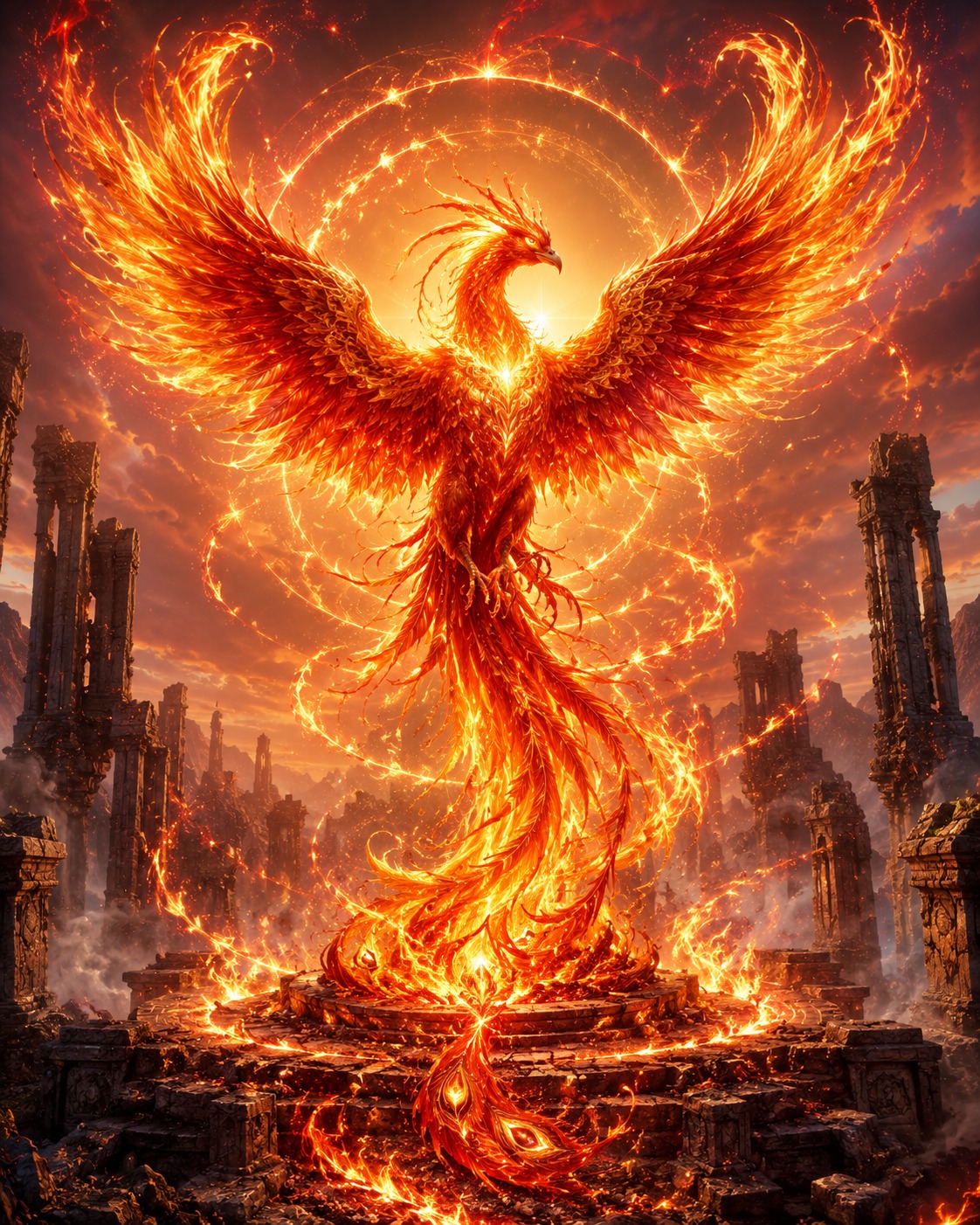
The Phoenix Spirit (Greek Phoinix, Latin Phoenix, English Phoenix) is the canonical iconographic figure of the immortal flame-bird — adapting the Egyptian Bennu (Bennu) and the Greek Phoenix tradition into the spirit category — that immolates itself every 500 or 1000 years and is reborn from the ashes. The etymology is presumed from the Greek Phoinix (Greek 'crimson' or 'Phoenician bird'), and the bennu ('the one that rises') of ancient Egypt — the canonical sacred bird of the resurrection of the sun god Ra and Osiris of Heliopolis — is the decisive origin of the Greek Phoenix iconography. The decisive textual canon is Chapter 73 of Book 2 of the Histories (Historiai) of the Greek historian Herodotus (Herodotus, c. 484-425 BCE) of the 5th century BCE — the testimony of Egyptian priests of seeing the Phoenix at the Sun Temple of Heliopolis and the canon that every 500 years the Phoenix comes from Arabia to Heliopolis carrying the corpse of its father Phoenix in a myrrh egg — the decisive canon, and the decisive Latin-literary canon is the canon of lines 392-407 of Book 15 of the Metamorphoses of the Roman poet Ovid (Publius Ovidius Naso, 43 BCE - 17 CE) of c. 8 CE — the 1000-year cyclic self-immolation and rebirth from the ashes — the decisive canon. The decisive modern canon is the Headmaster Dumbledore's phoenix Fawkes of the Harry Potter (Harry Potter) series of the British author J. K. Rowling (J. K. Rowling, b. 1965) of 1997-2007 — first appearing in Chapter 12 of Harry Potter and the Chamber of Secrets of 1998 — the decisive culminating work of the 21st-century global Phoenix canon.
Origin
The iconographic origin is the fusion of (1) the canon of the bennu ('the one that rises') — the sacred bird of the resurrection of the sun god Ra and Osiris of Heliopolis in ancient Egypt of c. 2400 BCE — in the Pyramid Texts and (2) the canon of Chapter 73 of Book 2 of the Histories (Historiai) of the Greek historian Herodotus (Herodotus) of the 5th century BCE — the Heliopolis Phoenix canon. The decisive textual canon is Chapter 73 of Book 2 of the Histories of Herodotus (c. 484-425 BCE) of the 5th century BCE — 'I have seen it only in paintings, but the Egyptian priests say that the Phoenix comes once every 500 years from Arabia to Heliopolis, carrying the corpse of its father Phoenix in a myrrh egg, and buries it in the Sun Temple' — the decisive canon. The decisive Latin-literary canon is the canon of lines 392-407 of Book 15 of the Metamorphoses of Ovid (Publius Ovidius Naso, 43 BCE - 17 CE) of c. 8 CE — the 1000-year cyclic Phoenix self-immolating on a palm tree and being reborn from the ashes — the decisive canon, and Chapter 2 of Book 10 of the Natural History (Naturalis Historia) of the Roman naturalist Pliny the Elder (Plinius Maior, 23-79 CE) of 77 CE and Chapter 28 of Book 6 of the Annals (Annales) of the Roman historian Tacitus (Tacitus, c. 56-120 CE) of c. 117 CE — the record of the appearance of the Phoenix in Egypt in 34 CE — are the decisive canons. The poem On the Phoenix (De Ave Phoenice) of the Latin poet Lactantius (c. 250-325 CE) of c. 300 CE — canonising the Phoenix as the decisive Christian symbol of Christ's resurrection — and the Physiologus (Physiologus) of an anonymous Greek Christian allegory collection of the 2nd century CE decisively established the Phoenix as the symbol of Christ's resurrection.
Features
- Form of a giant bird, with golden and red feathers
- Whole body wrapped in flame
- Cyclically self-immolating every 500 or 1000 years
- Immortality through rebirth from ashes
- Healing power in its tears
- Song comforts humans
Stories
The bennu-bird canon of ancient Egyptian Heliopolis of c. 2400 BCE and the canon of Chapter 73 of Book 2 of the Histories of Herodotus of the 5th century BCE are the decisive origin, and the canon of lines 392-407 of Book 15 of Ovid's Metamorphoses of c. 8 CE established the decisive Latin-literary canon. Chapter 2 of Book 10 of Pliny the Elder's Natural History of 77 CE and Chapter 28 of Book 6 of Tacitus's Annals of c. 117 CE became the decisive Roman natural-philosophy canon, and the poem On the Phoenix (De Ave Phoenice, 170 lines) of Lactantius of c. 300 CE and the anonymous Physiologus of the 2nd century CE decisively canonised the Phoenix as the Christian symbol of Christ's resurrection. The Old English poem The Phoenix (about 677 lines, in the Exeter Book) by an anonymous British poet of the 13th century — a translation of Lactantius's Latin poem — is the decisive English-literary canon, and the poem The Phoenix and the Turtle (67 lines in total) of the British William Shakespeare (1564-1616) of 1597 became the British Renaissance poetic canon. In 1719-1759 French-British alchemical iconography, the Phoenix settled as the decisive symbol of the regeneration of the Philosopher's Stone (Lapis Philosophorum), and the flame-bird of The Last Battle of the British author C. S. Lewis (1898-1963) of 1962 is the 20th-century children's-literary canon. The Phoenix of the 1977 D&D Monster Manual by Gygax of TSR in the USA and the Stravinsky's Firebird (L'Oiseau de feu, 1910) sequence of the Disney animated film Fantasia 2000 of 17 December 1999 are the 20th-century global Phoenix canon, and the decisive 21st-century canon is the Headmaster Dumbledore's phoenix Fawkes of the Harry Potter (Harry Potter) series of the British author J. K. Rowling (b. 1965) of 1997-2007 — first appearing in Chapter 12 of Harry Potter and the Chamber of Secrets (published in Britain on 2 July 1998) — the decisive culminating work of the global Phoenix canon.
Weakness
The Phoenix's weaknesses are: (1) just after self-immolation, before rebirth from ashes — the decisive canon in Herodotus's 5th-century BCE Histories and Ovid's c. 8 CE Metamorphoses Book 15 that the Phoenix is weak for a brief time after self-immolation and before rebirth from ashes; (2) cyclic binding — the temporal binding canon that the Phoenix is bound to the 500-year (Herodotus) or 1000-year (Ovid) cycle and cannot self-immolate otherwise; (3) binding to Heliopolis — the decisive environmental binding canon in Herodotus's 5th-century BCE Histories that the Phoenix comes every 500 years from Arabia to the Sun Temple of Heliopolis; (4) sadness — the canon in Chapter 12 of J. K. Rowling's 1998 Harry Potter and the Chamber of Secrets that Fawkes (Fawkes) comforts with a sad song but is weakened by sadness; (5) dark magic — the canon in Rowling's 1998 Harry Potter that Fawkes's tears heal the basilisk's poison but is weak against dark magic; (6) evil intent — the canon in Lactantius's c. 300 CE On the Phoenix that the Phoenix does not show itself to those with evil intent; (7) absence of a mate — the canon in Herodotus's 5th-century BCE Histories and Ovid's c. 8 CE Metamorphoses that the Phoenix is always alone, without a mate; (8) no decisive canon — the decisive canon that the Phoenix has no death because it is essentially reborn. The decisive canonical finale of Chapter 12 of J. K. Rowling's Harry Potter and the Chamber of Secrets published on 2 July 1998 — in which Headmaster Dumbledore's phoenix Fawkes is reborn as a young Fawkes after self-immolation — and the canon of Chapter 17 — in which Fawkes's tears heal Harry's basilisk poison wound — are the decisive finale of the 21st-century global Phoenix canon.
Cultural Significance
The Phoenix is not merely a flame-bird icon but the canonical iconographic figure of the Western resurrection canon, traversing the bennu-bird of ancient Egyptian Heliopolis of c. 2400 BCE, Herodotus's Histories of the 5th century BCE, Ovid's Metamorphoses of c. 8 CE, Pliny the Elder's Natural History of 77 CE, Tacitus's Annals of c. 117 CE, Lactantius's On the Phoenix of c. 300 CE, the Physiologus of the 2nd century CE, the Old English poem The Phoenix of the 13th century, Shakespeare's The Phoenix and the Turtle of 1597, the 1977 D&D, and J. K. Rowling's Harry Potter of 1997-2007. The bennu bird ('the one that rises') of ancient Egyptian Heliopolis (Heliopolis, now northeastern Cairo) of c. 2400 BCE — the decisive religious centre of the resurrection of the sun god Ra and Osiris — is the decisive sacred bird of ancient Egypt, and the Histories (Historiai, 9 books in total) of the Greek historian Herodotus (c. 484-425 BCE) of the 5th century BCE — the founder of Western historiography — with the Phoenix canon of Book 2 Chapter 73, became the decisive canon of Greek Phoenix iconography. The 1000-year cyclic Phoenix canon of lines 392-407 of Book 15 of Ovid's Metamorphoses of c. 8 CE and Lactantius's On the Phoenix (De Ave Phoenice) of c. 300 CE — canonising the Phoenix as the decisive Christian symbol of Christ's resurrection — became the decisive Christian canon of 4th-13th-century medieval Europe, and the Old English poem The Phoenix (about 677 lines, in the Exeter Book — held by Exeter Cathedral in Devon, Britain) by an anonymous British poet of the 13th century is the decisive English-literary canon. The poem The Phoenix and the Turtle of the British Shakespeare (1564-1616) of 1597 is the decisive canon of British Renaissance poetry, and Headmaster Dumbledore's phoenix Fawkes of the Harry Potter and the Philosopher's Stone (7-volume series, 1997-2007, over 500 million copies sold worldwide cumulatively) of J. K. Rowling (b. 1965) published by Bloomsbury in Britain on 26 June 1997 became the decisive culminating work of the 21st-century global Phoenix canon.
In Popular Culture
- Ancient Egyptian bennu bird Pyramid Texts (c. 2400 BCE) — decisive Egyptian canonical origin
- Herodotus, Histories, Book 2 Chapter 73 (5th century BCE) — decisive Greek Phoenix canon
- Ovid, Metamorphoses, Book 15 lines 392-407 (c. 8 CE) — decisive Latin-literary canon
- Pliny the Elder, Natural History, Book 10 Chapter 2 (77 CE) — Roman natural-philosophy canon
- Tacitus, Annals, Book 6 Chapter 28 (c. 117 CE) — Roman historical canon
- Lactantius, On the Phoenix (c. 300 CE) — decisive Christian canon
- Old English poem The Phoenix (13th century) — decisive English-literary canon
- Shakespeare, The Phoenix and the Turtle (1597) — British Renaissance poetic canon
- Gygax, D&D Monster Manual, Phoenix (1977) — fantasy RPG canon
- J. K. Rowling, Harry Potter and the Chamber of Secrets, Fawkes (1998) — decisive 21st-century global canon
Trivia
The Greek etymology Phoinix (Phoinix) of Phoenix means 'crimson' or 'Phoenician bird', and the Latin Phoenix and English Phoenix (Old English fenix) and Korean bulsajo (immortal bird) are canonical vocabulary. The ancient Egyptian bennu (bennu) — derived from the root wbn ('to rise, to ascend') — is the canonical vocabulary of 'the one that rises'. In Chapter 73 of Book 2 of the Histories (Historiai) of the 5th-century BCE Greek historian Herodotus (c. 484-425 BCE) — 'I have seen it only in paintings, but the Egyptian priests say that the Phoenix comes once every 500 years from Arabia to Heliopolis, carrying the corpse of its father Phoenix in a myrrh egg, and buries it in the Sun Temple' — the decisive canonical record is the decisive origin of the Greek Phoenix iconography. In lines 392-407 of Book 15 of Ovid's (43 BCE - 17 CE) Metamorphoses of c. 8 CE — the 1000-year cyclic Phoenix self-immolating on a palm tree and being reborn from the ashes — is the decisive Latin-literary canon, and the poem On the Phoenix (De Ave Phoenice, 170 lines) of the Latin poet Lactantius (c. 250-325 CE) of c. 300 CE — canonising the Phoenix as the decisive Christian symbol of Christ's resurrection — is the decisive 4th-century Christian poem. The Old English poem The Phoenix (about 677 lines), composed in the 13th century and included in the Exeter Book (c. 970 CE) — held by Exeter Cathedral in Devon, Britain — is the decisive English-literary canon as a translation of Lactantius's Latin poem. The poem The Phoenix and the Turtle (67 lines in total) of the British Shakespeare (1564-1616) of 1597 — published in 1601 in the Love's Martyr poetry collection of Robert Chester — is the decisive canon of British Renaissance poetry. The Headmaster Dumbledore's phoenix Fawkes of the Harry Potter and the Philosopher's Stone series (7 volumes, 1997-2007, over 500 million copies sold worldwide cumulatively, translated into 80 languages) of J. K. Rowling (Joanne Rowling, born 31 July 1965 in Yate, Gloucestershire, England, Britain) published by Bloomsbury in Britain on 26 June 1997 — first appearing in Chapter 12 of Harry Potter and the Chamber of Secrets published on 2 July 1998 — is the decisive culminating work of the 21st-century global Phoenix, and the 15 November 2002 USA-released Warner Brothers film Harry Potter and the Chamber of Secrets (worldwide box office about 879 million dollars) became the decisive visual canon.