Fire-drake
Fire Dragon of Beowulf and Norse Myth
Names in Other Languages
 파이어 드레이크한국어
Fire-drake · 베오울프와 북유럽의 화염 용
 ファイアー・ドレイク日本語
Fire-Drake · イグニス(Ignis) · サライム(Salaime) — 上位の炎の精霊
 炎龍精靈繁體中文
Fire-Drake · 伊格尼斯(Ignis) · 薩萊姆(Salaime) — 上位火焰精靈
 FeuerdracheDeutsch
Fire-Drake · Ignis · Salaime — Überlegener Feuergeist
 Drake de FeuFrançais
Fire-Drake · Ignis · Salaime — Esprit du Feu Supérieur
 Drake de FuegoEspañol
Fire-Drake · Ignis · Salaime — Espíritu del Fuego Superior
 Drake de FogoPortuguês
Fire-Drake · Ignis · Salaime — Espírito do Fogo Superior
 Smok OgniaPolski
Fire-Drake · Ignis · Salaime — Wyższy Duch Ognia
 Огненный ДрейкРусский
Fire-Drake · Игнис · Салайм — Высший Дух Огня
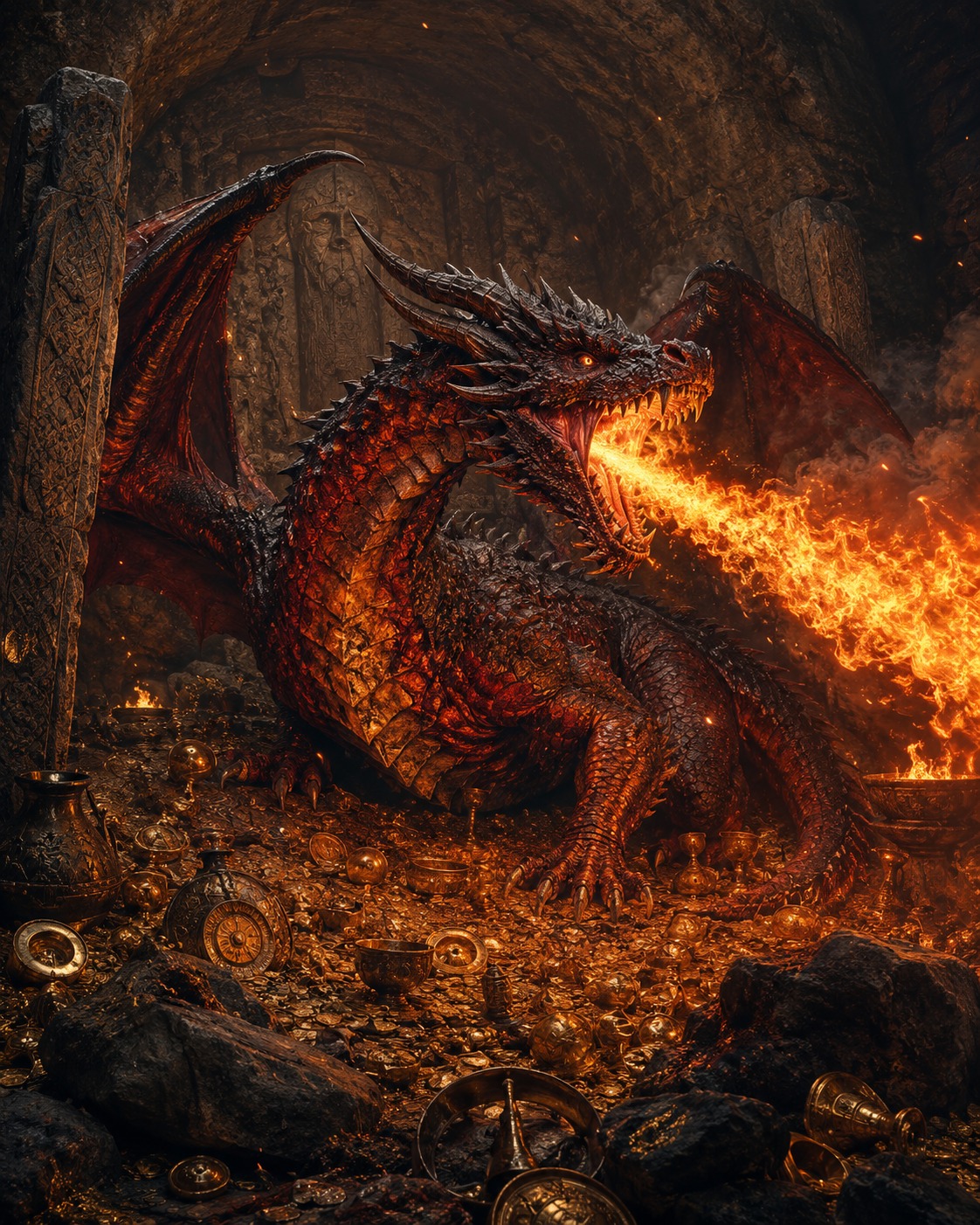
The Fire-drake (Old English fyrdraca, English fire-drake) is the decisive canonical name for the fire-breathing dragon (draca) of Old English and Norse mythology. The etymology is the combination of the Old English fyr ('fire') and draca (borrowed from the Latin draco and Greek drakon, 'dragon'), the Old form of English dragon. The decisive textual canon is the canon in lines 2200-3182 of Book 3 of the Old English epic Beowulf (3,182 lines in total) by an anonymous author of the 8th-10th centuries — in which the hero Beowulf, in his old age after ruling the Geat kingdom for fifty years, when a thief steals the treasure of a sleeping fire-drake — the dragon devastates the Geat kingdom with fire — Beowulf, with his loyal retainer Wiglaf, slays the dragon but dies from the dragon's venom. The Beowulf single manuscript — the Nowell Codex (Cotton Vitellius A.xv at the British Library) copied around the year 1000 — is the decisive textual canon, and the Smaug of The Hobbit by J. R. R. Tolkien (1892-1973), published in Britain on 21 September 1937 — the fire-drake guarding the treasure under the Lonely Mountain — is the decisive modern adaptation of the global fantasy fire-dragon canon of the twentieth century, and the Red Dragon (fire breath) of the 1977 D&D Monster Manual by Gary Gygax of TSR in the USA — consistent through to 5e (5th Edition) of 2014 — is the decisive canon of the modern fantasy RPG fire-dragon.
Origin
The iconographic origin is the fusion of (1) the fire-dragon canon in lines 2200-3182 of Book 3 of the Old English epic Beowulf by an anonymous author of the 8th-10th centuries and (2) the Fafnir canon of the Prose Edda (Snorra Edda, c. 1220) of the early-thirteenth-century Icelandic poet Snorri Sturluson (1179-1241). In the Beowulf canon — the Nowell Codex (Cotton Vitellius A.xv at the British Library) single manuscript copied around the year 1000 — lines 2200-3182 of Book 3, the hero Beowulf of the Geat kingdom, in his old age after ruling for fifty years, when a thief steals a golden cup from a sleeping fire-drake (fyrdraca) — the angered dragon devastates the Geat kingdom with fire — Beowulf, with his loyal retainer Wiglaf, slays the dragon but is bitten by the dragon's fangs and dies — the decisive canonical heroic-epic finale. The Fafnir canon of the Skaldskaparmal (Language of Poetry) of the Prose Edda of the early-thirteenth-century Icelandic poet Snorri Sturluson and of the Volsunga saga of a similar period — in which Fafnir, who kills his brother Regin and takes the golden treasure before transforming into a dragon, is slain by the hero Sigurd with the sword Gramr — and the decisive Norse canon is the canonical fusion of fire-drake iconography. The various dragon canons of the Gesta Danorum of c. 1200 by the Danish historian Saxo Grammaticus (c. 1150-1220) are also decisive canons.
Features
- Massive dragon body
- Fire breath
- Sleeps on a hoard of treasure
- Lifespan of hundreds of years
- Absolutely protective of his treasure
- Weak point between scales — usually the belly
Stories
The fire-dragon canon in lines 2200-3182 of Book 3 of Beowulf by an anonymous author of the 8th-10th centuries is the decisive origin of the fire-drake canon, and the Fafnir canon of the early-thirteenth-century Snorri's Prose Edda and the Volsunga saga is the decisive canon of the Norse fire-dragon. The lecture Beowulf: The Monsters and the Critics, delivered on 25 November 1936 at the British Academy by the Oxford University professor J. R. R. Tolkien (1892-1973), became the decisive turning point of Beowulf scholarly evaluation and decisively settled the twentieth-century English-literary canon, and the Smaug of The Hobbit by Tolkien, published on 21 September 1937 by the British publisher George Allen & Unwin — the fire-drake guarding the golden treasure of the dwarf kingdom Erebor under the Lonely Mountain — settled the global fantasy fire-dragon canon as the decisive modern adaptation of the Beowulf fire-dragon canon. The Red Dragon of the 1977 D&D Monster Manual by Gary Gygax of TSR in the USA — fire breath, treasure hoarding, powerful magic resistance, consistent through to 5e (5th Edition) of 2014 — is the decisive canon of the modern fantasy RPG fire-dragon, and the Drogon of the novel series A Song of Ice and Fire by the American author George R. R. Martin (b. 1948) of 1996-2011 — the black fire-dragon of Daenerys Targaryen — established the twenty-first-century global fire-dragon canon. The decisive twenty-first-century film canon is The Hobbit: An Unexpected Journey (released 14 December 2012 in the USA) and The Hobbit: The Desolation of Smaug (2013) directed by Peter Jackson — with Smaug voiced by Benedict Cumberbatch, worldwide box office about 958 million dollars — the decisive twenty-first-century global fire-dragon cinematic canon.
Weakness
The fire-drake's weaknesses are: (1) the weak point between scales — the canonical weakness in the Book 3 canon of Beowulf that Beowulf and Wiglaf slay the dragon by piercing its soft-scaled neck, and the Smaug of Tolkien's 1937 The Hobbit also dies by Bard's black arrow through the weak point — a missing scale on the left chest; (2) the hero's magical weapon — the decisive canon in the 13th-century Volsunga saga Fafnir canon that the hero Sigurd slays Fafnir with the magical sword Gramr made by the smith Regin; (3) attachment to treasure — the canonical weakness that the fire-dragon is so attached to his treasure that even one stolen cup enrages him to devastate a village and ultimately attract the hero; (4) mutual death by the dragon's venom — the decisive canonical finale in the Book 3 canon of Beowulf that the dragon bites Beowulf's neck and the dragon dies but Beowulf also dies of venom; (5) limited number of fire-breath uses — the modern RPG canonical weakness since the 1977 D&D system that the fire breath can only be used again after a certain time; (6) pride — the canon in Tolkien's 1937 The Hobbit that Smaug, boasting of his scales and strength, exposes the weak point to Bilbo; (7) the maiden's devotion — the medieval European dragon canon that the pure devotion of a maiden seals the dragon — the 6th-century St. George canon; (8) sacred light — the medieval European Catholic dragon canon that sacred light weakens the dragon. The decisive canonical finale of lines 3157-3168 of Book 3 of Beowulf — Beowulf's cremation and the Geats' grief — and the canon in Chapter 14 of Tolkien's 1937 The Hobbit — Smaug devastates the lake town Esgaroth with fire before dying by Bard's black arrow — is the decisive finale.
Cultural Significance
The fire-drake is not merely a fire-dragon icon but the canonical iconographic figure of the Western fire-dragon canon traversing the 8th-10th-century Old English Beowulf, the 13th-century Norse Volsunga saga Fafnir, the c. 1200 Saxo Grammaticus Gesta Danorum, the 1936 Tolkien Beowulf: The Monsters and the Critics lecture, the 1937 Tolkien The Hobbit Smaug, the 1977 D&D Red Dragon, and the 1996 George R. R. Martin A Song of Ice and Fire Drogon. Beowulf (3,182 lines in total) — as the decisive canon of Old English literature — is an anonymous heroic epic composed in Mercia or Northumbria in Britain in the 8th-10th centuries, and only the single manuscript Nowell Codex (Cotton Vitellius A.xv at the British Library) copied around the year 1000 — partially damaged in the 1731 Cotton Library fire — has been preserved to the present. The 25 November 1936 British Academy lecture Beowulf: The Monsters and the Critics by J. R. R. Tolkien (1892-1973, professor of Anglo-Saxon at Oxford University) — as the decisive turning point of Beowulf scholarly evaluation — is the decisive event of 20th-century English literature, interpreting the fire-dragon not as mere allegory but as the decisive canon of the full-fledged heroic-epic finale. The Smaug of Tolkien's The Hobbit published in Britain on 21 September 1937 — as the decisive adaptation of the fire-dragon iconography developed by Tolkien in the Beowulf lecture — established the 20th-century global fantasy fire-dragon canon, and the Red Dragon of the 1977 D&D Monster Manual — consistent through to 5e (5th Edition) of 2014 — is the decisive canon of the modern fantasy RPG fire-dragon. The Drogon of George R. R. Martin's 1996-2011 A Song of Ice and Fire series and the 2011-2019 HBO drama Game of Thrones (about 44 million worldwide viewers) is the decisive media work of the 21st-century global fire-dragon canon.
In Popular Culture
- Old English epic Beowulf, Book 3, lines 2200-3182 (8th-10th centuries) — decisive fire-dragon canon
- Nowell Codex manuscript (c. 1000) — Beowulf single manuscript decisive canon
- Snorri Sturluson, Prose Edda (c. 1220) — Norse Skaldskaparmal dragon canon
- Volsunga saga, Fafnir (13th century) — Norse Sigurd dragon canon
- Saxo Grammaticus, Gesta Danorum (c. 1200) — Danish dragon canon
- Tolkien lecture, Beowulf: The Monsters and the Critics (1936) — decisive 20th-century English-literary turn
- Tolkien, The Hobbit, Smaug (1937) — 20th-century global fantasy fire-dragon canon
- Gygax, D&D Monster Manual, Red Dragon (1977) — modern RPG decisive canon
- George R. R. Martin, A Song of Ice and Fire, Drogon (1996) — 21st-century fire-dragon canon
- Peter Jackson film, The Hobbit: The Desolation of Smaug (2013) — decisive 21st-century cinematic canon
Trivia
The etymology of fire-drake — the Old English fyrdraca, a combination of fyr ('fire') and draca (borrowed from the Latin draco and Greek drakon, 'dragon') — is the Old form of English dragon, and fyrdraca appears decisively in line 2689 and line 2825 of Book 3 of Beowulf. The Old English epic Beowulf (3,182 lines in total) composed in the 8th-10th centuries — copied around the year 1000 in a monastery in Mercia or Northumbria in Britain by two anonymous scribes into the Nowell Codex (Cotton Vitellius A.xv at the British Library) — partially damaged at the margins but the text preserved in the 23 October 1731 Cotton Library fire at Ashburnham House in London, Britain — is the decisive single manuscript. The 25 November 1936 British Academy lecture Beowulf: The Monsters and the Critics by Oxford University professor J. R. R. Tolkien (1892-1973) — overturning the previously prevailing scholarly view that Beowulf was merely a historical source and establishing the decisive literary evaluation as a heroic epic — is the decisive event of 20th-century English literature. The Smaug of Tolkien's The Hobbit, or There and Back Again published by the British publisher George Allen & Unwin on 21 September 1937 — Tolkien himself coined the etymology from the Old Germanic smaug-/smugan ('to squeeze through') — is the fire-drake guarding the golden treasure of the dwarf kingdom Erebor under the Lonely Mountain, and is the decisive global fantasy canon with over 150 million copies sold worldwide cumulatively from 1937 to 2024. The 13 December 2013 The Hobbit: The Desolation of Smaug (with Smaug voiced by Benedict Cumberbatch, 161 minutes, IMAX 3D) released in the USA, directed by Peter Jackson — with worldwide box office of 958 million dollars — is the decisive 21st-century global fire-dragon cinematic canon.