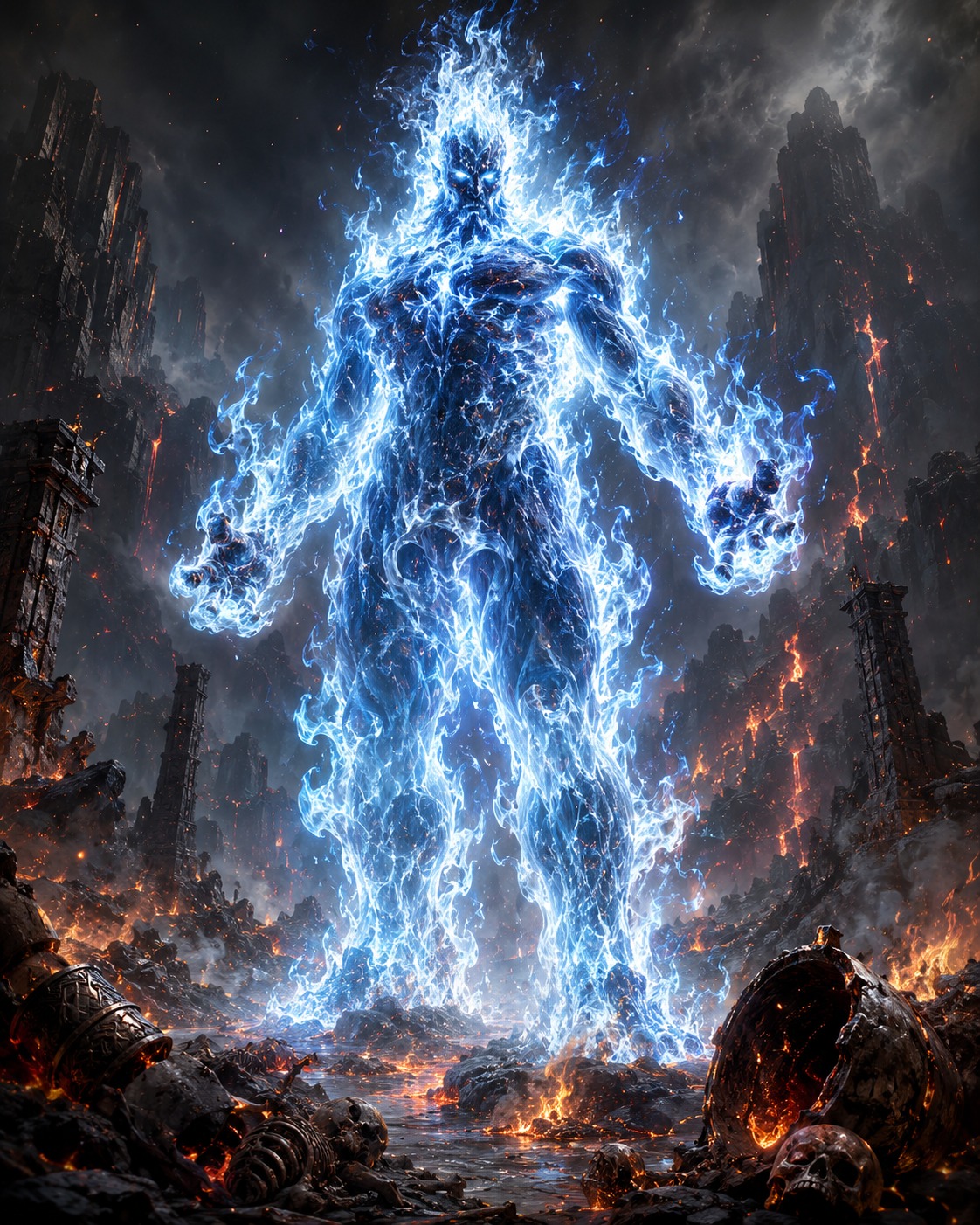
Logi
Logi — Spirit of the Consuming Flame
Names in Other Languages
 로기한국어
로기한국어Logi — 소비하는 불꽃의 정령
 ロギ日本語
ロギ日本語Logi — 消費する炎の精霊
 Logi繁體中文
吞噬一切的火焰精靈
 LogiDeutsch
Logi — Geist der Verzehrenden Flamme
 LogiFrançais
Logi — Esprit de la Flamme Dévorante
 LogiEspañol
Logi — Espíritu de la Llama Devoradora
 LogiPortuguês
Espírito da chama devoradora
 LogiPolski
Logi — Duch Pożerającego Płomienia
 ЛогиРусский
Logi — Дух Пожирающего Пламени
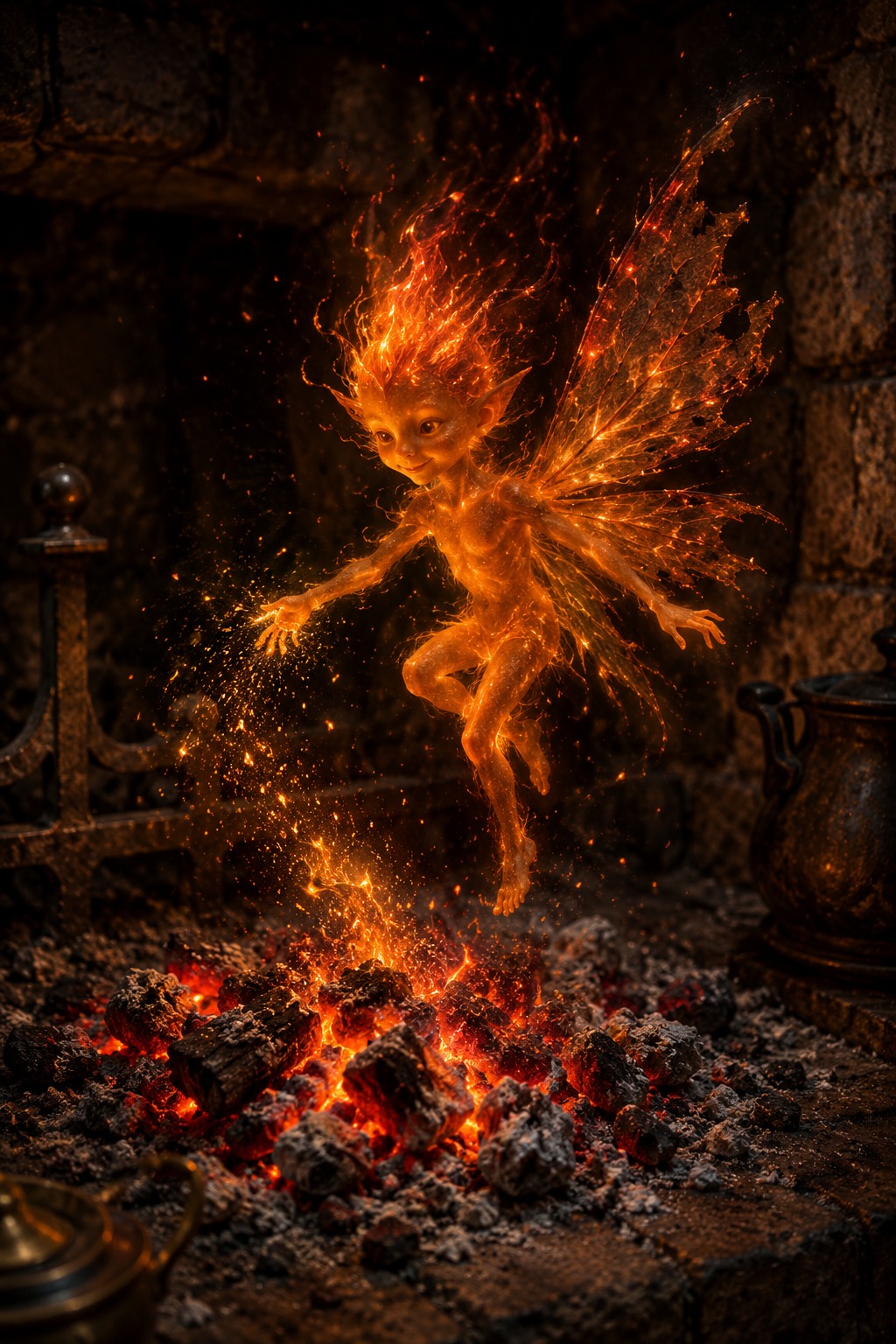
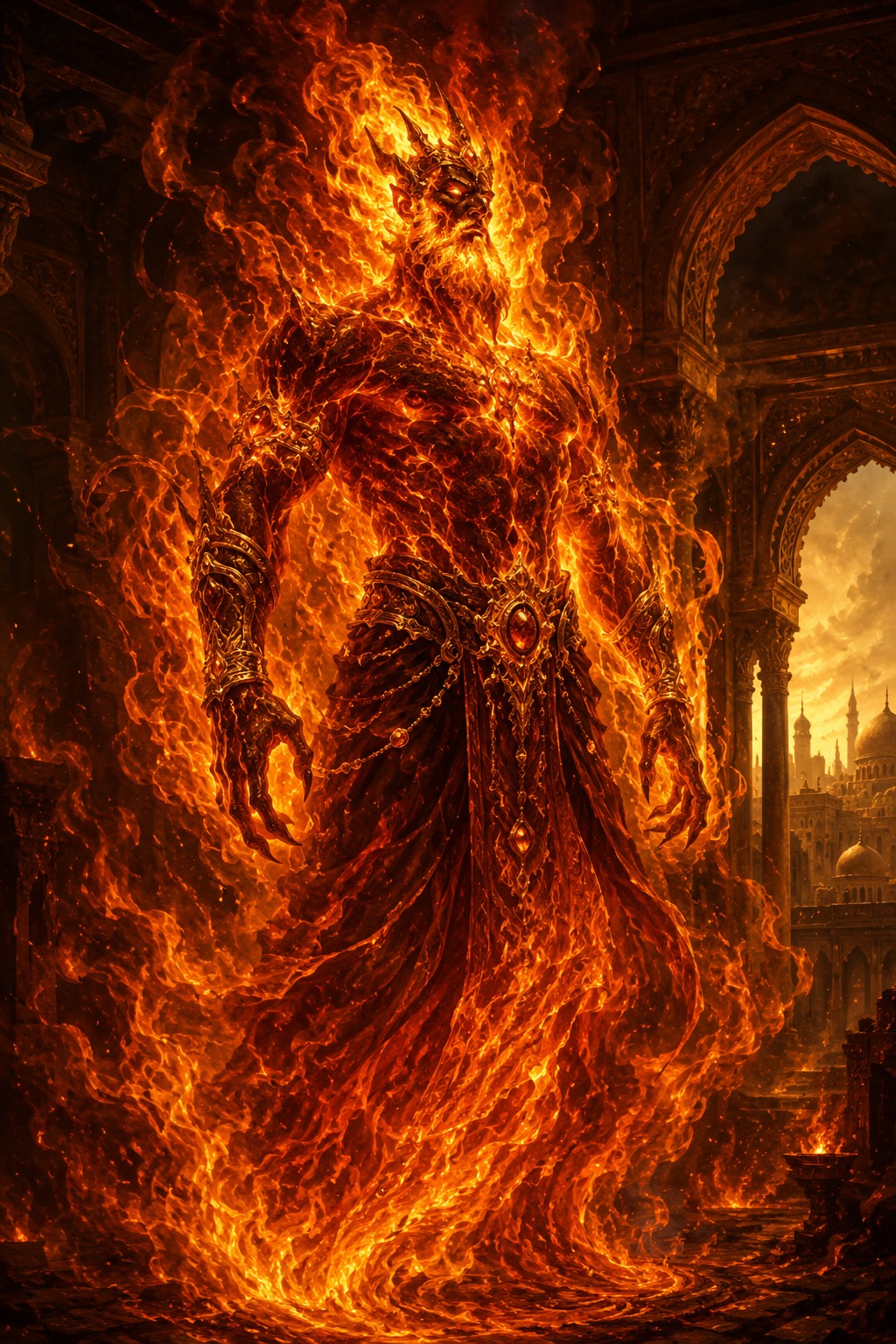
Logi (Old Norse Logi, 'flame, fire') is the decisive canonical personification of the natural flame called 'flame itself' in Norse mythology, the decisive canonical spirit belonging to the giant race Jotnar of fire. The etymology is the decisive canonical vocabulary derived from the Old Norse logi ('flame, fire'), and despite phonetic similarity, it is the decisive canon completely different from the trickster god Loki (Loki). The decisive textual canon is the decisive canonical episode in chapters 46-47 of Gylfaginning (Gylfaginning) of the Prose Edda (Prose Edda) of c. 1220 — not Skaldskaparmal — of the early 13th-century Icelandic poet-historian Snorri Sturluson (Snorri Sturluson, 1179-1241), in which Thor (Thorr) and Loki (Loki) are tested at the palace of the giant king Utgarda-Loki (Utgarda-Loki), and in the eating contest between Loki and Logi — when Loki had eaten all the flesh of the meat, Logi had swallowed not only the flesh but the bones and the trough itself — Logi won — the decisive mythological canon. This episode is the decisive mythological allegory of the natural law 'fire burns everything (loginn brann ut)', and the canonical revelation at the end of the episode by Utgarda-Loki — that what they saw was an illusion and Logi was 'wildfire (villieldr)' — that is, the wild natural flame itself.
Origin
The iconographic origin is the natural-flame-spirit belief of the 9th-11th-century Norse Viking mythology, and the decisive textual canon is the decisive canonical episode in chapters 46-47 of Gylfaginning (Gylfaginning) of the Prose Edda (Prose Edda) of the early 13th-century — c. 1220 — Icelandic — Reykholt — poet-historian Snorri Sturluson (Snorri Sturluson, 1179-1241). The decisive mythological canon is the decisive canon in which Thor (Thorr), his servant Thjalfi (Thjalfi), and Loki (Loki) — three together — are tested at the palace (Utgardr) of the giant king Utgarda-Loki (Utgarda-Loki) — in Jotunheimr (Jotunheimr) the land of giants — and when Loki boasted of his gluttony, Utgarda-Loki had him compete with his servant Logi (Logi) in an eating contest from a large meat trough — when Loki had eaten all the flesh of the meat, Logi had swallowed not only the flesh but the bones and the wooden trough itself — Logi won the decisive canon. At the end, Utgarda-Loki revealed that what they saw was an illusion and Logi was 'wildfire (villieldr)' — that is, the wild natural flame — the decisive canon, and the fragment poems of the Poetic Edda (Poetic Edda) of the c. 1270 Codex Regius manuscript (Codex Regius) also confirm the fire-giant canon.
Features
- Giant humanoid body
- Emits blue-white high-temperature flames from the whole body
- Quickly turns all touched organic matter to ash
- Completely burns even bones and dishes
- Forms a natural-ignition heat field when moving
- Weakens in water and mud terrain
Stories
The natural-flame-spirit belief of the 9th-11th-century Norse Viking mythology is the decisive origin, and the decisive textual canon is the canon of the Utgarda-Loki test of Thor, Loki, and Thjalfi, and the eating contest of Loki and Logi in chapters 46-47 of Gylfaginning (Gylfaginning) of the Prose Edda (Prose Edda) of the early 13th-century — c. 1220 — Icelandic Snorri Sturluson (Snorri Sturluson, 1179-1241). The fragment poems of the Poetic Edda (Poetic Edda) of the c. 1270 Codex Regius manuscript (Codex Regius) also confirm the fire-giant canon, and the 19th-century Germanic-nationalism revival — the 1855 Nordic-Germanic Gods and Heroes (Nordisch-Germanische Gotter und Helden) of the German scholar Wilhelm Wagner and the 1856 German prose Edda translation of the German scholar Karl Simrock — is the decisive 19th-century scholarly canon. The decisive modern canon is the Logi of the 1986 D&D Legends & Lore (Legends & Lore) by TSR in the USA, and the short prose The Sandman: World's End of the American writer Neil Gaiman (Neil Gaiman, b. 1960) of 1995 — the Utgarda-Loki and Logi episode — is the 21st-century global canonical revival. The 2017 US publication Norse Mythology (Norse Mythology) of Neil Gaiman — New York Times Best Seller — and the Utgarda-Loki test chapter of Thor and Loki is the 21st-century decisive American canon, and the 2017 Marvel Studios film Thor: Ragnarok (Thor: Ragnarok) (directed by Taika Waititi, worldwide box office about 854 million dollars) — the decisive mythological connection of the Ragnarok fire giant Surtr and Logi — is the 21st-century decisive film canon.
Weakness
Logi's weaknesses are: (1) an environment with nothing to burn — the decisive canonical weakness that Logi, whose specialty is complete combustion, sees a sharp decline in energy when there is no organic matter to burn around; (2) large-scale water magic, sea, river — in the 13th-century Snorri's Prose Edda canon and the Norse natural-flame canon, small water sources are powerless but large-scale water magic is the decisive weakness; (3) mud terrain — mud is the natural enemy of flame — the decisive canonical weakness; (4) the end of Ragnarok — in the 9th-13th-century Norse mythological canon, at Ragnarok (Ragnarok) the fire giants bring the end of everything but they too disappear — the decisive mythological canonical weakness; (5) the illusion canon — the decisive canonical weakness at the end of chapters 46-47 of Snorri's 13th-century Gylfaginning in which Utgarda-Loki reveals that the contest with Logi was an illusion; (6) the nature of wildfire — the uncontrollable nature of wild flame in the decisive canon in which Utgarda-Loki called Logi 'wildfire (villieldr)'; (7) Thor's Mjolnir (Mjolnir) — Thor's sacred hammer in the 13th-century Prose Edda canon — the decisive canon; (8) sacred sealing — weak against the sealing of sacred gods in the Norse god canon. The decisive canonical finale is chapter 47 of Snorri's 13th-century Gylfaginning — in which Utgarda-Loki makes his palace vanish as an illusion after Thor's group leaves — the decisive mythological canon.
Cultural Significance
Logi is not merely a fire-giant icon but the canonical iconographic figure of the decisive Norse fire canon, traversing the Prose Edda of Snorri Sturluson of c. 1220, the Poetic Edda of the c. 1270 Codex Regius manuscript, the 1856 Karl Simrock German translation, the 1986 D&D Legends & Lore, the 1995 Neil Gaiman's The Sandman, the 2017 Neil Gaiman's Norse Mythology, and the 2017 Marvel film Thor: Ragnarok. In the natural-flame-spirit belief of the 9th-11th-century Norse Viking mythology — the decisive canon of the spirit of natural flame itself — settled as the decisive canon in chapters 46-47 of Gylfaginning (Gylfaginning) of the Prose Edda (Prose Edda) of c. 1220 of the early 13th-century Icelandic — Reykholt — poet-historian Snorri Sturluson (Snorri Sturluson, born c. 1179 in Hvammur, Iceland, assassinated 23 September 1241 at Reykholt, Iceland). The decisive mythological canon is the decisive canon in which Thor (Thorr), his servant Thjalfi (Thjalfi), and Loki (Loki) — three together — are tested at the palace of the giant king Utgarda-Loki (Utgarda-Loki) — in Jotunheimr (Jotunheimr) the land of giants — and in the eating contest between Loki and Logi, Logi swallowed not only the flesh but the bones and the trough itself and won — the decisive mythological canon — became the decisive mythological allegory of the natural law 'fire burns everything (loginn brann ut)'. The graphic novel The Sandman: World's End (Vertigo) of the American writer Neil Gaiman (Neil Gaiman, born 10 November 1960 in Portchester, Hampshire, England) of July 1995 — the Utgarda-Loki and Logi episode — and Norse Mythology (Norse Mythology) (W. W. Norton, New York Times Best Seller) of Neil Gaiman published in the USA on 7 February 2017 are the 21st-century American decisive canons, and the Marvel Studios film Thor: Ragnarok (Thor: Ragnarok) (directed by Taika Waititi, worldwide box office about 854 million dollars) released in the USA on 3 November 2017 — the decisive mythological connection of the Ragnarok fire giant Surtr (Surtr) and Logi — is the 21st-century decisive global film canon.
In Popular Culture
- Snorri Sturluson, Prose Edda, Gylfaginning chapters 46-47 (c. 1220) — decisive origin canon
- Poetic Edda Codex Regius manuscript (c. 1270) — decisive poetic canon
- Wilhelm Wagner, Nordic-Germanic Gods and Heroes (1855) — 19th-century scholarly canon
- Karl Simrock German prose Edda translation (1856) — 19th-century decisive translation canon
- Wagner opera Der Ring des Nibelungen (1876) — 19th-century musical canon
- TSR D&D Legends & Lore, Logi (1986) — decisive fantasy RPG canon
- Neil Gaiman, The Sandman: World's End (1995) — decisive graphic novel canon
- Neil Gaiman, Norse Mythology (2017) — decisive 21st-century literary canon
- Marvel film Thor: Ragnarok (2017) — decisive 21st-century global film canon
Trivia
The Old Norse logi of Logi is the decisive canonical vocabulary meaning 'flame, fire' — derived from the Indo-European root leuk- ('light, brightness') — cognate with the English light, the Latin lux, and the Greek leukos. Despite phonetic similarity to the trickster god Loki (Loki, Old Norse Loki), it is the decisive canonical spirit completely different, and the early 13th-century Snorri Sturluson clearly distinguished the two figures in the Prose Edda to avoid confusion. The decisive textual canon is the decisive canon in chapters 46-47 of Gylfaginning (Gylfaginning) of the Prose Edda (Prose Edda) of c. 1220 of the early 13th-century Icelandic — Reykholt — poet-historian Snorri Sturluson (Snorri Sturluson, born c. 1179 in Hvammur, Iceland, assassinated 23 September 1241 at Reykholt, Iceland by order of King Haakon IV of Norway). At the palace of Utgarda-Loki (Utgarda-Loki) — 'Loki of the outer enclosure' — Thor (Thorr), his servant Thjalfi (Thjalfi), and Loki (Loki) — three together — are subjected to five tests, the second of which is the eating contest between Loki and Logi from a large meat trough — when Loki had eaten all the flesh of the meat, Logi had swallowed not only the flesh but the bones and the wooden trough itself and won — the decisive mythological canon — is the decisive mythological allegory of the natural law 'fire burns everything (loginn brann ut)'. At the end of chapter 47, Utgarda-Loki revealed that what they saw was an illusion and Logi was 'wildfire (villieldr)' — that is, the wild natural flame itself — the decisive canon. The Utgarda-Loki episode in Chapter 13 of Norse Mythology (Norse Mythology) (New York Times Best Seller No. 1) of Neil Gaiman (Neil Gaiman, born 10 November 1960 in Portchester, Hampshire, England) published by W. W. Norton in the USA on 7 February 2017 is the 21st-century American decisive canon, and the Ragnarok fire giant Surtr (Surtr) of the Marvel Studios film Thor: Ragnarok (Thor: Ragnarok) (directed by Taika Waititi, worldwide box office about 854 million dollars) released in the USA on 3 November 2017 is the 21st-century decisive global film canon.